
SEBA Class 9 Maths Chapter 9 Areas of parallelograms and triangles Solutions English Medium As Per New Syllabus. to each chapter is provided in the list so that you can easily browse through different chapters SEBA Class 9 Maths Chapter 9 Areas of parallelograms and triangles Notes and select need one. SEBA Class 9 Maths Chapter 9 Areas of parallelograms and triangles Question Answers Download PDF. SEBA Class 9 General Maths Solutions.
SEBA Class 9 Maths Chapter 9 Areas of parallelograms and triangles
Also, you can read the SCERT book online in these sections Solutions by Expert Teachers as per State Council of Educational Research and Training (SCERT) Book guidelines. SEBA Class 9 Maths Chapter 9 Areas of parallelograms and triangles are part of All Subject Solutions. Here we have given SEBA Solutions For Class 9 Maths for All Chapters, You can practice these here.
Areas of parallelograms and triangles
Chapter: 9
| Exercise 9 |
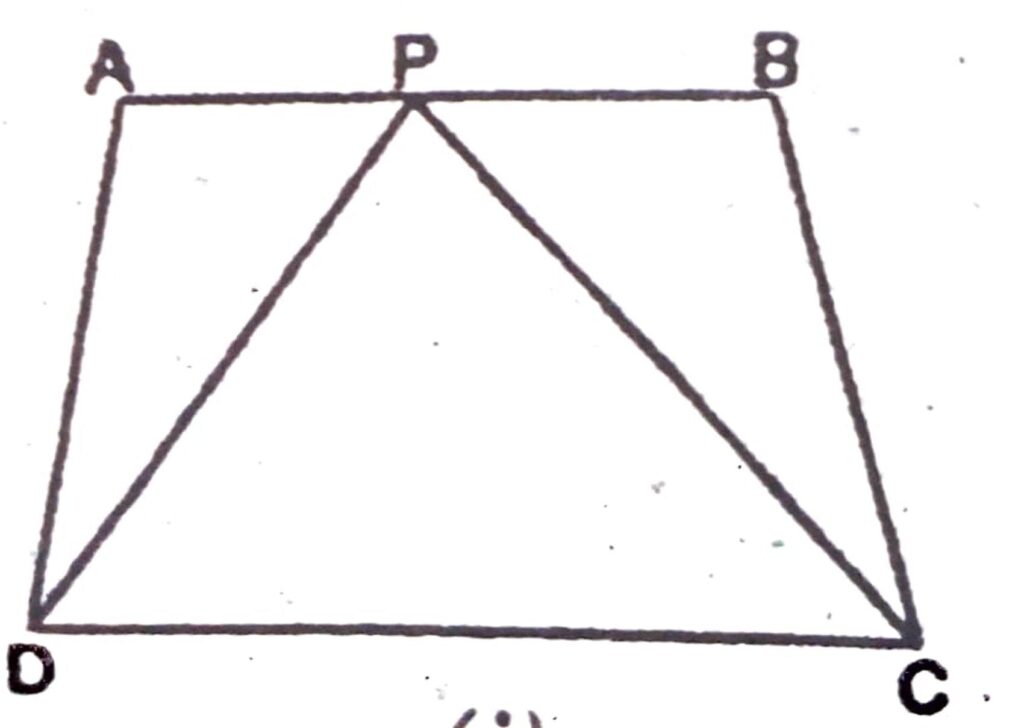
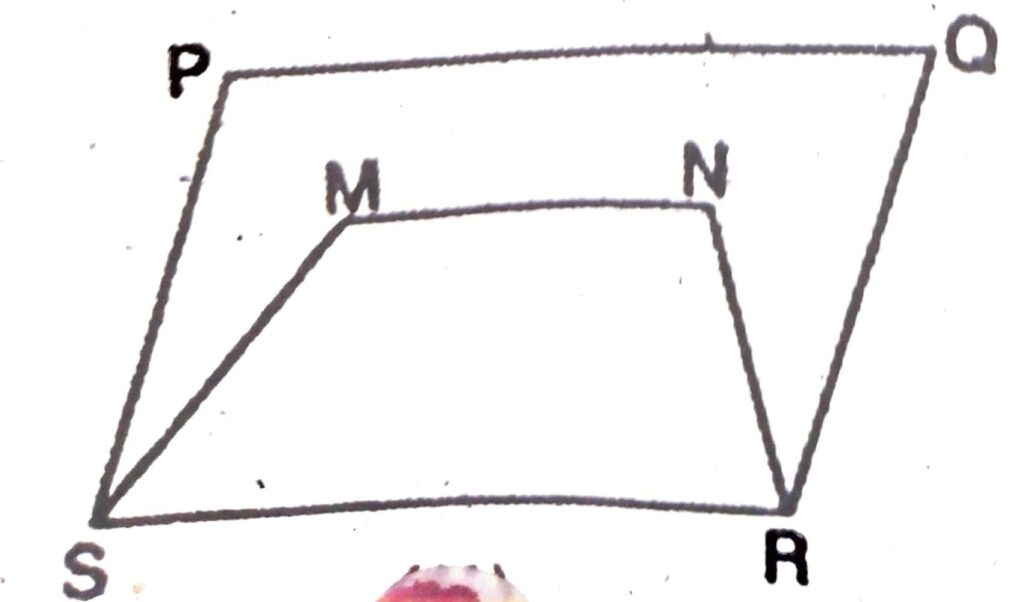
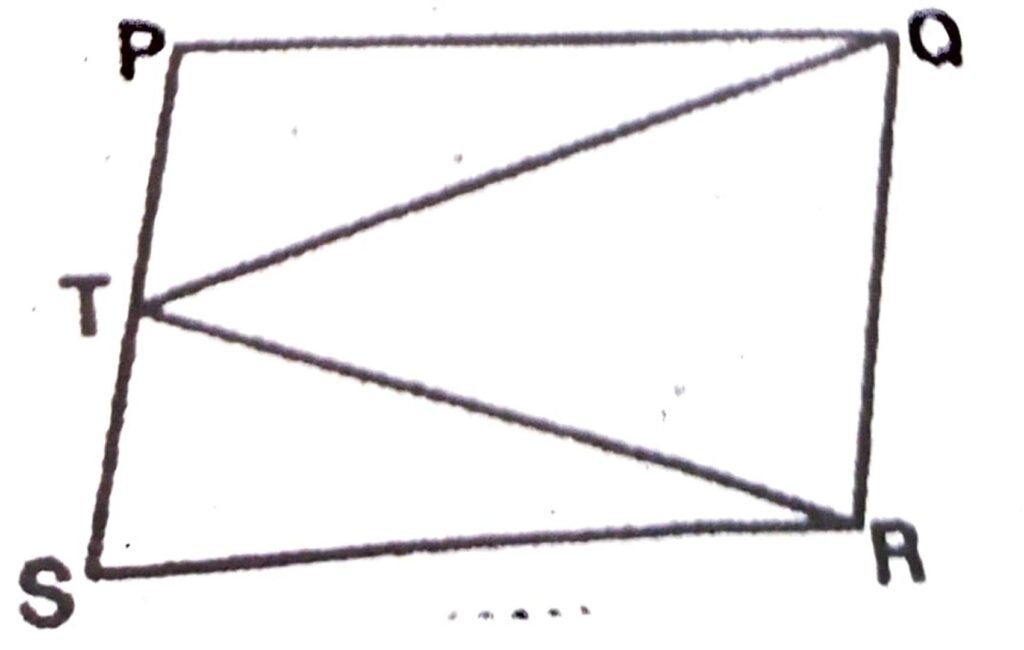
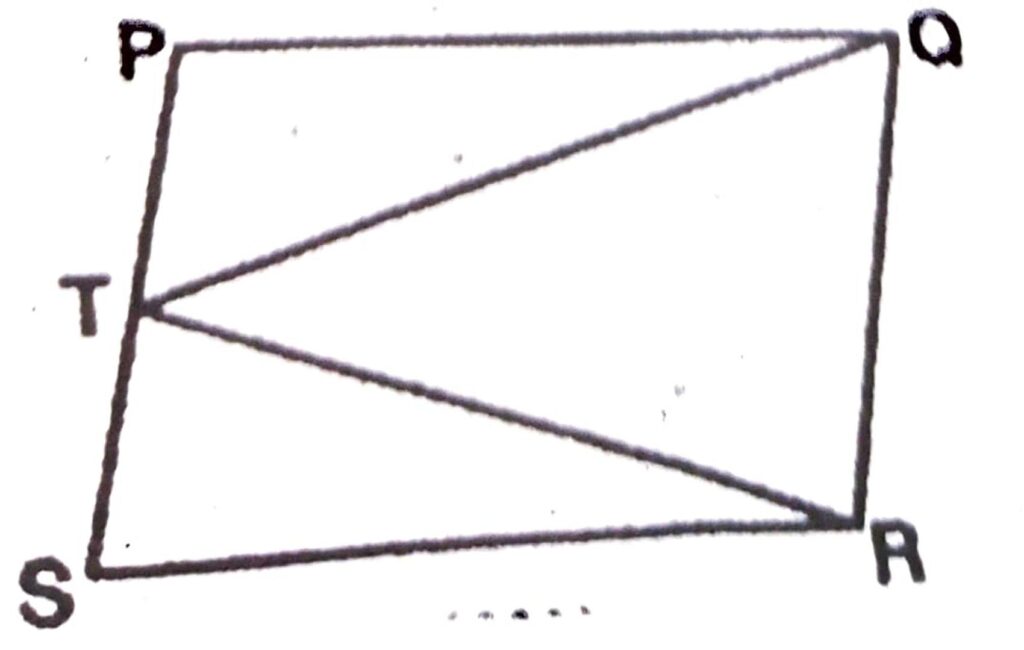
Q.1. Which of the following figures lie on the same base and between the same parallels. In such a case, write the common base and the two. parallels.
(i)
(ii)
(iii)
(iv)
(v)
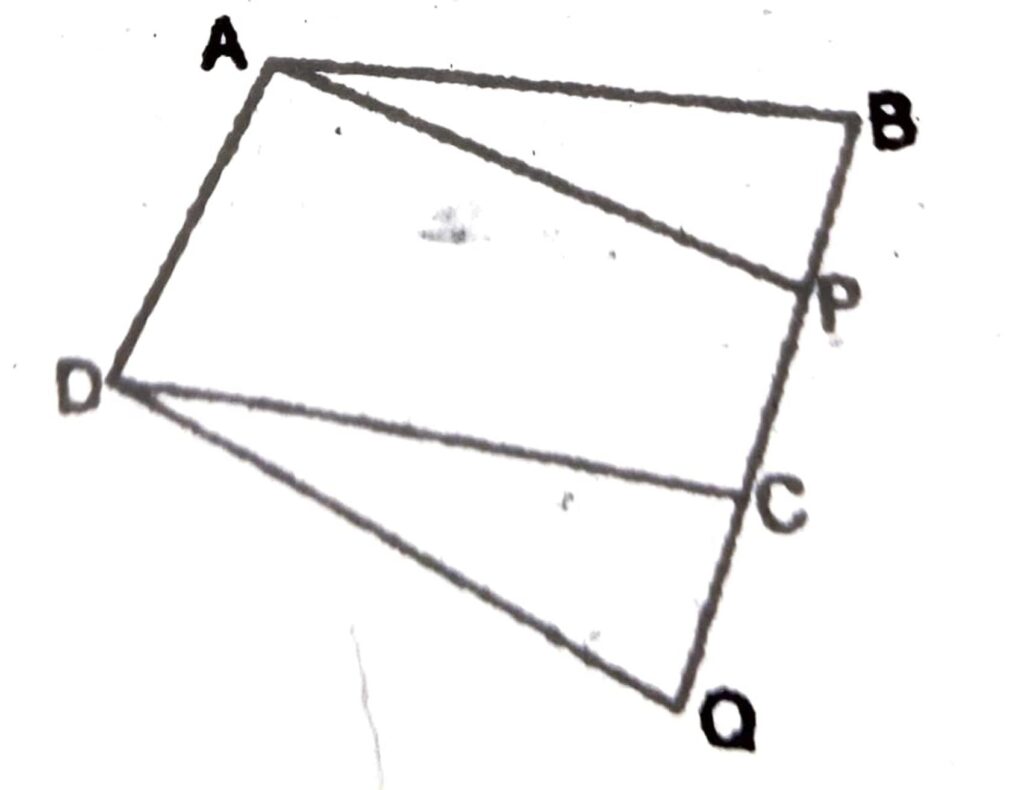
(vi)

Ans: (i) ∆PDC and quadrilateral ABCD lie on the same base DC and between the same parallels DC and AB.
(iii) ∆TRQ and parallelogram SRQP lie on the same base RQ and between the same parallels RQ and SP.
(v) Quadrilaterals ABCD and ABQD lie on the same base AD and between the same parallels AD and BQ.
Q.2. In figure, ABCD is a parallelogram, AE⊥DC, and CF⊥AD. If AB = 16 cm, AE = 8 cm and CF = 10 cm find AD.
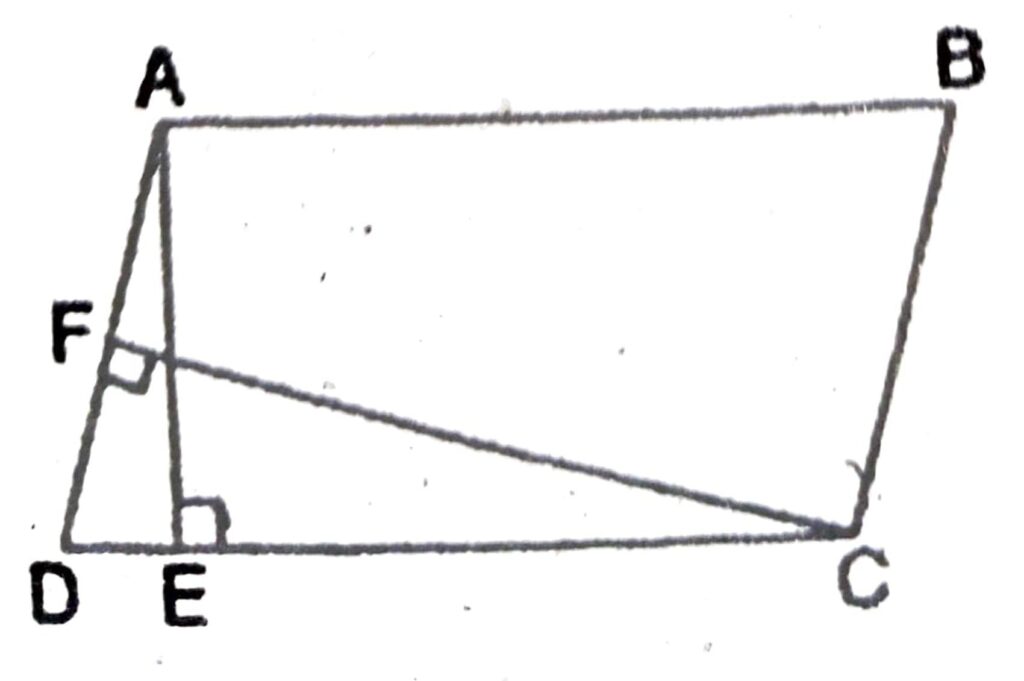
Ans: ar (parallelogram ABCD) = AB X AE
= 16 x 8 cm²
= 128 cm² … (1)
ar (parallelogram ABCD) = AD X CF
= AD x 10 cm² … (2)
From (1) and (2), we get
AD x10 = 128

Q.3. P and Q are any two points lying on the sides DC and AD respectively of a parallelogram ABCD. Show that ar(APW) = ar(BQC)
Ans: Given: P and Q are any two points lying on the sides DC and A.D respectively of a parallelogram ABCD.
To Prove: ar(APW) = ar(BQC)
Proof: ∵ ∆ APB and || gm ABCD are on the same base AB and between the same parallels AB and DC.

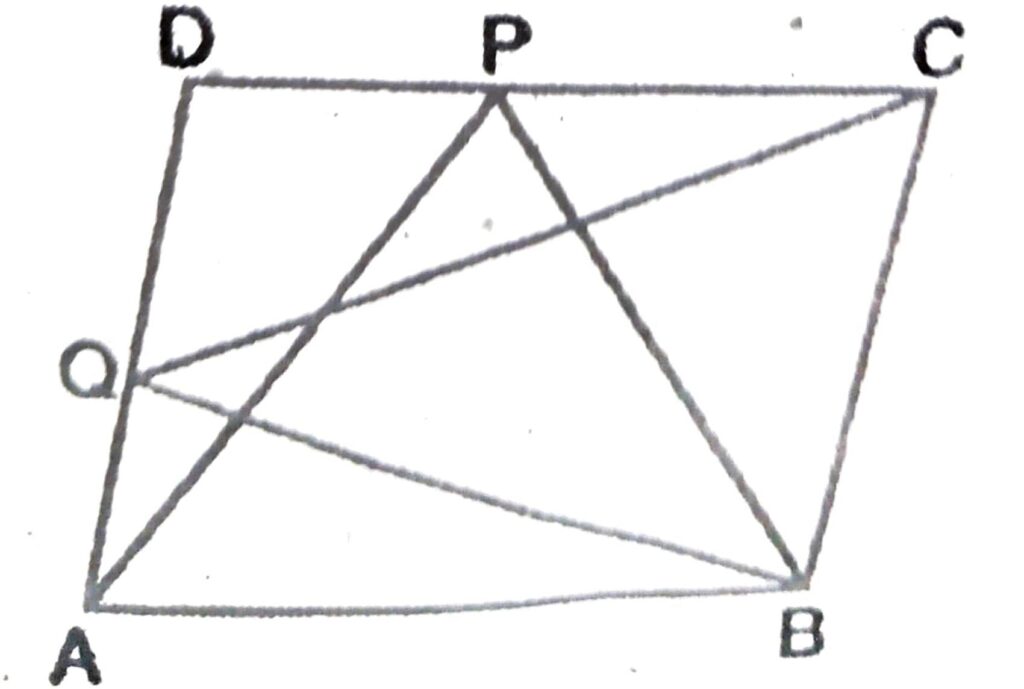
∵ BQC and || gm ABCD are on the same base BC and between the same parallels BC and AD.

From (1) and (2),
ar(∆APB) = ar(∆BQC)
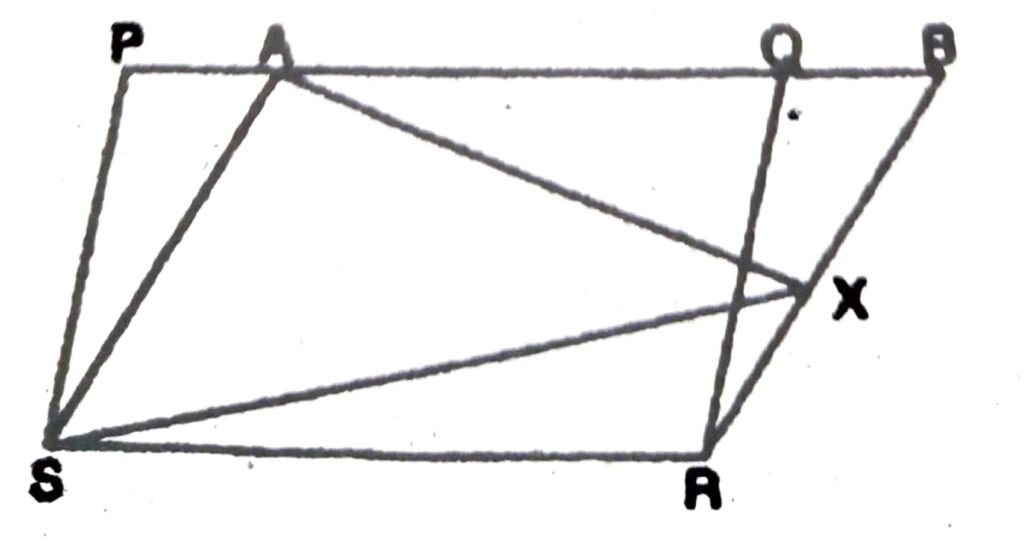
Q.4. In figure, PQRS and ABRS are parallelograms and X is any point on side BR. Show that:
(i) ar (PQRS)=ar(APRS)

Ans: Given: PQRS and ABRS parallelograms and X is any point on side BR.
To Prove: (i) ar (PQRS)=ar(ABRS)

Proof: (i) In∆PSA and ∆ QRB
∠ SPA =∠RQB …(1)
∠ PAS =∠QBR …(2)
| Corresponding angles from PS || QR and transversal PB Corresponding angles from
SS|| BR and transversal PB
∴ ∠ PSA =∠QRB …(3)
| Angle sum property of a triangle
Also, PS = QR …(4)
| Opposite sides of || gm PQRS
From (1), (3) and (4) we get
∆ PSA ≅ ∆ QRB …(5) | By ASA Rule
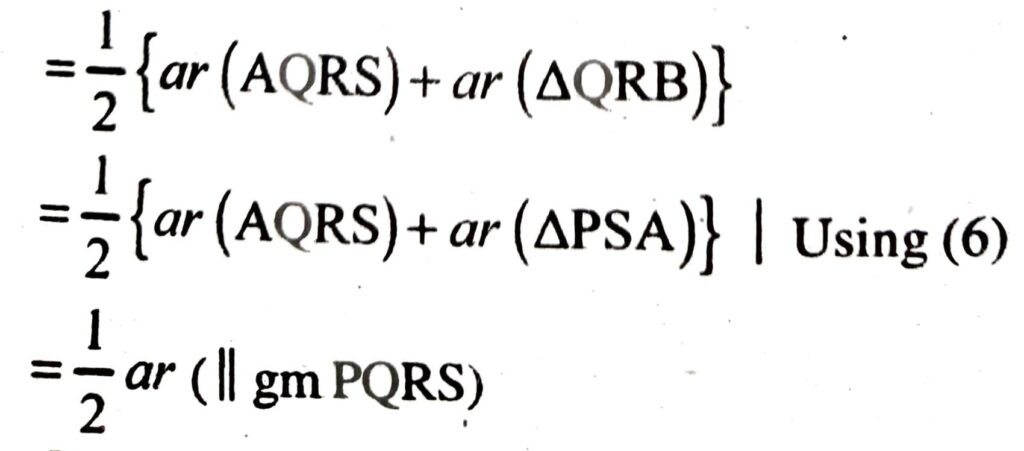
∴ ar(∆PSA) = ar(∆QRB) …(6) ∵ Congruent figures have equal areas
Now, ar(PQRS)= ar(∆PSA) +ar(AQRS)
= ar(∆QRB) +ar(AQRS) | Using (6)
= ar (ABRS)
(ii) ∵ ∆ AXS and || gm ABRS are on the same base AS and be- tween the same parallels AS and BR.

Choose the correct option (Q.No. 5 and 6):


 Buy Now