
SEBA Class 9 Maths Chapter 8 Quadrilaterals Solutions English Medium As Per New Syllabus. to each chapter is provided in the list so that you can easily browse through different chapters SEBA Class 9 Maths Chapter 8 Quadrilaterals Notes and select need one. SEBA Class 9 Maths Chapter 8 Quadrilaterals Question Answers Download PDF. SEBA Class 9 General Maths Solutions.
SEBA Class 9 Maths Chapter 8 Quadrilaterals
Also, you can read the SCERT book online in these sections Solutions by Expert Teachers as per State Council of Educational Research and Training (SCERT) Book guidelines. SEBA Class 9 Maths Chapter 8 Quadrilaterals are part of All Subject Solutions. Here we have given SEBA Solutions For Class 9 Maths for All Chapters, You can practice these here.
Quadrilaterals
Chapter: 8
| Exercise 8.1 |
Q.1. If the diagonals of a parallelogram are equal, then show that it is a rectangle.
Ans: Given: In parallelogram ABCD, AC = BD

To Prove: || gm ABCD is a rectangle.
Proof: In ∆ ACB and ∆ BDA
AC = BD | Given
AB = BA | Common
BC = AD | Opposite sides of || gm ABCD
∴ ACB ≅ ∆BDA | ISSS Rule
∴ ∠ ABC = ∠ BAD …(1) c.p.c.t.
Again,∵ AD || BC | Opp. sides of || gm
ABCD and transversal AB intersects them
∴ ∠BAD+∠ABC = 180⁰…(2) Sum of consecutive interior angles on the same side of the transversal is 180⁰
From (1) and (2),
∠BAD=∠ABC = 90⁰ ∴ ∠ A = 90⁰
∴ || gm ABCD is a rectangle.
Q.2. Show that the diagonals of a quadrilateral bisect each other at right angles.
Ans: Given: ABCD is a quadrilateral where diagonals AC and BD intersect each other at right angles at O.
To Prove: Quadrilateral ABCD is a rhombus.
Proof: In ∆AOB and ∆AOD
AO = AO | Common
OB = OD | Given
∠AOB =∠AOD | Each = 90⁰
∴ ∆AOB ≅ ∆AOD | SAS Rule
∴ AB = AD …(1) I c.p.c.t.
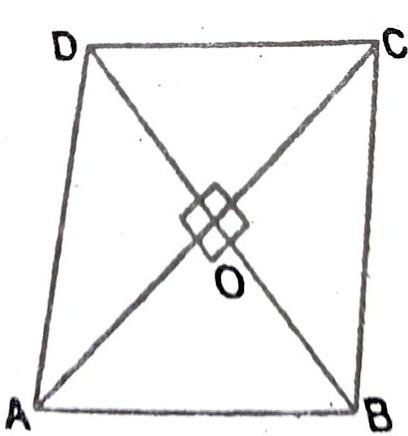
Similarly, we can prove that
AB = BC
BC = CD
CD = AD
In view of (1), (2), (3) and (4), we obtain
AB = BC =CD=DA
∴ Quadrilateral ABCD is a rhombus.
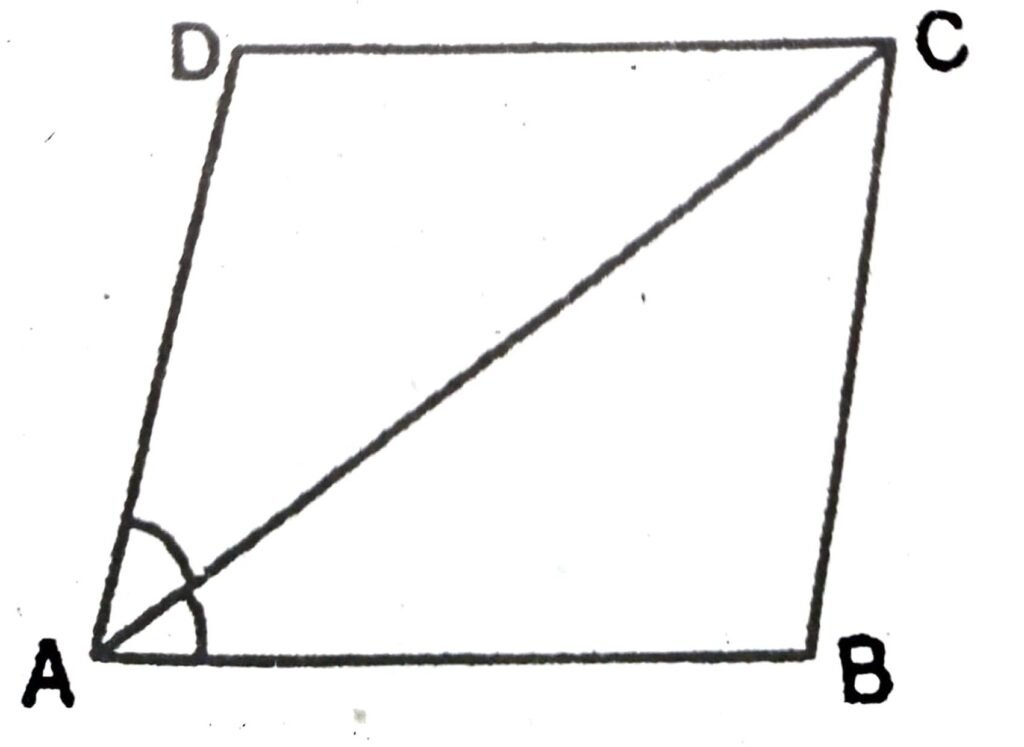
Q.3. Diagnosal AC of a parallelogram ABCD bisects ∠A. Show that:
(i) it bisects ∠C also
(ii) ABCD is a rhombus
Ans: Given: Diagonal AC of a parallelogram ABCD bisects ∠A.
To Prove: (i) it bisects ∠C also.
(ii) ABCD is a rhombus.
Proof: (i) In ∆ADC and ∆ CВА,
AD=BC | Opp. sides of || gm ABCD
CA=CA | Opp. sides of ||gm ABCD
∴ ∆ADCA ≅∆СВА | SSS Rule
∴ ∠ACD = ∠CAB | c.p.c.t.
and ∠DAC = ∠BCA | c.p.c.t.
But ∠CAB=∠DAC | Given
∴ ∠ACD=∠ BCA
∴ AC bisects ∠C also
(ii) From above,
∠ACD = ∠CAD
∴ AD = CD | Opposite sides of equal angles of a triangle are equal
∴ AB=BC=CD = DA |∵ ABCD is a || gm
Q.4. ABCD is a rectangle in which diagonal AC bisects ∠A. Show that
(i) ABCD is a square
(ii) diagonal BD bisects ∠B as well as ∠D.
Ans: Given: ABCD is a rectangle in which diagonal AC bisects ∠A as well as ∠C
To Prove: (i) ABCD is a square.
(ii) diagonal BD bisects ∠B as well as ∠D.
Proof: (i) ∵ AB || DC
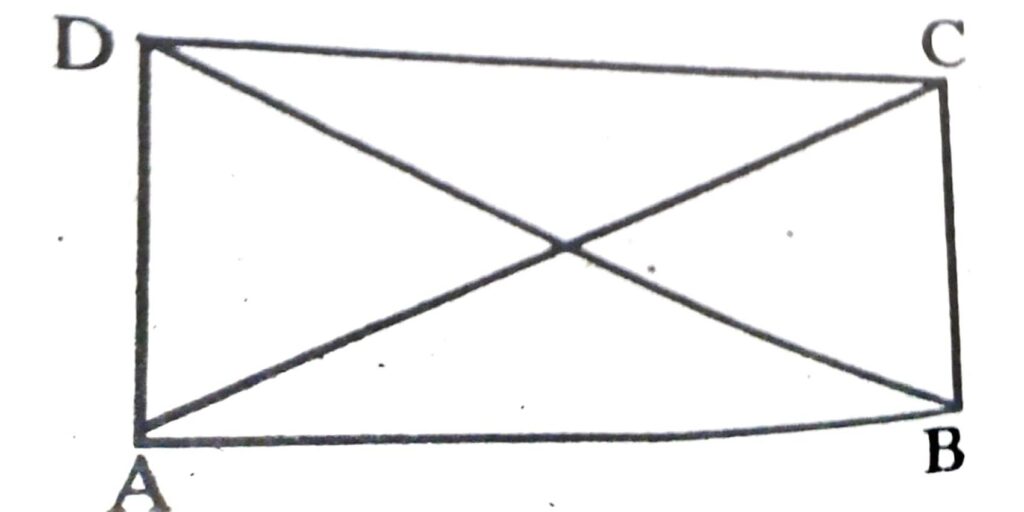
and transversal AC intersects them
∴ ∠ACD = ∠CAB || Alt. Int. ∠S
But ∠CAB=∠CAD
∴ ∠ACD=∠CAD
∴ AD = CD || Sides opposite to equal angles of a triangle are equal
∴ ABCD is a square
(ii) In ∆ BDA and ∆DBC
BD = DB | Common
DA = BC | Sides of a square ABCD
AB = DC | Sides of a square ABCD
∴ ∆BDA ≅ ∆DBC | SSS Rule
∴ ∠ABD = ∠ CDB | c.p.c.t.
But ∠CDB = ∠CBD | ∵ CB = CD (Sides of a square ABCD)
∴ ∠ ABD = ∠ CBD
∴ BD bisects ∠ B
Now, ∠ ABD = ∠ CBD
∠ABD = ∠ ADB | ∵ AB=AD
∠CBD =∠CDB | ∵ CB=CD
∴ ∠ ADB = ∠ CDB
∴ BD bisects ∠ D
∴ ABCD is a rhombus.
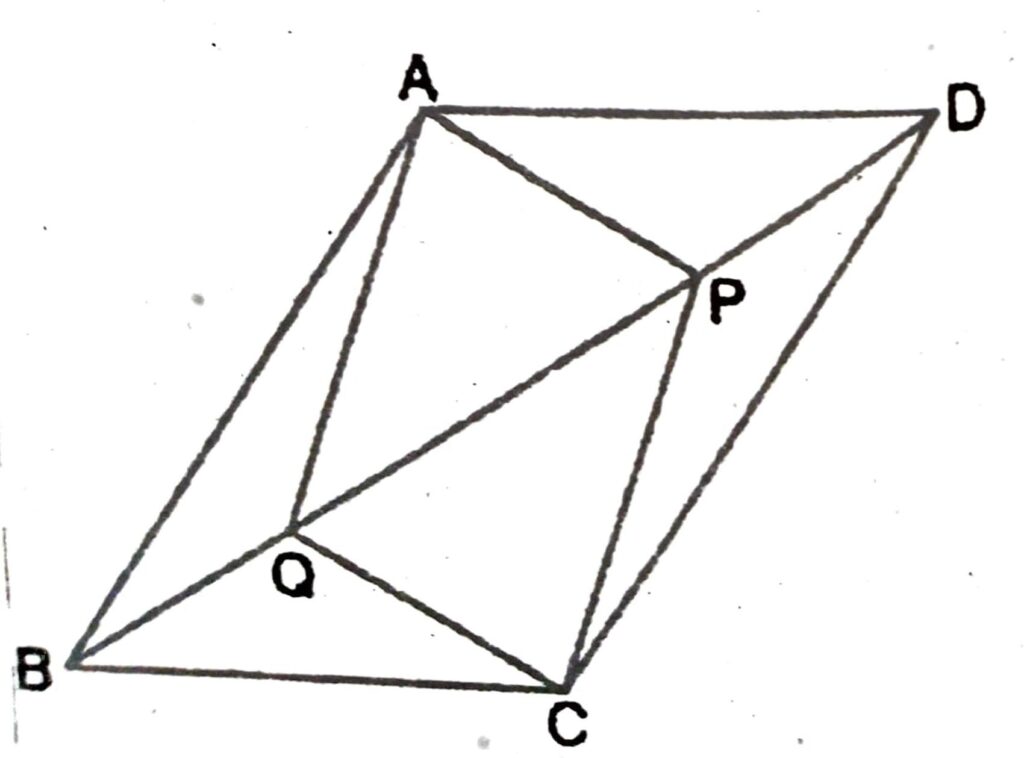
Q.5. In parallelogram ABCD, two points P and Q are taken on diagonal BD such that DP = BQ. Show that:
(i) ∆ APD≅∆CQB
(ii) AP = CQ
(iii) ∆ AQB≅∆CPD
(iv) AQ = CP
(v) APQC is a parallelogram.
Ans: Given: In parallelogram ABCD, two points P and Q are on di- agonal BD such that DP = BQ
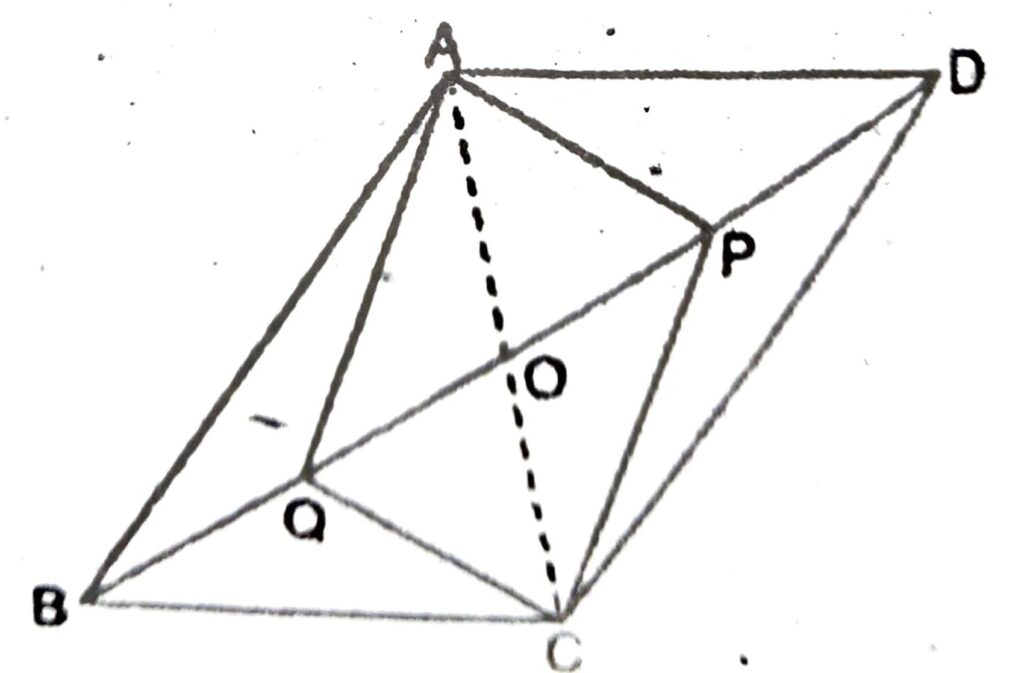
Construction: Join AC to intersect BD at O.
Proof: (i) In ∆APD and ∆CQB | From (ii)
PD = QB | Given
AD = BC | Opp. sides of || gm ABCD
∴ ∆ APD≅∆ CQB | SSS Rule
(ii) ∵ APCQ is a || gm | Proved in (i) above
AP = CO | Op. sides of a || gm are equal
(iii) In ∆AQB and ∆ CPD,
AQ = CP | From (iii)
QB = PD | Given
AB = CD | Opp. sides of || gm ABCD
∴ ∆ AQB ≅ ∆CPD | SSS Rule
(iv) APQC is a || gm | Proved in (i) above
∴ AQ = CP | Opp. sides of a || gm are equal
(v) ∵ The diagonals of a parallelogram bisect each other.
∴ OB = OD
∴ OB-BQ=OD-DP | ∵ BQ = DP (given)
∴ OQ=OP …(1)
Also, OA = OC…(2) | Diagonals of a || gm bisect each other
In view of (1) and (2), APQC is a parallelogram.
Q.6. ABCD is a parallelogram and AP and CQ are perpendicular from vertices A and C on diagonal BD respectively. Show that:

(i) ΔΑΡΒ ≅ ∆ CQD
(ii) AP=CQ
Ans: Given: ABCD is a parallelo- gram and AP and
CQ are perpendiculars from verti- ces A and Con diagonal BD respec- tively.
To Prove: (i) ∆ APB ≅ ∆ CQD
(ii) AP = CQ
Proof: (i) In ∆APB and ∆ CQD,
AB = CD | Opp. sides || gm ABCD
∠ ABP = ∠ CDQ | ∵ AB || DC and transversal BD intersects them
∠APB = ∠CQD | Each = 90⁰
∴ ΔΑΡΒ ≅ Δ CQD | AAS Rule
(ii) ∵ ∆ APB≅∆CQD | Proved above in (i)
∴ AP = CQ | c.p.c.t.
Q.7. ABCD is a trapezium in which AB || CD and AD = BC. Show that:

(i) ∠ A = ∠ B
(ii) ∠ C =∠D
(iii) ∆ ABC ≅ ∆ BAD
(iv) diagonal AC = diagonal BD
Ans: Given: ABCD is a trapezium in which AB || CD and AD = BC
Construction: Extend AB and draw a line through C parallel to DA intersecting AB produced at E.
Proof: (i) AB || CD | Given
and AD || EC | By construction
∴ AECD is a parallelogram
| Aquadrillelogram if a pair of opposite sides is parallel and is of equal length
∴ AD = EF | Opp. sides of a || gm are equal
But AD = BC | Given
∴ EC = BC
∴ ∠CBE =∠CEB …(1)
| Angles of opposite to equal sides of a triangle are equal
∠ B+∠CBE = 180⁰ …(2)
| Linear Pair Axiom
∵ AD ||FC
| By construction and transversal AE intersects them
∴ ∠ A+∠CEB = 180⁰ …(3)
| The sum of consecutive interior angles on the same side of the transversal is 180⁰
From (2) and (3),
∠ B+∠CBE =∠A+ ∠ CEB
But ∠ CBE =∠CEB | From (1)
∴ ∠B = ∠ A or ∠ A = ∠ B
(ii) ∵ AB ||BD
∴ ∠ A + ∠ D = 180⁰
| The sum of consecutive interior angles on the same side of the transversal is 180⁰
and ∠ B+ ∠ C = 180⁰
∴ ∠A +∠D= ∠ B+ ∠ C
But ∠ A = ∠ B | Proved in (i)
∴ ∠ D =∠C or∠C =∠D
(iii) In ∆ABC and ∆BAD,
AB = BA | Common
BC = AD | Given
∠ ABC = ∠ BAD | From (i)
∴ ∆ ABC≅∆BAD | SAS Rule
(iv) ∵ ∆ ABC ≅ ∆ BAD | From (iii) above
∴ AC = BD | c.p.c.t.
8. In the following question, there is a statement of assertion (A) followed by a statement of reason (R). Choose the correct option from the given alternatives.
Assertion (A): Opposite angles of a parallelogram are equal.
Reason (R): If one pair of opposite sides of a quadrilateral are equal and parallel, then it is a parallelogram.
(a) Both A and R are true and R is the correct explanation of A.
(b) Both A and R are true, but R is not correct explanation of A.
(c) A is true, but R is false.
(d) A is false, but R is true.
Ans. Assertion: Opposite angles of a parallelogram are equal, which is true.
Reason: If one pair of opposite sides of a quadrilateral are equal and parallel, then it is a parallelogram, which is True.
But, Reason does not provide the logical explanation for why the opposite angles are equal.
Hence, Reason is not the correct explanation for the Assertion.
The correct option is (b)
Choose the correct option (Q. No. 9 to 15)
9. The diagonals of a parallelogram
(a) do not bisect each other.
(b) are equal.
(c) bisect each other.
(d) are perpendicular to each other.
Ans. The diagonals of a parallelogram bisect each other at the point of intersection.
The correct option is (c)
10. Consider the following two statements and then choose the correct option from the given alternatives:
(i) A square is a parallelogram.
(ii) A square is a rhombus.
(a) only (i) is true.
(b) only (ii) is true.
(c) Both (i) and (ii) are true
(d) Both (i) and (ii) are false.
Ans. A square is a parallelogram In a square
(i) opposite sides are equal and parallel.
(ii) opposite angles are equal.
The option (i) is correct.
A square is a rhombus.
In a square all sides are equal.
Hence, the option (ii) is correct.
The correct option is (c)
11. Match the quadrilateral in column A with its property in column B, then choose the correct option.
| Column – A | Column- B |
| 1. Rectangle | (i) Opposite sides are equal and parallel. |
| 2. Parallelogram | (ii) Digonals are equal. |
| 3. Square | (iii) diagonals bisect at right angles |
| 4. Rhombus | (iv) All sides are equal and each angle is 90° |
(a) 1→(ii), 2 → (i), 3→(iv), 4→(iii)
(b) 1→(ii), 2 → (iv), 3→(i), 4→(iii)
(c) 1→(ii), 2→(iii), 3→ (iv), 4-(i)
(d) 1→(i), 2 → (ii), 3→(iii), 4- (iv)
Ans: 1. Rectangle → Diagonals are equal → (ii)
2. Parallelogram→ opposite sides are equal and parallel → (i)
3. Square → all sides are equal and each angle 90° → (iv)
4. Rhombus → diagonals bisect at right angles → (iii)
The correct option is (a)
12. Choose the correct option from the following alternatives.
A parallelogram is also a rhombus if :
(i) All sides are equal
(ii) Opposite angles are equal
(iii) Diagonals bisect each other at right angles.
(iv) All angles are 90°
(a) (i) and (iii) are correct
(b) (i) and (ii) are correct
(c) (iii) and (iv) are correct
(d) only (iv) is correct
Ans. A parallelogram is also a rhombus if
(i) All sides are equal
(ii) Diagonals bisect each other at right angles.
The correct option is (a)
13. Read the following statements, then choose the correct options.
(i) In a parallelogram, diagonals are always equal
(ii) A trapezium is also a parallelogram
(a) Only (i) is true
(b) Only (ii) is true
(c) Both (i) and (ii) are false
(d) Both (i) and (ii) are true
Ans. (i) In a parallelogram, diagonals are not always equal.
∵ Statement (i) is false.
(ii) A trapezium is not a parallelogram. Statement (ii) is also false.
∴ The correct option is (c)
14. The diagonals of a rhombus intersect at 90°, and each diagonal bisects :
(a) One angle only
(b) All angles
(c) Two opposite angles
(d) No angle
Ans. The diagonals of a rhombus intersect at 90°and each diagonal bisects two opposite angles.
The correct option is (c)
15. Which property is true for both rhombus and rectangle?
(a) All sides are equal
(b) All angles are equal
(c) Diagonals bisect each other
(d) Diagonals are perpendicular to each other
Ans. Diagonals bisect each other for both rhombus and rectangle
∴ The correct option is (c)


 Buy Now