
SEBA Class 9 Maths Chapter 7 Triangles Solutions English Medium As Per New Syllabus. to each chapter is provided in the list so that you can easily browse through different chapters SEBA Class 9 Maths Chapter 7 Triangles Notes and select need one. SEBA Class 9 Maths Chapter 7 Triangles Question Answers Download PDF. SEBA Class 9 General Maths Solutions.
SEBA Class 9 Maths Chapter 7 Triangles
Also, you can read the SCERT book online in these sections Solutions by Expert Teachers as per State Council of Educational Research and Training (SCERT) Book guidelines. SEBA Class 9 Maths Chapter 7 Triangles are part of All Subject Solutions. Here we have given SEBA Solutions For Class 9 Maths for All Chapters, You can practice these here.
Triangles
Chapter: 7
| Exercise 7.1 |
Q.1. In quadrilateral ABCD AC = AD and AB bisects ∠ A.Show that ∠ ABC≅∆ADB.
What can you say about BC and BD?
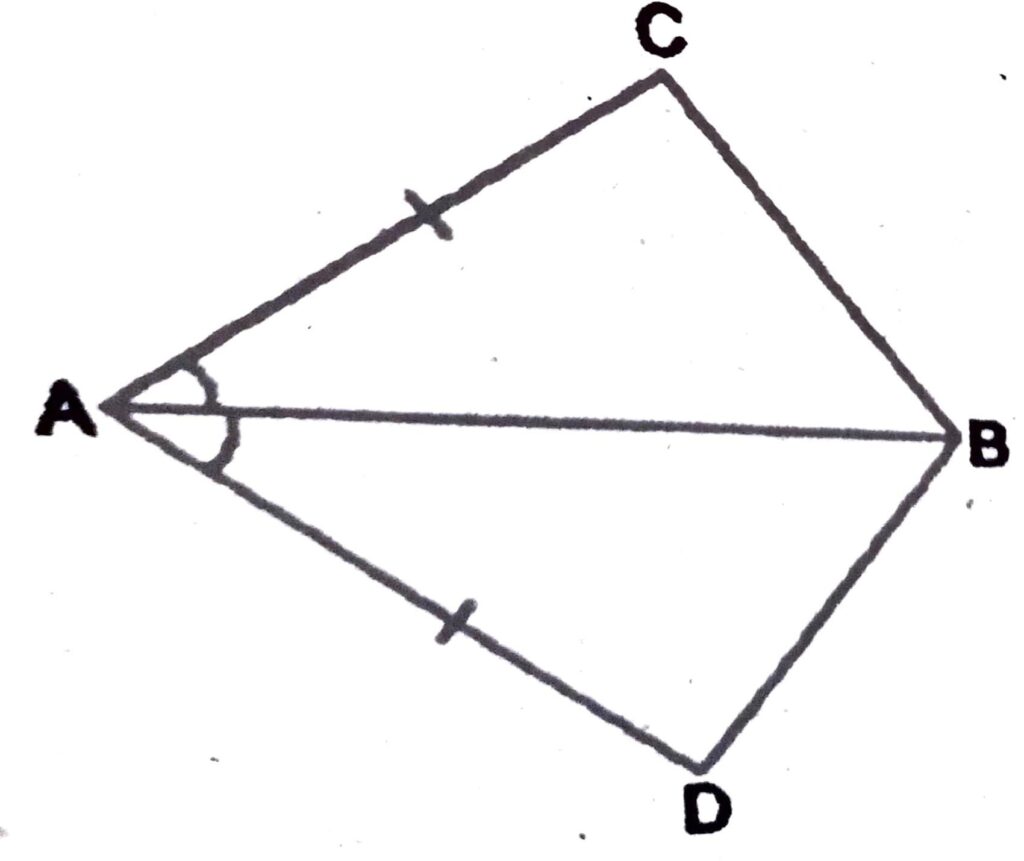
Ans: In ∆ABC and ∆ABD
AC = AD (Given)
∠ CAB = ∠ DAB (Given)
AB = AB (Given)
Therefore,
By SAS congruence condition
∆ABC ≅∆ABD
So, BC = BD (By C.P.C.T)
Q.2. ABCD is a quadrilateral in which AD = BC and ∠ DAB = ∠ BCA
Prove that
(i) ∆AB D ≅ ∆ BAC
Ans: In ∆ ABD and ∆BAC
(ii) BD = AC
Ans: AD = BC (Given)
(iii) ∠ ABD =∠BAC
Ans: ∠ DAB = ∠CBA
(Given)
(Common)
and AB = BA
By SAS Congruence Condition
∆ABD ≅ ∆BAC
(ii) BD=AC( By C.P.C.T)
(iii) ∠ABD = ∠ BAC
(Again by C.P.C.T)
Q.3. AD and BC are equal perpendiculars to a line segment AB. Show that CD bisects AB.
Ans: In ∆ AOD and ∆ BOC
AD=BC (Given)
∠ OAD = ∠ OBC (each 90⁰)
∠ AOD = ∠ BOC
(Vertically opposite angles)
Therefore, by ASA congruence condition.
So, OA = OB
(By C.P. С.Т.)
Hence, CD bisects line segment AB.
Q.4. L and m are two parallel lines intersected by another pair of parallel lines p and q.
Show that ∆ ABC = ∆ CDA
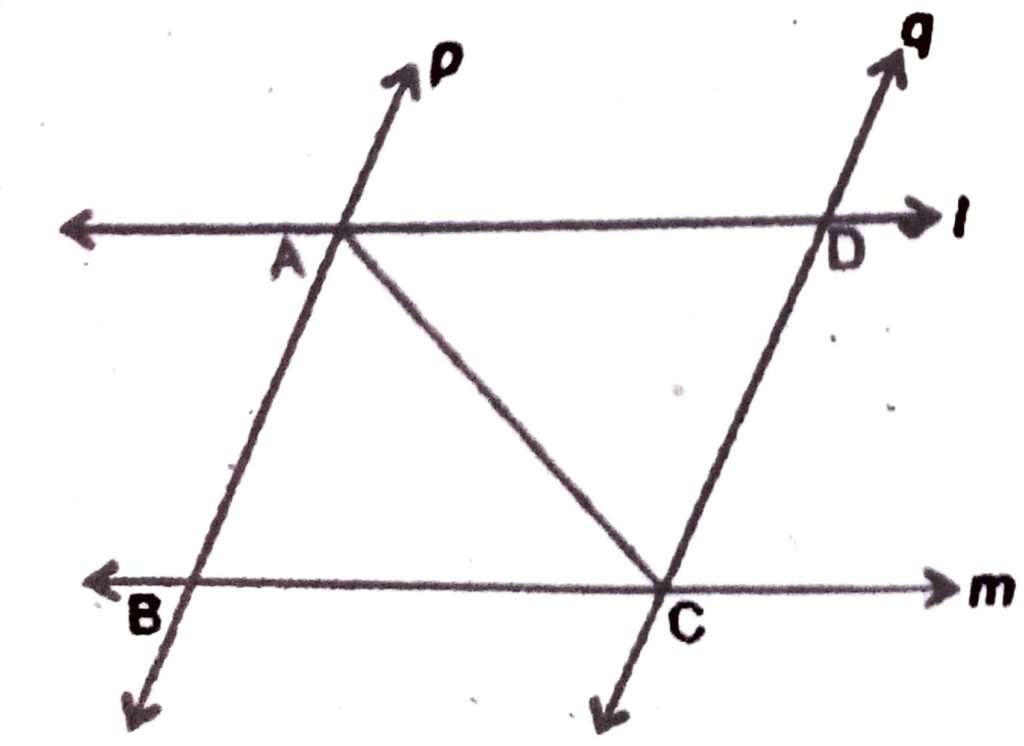
Ans: We have given that l ||m and p ||q
Therefore, In ∆ ABC and ∆ACDA
(Alternate interior angles as AB || CD)
∠ACB = ∠ CAD
(Alternate interior angles as BC II DA)
AC = CA
So, By A-S-A congruence condition.
∆ ABC ≅ ∆CDA
Q.5. Line 1 is the bisector of an angle ∠ A and B is any point on 1. BP and BQ are perpendiculars from B to the arms of ∠ A show that:
(i) ∆APB = ∆AQB
Ans:
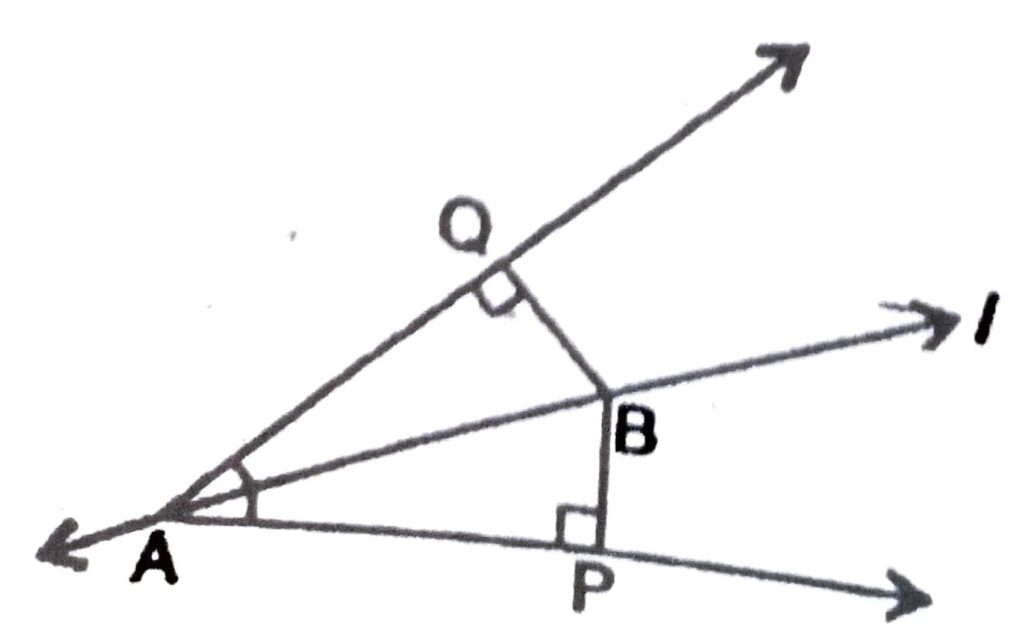
In ∆ABP and ∆ABQ
∠BAP =∠BAQ (Given)
∠ APB = ∠ AQB (Each 90⁰)
AB = AB (Common)
By A – A – S congruence condition.
So, ∆ABP = ∆ABQ
(ii) BP = BQ or B is equidistant from the arms of ∠ A
Ans: BP = BQ (By C.P.C.T.)
Q.6. In AC = AE,AB = AD and ∠ BAD = ∠ EAC. Show that BC = DE
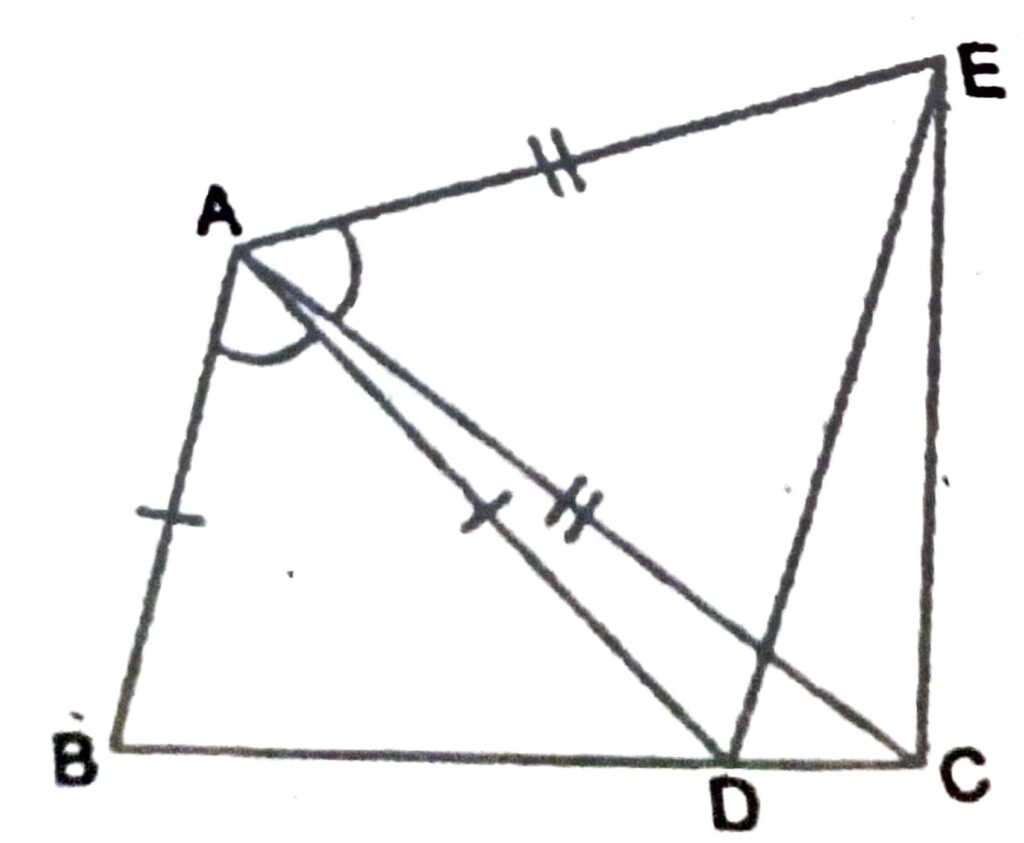
Ans: In ∆ BAC and ∆ DAE
AB = AD (Given)
AC = AB (Given)
∠ BAD = ∠ EAC …(1) (Given)
Adding ∠ DAC both side in equation (1)
∠BAD +∠DAC= ∠ EAC+∠DAC
∠ BAC = ∠ DAE
Therefore by S-A-S Congruence Condition
∆ BAC ≅ ∆ DAE
So, BC = DE (By C.P.C.T.)
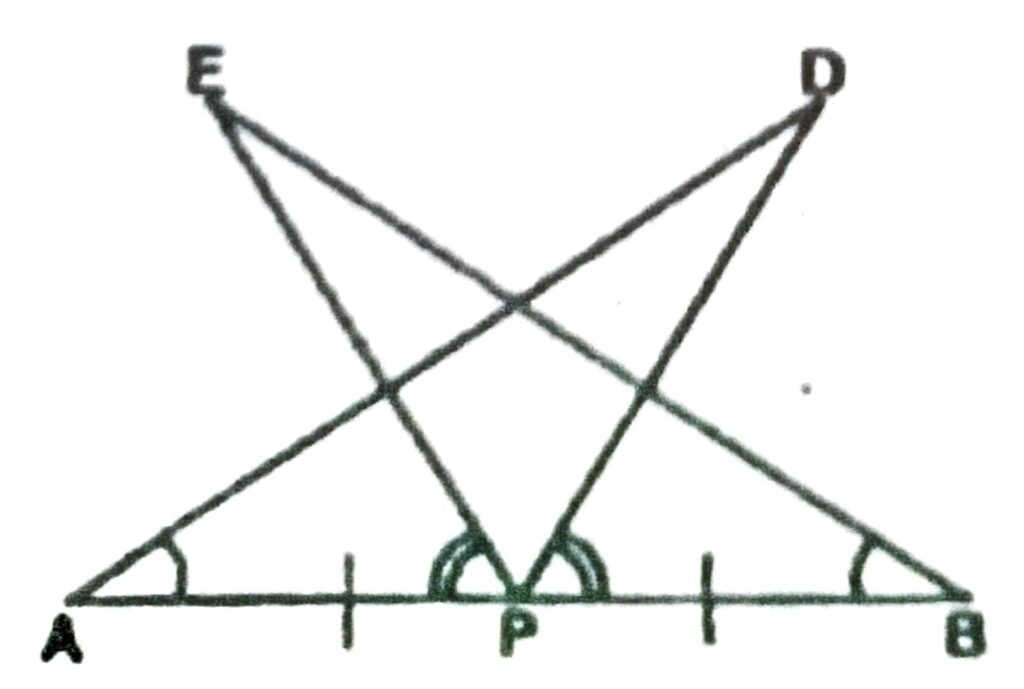
Q.7. AB is a line segment and P is its mid point. D and E are points on the same side of AB such that ∠ BAD = ∠ ABE and ∠ EPA = ∠ DPB show that
(i) ∆ DA P ≅ EBP
Ans: ∆DAP and ∆EBP
∠ DAP =∠EBP (Given)
∠ APE = ∠ DPB (Given)
∴ ∠APE + ∠ EPD=∠DPB+ ∠ EPD
(Add ∠ EPD both side)
∠APD =∠BPE
AP = BP
(Given P is the midpoint of AB)
By A-S-A Congruence Condition.
∆DAP = ∆EBP
(ii) AD = BE
Ans: AD = BE
(By C.P.C.T.)
Q.8. In the right triangle ABC, right angled at C, M is the midpoint of hypotenuse AB, C is joined to M and produces a point D such that DM = CM. Point D is joined to point B. Show that
(i) ∆ AMC ≅ ∆BMD
Ans: In ∆AMC and ∆BMD
AM = BM (Given)
CM = DM (Given)
∠ AMC = ∠ BMD
(Vertically opp. angles)
∴ By S-A-S Congruence Condition.
∆AMC ≅ ∆BMD
(ii) ∠ DBC is right angle.
Ans: ∠CAM = ∠ DBM (by C.P.C.T)
Also,∠CAM+∠MBC = 90⁰ (Since ∠ C 90⁰ )
∴ ∠DBM + ∠MBC = 90⁰ (∠CAM=∠DBM)
or, ∠ DBC = 90⁰
(iii) ∆ DBC ≅∆ ACB
Ans: In ∆ DBC and ∆ ACB
BC = BC (Common)
DB = AC
( ∴ ∆BMD = ∆AMC, by C.P.M.T)
and ∠ DBC = ∠ AVB (each 90 proved above)
Therefore, by S-A-S Congruence Condition.
∆ DBC ≅ ∠ ACB
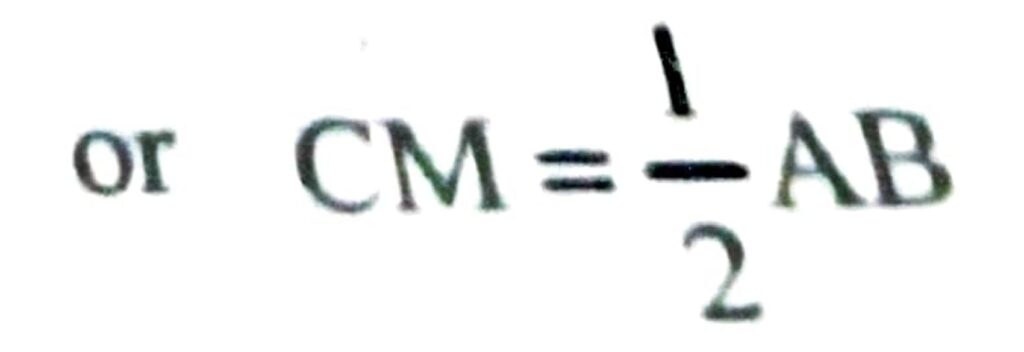
(iv) CM = 1/2 AB
Ans: Since ∆ DBC ≅ ∠ ACB
DC = AB
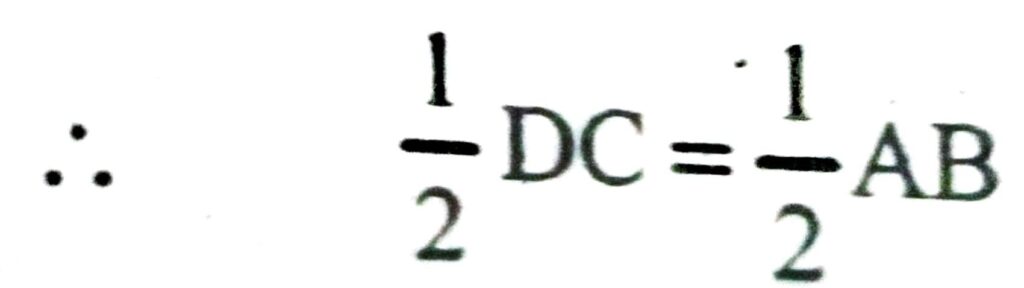
CM = AM
9. It is given that AABC = AFDE and AB = 5cm, ∠B = 40°, ∠A = 80° and DE = 6cm. Which of the following are correct for –
(i) DF = 5cm, ∠F = 60°
(ii) DF = 5cm, ∠E = 60°
(iii) DE = 6cm, ∠E = 60°
(iv) DE = 6cm, ∠D = 40°
(A) (i), (ii)
(B) (ii), (iii)
(C) (iii), (iv)
(D) (ii), (iii), (iv)
Ans:
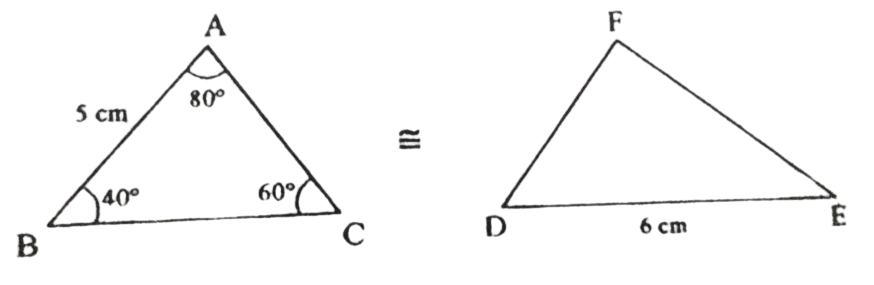
In A ABC,
ZA+ZB+ZC=180°
⇒80° +40° + ∠C= 180°
∠C=180°-120°
⇒∠C=60°
∵ Δ ABC = Δ FDE
∴ ∠A=∠F= 80° (CPCT)
∠B = ∠D=40° (CPCT)
∠C=∠E=60° (CPCT)
AB = DF = 5 cm (CPCT)
BC = DE = 6 cm (CPCT)
The correct option is (D)
10. Assertion (A): In triangles ABC and PQR, if BC= QR, ∠B = ∠Q, AB = PQ then AABC = APQR. So, CA = RP, ∠BCA = ∠QRP, ∠BAC = ∠QPR (CPCT)
Reason (R): In congruent triangles corresponding parts are equal and we write ‘CPCT’ for corresponding parts of congruent triangles.
(A) Assertion is true, Reason is also true. But reason is not a correct explanation for Assertion.
(B) Assertion is true, Reason is also true. Reason is a correct explanation for Assertion.
(C) Assertion is true, Reason is false.
(D) Assertion is false, Reason is true.
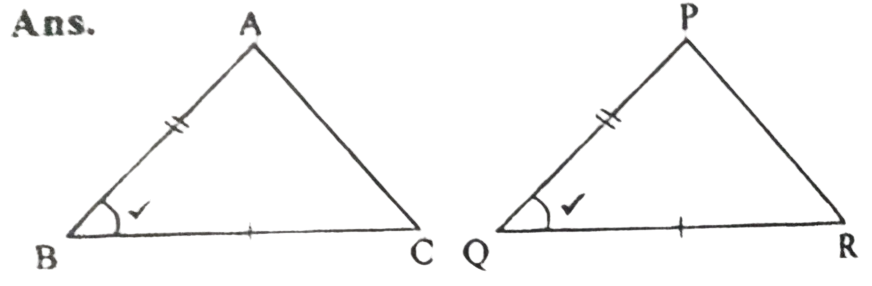
Here, ΔABC ≅ ΔPQR (By SAS)
So, CA = RP, ∠ BCA = angle QRP ∠ BAC = angle QPR(CPCT)
∴ Assertion (A) is True.
Reason (R)
In congruent triangles corresponding parts are equal and we write ‘CPCT’ for corresponding parts of congruent triangles. Reason is also true and Reason is the correct explanation of Assertion.
The correct option is (B)
Subject Ka Complete Video Solution Dekhein
Step-by-step easy concept explanation aur full questions Answer ke liye watch karein ya app download karein:


 Buy Now