
NCERT Class 8 Social Science Chapter 4 The Colonial Era in India Solutions English Medium As Per New Syllabus. to each chapter is provided in the list so that you can easily browse through different chapters NCERT Class 8 Social Science Chapter 4 The Colonial Era in India Notes and select need one. NCERT Class 8 Social Science Chapter 4 The Colonial Era in India Question Answers Download PDF. NCERT Class 8 Social Science Texbook Solutions English Medium.
NCERT Class 8 Social Science Chapter 4 The Colonial Era in India
Also, you can read the NCERT book online in these sections Solutions by Expert Teachers as per Central Board of Secondary Education (CBSE) Book guidelines. CBSE Class 8 Social Science Textual Solutions in English Medium are part of All Subject Solutions. Here we have given NCERT Class 8 Social Science Notes, CBSE Class 8 Social Science English Medium Solutions for All Chapters, You can practice these here.
The Colonial Era in India
Chapter: 4
| Theme B — Tapestry of the Past |
The Big Questions
1. What is colonialism? (Page 84)
Ans: Colonialism is a system in which one country takes control of another country or region and imposes its own political, economic and cultural systems. It often involves exploiting the resources and people of the controlled country.
2. What drew European powers to India?
Ans: European powers were attracted to India because of its great wealth, spices, cotton, silk, precious stones and other valuable goods. They wanted to control Indian trade, markets and natural resources. Political competition and the desire to spread Christianity also encouraged them to establish colonies in India.
3. What was India’s economic and geopolitical standing before and during the colonial period?
Ans: Before colonial rule, India was one of the world’s richest countries and contributed at least one-fourth of the world’s GDP. It was famous for its agriculture, textiles, handicrafts and trade. During British rule, India gradually lost its economic strength and political independence. Its industries declined, wealth was taken to Britain and its share of world GDP fell to around 5% by Independence.
4. How did the British colonial domination of India impact the country?
Ans: British colonial rule had a major negative impact on India. It led to the exploitation of resources, heavy taxation, poverty and severe famines. Indian industries and traditional crafts declined due to British economic policies. The British also changed India’s education, administration and legal systems to serve their own interests. As a result, India lost much of its wealth, independence and traditional institutions.
LET’S EXPLORE
1. Why do you think Dadabhai Naoroji means by ‘un-British rule in India’? (Hint: he was an MP in the House of Commons in 1892.) (Page 98)
Ans: Dadabhai Naoroji meant that British rule in India was unfair and against the principles of justice and freedom that Britain itself claimed to follow. As a British MP, he believed that the British were exploiting India by taking away its wealth instead of working for its welfare. He called this rule ‘un-British’ because it went against British values of fairness and justice.
2. Do you understand all the terms used above to list and describe Indian textiles? If not, form groups of four or five and try to find out more, then compare your findings with the help of your teacher. (Page 100)
Ans: Yes, I understand some of the terms, but I need to learn more about them. We can form groups of four or five, collect information about different Indian textiles, their materials, designs, patterns and weaving techniques, and compare our findings with the help of our teacher.
3. Examine the map. What are the main differences with the map of today’s India, in terms both of borders and of names? (Page 105)
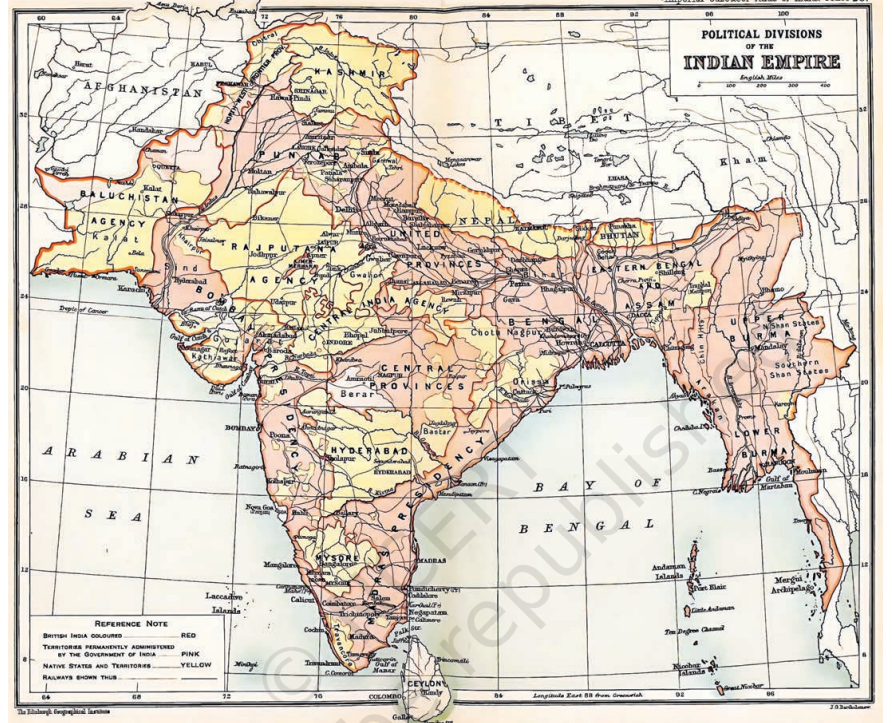
Ans: The main differences between the map of the Indian Empire and today’s map of India are:
(i) Differences in borders: The Indian Empire included areas that are now Pakistan, Bangladesh and Myanmar (Burma). Today, these are separate countries. India’s present borders are much smaller than those shown on the map.
(ii) Princely states: The map shows many princely states, such as Hyderabad, Mysore, Kashmir and states of Rajputana. Most of these were later integrated into independent India.
(iii) Differences in names: Many regions had different names during British rule. For example, the United Provinces is now Uttar Pradesh, the Central Provinces covered parts of present-day Madhya Pradesh and Maharashtra, and Madras Presidency covered areas that are now Tamil Nadu and neighbouring states.
(iv) Administrative divisions: The map shows British administrative regions such as Bombay Presidency, Madras Presidency, Bengal and Punjab. Today, India is divided into states and Union Territories.
4. Note how the Santhals are depicted in the 1856 sketch (Fig. 4.17) drawn from an artist’s imagination: observe their complexion, dress, weapons and draw your conclusions as regards the image this depiction would create in the popular mind in Britain (Page 107)
Ans: The 1856 sketch depicts the Santhals as dark-complexioned people wearing simple traditional clothes and carrying weapons such as bows and arrows. Their appearance makes them look like forest-dwelling and brave warriors. This depiction may have created an image in the minds of people in Britain that the Santhals were uncivilised, primitive and violent people. However, this was only the artist’s imagination and not a true representation of their culture and lifestyle.
5. Indigo is a natural deep blue pigment used in dyeing. Can you think of other natural substances that have been traditionally used in India to dye cloth? (Page 108)
Ans: In India, various natural substances have traditionally been used to dye clothes. Turmeric is used to produce yellow colour, indigo gives deep blue colour, henna (mehendi) produces reddish-brown colour, and madder root gives red colour. Saffron is used to produce yellow-orange shades, while pomegranate peels give yellowish and brown shades. Lac is also used to produce red and pink colours. These natural dyes are obtained from plants, roots, flowers, fruits and insects and have been traditionally used to colour cotton, silk and woollen fabrics.
6. Why do you think the term ‘Sepoy Mutiny’ rejected after Indian Independence? Write one paragraph explaining your reasons. (Page 108)
Ans: The term ‘Sepoy Mutiny’ was rejected after Indian Independence because it described the revolt of 1857 as merely a rebellion by Indian soldiers against British officers. In reality, it was a much wider uprising in which kings, farmers, ordinary people and soldiers participated to fight against British rule. Indians considered it an important struggle for freedom and national independence. Therefore, it came to be known as the First War of Indian Independence rather than the Sepoy Mutiny.
7. In the sentence “It opened (or re-opened) India to the world and the world to India”, why do you think we added ‘re-opened’? (Page 112)
Ans: We added the word ‘re-opened’ because India had already established trade and cultural relations with different parts of the world in ancient times. Later, these connections were reduced due to various historical events. During the colonial period, India became connected with the world again. Therefore, the word ‘re-opened’ shows that India was reconnecting with the world.
8. Some argue that stolen cultural heritage has been better preserved abroad than it would have been in India. What is your view on its repatriation? Discuss in groups.
Ans: In my view, stolen cultural heritage should be returned to India because it belongs to our history, culture and identity. Although some objects may have been preserved abroad, they have greater historical and emotional value in their country of origin. India has the right to protect and display its own cultural heritage for future generations.
THINK ABOUT IT
1. What exactly did Macaulay mean when he wrote that “a single shelf of a good European library was worth the whole native literature of India and Arabia”? And why should he want to make Indians “English in taste, in opinions, in morals, and in intellect”? How does this relate to the ‘civilising mission’ mentioned at the start of the chapter? Ask your teacher to guide a class debate on these questions. (Page 102)
Ans: Macaulay believed that European literature and knowledge were far superior to the traditional literature and knowledge of India and Arabia. He wanted Indians to adopt English language, culture, values and ways of thinking. His aim was to create Indians who were Indian by birth but English in their taste, opinions, morals and intellect. This idea was closely related to the British ‘civilising mission’, as the British believed that Western education and culture would make Indians more civilised. In this way, they tried to justify their colonial rule and spread British influence in India.
2. What is meant by “the sun never sets on the British Empire”? Do you think this was a correct statement? (Page 104)
Ans: The phrase “the sun never sets on the British Empire” means that the British Empire was so vast that it had colonies in different parts of the world, where it was always daytime in at least one of them. Yes, this was a correct statement during the height of British rule because Britain controlled territories across different continents, including India, Africa, Asia and America. However, this is no longer true because most British colonies have gained independence.
Questions and activities
1. What is colonialism? Give three different definitions based on the chapter or on your knowledge.
Ans: (i) Colonialism is a system in which a powerful country takes control of another country and rules over its people.
(ii) It is a process in which one country exploits the natural resources, wealth and labour of another country for its own benefit.
(iii) Colonialism is a form of foreign domination in which the ruling country controls the political, economic and social life of the people.
2. Colonial rulers often claimed that their mission was to ‘civilise’ the people they ruled. Based on the evidence in this chapter, do you think this was true in the case of India? Why or why not?
Ans: No, this was not true in the case of India. The British claimed that they wanted to civilise India, but their main aim was to exploit India’s wealth and resources. They destroyed many traditional industries, imposed heavy taxes and used India’s resources for their own benefit. Their policies caused poverty and suffering among Indians. Therefore, their claim of civilising India was mainly an excuse to justify colonial rule.
3. How was the British approach to colonising India different from earlier European powers like the Portuguese or the French?
Ans: The Portuguese and French mainly focused on establishing trading centres and controlling certain coastal areas in India. In contrast, the British gradually expanded their control over large parts of India through wars, political agreements and administrative policies. They established a powerful government and controlled India’s economy, resources and administration. Thus, British colonial rule became much wider and more systematic than that of earlier European powers.
4. “Indians funded their own subjugation.” What does this mean in the context of British infrastructure projects in India like the railway and telegraph networks?
Ans: It means that the British used Indian taxpayers’ money and resources to build infrastructure projects like railways and telegraph networks. Although these projects were built in India, they mainly served British interests, such as transporting raw materials, moving troops and controlling the country. Thus, Indians were forced to pay for facilities that helped the British strengthen their colonial rule over India.
5. What does the phrase ‘divide and rule’ mean? Give examples of how this was used by the British in India?
Ans: ‘Divide and rule’ means creating divisions among people to weaken their unity. The British used this policy by creating differences between Hindus and Muslims and different Indian rulers. This helped them maintain control over India.
6. Choose one area of Indian life, such as agriculture, education, trade, or village life. How was it affected by colonial rule? Can you find any signs of those changes still with us today?
Ans: Agriculture under British Rule
British rule badly affected Indian agriculture. Farmers had to pay heavy taxes and were forced to grow cash crops like indigo and cotton. Many farmers became poor and fell into debt. Even today, rural poverty and problems related to land ownership can be seen in India.
7. Imagine you are a reporter in 1857. Write a brief news report on Rani Lakshmibai’s resistance at Jhansi.
Ans: News Report – Rani Lakshmibai’s Resistance at Jhansi
Jhansi, June 1858
Rani Lakshmibai fought bravely against British rule during the Revolt of 1857. The British refused to accept her adopted son as the heir to Jhansi. She led her army against the British but lost Jhansi in April 1858. Later, she continued fighting near Gwalior with Tatya Tope. She died bravely in battle in June 1858.
Timeline:
(i) May 1857 – Revolt began at Meerut.
(ii) June 1857 – Revolt spread to Jhansi.
(iii) April 1858 – British captured Jhansi.
(iv) June 1858 – Rani Lakshmibai died fighting near Gwalior.
8. Imagine an alternate history where India was never colonised by European powers. Write a short story of about 300 words exploring how India might have developed on its own path.
Ans: India Without Colonial Rule
If India had never been colonised by European powers, it might have developed differently. Indian rulers could have developed their own industries, trade and education systems.
Indian handicrafts, textiles and agriculture might have grown further. The country could have built its own railways, roads and industries using its resources.
Education, science and technology might have developed through Indian institutions. Farmers and traders could have enjoyed better opportunities without colonial exploitation.
However, India might still have faced problems like conflicts between kingdoms and social inequalities.
India had great natural resources, knowledge and talent. Without colonial rule, it might have become a strong and developed nation through its own efforts.
9. Role-play: Enact a historical discussion between a British official and an Indian personality like Dadabhai Naoroji on the British colonial rule in India.
Ans: Historical Discussion
British Official: We have developed railways, roads and telegraph networks in India.
Dadabhai Naoroji: But these developments mainly benefit the British, while Indians are suffering from poverty.
British Official: We have also improved trade and administration.
Dadabhai Naoroji: The British are taking India’s wealth to Britain. This is known as the Drain of Wealth.
British Official: What do you want from us?
Dadabhai Naoroji: We want economic justice, equal opportunities and self-government for Indians.
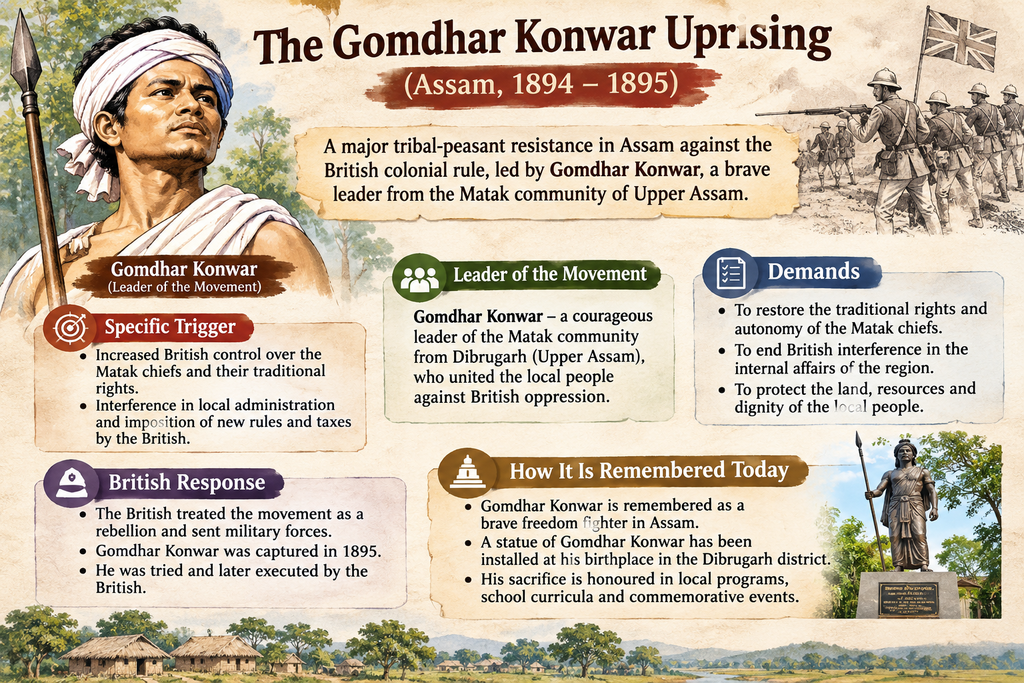
10. Explore a local resistance movement from your state or region during the colonial period. Prepare a report.
10.Explore a local resistance movement (tribal, peasant, or princely) from your state or region during the colonial period. Prepare a report or poster describing:
(i) What was the specific trigger, if any?
(ii) Who led the movement?
(iii) What were their demands?
(iv) How did the British respond?
(v) How is this event remembered today (e.g., local festivals, songs, monuments)?
Subject Ka Complete Video Solution Dekhein
Step-by-step easy concept explanation aur full questions Answer ke liye watch karein ya app download karein:


 Buy Now