
NCERT Class 8 Social Science Chapter 6 The Parliamentary System: Legislature and Executive Solutions English Medium As Per New Syllabus. to each chapter is provided in the list so that you can easily browse through different chapters NCERT Class 8 Social Science Chapter 6 The Parliamentary System: Legislature and Executive Notes and select need one. NCERT Class 8 Social Science Chapter 6 The Parliamentary System: Legislature and Executive Question Answers Download PDF. NCERT Class 8 Social Science Texbook Solutions English Medium.
NCERT Class 8 Social Science Chapter 6 The Parliamentary System: Legislature and Executive
Also, you can read the NCERT book online in these sections Solutions by Expert Teachers as per Central Board of Secondary Education (CBSE) Book guidelines. CBSE Class 8 Social Science Textual Solutions in English Medium are part of All Subject Solutions. Here we have given NCERT Class 8 Social Science Notes, CBSE Class 8 Social Science English Medium Solutions for All Chapters, You can practice these here.
The Parliamentary System: Legislature and Executive
Chapter: 6
| Theme D — Governance and Democracy |
The Big Questions
1. What is India’s parliamentary system, and how is it structured? (page 139)
Ans: India follows a parliamentary system of democracy. The Parliament consists of the President and two Houses: the Lok Sabha (Lower House) and the Rajya Sabha (Upper House). The people directly elect Lok Sabha members, while Rajya Sabha members are indirectly elected.
2. What are the key functions of the Parliament?
Ans: The main functions of Parliament are:
(i) Making laws.
(ii) Amending the Constitution.
(iii) Keeping a check on the government.
(iv) Approving and monitoring the government budget.
3. What are the roles of the legislature and the executive in India’s Parliamentary democracy?
Ans: The Legislature makes laws, approves the budget and checks the work of the government. The Executive implements laws, runs the government and takes important decisions for the country.
4. How are the legislature and the executive organised at the union and state levels?
Ans: (i) At the Union Level: The Legislature consists of the President, Lok Sabha and Rajya Sabha. The Executive consists of the President, Vice President and Council of Ministers headed by the Prime Minister.
(ii) At the State Level: The Legislature consists of the Governor and the State Legislature (Vidhan Sabha and, in some states, Vidhan Parishad). The Executive consists of the Governor and Council of Ministers headed by the Chief Minister.
LET’S EXPLORE
1. Draw a small chart to show the process of how RTE became an act. What do you think the process would be if RTE had been tabled in the Lok Sabha? (Page 148)
Ans:
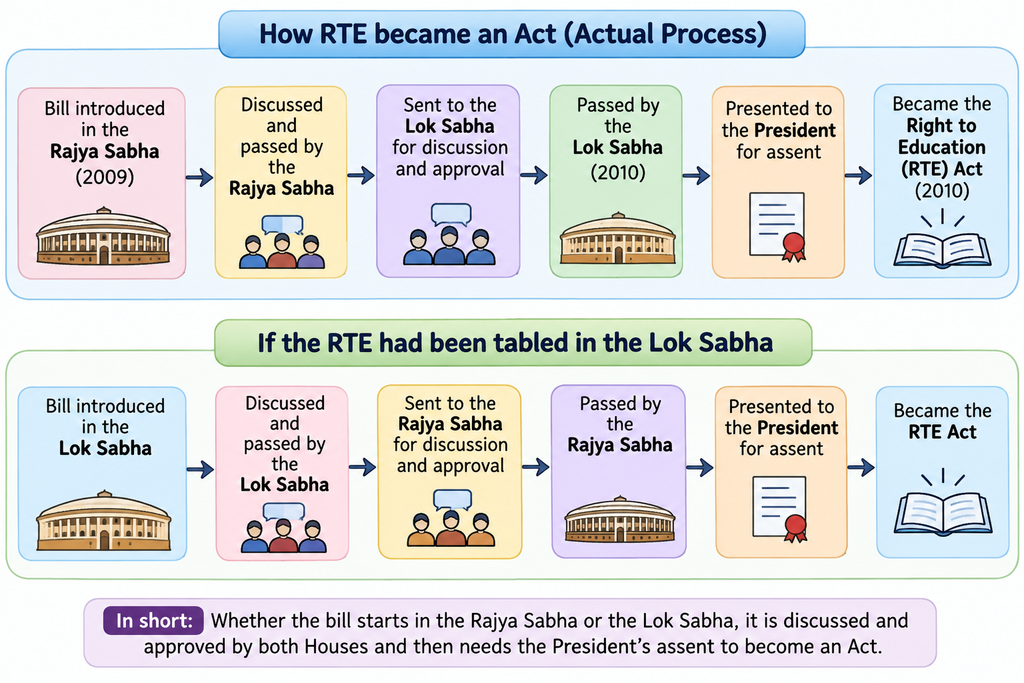
2. Why do you think that Parliament keeps an eye on government expenditure? (Hint: Whose money does the government spend?) (Page 151)
Ans: The government spends public money collected from people through taxes. Parliament keeps an eye on government expenditure to ensure that the money is used properly and not wasted or misused.
3. If the Executive is part of the Legislature, how do we say that there is separation of power? (Hint: revisit the section on legislature above) (Page 152)
Ans: Although the Executive is part of the Legislature, both have different functions. The Legislature makes laws and keeps a check on the government, while the Executive implements those laws and runs the government. Thus, their powers and responsibilities are separate.
4. What might happen if one of the organs — Legislature, Executive, Judiciary — had all the power? How could it affect the rights of people? Discuss with your classmates how each organ checks the others. For example, how does the Legislature question the actions of the Executive? How does the Judiciary make sure that laws and government actions respect the Constitution? Do you think there might be ways in which the actions of the Judiciary itself are reviewed? (page 154)
Ans: If any one organ of the government had all the power, it could misuse its authority and become unfair. This could affect people’s freedom, equality and fundamental rights.
(i) Legislature: It makes laws and checks the Executive by asking questions, holding debates and discussing government policies.
(ii) Executive: It implements laws and runs the administration. It is answerable to the Legislature for its actions.
(iii) Judiciary: It protects the Constitution and people’s rights. It can declare laws and government actions unconstitutional if they violate the Constitution.
(iv) Review of Judiciary: Yes, the decisions of lower courts can be reviewed by higher courts, and the Supreme Court can review its own judgments in certain cases.
5. Can you find examples where the Judiciary has asked lawmakers to review a law? Can you find any instances when the implementation of a law has been questioned by the Judiciary? (page 154)
Ans: Yes, there are several examples in India where the Judiciary has asked the government to review laws or questioned their implementation.
(i) Review of a Law: In 2022, the Supreme Court asked the Central Government to reconsider the colonial-era sedition law (Section 124A of the IPC) because of concerns about its misuse and its impact on freedom of speech.
(ii) Questioning Implementation of a Law: In 2022, the Supreme Court questioned why police were still registering cases under Section 66A of the IT Act, even though the Court had declared it unconstitutional in 2015.
6. What type of legislature does your state have? (Page 157)
Ans: Assam has a unicameral legislature, which means it has only one House, called the Legislative Assembly (Vidhan Sabha). It consists of 126 elected members.
7. Take up a small group project. Compile data regarding the functioning of the legislature in your state or union territory. (Page 159)
Ans: Project: Functioning of the Assam Legislative Assembly
Assam has a Legislative Assembly called the Assam Vidhan Sabha. It is responsible for making laws and discussing important issues related to the state.
Project details:
(i) Assam has a unicameral legislature, which means it has only one House.
(ii) The Assam Legislative Assembly has 126 elected members, known as MLAs.
(iii) The Assembly meets in sessions to discuss state issues, make laws and approve the state budget.
(iv) The Speaker presides over the meetings and maintains discipline in the House.
(v) MLAs discuss important matters such as education, healthcare, roads, employment and agriculture.
(vi) Parliamentary-style committees examine government policies, budgets and other important matters.
(vii) During the 15th Assembly (2021–2026), the Assembly met for an average of 20 days per year and passed 240 Bills, excluding Appropriation Bills.
8. Seek an appointment with an MLA and gather information about challenges with respect to the state legislature.
Ans: I would like to meet an MLA of my constituency to understand the challenges faced by the Assam Legislative Assembly.
I would ask the following questions:
(i) What are the major challenges faced by the state legislature?
(ii) How does the Assembly ensure that the problems of people are discussed?
(iii) Why are some important Bills delayed?
(iv) How does the government ensure proper implementation of laws?
(v) What steps are being taken to improve education, healthcare and employment in our state?
Questions and activities
1.Find out how many representatives from your state are in each House of the Parliament. (Page 161)
Ans: Assam is represented in both Houses of the Indian Parliament. The representatives are elected or selected to speak for the people of the state and raise their issues in Parliament.
(i) Lok Sabha: Assam has 14 members who are directly elected by the people through general elections. They represent different constituencies of the state.
(ii) Rajya Sabha: Assam has 7 members who are indirectly elected by the elected members of the Assam Legislative Assembly. They represent the interests of the state at the national level.
2. What makes the Indian Parliament the “voice of the people”? How does it ensure that different opinions are heard?
Ans: The Indian Parliament is called the “voice of the people” because its members represent citizens from different states and regions. Lok Sabha members are directly elected by the people, while Rajya Sabha members are indirectly elected by the state legislatures. This ensures that different sections of society and regions get representation.
Parliament ensures that different opinions are heard through:
(i) Question Hour: MPs ask questions to the government and raise important public issues.
(ii) Debates and Discussions: Members from different political parties express their views on laws and national issues.
(iii) Parliamentary Committees: These committees examine bills, budgets and government policies in detail.
3. Why do you think the Constitution made the Executive responsible to the Legislature?
Ans: The Constitution made the Executive responsible to the Legislature to ensure that the government remains accountable to the people’s representatives. It helps prevent the misuse of power and ensures that the government works according to the Constitution and laws.
(i) It prevents the misuse of power and ensures that leaders act within their limits.
(ii) Ministers have to explain and take responsibility for their decisions and actions in Parliament.
(iii) This structure strengthens democracy by making the government transparent and responsible to citizens.
(iv) It makes the government more transparent and responsible to the people.
4. Why do you think we have chosen the system of bicameral legislature at the Union level?
Ans: India has adopted a bicameral legislature at the Union level because it has two Houses: the Lok Sabha and the Rajya Sabha. The Constitution makers believed that both the people and the states should get proper representation in Parliament.
(i) The Lok Sabha represents the people of India directly.
(ii) The Rajya Sabha represents the states and protects their interests.
(iii) Having two Houses allows bills to be discussed and examined from different perspectives.
(iv) It ensures better representation of India’s diverse regions and communities.
(v) Thus, the bicameral legislature ensures fair representation for everyone.
5. Try to track the journey of a recent bill passed by the Parliament. Identify in which House it was introduced. Were there any major debates or disagreements? How long did it take for the bill to become a law? Use newspaper archives, government websites, and Lok Sabha debates, or ask your teacher for help.
Ans: Example: The Waqf (Amendment) Bill, 2024.
(i) The Bill was first introduced in the Lok Sabha on 8 August 2024.
(ii) It was sent to a committee for detailed examination and suggestions.
(iii) There were disagreements between the ruling party and opposition. The government supported the
Bill, while opposition parties raised objections.
(iv) The Lok Sabha passed the Bill on 3 April 2025, and the Rajya Sabha passed it on 4 April 2025.
(v) The President gave her approval on 5 April 2025. After that, it became a law.
(vi) It took about 8 months to become a law.
6. Choose a recent law passed by the Parliament. Divide into teams to role-play different parts of the process — MPs debating in Lok Sabha and Rajya Sabha, ministers answering questions, and the President giving assent. Present a short skit showing how a bill becomes a law; enact a ‘model Parliament’.
Ans: We can perform a short skit based on the Waqf (Amendment) Act, 2025 to show how a Bill becomes a law.
Characters:
(i) Speaker of Lok Sabha.
(ii) Members of Parliament (Ruling Party and Opposition).
(iii) Minister in charge of the Bill.
(iv) Chairman of Rajya Sabha.
(v) President of India.
Short Skit: How a Bill Becomes a Law
Scene 1: Introduction in Lok Sabha
Speaker: Today, we will discuss the Waqf (Amendment) Bill, 2024.
Minister: I introduce this Bill for discussion and approval.
Scene 2: Debate in Lok Sabha
Ruling Party MP: We support this Bill because it aims to improve the management of Waqf properties.
Opposition MP: We have some concerns about the Bill and want the government to explain its provisions.
Minister: The government is ready to answer your questions.
Speaker: After discussion and voting, the Bill is passed by the Lok Sabha.
Scene 3: Discussion in Rajya Sabha
Chairman: The Bill is now presented in the Rajya Sabha for discussion.
Rajya Sabha MP: We will examine the Bill and vote on it.
Chairman: The Bill is passed by the Rajya Sabha.
Scene 4: President’s Assent
President: I give my assent to the Bill. It is now a law.
7. The Women’s Reservation Bill, 2023, was passed with wide support. Why might it have taken over 25 years for this bill to be passed, despite being discussed for so long?
Ans: The Women’s Reservation Bill took over 25 years to pass because:
(i) There were disagreements among political parties about its provisions.
(ii) Some leaders demanded separate reservations for women belonging to OBC communities.
(iii) Political parties had different opinions about how the seats should be reserved.
(iv) There was a lack of political agreement and support for a long time.
(v) Finally, in 2023, the bill received wide support and was passed by Parliament.
8. Sometimes the Parliament is disrupted and does not function for the number of days it is supposed to. What impact do you think this has on the quality of laws and the trust people place in their representatives?
Ans: When Parliament is disrupted, important discussions and debates cannot take place properly. This affects the quality of laws and reduces people’s trust in their representatives.
(i) Important bills may be passed without proper discussion.
(ii) MPs do not get enough time to express their opinions and raise public issues.
(iii) Important government work gets delayed.
(iv) People may lose trust in their representatives because they are not performing their duties properly.
9. Can you create ‘interest’ groups among students and list questions related to any policy that you may want to ask your MP and / or your MLA? How would these questions be different if it is to the MP instead of the MLA, and vice versa?
Ans: Students can form different interest groups to discuss important issues related to education, employment and the environment. Each group can prepare questions for their elected representatives.
Group A: Questions for MP (Member of Parliament)
(i) Education: What steps is the Central Government taking to improve the education system across India?
(ii) Employment: What plans does the government have to reduce unemployment among educated youth?
(iii) Environment: What policies are being introduced to control pollution and protect natural resources?
Group B: Questions for MLA (Member of Legislative Assembly)
(i) Education: How will the government improve the facilities and teaching quality in schools and colleges in our area?
(ii) Employment: What opportunities are being created for unemployed youth in our state?
(iii) Environment: What measures are being taken to keep our locality clean and pollution-free?
Difference: An MP is responsible for raising national issues in Parliament, whereas an MLA represents the people of a particular constituency in the State Legislative Assembly and focuses on state and local issues.
10. What is the role that the Judiciary plays in Indian democracy? What could happen if we didn’t have an independent judiciary?
Ans: The Judiciary plays an important role in Indian democracy by protecting the Constitution, ensuring justice and safeguarding the Fundamental Rights of citizens.
(i) It interprets the Constitution and laws.
(ii) It protects the Fundamental Rights of citizens.
(iii) It settles disputes between individuals, states and the government.
(iv) It checks whether government actions follow the Constitution.
If we did not have an independent Judiciary, the government could misuse its power, citizens might not get justice and their Fundamental Rights could be violated.
Subject Ka Complete Video Solution Dekhein
Step-by-step easy concept explanation aur full questions Answer ke liye watch karein ya app download karein:


 Buy Now