
NCERT Class 8 Social Science Chapter 2 Reshaping India’s Political Map Solutions English Medium As Per New Syllabus. to each chapter is provided in the list so that you can easily browse through different chapters NCERT Class 8 Social Science Chapter 2 Reshaping India’s Political Map Notes and select need one. NCERT Class 8 Social Science Chapter 2 Reshaping India’s Political Map Question Answers Download PDF. NCERT Class 8 Social Science Texbook Solutions English Medium.
NCERT Class 8 Social Science Chapter 2 Reshaping India’s Political Map
Also, you can read the NCERT book online in these sections Solutions by Expert Teachers as per Central Board of Secondary Education (CBSE) Book guidelines. CBSE Class 8 Social Science Textual Solutions in English Medium are part of All Subject Solutions. Here we have given NCERT Class 8 Social Science Notes, CBSE Class 8 Social Science English Medium Solutions for All Chapters, You can practice these here.
Reshaping India’s Political Map
Chapter: 2
| Theme B — Tapestry of the Past |
The Big Questions
1. How did foreign invasions and the rise of new dynasties reshape India’s political boundaries during this period? (Page 21)
Ans: Foreign invasions by Turkic, Afghan and Mughal rulers changed India’s political boundaries. Many old kingdoms fell, and new dynasties like the Delhi Sultanate and Mughal Empire came to power. Regional kingdoms such as the Vijayanagara and Maratha empires also emerged. As a result, India’s political map changed frequently due to wars, conquests and alliances.
2. How did Indian society respond to invasions? How did India’s economy adapt during times of political instability?
Ans: Indian society responded to invasions with resistance and courage. Many rulers fought to protect their kingdoms, while people tried to preserve their traditions and culture. Despite political instability, agriculture, trade, crafts and industries continued to grow. New cultural traditions also developed through the interaction of different communities.
3. What impact did this period have on the lives of the people?
Ans: This period brought both difficulties and changes in people’s lives. Wars and invasions caused destruction, displacement, heavy taxes and hardship for common people. However, trade, agriculture, art, architecture and literature also developed. Different cultures influenced each other and created a rich shared heritage.
LET‘S EXPLORE
1. Looking at Fig. 2.6, why do you think Ala-ud-din Khilji called himself ‘the second Alexander’? (Page 26 )
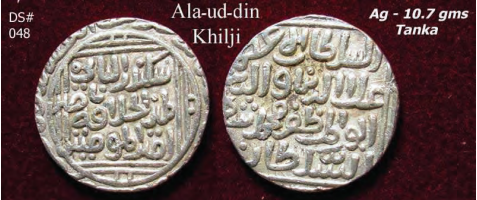
Ans: Ans: Ala-ud-din Khilji called himself ‘the second Alexander’ because he wanted to become a great conqueror like Alexander the Great. He expanded his empire through military campaigns and aimed to conquer large parts of the world.
2. What kind of resources do you think were needed to maintain an army and wage war in those days? Discuss in groups the various types of expenditure involved, from weapons or food for soldiers to animals used in warfare, road construction, etc. (Page 26)
Ans: To maintain an army and fight wars in those days, rulers needed a large amount of money and resources. These included weapons, food, clothes and salaries for soldiers. They also needed horses, elephants and camels for warfare and transportation. Money was required for building forts, roads, bridges and arranging food supplies. All these expenses helped rulers maintain a strong army and protect their kingdoms.
3. Why do you think such locations were chosen for many of the medieval forts? Discuss pros and cons. (Hint: think of issues of strategy, security, vulnerability, etc.) (Page 31)
Ans: Medieval forts were often built on hills, mountains and places surrounded by forests or rivers for better security and protection from enemies. Such locations made it difficult for enemy armies to attack and helped rulers keep watch over their surroundings. However, these places were difficult to reach, and arranging food, water and other supplies was also challenging.
4. In Fig. below, what elements do you observe? What do they tell you about life then? (Hint: observe the weapons, the animals, the activities. (Page 35)
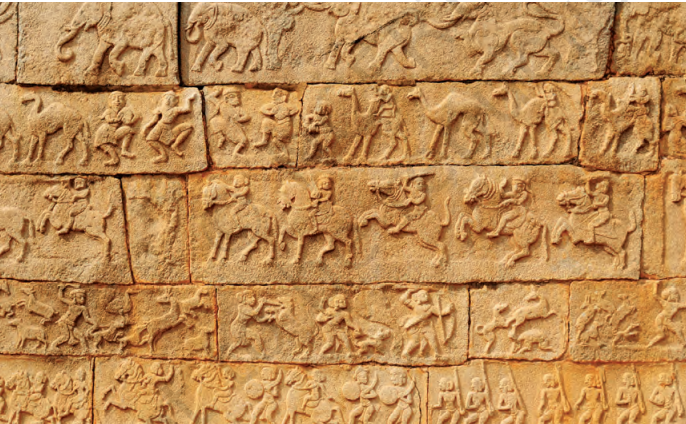
Ans: The picture shows soldiers carrying weapons such as swords, bows and arrows. We can also see horses and other animals used for transportation and warfare. People are engaged in fighting and other activities. These carvings tell us that warfare, hunting, animal use and military activities were important parts of life during that period.
6. Compare the maps in Figs. 2.3, 2.12 and 2.16. What differences do you notice? What is the ‘reshaping’ that has occurred? (page 41)
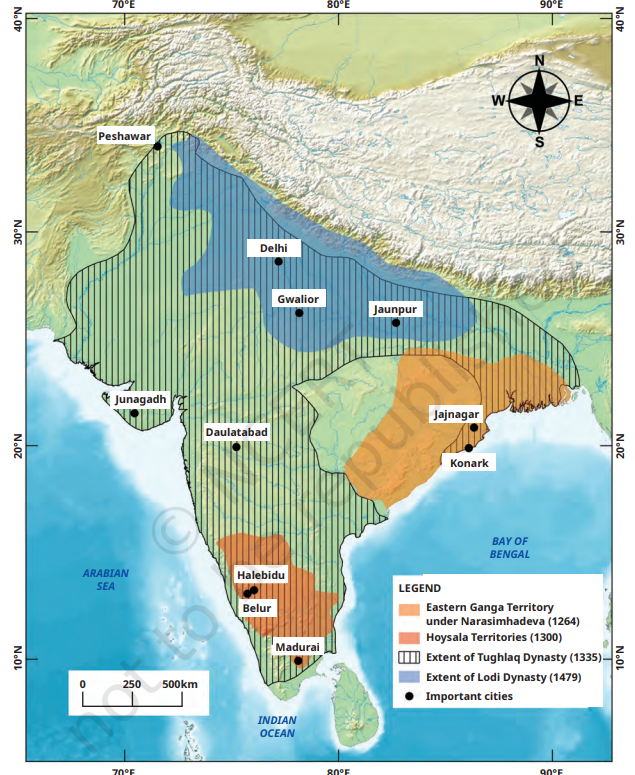
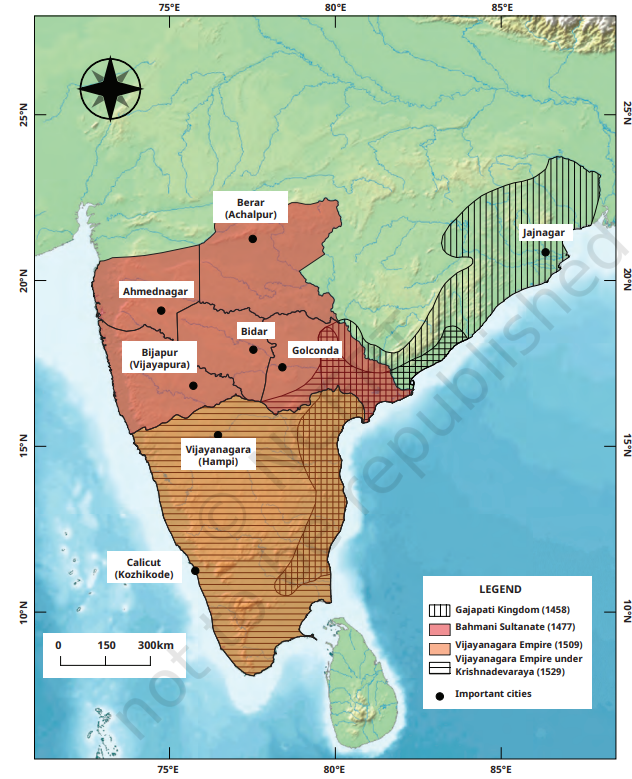
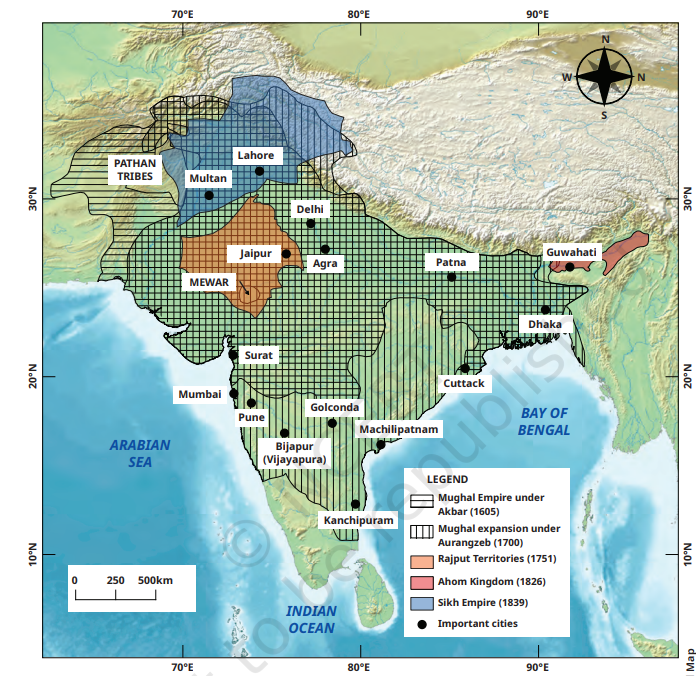
Ans: The three maps show how India’s political boundaries changed over time. In Fig. 2.3, India was divided among several regional kingdoms, such as the Delhi Sultanate, Eastern Ganga and Hoysala kingdoms. In Fig. 2.12, the Mughal Empire expanded under Akbar and Aurangzeb, while the Vijayanagara and Bahmani kingdoms also existed in the south. In Fig. 2.16, new powers like the Rajputs, Ahoms and Sikhs emerged. This reshaping occurred due to invasions, wars, conquests, alliances and the rise and fall of different dynasties.
7. In his last letters to two of his sons, Aurangzeb wrote, “I came alone and am going away alone. I know not who I am and what I have been doing. … I have not done well for the country and the people, and of the future there is no hope. I was helpless [in life] and I am departing helpless.” What do these words tell us about Aurangzeb? How do you feel about them? (Page 45)
Ans: These words show that Aurangzeb felt lonely, helpless and regretful at the end of his life. He realised that he had not done enough for the country and its people. I feel sad after reading his words because they show that power and wealth cannot always bring happiness and peace. A ruler should always work for the welfare of the people.
8. Discuss in class how the pain system affected the daily lives of the people in the Ahom kingdom, both in terms of challenges and benefits, and helped the king manage both the army and the economy. (Page 48)
Ans: The paik system played an important role in the Ahom kingdom. Under this system, people had to provide services to the king, such as working in agriculture, building roads and helping in military activities. It helped the king maintain a strong army and develop the economy. However, people sometimes had to leave their homes and work for the kingdom, which created difficulties in their daily lives. On the other hand, they received protection and benefited from public works and development.
9. How did the Ahoms use the rivers, hills and forests of Assam to their advantage? Can you think of ways in which the geography helped them build defences and fight wars? (Page 49)
Ans: The Ahoms used the rivers of Assam as natural barriers and means of transport. The hills and dense forests made it difficult for enemies to enter their territory. They used these natural features to build strong defences, hide from enemies and plan surprise attacks. This geography helped them protect their kingdom and fight wars effectively.
THINK ABOUT IT
1. Why do we use the term ‘image’ rather than common terms like ‘idol’ or ‘icon’? The latter two terms are considered pejorative in the context of Judaism, Christianity and Islam, whose orthodox sects condemn ‘idolatry’ or the worship of ‘idols’ or ‘icons’.
India’s classical texts used words like mūrti, vigraha, pratimā, rūpa, etc., to designate images, often statues, used for worship in temples or homes. In English, ‘image’ is a neutral term (Page 28)
Ans: We use the term ‘image’ because it is a neutral and respectful word. Terms like ‘idol’ and ‘icon’ are considered negative in some religious contexts. Indian classical texts use words like Murti, Vigraha, Pratima and Rupa for objects used in worship. Therefore, ‘image’ is a more suitable and neutral term.
2. During the time of the Tughlaqs, the Musunuri Nayakas, Telugu chieftains, rallied over 75 more chieftains of the region, formed a confederacy that defeated smaller provinces, formed a confederacy that defeated the Delhi Sultanate forces, and expelled Muhammad bin Tughlaq’s army from Warangal (present-day Telangana) around 1330–1336. Do you think it would have been an easy task to bring together 75 leaders in those days? (Page 29)
Ans: No, it would not have been an easy task to bring together 75 chieftains in those days. Each leader had their own interests, power and territory. They had to overcome their differences, build trust and work together with proper planning. Their unity and cooperation helped them defeat the Delhi Sultanate forces and protect their region.
3. Have you noticed the term pati in titles like ‘Gajapati’? Pati means ‘lord’ or ‘master’ and was commonly used by many ruling dynasties of this period to signify power and stature. The Vijayanagara kings were called ‘Narapati’, the Bahmani Sultanate rulers ‘Ashwapati’, and the Maratha rulers ‘Chhatrapati’ — each title reflecting different aspects of kingship and power. Can you guess what these three terms might mean? (Page 32)
Ans: These three terms have different meanings:
(i) Narapati: Lord or master of men (people).
(ii) Ashwapati: Lord or master of horses.
(iii) Chhatrapati: Lord or master of the umbrella, symbolising royal authority and power.
4.What strikes you in Babur’s impressions of India? Discuss in groups. (Page 37)
Ans: What strikes me most about Babur’s impressions is that he found India rich in gold, silver and skilled artisans, but considered it a country of few charms compared to Central Asia. He also appreciated India’s climate during the rainy season, natural beauty, birds and fruit trees. Despite his mixed feelings, he decided to stay in India and establish his empire because of its wealth and opportunities.
5. Why do you think Akbar employed different strategies to expand his empire, while the earlier rulers of Delhi relied mostly on military might? (page 40)
Ans: Akbar used different strategies to expand his empire because he wanted to establish a strong and stable kingdom. Unlike earlier Delhi rulers, who mainly depended on military power, Akbar also used friendship, alliances and marriage relations with Rajput rulers. He included people from different communities in his administration and respected their traditions. These policies helped him gain the support of local rulers and expand his empire peacefully.
6. We saw above that Delhi sultans’ average reign lasted about nine years. This figure becomes 27 years in the case of Mughal emperors up to Aurangzeb; and 16 years if we consider all Mughal rulers, up to the end of the empire in the 19th century. What do you make of these numbers of years of reign? (Page 43)
Ans: These numbers show that Mughal emperors generally ruled for a longer period than the Delhi Sultans. This suggests that the Mughal Empire had greater political stability and a stronger system of administration. However, the shorter average reign of all Mughal rulers shows that the empire faced instability towards its later years.
7. Some of the invaders and rulers mentioned above committed terrible deeds and atrocities. Many more could have been mentioned. As the ‘Note on History’s Darker Chapters’ on page 20 makes clear, we must keep in mind that this is about people in the past, not people of today. We need to know the facts of the past, and the victims of these atrocities deserve our respect and remembrance. But it is important to keep in mind that we, today, bear no responsibility for actions of individuals hundreds of years ago. (Page 45)
Ans: Ans: We should learn about the atrocities committed by rulers in the past and remember the victims with respect. However, we should not blame people living today for the actions of individuals who lived hundreds of years ago. History teaches us about the mistakes of the past so that we can build a better and more peaceful future.
8. Why do you think Guru Tegh Bahadur endured torture rather than convert? Why did he think his sacrifice would make a difference? (Page 52)
Ans: Guru Tegh Bahadur endured torture because he strongly believed in religious freedom and the right of every person to follow their own faith. He refused to give up his beliefs. He thought his sacrifice would inspire people to stand against injustice and protect religious freedom.
9. What values did the Sikh Gurus and the Khalsa embody?
Ans: The Sikh Gurus and the Khalsa embodied courage, equality, honesty, service, compassion and devotion. They taught people to stand against injustice and help others without discrimination.
10. How are they relevant in today’s world?
Ans: Their values are still relevant today. We should respect all religions, treat everyone equally, help those in need and stand against injustice. Their teachings inspire us to build a peaceful and fair society.
Questions and Activities
1. Compare the political strategies of the Delhi Sultanate and the Mughals. What similarities and differences existed between them?(Page 59)
Ans: Both the Delhi Sultans and the Mughals used military power to expand their kingdoms and control territories. They appointed officers and collected taxes to manage their empires. However, the Mughals, especially Akbar, also made alliances with Rajputs and included people from different communities in their administration. This helped them build a stronger and more stable empire.
2. Why did kingdoms like the Vijayanagara Empire and the Ahom Kingdom manage to resist conquest for a longer time compared to others?
Ans: These kingdoms used their geographical conditions to protect themselves. Vijayanagara had hills and strong forts, while the Ahoms used rivers, forests and hills as natural defences. They also had strong armies and good military strategies. Support and cooperation from local people helped them resist enemy attacks.
3. Imagine you are a scholar in the court of Akbar or Krishnadevaraya. Write a letter to a friend describing the politics, trade, culture, and society you are witnessing.
Ans:
Dear Friend,
I hope you are doing well. I am writing this letter from the court of Emperor Akbar. The emperor is a powerful ruler who follows different political strategies and maintains good relations with many Rajput rulers. Trade is growing, and merchants bring different goods from distant places. The court is full of scholars, artists, poets and musicians. People from different religions and communities live and work here. I feel lucky to witness such a rich and interesting society.
Your Friend.
4. How come Akbar, a ruthless conqueror in his young days, grew tolerant and benevolent after some years? What could have led to such a change?
Ans: As Akbar grew older, he gained more experience as a ruler. He understood that an empire could not remain strong through force alone. His contact with people of different religions and communities helped him respect their beliefs. He started following policies of tolerance, friendship and cooperation to maintain peace in his empire.
5. What might have happened if the Vijayanagara Empire had won the Battle of Talikota? Imagine and describe how it could have changed the political and cultural history of south India.
Ans: If the Vijayanagara Empire had won the Battle of Talikota, it might have remained powerful for a longer time. Its rulers could have continued to protect temples, promote art and architecture, and support trade. The empire might also have maintained greater political control over south India. As a result, the culture and traditions of Vijayanagara could have continued to grow.
6. Many values promoted by early Sikhism, including equality, seva, and justice, remain relevant today. Select one of these values and discuss how it remains relevant in contemporary society.
Ans: I choose the value of equality. Equality means treating everyone with respect, without discrimination based on religion, caste, gender or social status. It is important today because every person deserves equal rights and opportunities. By following this value, we can build a fair and peaceful society.
7. Imagine you are a trader in a port city (Surat, Calicut or Hooghly). Describe the scenes you see as regards goods, people you trade with, movement of ships, etc.
Ans: I am a trader in the port city of Surat. Many ships arrive at the port from different countries. They carry spices, cotton cloth, silk, perfumes and other goods. Traders from India, Arabia, Persia and Europe come here to buy and sell products. The port is always busy with ships, workers, merchants and sailors. Trade has made this city rich and lively.
Subject Ka Complete Video Solution Dekhein
Step-by-step easy concept explanation aur full questions Answer ke liye watch karein ya app download karein:


 Buy Now