
NCERT Class 8 Social Science Chapter 5 Universal Franchise and India’s Electoral System Solutions English Medium As Per New Syllabus. to each chapter is provided in the list so that you can easily browse through different chapters NCERT Class 8 Social Science Chapter 5 Universal Franchise and India’s Electoral System Notes and select need one. NCERT Class 8 Social Science Chapter 5 Universal Franchise and India’s Electoral System Question Answers Download PDF. NCERT Class 8 Social Science Texbook Solutions English Medium.
NCERT Class 8 Social Science Chapter 5 Universal Franchise and India’s Electoral System
Also, you can read the NCERT book online in these sections Solutions by Expert Teachers as per Central Board of Secondary Education (CBSE) Book guidelines. CBSE Class 8 Social Science Textual Solutions in English Medium are part of All Subject Solutions. Here we have given NCERT Class 8 Social Science Notes, CBSE Class 8 Social Science English Medium Solutions for All Chapters, You can practice these here.
Universal Franchise and India’s Electoral System
Chapter: 5
| Theme D — Governance and Democracy |
The Big Questions
1. What is a universal adult franchise? (Page 117)
Ans: Universal adult franchise means that every Indian citizen aged 18 years and above has the right to vote, irrespective of caste, religion, gender, education or income. Every vote has equal value.
2. What is an electoral system?
Ans: An electoral system is a set of rules and procedures through which people vote to choose their representatives and form a government.
3. How does India’s electoral system work?
Ans: In India, citizens aged 18 years and above can vote in elections. The Election Commission of India conducts free and fair elections. People vote for their chosen candidates through EVMs. The candidate who gets the highest number of votes wins. The elected representatives form the government.
LET’S EXPLORE
1. India changed the minimum age for voting from 21 to 18 in 1988. Discuss whether this was a good move. (Page 118)
Ans: The decision to reduce the voting age in India from 21 to 18 in 1988 was an important step towards making democracy more inclusive. It allowed young adults to take part in elections and have a say in decisions that affect their future. The change also brought India closer to international standards and gave millions of young people a voice on issues such as education and employment. Although some young voters may lack political experience, this step made Indian democracy more inclusive and gave youth a voice in choosing their leaders.
2. In 1947, our literacy rate was about 14 per cent, only about 8 per cent among women. Some argued that the right to vote should be given only to literate people. Discuss in your group why the Constitution makers may have decided on universal franchise from the time of Independence itself. (Page 120)
Ans: The Constitution makers decided to introduce Universal Adult Franchise from the beginning because they believed that voting is a right, not a reward for education. Poor, uneducated people, women and rural communities had also contributed to the freedom struggle and deserved an equal voice. Universal franchise promoted equality and social justice by allowing every adult citizen to choose their representatives and participate in democracy.
3. Discuss in groups (Page 121)
(a) What role do such measures play in a democracy?
Ans: These measures ensure that every eligible citizen, including elderly people, persons with disabilities and people living in remote areas, can participate in elections. They make democracy more inclusive and uphold the principle of Universal Adult Franchise.
(b) Do you know of anyone who benefitted from these improved accessibility measures?
Ans: Yes, I know an elderly person who was able to vote from home during the 2024 General Elections through the postal voting facility.
(c) How might they increase voter participation in your neighbourhood?
Ans: These measures make voting easier for people with physical disabilities, elderly citizens and those who face difficulties reaching polling stations. As a result, more people may participate in elections.
(d) How can technology assist?
Ans: Technology can help through mobile apps for requesting assistance, accessible voter information and facilities like ramps and other support for persons with disabilities. This makes voting easier for everyone.
4. If you have access to the internet, visit the ECI website (https:// www.eci.gov.in/persons- -with-disabilities.) Read and identify the various interventions that the ECI has taken to facilitate voting by people with disabilities. (Page 121)
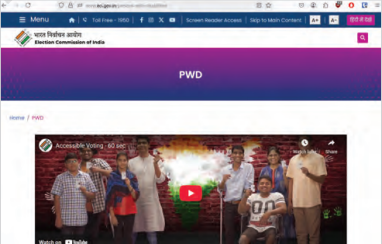
Ans: The Election Commission of India has introduced several facilities to make voting easier for Persons with Disabilities (PwDs).
These include:
(i) Identifying PwD voters at each polling station.
(ii) Providing ground-floor polling stations and separate queues.
(iii) Offering the option of voting from home.
(iv) Providing voter ID cards and voter slips in Braille.
(v) Including Braille features in EVMs.
(vi) Arranging wheelchairs, ramps and free transport to polling stations.
(vii) Providing wheelchairs, ramps, and free pick-and-drop transport.
5. About 34 per cent of eligible voters did not exercise their right to vote in the 2024 elections. Why do you think this is so? (Page 123)
Ans: The 34 per cent of eligible voters who did not vote may have faced voter apathy due to a lack of awareness, disinterest in politics, or the belief that their vote would not make a difference. Additionally, practical difficulties such as long distances to polling stations, health issues, or lack of proper ID may have also prevented them from voting.
6. What are the most important aspects of the election process in this caselet? (Page 125)
Ans: The important aspects include nomination of candidates, campaigning, secret voting, fair counting of votes and declaration of results.
7. Why was it important to have a secret ballot?
Ans: A secret ballot protects voters’ choices and allows them to vote freely without pressure or fear.
8. What considerations might the students have had while exercising their choice?
Ans: Students might have considered the candidates’ ideas, promises, leadership qualities and ability to represent the class.
9. Do you think the students have any responsibility after Gurmat was elected as the class rep? If yes, what are they?
Ans: Yes, students should cooperate with Gurmat, support her work and share their problems and suggestions with her.
10. What was the role that Ms. Usha played? Why was it important?
Ans: Ms. Usha acted as the Election Officer. She explained the rules, arranged voting booths, ensured fair voting and supervised the counting process. Her role was important for conducting a fair and transparent election.
11. Why was it important for Ms. Usha to organise a Braille ballot paper for Neha?
Ans: It allowed Neha, who has visual impairment, to vote independently and participate equally in the election.
12. What would happen if many students in the class chose not to mark a preference?
Ans: Their ballot papers would be treated as invalid and would not count towards any candidate. This would reduce the number of valid votes and affect voter participation.
13. Identify teachers in your school or vicinity who may have performed election duty. Invite them to your class to share their experiences. (Page 128)
Ans: We can invite teachers from our school who have performed election duty. They can share their experiences of helping voters, checking voter lists, managing polling stations and maintaining discipline during elections. This will help us understand how elections are conducted fairly and smoothly.
14.Identify teachers in your school or vicinity who may have performed election duty. Invite them to your class to share their experiences. (Page 128)
Ans: We can invite teachers from our school who have performed election duty. They can share their experiences of helping voters, checking voter lists, managing polling stations and maintaining discipline during elections. This will help us understand how elections are conducted fairly and smoothly.
LET’S EXPLORE (page 131)
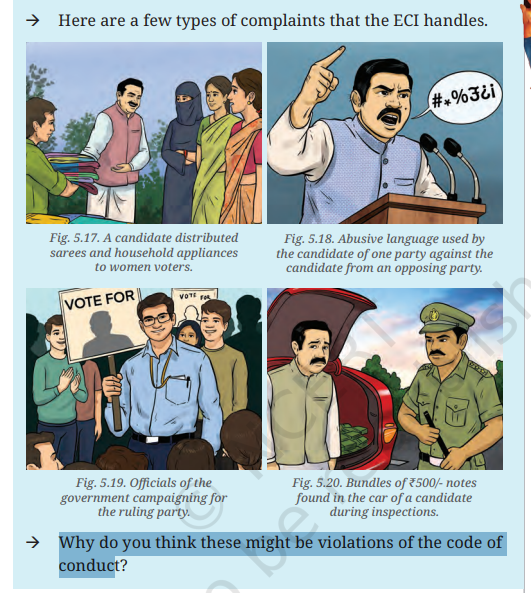
Ans: These may be violations of the Model Code of Conduct because:
(i) Distribution of gifts: Giving sarees and household appliances to voters is an attempt to influence their votes through gifts.
(ii) Abusive language: Using insulting or abusive language against an opposing candidate goes against the principles of fair elections.
(iii) Government campaigning: Government officials campaigning for the ruling party is a misuse of government machinery and resources.
(iv) Distribution of money: Carrying bundles of cash to influence voters through money is an unfair electoral practice.
15. When is the next election in the region where you are located? Is it to the state, urban local body or panchayat? (Page 132)
Ans: (i) I am located in Dwarka, Delhi.
(ii) The next expected election in my region is the Municipal Corporation of Delhi (MCD) election, likely to be held between December 2027 and January 2028.
(iii) It is an Urban Local Body Election, not a State Assembly or Panchayat election.
16. Who are the MP and MLA / MLAs of the constituency you are located in? (A Lok Sabha constituency may have two or more assembly constituencies.) (Page 134)
Ans: (i) MP (Member of Parliament): Bijuli Kalita Medhi, representing the Guwahati Lok Sabha Constituency. She belongs to the Bharatiya Janata Party (BJP).
(ii) MLA (Member of Legislative Assembly): Pradyut Bordoloi, representing the Dispur Assembly Constituency. He belongs to the Bharatiya Janata Party (BJP).
17. Which party does each of them belong to?
Ans: Both the MP, Bijuli Kalita Medhi, and the MLA, Pradyut Bordoloi, belong to the Bharatiya Janata Party (BJP).
18. What are the concerns of the MP and MLA, respectively?
Ans: (i) MP: The main concerns of the MP are flood control, better roads, transportation, employment opportunities and overall development of the Guwahati region.
(ii) MLA: The main concerns of the MLA are solving waterlogging problems, improving drainage systems, providing clean drinking water, reducing traffic congestion and developing better infrastructure in Dispur.
Questions and Activities
1. Why is universal adult franchise important for a healthy democracy?
Ans: Universal adult franchise gives every adult citizen the right to vote without discrimination. It ensures equality and allows people to choose their leaders.
2. What is the meaning of ‘secret ballot’? Why is this important in a democracy?
Ans: Secret ballot means voting privately without revealing our choice to anyone. It protects voters from pressure, threats and influence.
3. Give examples of direct and indirect elections.
Ans: (i) Direct Election: Lok Sabha and State Legislative Assembly elections.
(ii) Indirect Election: Rajya Sabha and Presidential elections.
4. How is the election of members to the Lok Sabha different from that to the Rajya Sabha?
Ans: Lok Sabha members are directly elected by the people, while Rajya Sabha members are indirectly elected by elected MLAs.
5. What, in your view, are the advantages of the EVM over paper ballots?
Ans: EVMs make voting faster, reduce invalid votes, save paper and help in counting votes quickly.
6. Voter turnout has been declining in some urban areas of India. What could be the reasons for this trend, and what steps can be taken to encourage more people to vote?
Ans: Busy lifestyles, lack of interest and migration may be the reasons. Awareness campaigns, easy voter registration and encouraging people to vote can improve turnout.
7. Why do you think a proportion of seats in the Lok Sabha is reserved for scheduled castes and scheduled tribes? Write a short note.
Ans: Seats are reserved for SCs and STs to give them equal representation in Parliament. It helps protect their rights and allows them to raise their issues.
8. Social media is changing the way we experience elections. But is this strengthening democracy or confusing it? Discuss in pairs: What are the benefits, what are the challenges, and what might the future of elections be in a digital age?
Ans: Social media helps people get election updates and share their opinions. However, fake news and misleading information can confuse voters. In the future, digital platforms may make elections more interactive and informative.
9. Visit the website https://www.indiavotes.com, and choose a parliamentary constituency election from any year and explore its results. Do the same for an assembly election in your state.
Ans: (i) Lok Sabha Election: In the 2024 Lok Sabha election, Bijuli Kalita Medhi of BJP won the Guwahati constituency.
(ii) Assam Assembly Election: In the 2021 Assam Assembly election, Atul Bora of AGP won the Bokakhat constituency.
Subject Ka Complete Video Solution Dekhein
Step-by-step easy concept explanation aur full questions Answer ke liye watch karein ya app download karein:


 Buy Now