
SEBA Class 9 Maths Chapter 6 Lines and Angles Solutions English Medium As Per New Syllabus. to each chapter is provided in the list so that you can easily browse through different chapters SEBA Class 9 Maths Chapter 6 Lines and Angles Notes and select need one. SEBA Class 9 Maths Chapter 6 Lines and Angles Question Answers Download PDF. SEBA Class 9 General Maths Solutions.
SEBA Class 9 Maths Chapter 6 Lines and Angles
Also, you can read the SCERT book online in these sections Solutions by Expert Teachers as per State Council of Educational Research and Training (SCERT) Book guidelines. SEBA Class 9 Maths Chapter 6 Lines and Angles are part of All Subject Solutions. Here we have given SEBA Solutions For Class 9 Maths for All Chapters, You can practice these here.
Lines and Angles
Chapter: 6
| Exercise 6.1 |
Q.1. In figure, lines AB and CD intersect at 0. If ∠ AOC+ ∠ BOE = 70⁰and ∠ BOD = 40⁰ , find ∠ BOE and reflex ∠COE.
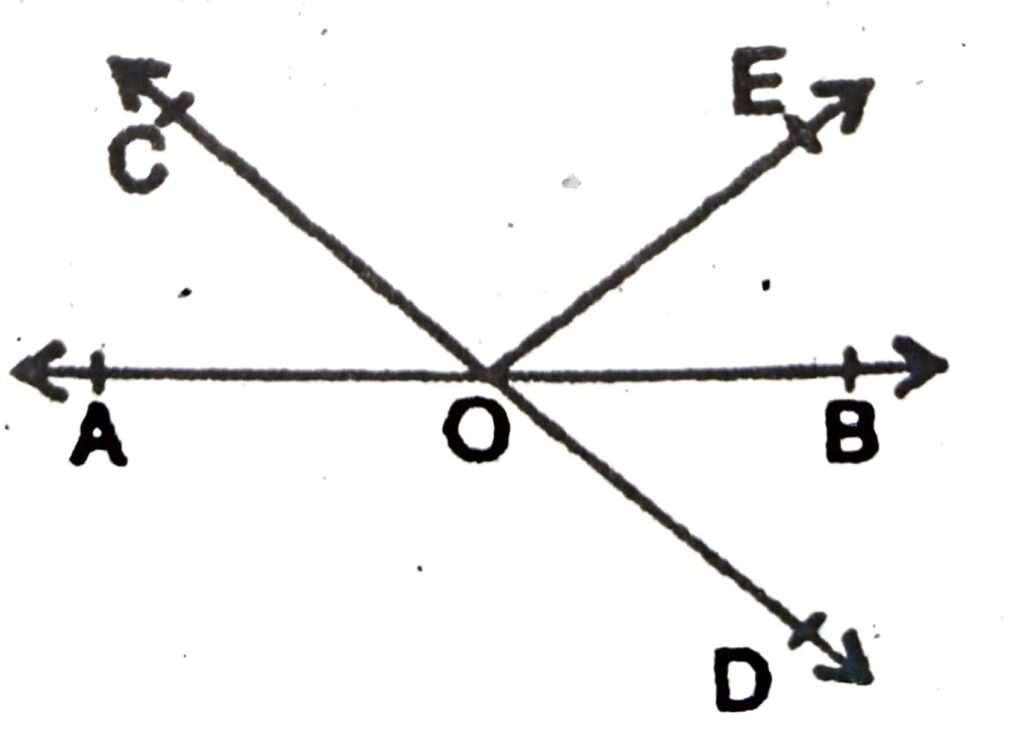
Ans: ∴ Lines AB and CD intersect at O
∴ ∠ AOC + ∠ BOD
| Vertically Opposite Angles
But ∠ BOD = 40⁰ , …. (1) | Given
∠ AOC = 40⁰ …(2)
Now, ∠ AOC + ∠BOE = 70⁰
⇒ 40⁰ + ∠ BOE = 70⁰ | Using (2)
⇒ ∠ BOE = 70⁰ – 40⁰
⇒ ∠ BOE = 30⁰
Again, Reflex ∠COE =∠COD + ∠ BOD + ∠BOE
= ∠ COD + 40⁰ + 30⁰
| Using (1) and (2)
= 180⁰ + 40⁰ + 30⁰
∴ Ray OA stands on line CD
= 250⁰ (Linear Pair Axiom)
Q.2. In figure, lines XT and MN intersect at 0. If⇒∠POY=90⁰
and a:b = 2:3, find c.
Ans: Ray OP stands on line XY
∴ ∠POX + ∠POY = 180⁰ | Linear Pair Axioms
⇒ ∠POX +90⁰ = 180⁰ |∵∠POY=90⁰(Given)
⇒ ∠POX = 180⁰-90⁰
⇒ ∠POX = 90⁰
⇒ ∠POM + ∠XOM = 90⁰
⇒ a+b=90 ….(1)
A:b = 2:3

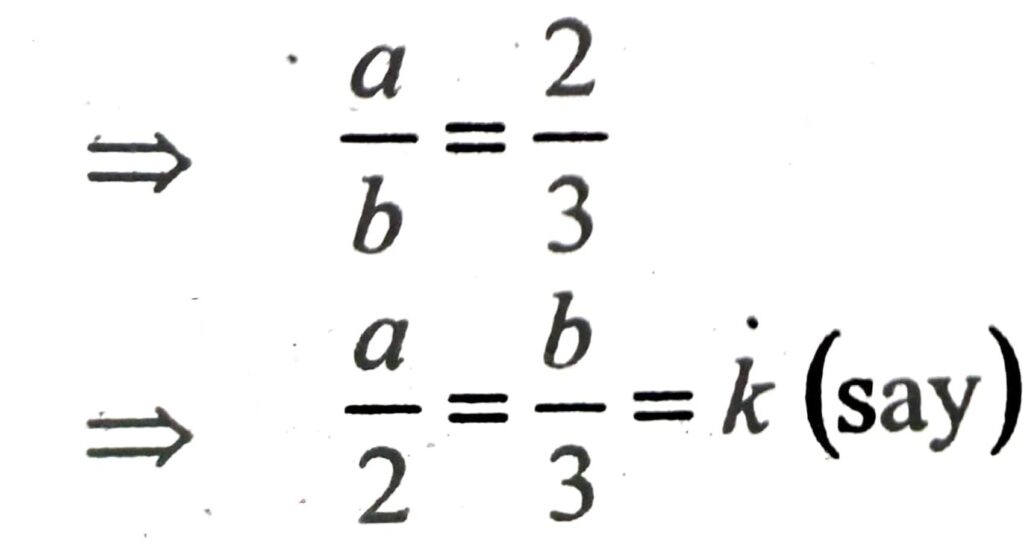
⇒ a = 2k
B = 3k
Putting the values of a and b in (1), we get
2k + 3k = 90⁰
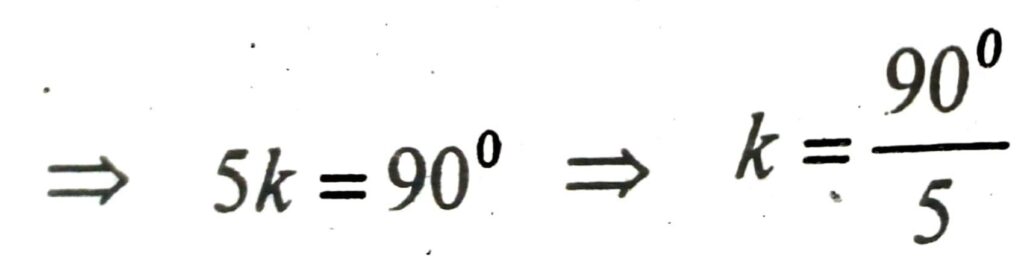
⇒ k=18⁰
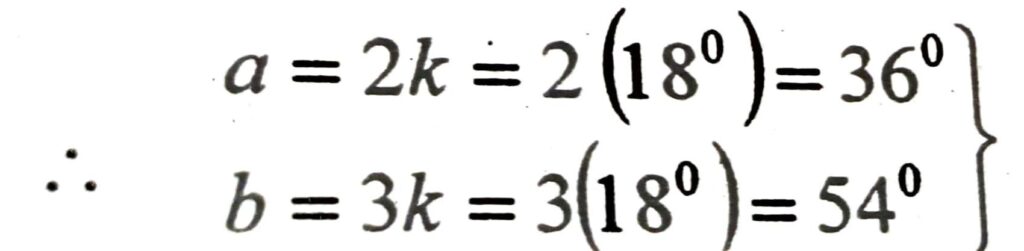
…(2)
∴ Ray OX stands on line MN
∴ ∠XOM + ∠ XON = 180⁰ | Linear Pair Axioms
⇒b+c=180⁰ ⇒54⁰ +c=180⁰ | Using (2)
⇒c = 180⁰-54⁰⇒c = 126⁰
Q.3. In figure,∠PQR=∠PRQ then prove that ∠PQS = ∠PRT.
Ans: Ray QP stands on line ST
∴ ∠ PQS+ ∠ PQR = 180⁰ …(1)| Linear Pair Axiom

∴ Ray RP stands on line ST
∴ ∠ PRQ + ∠ PRT = 180⁰
…(2) Linear Pair Axiom
From (1) and (2), we obtain
∠ PQS + ∠ PQR=∠PRQ+ ∠ PRT
⇒ ∠ PQS = ∠PRT
|∵ ∠ PQR = ∠ PRQ(Given)
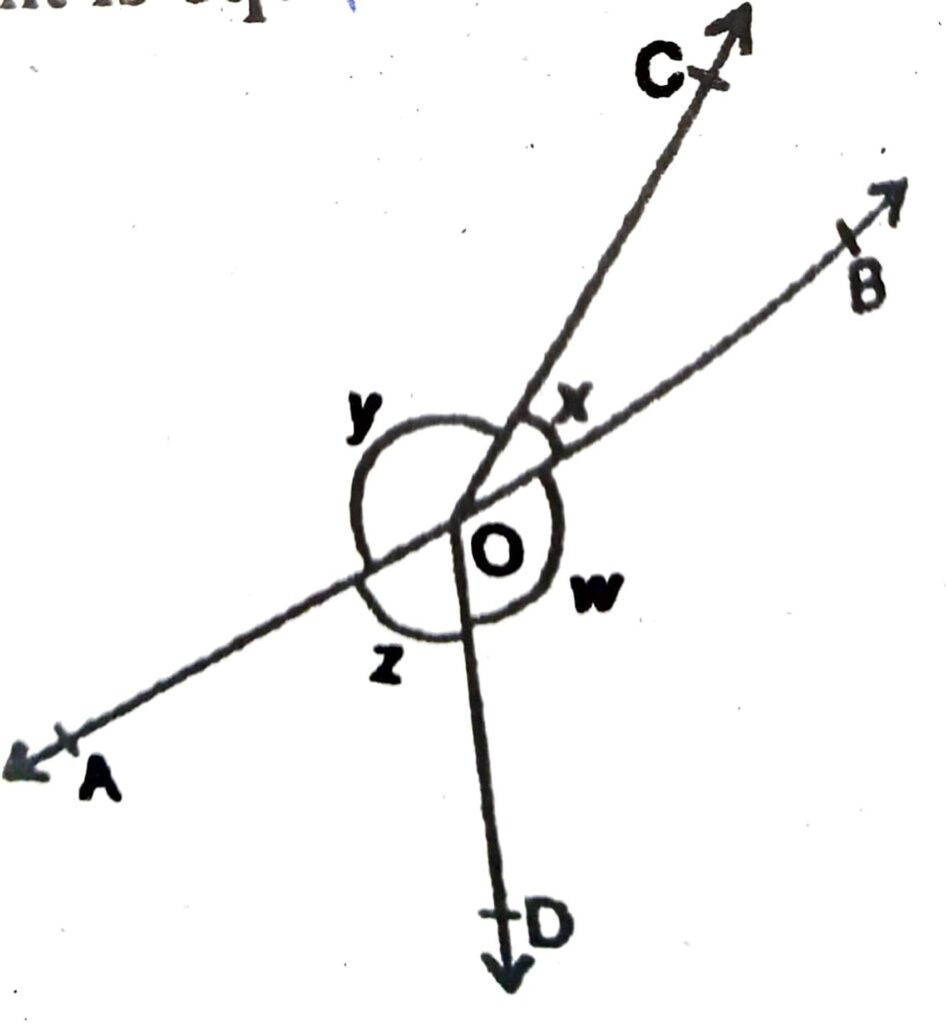
Q.4. In figure, if x + y = w + z then prove that AOB is a line.
Ans: x + y = w + z …(1)| Given
∴ The sum of all the angles around a point is equal to 360⁰
∴ x + y + w + z = 360⁰
⇒ x + y + x + y = 360⁰ | Using (1)
⇒ 2(x + y) = 360⁰
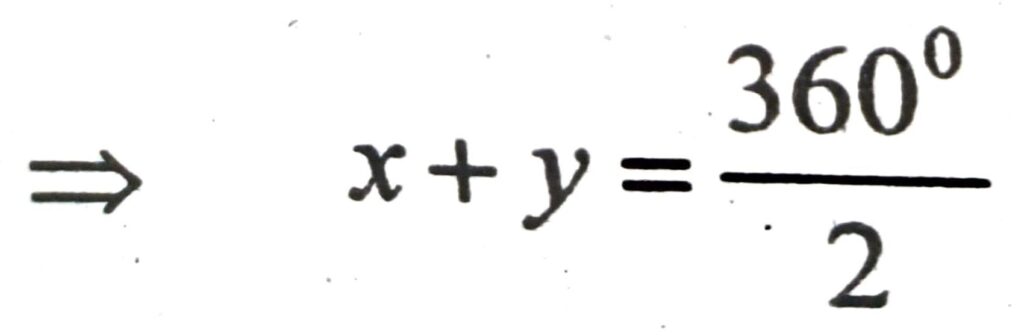
⇒ x + y = 180⁰
∴ AOB is a line If the sum of two adjacent angles is 180⁰, then the non-common arms of the angles form a line
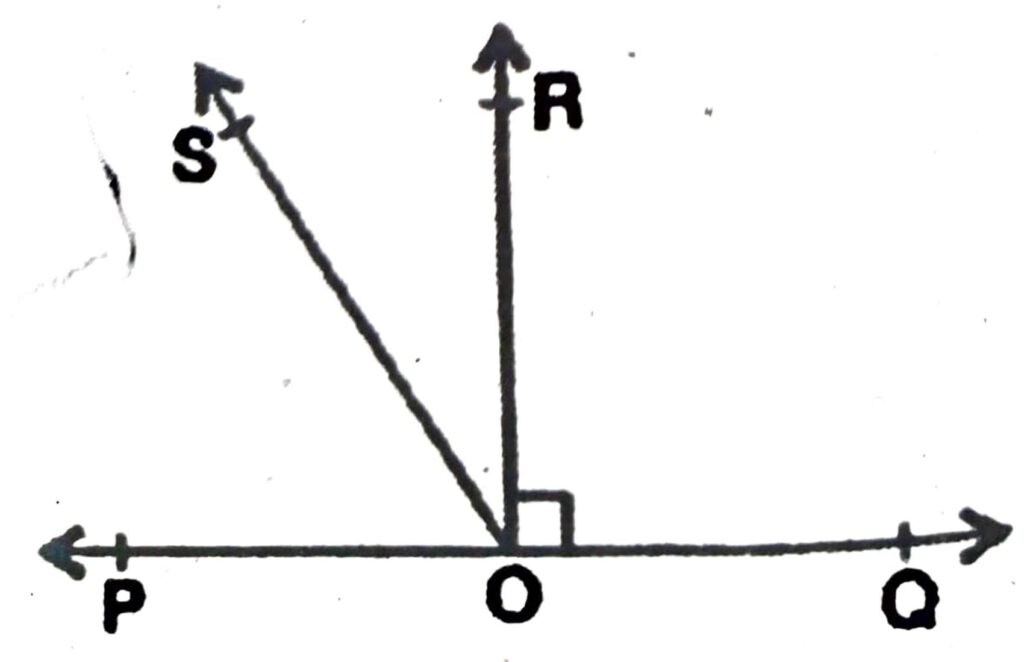
Q.5. In figure, POQ is a line. Ray OR is perpendicular to line PQ.
OS is another ray lying between rays OP and OR. Prove that

Ans: Ray OR is perpendicular to the line PQ
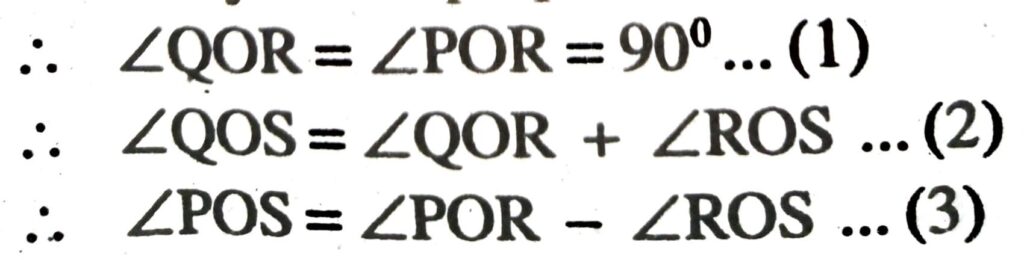
From (2) and (3),
∴ ∠ QOS – ∠ POS =(∠QOR- ∠POR) +2 ∠ROS=2∠ROS
| Using (1)

Q.6. It is given that ∠ XYZ = 64⁰ and XY is produced to point P. Draw a figure from the given information. If ray YQ bisects ∠ ZYP find ∠ XYQ and reflex ∠ QYP
Ans: Ray YZ stands on line PX
∴ ∠ XYZ+ ∠ ZYP = 180⁰ l Linear Pair Axiom
⇒ 64^ 0 + ∠ ZYP = 180⁰
| ∵ ∠ XYZ = 64⁰ Given)

⇒ ∠ ZYP = 180⁰- 64⁰
⇒∠ZYP = 116⁰ …(1)
∵ Ray YQ bisects ∠ ZYP

=58⁰ …(2)
∴ Reflex ∠ QYP = 360⁰ – 58⁰=302⁰
∵ The sum of all the angles round a point is equal to 360⁰
Again, ∠ XYQ = ∠ XYZ+ ∠ ZYQ
= 64⁰ + 58⁰

= 122⁰
7. Two Statements are given below-
Statement -1: If the sum of two adjacent angles is 180°, then the non common arms of the angles form a straight line.
Statement-2: If a ray stands on a straight line, then the sum of two adjacent angles so formed is 180°.
Choose the correct option.
(a) Both statement-1 and statement -2 are true
(b) Both statement-1 and statement -2 are false
(c) Statement-1 is true but statement -2 is false
(d) Statement-1 is false but statement -2 is true
Ans: Statement 1:
If the sum of two adjacent angles is 180°, then the non-common arms of the angles form a straight line, which is a property of linear pairs of angles.
Statement 1 is true.
Statement 2:
If a ray stands on a straight line, then the sum of two adjacent angles so formed is 180°
Which is definition of linear pair of angles.
Statement 2 is true.
∴ Option (a) is correct
8. When two straight lines intersect.
(i) Adjacent angles are complementary
(ii) Adjacent angles are supplementary
(iii) Vertically opposite angles are equal
(iv) Vertically opposite angles are supplementary.
Choose the correct option.
(a) (i) and (iii) are correct
(b) (ii) and (iv) are correct
(c) (ii) and (iii) are correct
(d) (iii) and (iv) are correct
Ans: When two straight lines intersect
(i) Adjacent Angles are complementary-False.
(ii) Adjacent angles are supplementary -True
(ii) Vertically opposite angles are equal – True
(iii) Vertically opposite angles are supplementary – False
∴ Correct statements are (ii) and (iii)
The correct option is (c)
9. The following question contain an Assertion (A) and a Reason (R) along with following four choices (a), (b), (c) and (d), only one of which is the correct. Mark the correct choice.
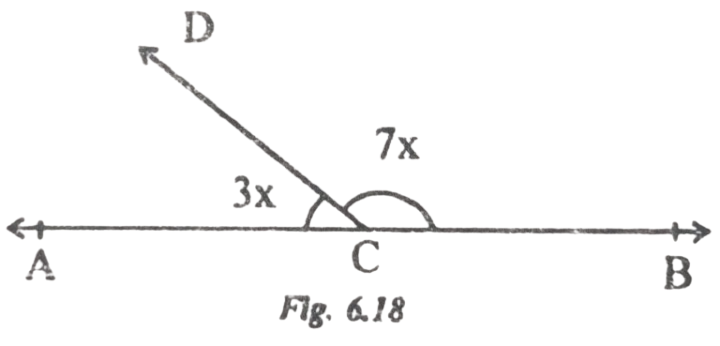
Assertion (A): In Fig. 6.18 given below, if ACB is a straight line then ∠BCD = 126°.
Reason (R): If a ray stands on a line, the sum of two adjacent angles so formed is 180.
(a) Both Assertion (A) and Reason (R) are true and Reason (R) is a correct explanation of Assertion (A)
(b) Both Assertion (A) and Reason (R) are true but Reason (R) is not the correct explanation of Assertion (A).
(c) Assertion (A) is true but Reason (R) is false.
(d) Assertion (A) is false but Reason (R) is true.
Ans: Assertion (A): As ∠ACD = 3x, ∠ BCD = 7x and ACB is a staight line
∴∠ACB= 180°
⇒ ∠ACD + BCD = 180° 3x+7x = 180° ⇒10x=180° ⇒ x = 18° BCD=7×18° = 126° Hence, Assertion is True.
Reason (R):
If a ray stands on a line, the sum of two adjacent angles so formed is 180°. Which is also True.
Reason (R) is the correct explanation of Assertion (A).
The correct option is (a)
10. The three statements are given below.
(i) If two straight lines intersect, then the vertically opposite angles are equal.
(ii) A line has only one end point.
(iii) If the two adjacent angles are complementary and equal then each angle is 45°
Choose the correct option.
(a) (i) and (ii) are true
(b) (i) and (iii) are true
(c) (i), (ii) and (iii) are true
(d) (ii) and (iii) are true
Ans: (i) If two straight lines intersect, then the vertically opposite angles are equal-True
(ii) A ray has only one end point and a line has no end points – False
[A line has no end point]
(iii) If two adjacent angles are complementary and equal then each angle 45° – True
Statement (iii) is true.
Hence, the correct option is (b)

 Buy Now