
SEBA Class 9 Maths Chapter 4 Linear Equations in Two Variables Solutions English Medium As Per New Syllabus. to each chapter is provided in the list so that you can easily browse through different chapters SEBA Class 9 Maths Chapter 4 Linear Equations in Two Variables Notes and select need one. SEBA Class 9 Maths Chapter 4 Linear Equations in Two Variables Question Answers Download PDF. SEBA Class 9 General Maths Solutions.
SEBA Class 9 Maths Chapter 4 Linear Equations in Two Variables
Also, you can read the SCERT book online in these sections Solutions by Expert Teachers as per State Council of Educational Research and Training (SCERT) Book guidelines. SEBA Class 9 Maths Chapter 4 Linear Equations in Two Variables are part of All Subject Solutions. Here we have given SEBA Solutions For Class 9 Maths for All Chapters, You can practice these here.
Linear Equations in Two Variables
Chapter: 4
| Exercise 4.1 |
Q.1. The cost of a notebook is twice the cost of a pen. Write a linear equation in two variables to represent this statement. (Take the cost of a notebook to be Rs x and that of a pen to be Rs y)
Ans: Let the cost of a notebook is Rs. x and cost of a pen is Rs. y.
Therefore a linear equation in two variables (x and y) representing the given statement is x = 2y.
Q.2. Express the following linear equations in the form a x + by + c = 0 and indicate the values of a, b and c in each case.

Ans:

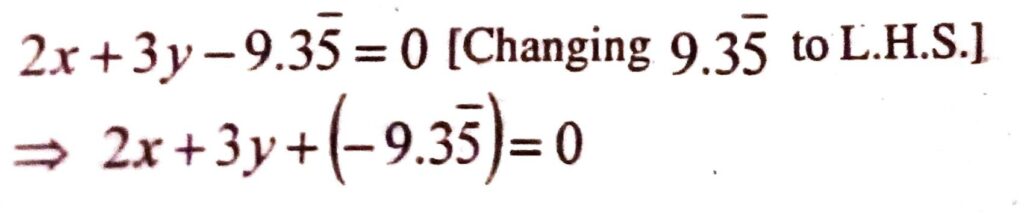
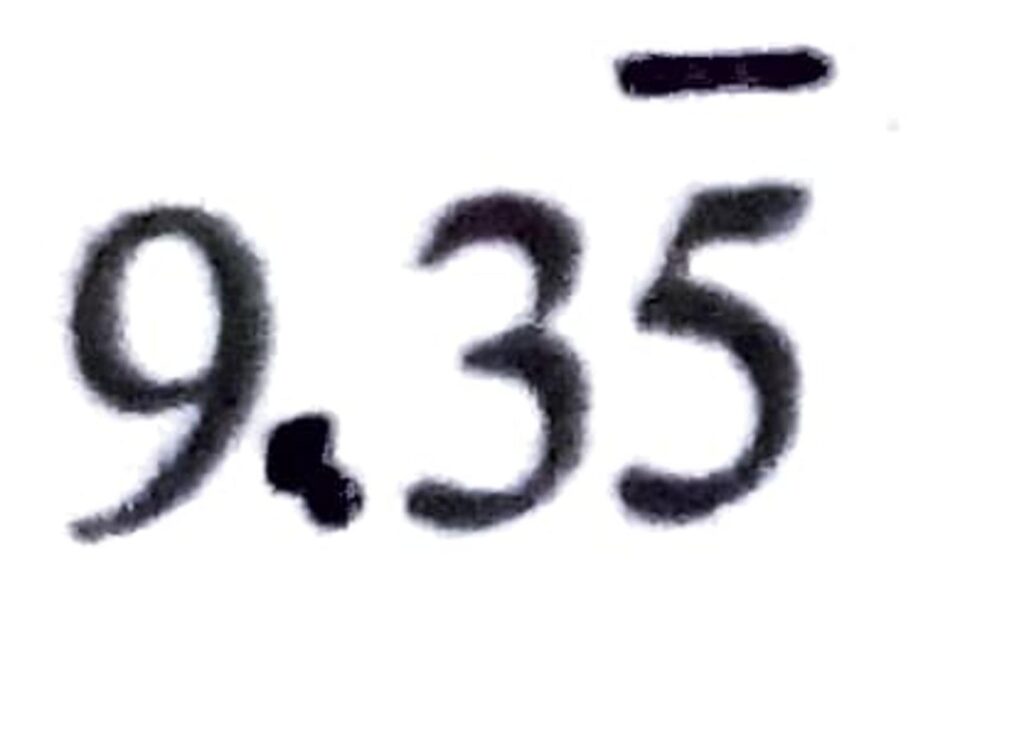
On comparing the coefficients of x and y and also constant terms we observe that
a=2,b=3 and c = –
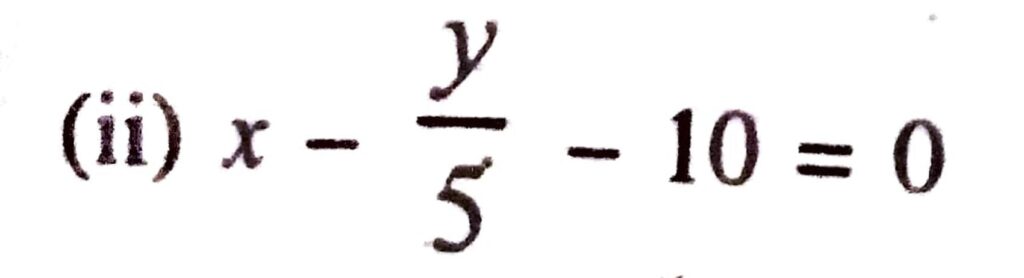
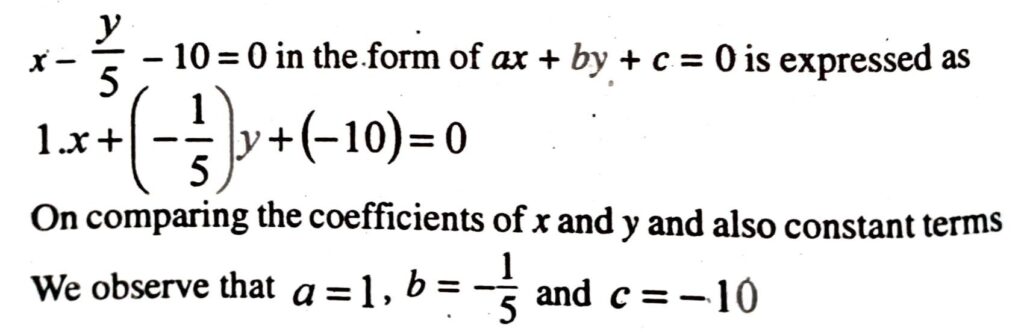
Ans:
(iii) -2x+3y= 6
Ans: -2x+3y =6 in the form of
ax + by +c=0 is written as
-2x+3y-6=0 [Changing 6 to L.H.S.]
⇒ -2x+3y+(-6)=0
On comparing the coefficients of x and y and also constant terms we observe that
a=-2, b=3 and c=0
(iv) x = 3y
Ans: x=3y in the form of ax + by + c= 0 is written as
x-3y = 0 ⇒1.x+(-3)y-+0=0
On comparing the coefficients of x and y and also constant terms
we observe that a=1,b=-3 and c=0
(v) 2x = -5y
Ans: 2x=-5y in the form of ax + by + c= 0 is written
as 2x+5y =0 [Changing -5y to L.H.S.]
⇒ 2x+5y+0=0
On comparing the coefficients of x and y and also constant terms
we observe that a =2, b=5 and c= 0
(vi) 3x + 2 = 0
Ans: 3x + 2 = 0 in the form of ax + by + c = 0 is written as
3x+0.y +2 = 0
On comparing the coefficients of x and y and also constant terms
we observe that a =3, b=0 and c= 0
(vii) y – 2 = 0
Ans: y -2 = 0 in the form of ax + by + c = 0 is written as
0.x+1.y+(-2)=0
On comparing the coefficients of x and y and also constant terms
we observe that a =0, b=1 and c= -2
(viii) 5 = 2x
Ans: 5= 2x in the form of ax + by + c = 0 is written as 5-2.x=0
⇒ -2x+0.y+5=0
On comparing the coefficients of x and y and also constant terms
we observe that a =2, b = 0 and c=5
3. A linear equation in two variables x and y is of the form ax+by+c=0, where
(a) a =0,b =0
(b) a = 0,b = 0
(c) a = 0,b = 0
(d) a = 0,c = 0
Ans: . (a) a = 0,b = 0
Explanation :
If a ≠ 0,b ≠ 0, then the equation will be in the form of by+c=0 (which is form of one variable)
If a ≠ 0,b ≠ 0, then it will be in the form of ax+c=0 (which is form of one variable)
| Exercise 4.2 |
Q.1. Which one of the following statements is true and why?
y = 3x + 5 has
(i) a unique solution.
Ans: We are given the equation y=3x+5 Put x = 0, then y=5
Therefore, (0,5) is the solution of this equation. Again, put x=1 then y =8
(ii) Only two solutions.
Ans: Therefore, (1, 8) is also the solution
of this equation. Again, put x = 2
then y=11.
(iii) Infinitely many solutions.
Ans: Therefore, (2, 11) is also the solution of this equation. Again x=3, y=8 and so on.
Now, it is clear that this equation has infinitely many solutions.
Remember. [A linear equation in two variable has infinitely many solution.]
Q.2. Write four solutions for each of the following equations:
(i) 2x + y = 7
Ans: (i) We have 2x + y = 7 put x = 0, then y = 7
Therefore, (0, 7) is the solution of this equation.
Again put x = 1, then x = 5
Therefore (1, 5) is also the solution of this equation. Again put x= 2,
then y = 3.
Therefore (2, 3) is also the solution of this equation. Again put x = 3
then y = 1
Therefore (3, 1) is also the solution of this equation.
Therefore, (0,7), (1,5), (2, 3) and (3, 1) are
the four solutions of the equation 2x + y = 7
(ii) лx + y = 9
Ans: We have given πx+=9 or,
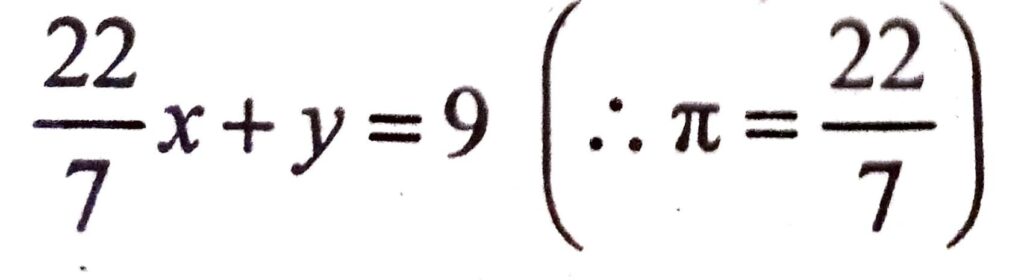

Therefore (0,9) is the solution of this equation.
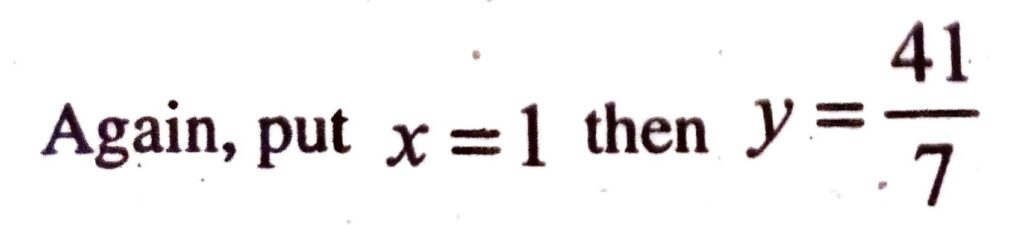

Again put x = 7 they y = – 13
Therefore (7,-13) is also the solution of this equation.
Again put x = 14, then y = – 35
Therefore (14,-35) is also the solution of this equation.

of equation πx+y=9
(iii) x+4y
Ans: We are given that x = 4y put y=0 then x=0
Therefore, (0, 0) is the solution of this equation.
Again y =1, then x=4.
Therefore (4, 1) is also part of this equation.
Again, put y = 2 then x= 8
Therefore, (8, 2) is also the solution of this equation.
Again put y = 3, x = 12
Therefore, (12, 3) is also the solution of this equation.
Hence, (0, 0), (4, 1), (8, 2) and (12, 3) are the four solutions of equation
x=4y
Q.3. Check which of the following are solutions of the equation
x-2y=4 and which are not.
(i) (0, 2)
Ans: We are given that x-2y=4
put x=0 and y = 2
then, 0-2×2=4,⇒-4=4
Here, L.H.S.≠R.H.S
Therefore, (0, 2) is not the solution of equation x-2y=4
(ii) (2, 0)
Ans: Put x=2 and y = 0
Then, 2-2×0=4⇒2=4
Here, L.H.S.≠R.H.S.
Therefore (2, 0) is not the solution of equation x-2y=4
(iii) (4,0)
Ans: Put x=2 and y = 0
Then 4-2×0=4⇒4=4
Here, L.H.S.=R.H.S.
Therefore, (4, 0) is the solution of equation x-2y=4
(iv) (√2, 4√2)
Ans: Put x=√2 and y = 4√2 in equation x-2y=4
Then √2-2×4√2=4 ⇒√2-8√2=4⇒7√2=4
Here, L.H.S.≠R.H.S.
Therefore, (√2, 4√2) is not the solution of equation x-2y=4
(v) (1, 1)
Ans: Put x=1 and y = 1 in equation x-2y=4
Then 1-2×1=4⇒1-2=4
L.H.S.≠R.H.S
Therefore, (1, 1) is not the solution of equation x – 2y = 4
2x + 2y = k.
Ans: We are given that x=2 and y = 1 is the solution of the equation
2x+3y=k
Put x=2 and y = 1 in equation 2x + 3y=k
2×2+3×1=k
4+3=k∴k=7
Hence, the value of k in equation 2x + 3y = k is 7
4. Find the value of k, if x = 2, y = 1 is a solution of the equation 2x + 3y = k.
Ans: Putting x = 2 and y = 1 in equation 2x + 3y = k, we get
2.2 + 3.1 = k
⇒ 4 + 3 = k
⇒ 7 = k
Hence, the required value of k is 7.
5. If x = 3k + 2 and y = 2k − 1 is a solution of the equation 4x − 3y + 1 = 0. Find
the value of k.
Ans: Here, x = 3k + 2, y = 2k − 1
Now, 4x − 3y + 1 = 0
⇒ 4 (3k + 2) − 3 (2k − 1) + 1 = 0
⇒ 12 k + 8 − 6k + 3 + 1 = 0
⇒ 6 k + 12 = 0
⇒ 6k = − 12
⇒ k = − 2
∴ The value of k is − 2
6. For what value of k, x = 2k − 1 and y = k is a solution of the equation 3x − 5y − 7 = 0?
Ans: Now, 3x − 5y − 7 = 0
using the values of x and y we get
3 (2k − 1) − 5k − 7 = 0
⇒ 6k − 3 − 5k − 7 = 0
⇒ k − 10 = 0
⇒ k = 10
∴ The value of k is 10
Choose the correct option (Q. No. 7 to 9)
7. Each of the points (− 2, 2), (0, 0), (3, −3) satisfies the linear equation
(a) x − y = 0
(b) x + y = 0
(c) − x + 2y = 0
(d) x − 3y = 0
Ans. Correct option (b)
Reason :
When (− 2, 2), x + y = − 2 + 2 = 0
When (0, 0), x + y = 0 + 0 = 0
When (3, − 3), x + y = 3 + (− 3) = 0
8. Statement P : If (2, 0) is a solution of the linear equation 2x + 3y = k then the value of k is 4.
Statement Q : If (3, 4) is a solution of the linear equation 3y = ax + 7 then the value of a is 1/2.
(a) Both the statements P and Q are true
(b) Both the statements P and Q are false
(c) Statements P is true but Q is false
(d) Statements P is false but Q is true
Ans. Statement P :
2x + 3y = K
Replacing x by 2 and y by 0 we get,
2 × 2 + 3 × 0 = K
⇒ K = 4
Which is True.
Statement Q :
Here,
3y = ax + 74. Find the value of k, if x = 2, y = 1 is a
solution of the equation 2x + 3y = k.
Sol. Putting x = 2 and y = 1 in equation 2x + 3y= k, we get
2.2 + 3.1 = k
⇒ 4 + 3 = k
⇒ 7 = k
Hence, the required value of k is 7.
Replacing x by 3 and y by 4 we get 3 * 4 = a * 3 + 7 Statement Q is False Option (c) is correct Rightarrow 12 – 7 = 3a Rightarrow 5 = 3a a = 5/3
9. Consider the linear equation 2x – 3y = 12
(i) It has infinite number of solutions.
(ii) (5, 7) is one a solution of the equation.
(iii) (6,0) is not a solution of the equation.
(iv) (9, 2) is one of the solutions.
Choose the correct option:
(a) (i) and (iv)
(b) (ii) and (iv)
(c) (iii) and (iv)
(d) (i) and (iii)
Ans: Option (a) correct
Reason:
2x – 3y = 12 is a linear equation
Hence, it has infinite number of solutions.
option (i) is true.
When (9, 2), Replace x by 9 and y by 2 in the equation of L.H.S.
= 2 * 9 – 3 * 2
= 18 – 6
= 12 =R.H.S
∴ option (iv) is true
Subject Ka Complete Video Solution Dekhein
Step-by-step easy concept explanation aur full questions Answer ke liye watch karein ya app download karein:


 Buy Now