
SEBA Class 9 Maths Chapter 3 Coordinate Geometry Solutions English Medium As Per New Syllabus. to each chapter is provided in the list so that you can easily browse through different chapters SEBA Class 9 Maths Chapter 3 Coordinate Geometry Notes and select need one. SEBA Class 9 Maths Chapter 3 Coordinate Geometry Question Answers Download PDF. SEBA Class 9 General Maths Solutions.
SEBA Class 9 Maths Chapter 3 Coordinate Geometry
Also, you can read the SCERT book online in these sections Solutions by Expert Teachers as per State Council of Educational Research and Training (SCERT) Book guidelines. SEBA Class 9 Maths Chapter 3 Coordinate Geometry are part of All Subject Solutions. Here we have given SEBA Solutions For Class 9 Maths for All Chapters, You can practice these here.
Coordinate Geometry
Chapter: 3
| Exercise 3.1 |
Q.1. How will you describe the position of a table lamp on your study table to another person?
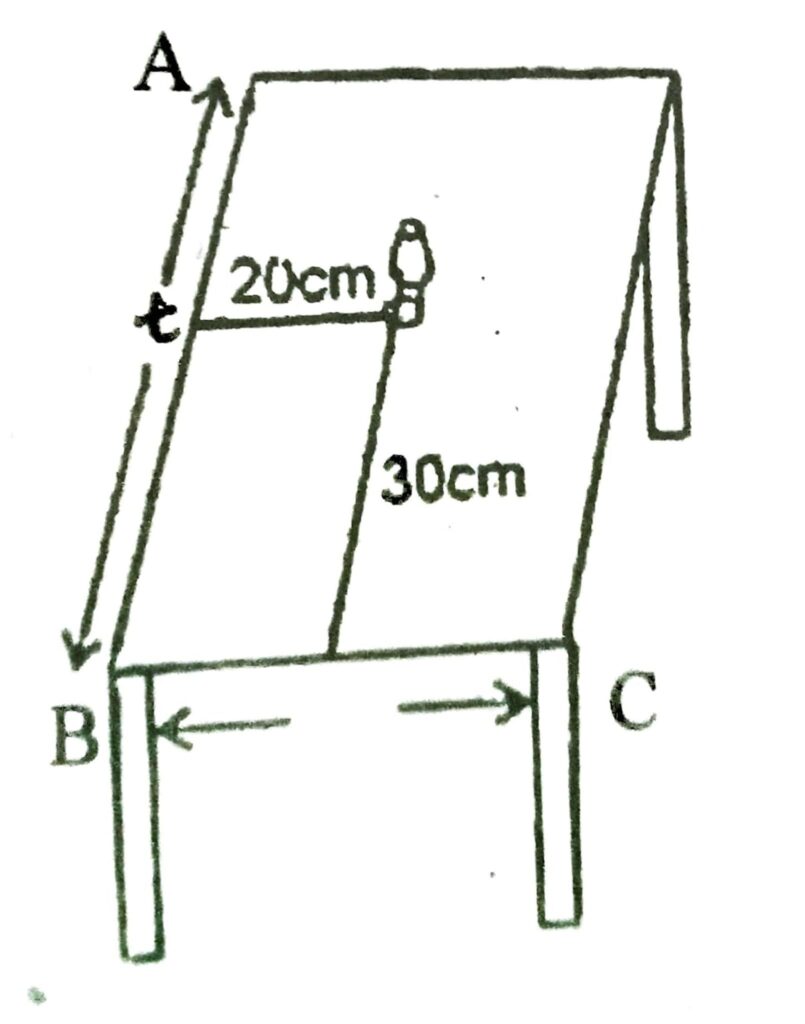
Ans: Consider the lamp placed on the table. Take the space taken by the lamp as a point and draw perpendiculars on length AB and breadth BC of the table. Now measure the distance. Let the length of perpendicular be 20 cm and 30 cm from length AB and breadth BC respectively. So, the position of the lamp from (AB, BC) edges will be (20, 30).
Q.2. (Street Plan): A city has two main roads meeting at the centre of the city. These two roads are along the North-South direction and East-West direction. All other streets of the city run parallel to main roads and are 200 m apart. There are about 5 streets in each direction. Using 1 cm=200 m, draw the model of the city on your notebook. Represent roads/streets by single lines.
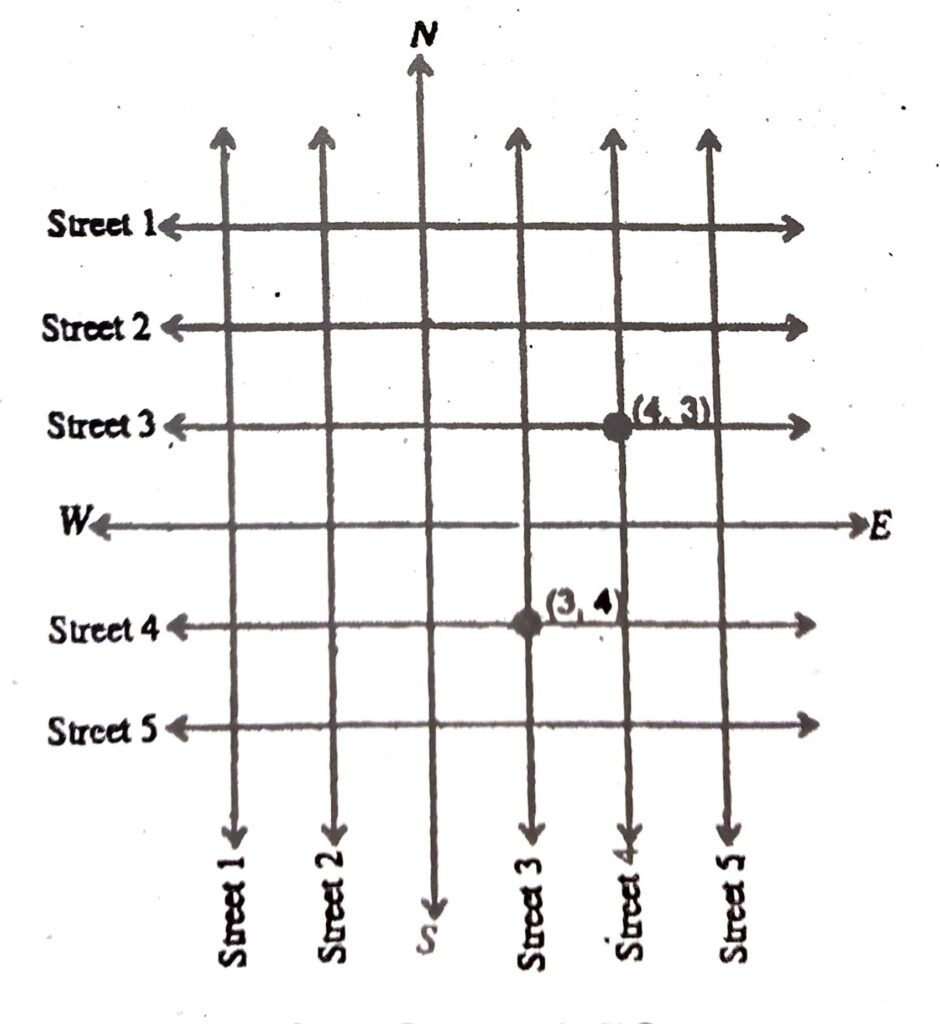
There are many cross streets in our modal. A particular cross-street is made by two streets, one running in the North- South direction and an- other in the East-West di- rection. Each cross street is referred of in the fol- lowing manner. If the 2nd street running in the North-South direction and 5th in the East-West direction meet at some crossing then we will call this cross-street (2, 5). Us- ing this convention, find
(i) How many cross-streets can be referred to as (4,3)?
(ii) How many cross-streets can be referred to as (3, 4)?
Ans: According to the question street plan drawn as both the cross streets are marked in the above figure. They are only one found because of the two reference lines we have used for locating them.
| Exercise 3.2 |
Q.1. Write the answer of each of the following questions:
(i) What is the name of horizontal and the vertical lines drawn to determine the position of any point in the cartesian plane?
Ans: The name of horizontal lines drawn to determine the position of any point in the cartesian plane is x-axis.
The name of the vertical line is y-axis.
(ii) What is the name of each part of the plane formed by these two lines?
Ans: The name of each part of the plane formed by x-axis and y-axis is called quadrants (one fourth part) numbered I, II, III and IV anti clock from OX.
(iii) Write the name of the point where these two lines intersect.
Ans: The name of the point where these two lines intersect is origin.
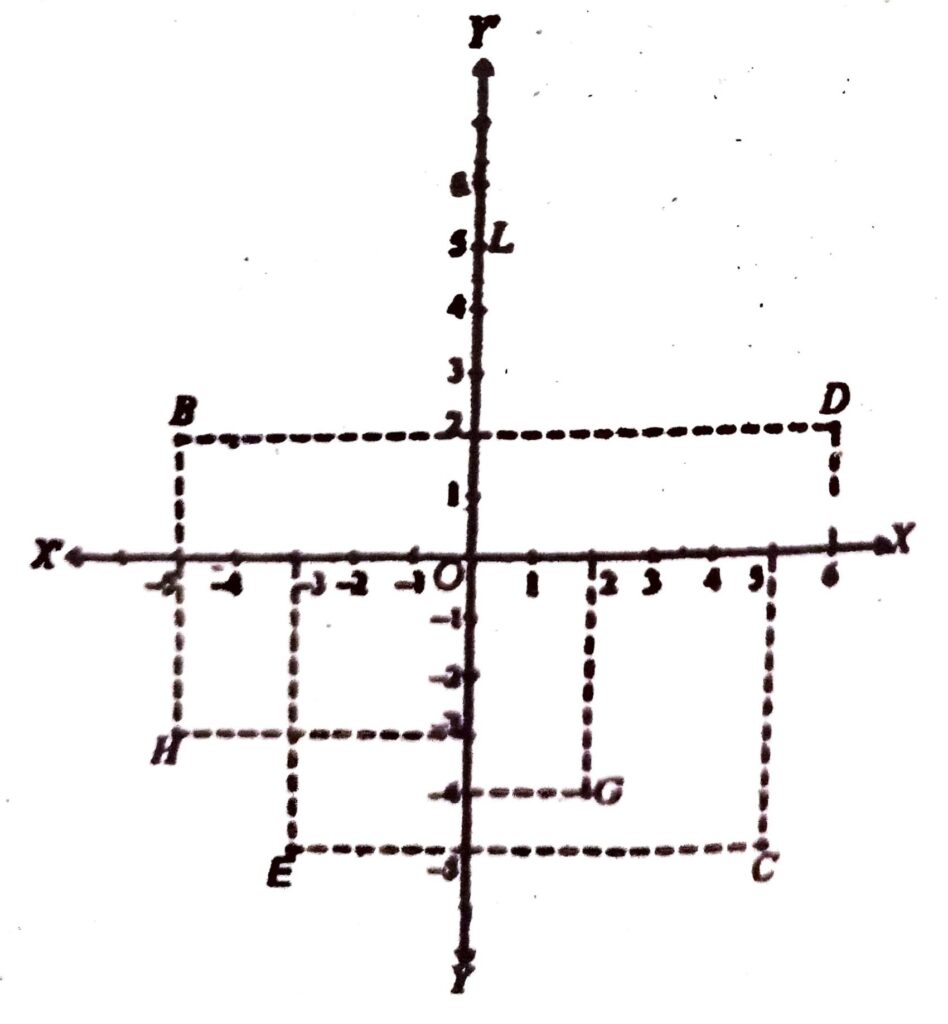
Q.2. See fig and write the following:
Ans: According to.
(i) The coordinates of B.
Ans: The coordinates of B is (-5, 2).
(ii) The coordinates of C.
Ans: The coordinates of C is (5, -5).
(iii) The point identified by the coordinates (-3, -5).
Ans: The point identified by the coordinates (- 3,-5) is E.
(iv) The point identified by the coordinates (2, -4).
Ans: The point identified by the coordinates (2, -4) is G.
(v) The abscissa of the point D.
Ans: The abscissa of point D is 6.
(vi) The ordinate of the point H.
Ans: The ordinates of the point H is -3.
(vii) The coordinates of the point L.
Ans: The coordinate of the point L is (0, 5)
(viii) The coordinates of the point M.
Ans: The coordinate of the point M is (-3, 0)
3. The point (- a, b) where a > 0 b > 0 lies, in
(a) Ist Quadrant
(b) IInd Quadrant
(c) IIIrd Quadrant
(d) IVth Quadrant
Ans. (b) IInd Quadrant
For example,
a = 5 > 0 b = 6 > 0 ..(-5, 6) which lies in the (ii) quadrant
Hence, (- a, b) lies in (ii) nd quadrant
4. The point (-3, 0) lies
(i) On the x-axis
(ii) In the 2nd quadrant
(iii) On the y-axis
(iv) At a distance 3 unit from origin
(a) Both (i) and (iv) are correct
(b) Both (i) and (ii) are correct
(c) Both (iii) and (iv) are correct
(d) Both (ii) and (iii) are correct
Ans. (a) Both (i) and (iv) are correct
Here, (-3, 0) lies on x – axis. The distance
from (0,0) to (-3, 0) is 3 units
5. Consider the following two statements and then choose the correct option from the given alternatives.
(i) The co-ordinates of a point symmetric to (9, 5) about the y-axis are (-9, 5).
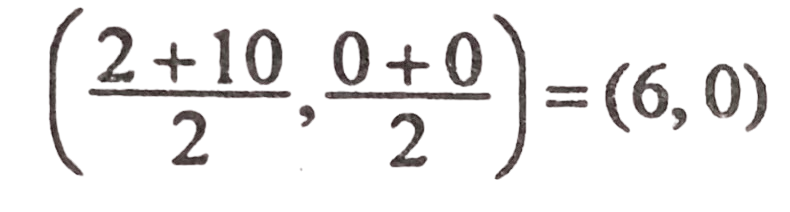
(ii) The mid point of (2, 0) and (10, 0) is (6, 0).
(a) Both (i) and (ii) are true
(b) Both (i) and (ii) are false
(c) Only (i) is true
(d) Only (ii) is true
Ans. (a) Both (i) and (ii) are true
For a point (a, b), its reflection about the y-axis is (-a, b),
Hence, the reflection of (9, 5)
about the y-axis are (-9, 5)
∴ (i) is true
Midpoint of coordinate (a, b) and (c, d) is
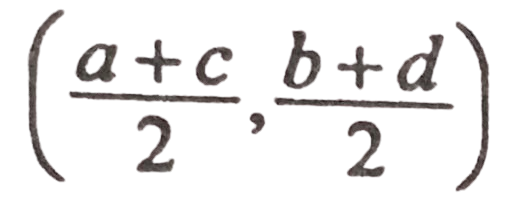
∴ Midpoint of (2, 0) and (10, 0) is
∴ (ii) is true
Hence correct option is (a)

 Buy Now