
SEBA Class 9 Maths Chapter 2 Polynomials Solutions English Medium As Per New Syllabus. to each chapter is provided in the list so that you can easily browse through different chapters SEBA Class 9 Maths Chapter 2 Polynomials Notes and select need one. SEBA Class 9 Maths Chapter 2 Polynomials Question Answers Download PDF. SEBA Class 9 General Maths Solutions.
SEBA Class 9 Maths Chapter 2 Polynomials
Also, you can read the SCERT book online in these sections Solutions by Expert Teachers as per State Council of Educational Research and Training (SCERT) Book guidelines. SEBA Class 9 Maths Chapter 2 Polynomials are part of All Subject Solutions. Here we have given SEBA Solutions For Class 9 Maths for All Chapters, You can practice these here.
Polynomials
Chapter: 2
| Exercise 2.1 |
Q.1. Which of the following expressions are polynomials in one vari-able and which are not? State reasons for your answer.
(i) 4x²-3x+7
Ans: Yes, 4 x²-3 x+7 is a polynomial of one variable. As x has degree 2 in it and only x is one variable.
(ii) y²+√2
Ans: Yes, y is only one variable.
(iii) 3√t+t√2
Ans: No as 3√t+r√2 can be written as 3,t¹/² +√2 Here, the exponent of t in 3 t ¹/² which is not a whole number.
(iv) y+2/y
Ans: No, as y+2/y can be written as y+2 y¹ where the exponent of y in 2/y is -1, which is not a whole number.
(v) x¹⁰+y³+t⁵⁰
Ans: Yes, It is a polynomial in three variables, x, y and t.
Q.2. Write the coefficients of x² in each of the following:
(i) 2 + x² + x
Ans: We have given that the equation 2 + x²+ x We can also write 1x²+ 1x + 2
Therefore, the coefficient of x² in this equation is 1.
(ii) 2 – x² + x³
Ans: We have given that the equation: 2 – x² + x³ We can also write x³- x² + 2
Therefore, the coefficient of x² in this equation is -1.
(iii) π/2 x² + x
Ans: We have given that the equation π/2x² + x
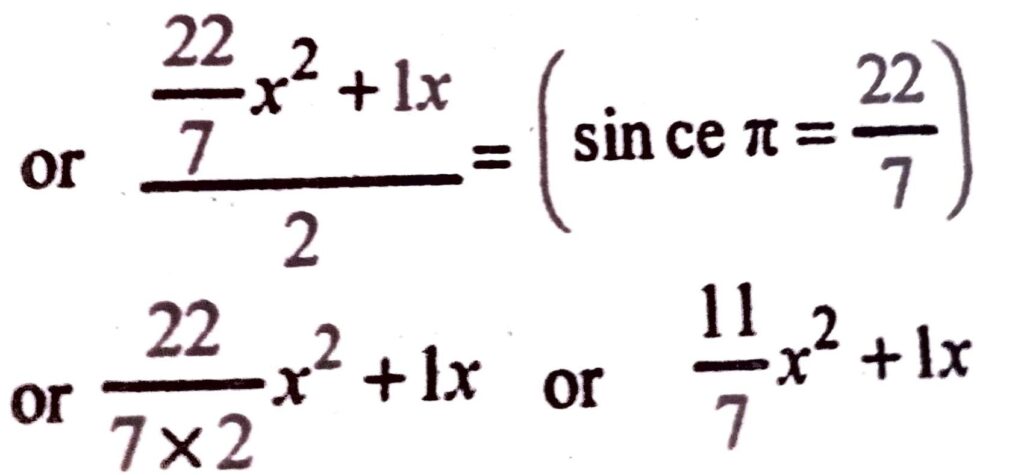
Therefore, the coefficient of x² in this equation is 11/.7
(iv) √2x- 1
Ans: We have given that the equation √2x -1
We can also write ox²+ √2x) – 1
Therefore, the coefficient of x² in this equation is 0.
(v) (2x – 3)(x² – 3x + 1)
Ans: (2x – 3)(x² – 3x + 1)
= 2x(x²- 3x + 1) – 3(x² – 3x + 1)
= 2x³- 6x² + 2x – 3x² + 9x – 3
= 2x³ – 9x² + 11x – 3
∴ Coefficient x ^ 2 = – 9
Q. 3. Give one example each of a binomial of degree 35, and a mono- mial of degree 100.
Ans: We know that polynomials having only two terms are called binomials.
Therefore, the example of a binomial of degree 35 is ax³⁵ + b where a and b are any real number.
Again, the example of a monomial of degree 100 is ax¹⁰⁰ where a is any real number.
Q.4. Write the degree of each of the following polynomials:
(i) 5x³ + 4x²+ 7x
Ans: We know that the highest power of variable in a polyno- mial is called degree of the polynomial, In polynomial 5x³ + 4x² + 7x
The highest power of variable x is 3.
Therefore, the degree of the polynomial 5x³ + 4x² + 7x is 3.
(ii) 4 – y²
Ans: In polynomial 4 – y² the highest power of the variable y is 2.
Therefore, the degree of the polynomial 4 – y² is 2.
(iii) 5t -√7
Ans: In polynomial 5t – √5 the highest power of the variable t is 1.
Therefore, the degree of polynomial 5t -√5 is 1.
(iv) 3hh.
The only term here is 3 which can be written as 3x⁰ .So the highest power of the variable x is 0.
Therefore, the degree of the polynomial 3 is 0.
Q.5. Classify the following as linear, quadratic and cubic polynomials.
(i) x²+ x
Ans: In polynomial x² + x the highest power of the variable x is 2.
So the degree of the polynomial is 2. We know that the polynomial of degree 2 is called a quadratic polynomial.
Therefore, the polynomial x² + x is a quadratic polynomial.
(ii) x – x³
Ans: In polynomial x – x³, the highest power of the variable x is 3. So the degree of the polynomial is 3.
We know that the polynomial of degree 3 is called a cubic polynomial.
Therefore, the polynomial x – x³ is a cubic polynomial.
(iii) y + y²+ 4
Ans: In polynomial y + y2 + 4 the highest power of the variable y is 2. So the degree of the polynomial is 2. We know that the polynomial of degree 2 is called quadratic polynomial.
Therefore, the polynomial y + y2 + 4 is a quadratic polynomial.
(iv) 1 + x
Ans: In polynomial l + x the highest power of the variable x is 1. So the degree of the polynomial is 1.
We know that the polynomial of degree 1 is called linear polynomial.
Therefore, polynomial 1 + x is a linear polynomial.
(v) 3t
Ans: In polynomial 3t, the highest power of the variable t is 1. So, the degree of the polynomial is 1.
We know that the polynomial of degree 1 is called a linear polynomial.
Therefore, polynomial 3t is a linear polynomial
(vi) r²
Ans: In polynomial r² the highest power of the variable r is 2. So, the degree of the polynomial is 2. We know that the polynomial of degree 2 is called quadratic polynomial.
Therefore, polynomial r ^ 2 is a quadratic polynomial.
(vii) 7x²
Ans: In polynomial 7x³ the highest power of the variable x is 3. So the degree of the polynomial is 3. We know that the polynomial of degree 3 is called a cubic polynomial.
Therefore, polynomial 7x³ is a cubic polynomial.
Q. 6. Which one is a polynomial?
(a) x- + 3x – 1
(b) y + 1/y
(c) 3y/2 + x
(d) 2√x+ 1
Ans: (c) 3y/2 + x
6. Two statements are given below.
Statement-1 : The degree of the zero polynomial is not defined.
Statement-2 : The degree of the non zero constant polynomial is zero.
Choose the correct option
(a) Statement 1 and statement 2 both are true
(b) Statement 1 and statement 2 both are false
(c) Statement 1 is true but statement 2 is false.
(d) Statement 1 is false but statement 2 is true.
Ans. (a) Statement 1 and statement 2 both are true
Explanation :
The degree of zero polynomial is not defined because in zero polynomial, the coefficient of any variable is zero, i.e.
0x², 0x³ or 0x⁷, ……….etc.
Hence we can not exactly determine the degree of variable
Statement I → True
A non-zero constant polynomial like 2 can be written as 2x⁰, Hence 2 is a polynomial of degree 0, because exponent of x is 0.
Statement II → True
7. Which of the following are constant polynomials?
(i) 5
(ii) x
(iii) 0
(iv) 5x
Choose the correct option
(a) (i) and (ii)
(b) (iii) and (iv)
(c) (i) and (iii)
(d) (i) and (iv)
Ans. (c) (i) and (iii)
Explanation:
We know that a polynomial of degree zero is called a constant polynomial.
5 = 5x⁰ (degree is 0)
0 = 0.x⁰ (degree is 0)
8. Match column-I with column-II
| Column-I | Column-II |
| (A) Zero of the zero polynomial is | (P) Zero |
| (B) √2 is a polynomial of degree | (Q) Not defined |
| (C) Degree of the zero polynomial is | (R) Any real number |
Choose the correct alternative.
(a) A → P, B → Q, C → R
(b) A → R, B → P, C → Q
(c) A → R, B → Q, C → P
(d) A → P, B → R, C → Q
Ans: (A) zero of the zero polynomial is any real number.
Let the zero polynomial be p(x) = 0. Let k be any real number. Since the equation p(x) = 0 is satisfied for every real value of k, therefore every real number is a zero of the zero polynomial.
Column I (A) → Column II (R)
(B) √2 = √2 x⁰,
Hence √2 is a polynomial of degree 0, because exponent of x is 0.
∴ Column I (B) → Column II (P)
(C) Degree of zero polynomial is not defined because in zero polynomial, the coefficient of any variable is zero.
i.e. 0.x² or 0.x³ ……etc.
We can not exactly determine the degree of variable…….
∴ Column I (C) → Column II (Q)
Hence the correct option (b)
9. If (3x − 1)⁷ = a₇x⁷ + a₆x⁶ + a₅x⁵ + a₄x⁴ + a₃x³ + a₂x² + a₁x + a₀ then
a₇ + a₆ + a₅ + a₄ + a₃ + a₂ + a₁ + a₀ is.
(a) 0
(b) 128
(c) 1
(d) 64
Ans: Here,
(3x – 1)7 = a₇ x⁷ + a₆x⁶ + a₅x⁵ + a₄x⁴ + a₃x³ + a₂x² + a₁x + a₀
Putting x = 1, we get
(3×1 – 1)7 = a₇×1⁷ + a₆×1⁶ + a₅×1⁵ + a₄×1⁴ + a₃×1³ + a₂×1² + a₁×1 + a₀
⇒ 2⁷ = a₇ + a₆ + ………. + a₀
∴ a₇ + a₆ + ………. + a₁ + a₀ = 128
The correct option is (b).
| Exercise 2.2 |
Q.1. Find the value of the polynomial 5x-4x²+3 at
(i) x = 0
Ans: Let P(x) = 5x-4 x² – 3
Therefore, P(0) = 5 (0) – 4 (0) + 3 = 0 – 0 + 3 = 3
So, the value of P(x) at x = 0 is 3.
(ii) x = – 1
Ans: Let P(x)=5x-4x²+3
Therefore, P(-1)=5(-1)-4(-1)²+3=6
So the value of P(x) at x=-1 is -6
(iii) x = 2
Ans: Let P(x)=5x-4x²+3
Therefore, P(2)=5×2-4(2)²+3=10-16+3=-3
So, the value of P(x) at x=2 is-3
Q.2. Find p(¹⁰) and p(²) for each of the following polynomials:
(i) p(y )= y² – y + 1
Ans: We have given P(y) = y²-y+1
Therefore, the value of polynomial p(y) at y = 0 is
P(0)=0²-0+1=1
Again, the value of polynomial p(y) at y = 1 is P(1)=1²-1+1=1
p(2) = 2²-2+1=3
(ii) p(t) = 2+1+2r²-t³
Ans: We have given, p(t) = 2+t+2r²-t³
Therefore, the value of polynomial p(t) at 1 = 0 is
P(0)=2+0+2.(0)² – (0)³ = 2
Again, the value of polynomial p(t) at t = 1 is
p(1)=2+1+2(1)² – (1)³=4
Again, the value of polynomial p(t) at t = 2 is
p(2)=2+2+2 (2)² – (2)³ = 4
(iii) p(x) = x³
Ans: We have given, p(x) = x³
Therefore, the value of polynomial p(x) at x=0 is
P(0)=(0)³ = 0
Again the value of polynomial p(x) at x = 1 is
p(1) = (1)³ = 1
Again, the value of polynomial p(x) at x = 2 is is
P(2)=(2)³=8
(iv) p(x)=(x-1)(x+1)
Ans: We have given p(x)=(x-1)(x+1)
Therefore, the value of polynomial p(x) at x=0 is
P(0)=(0-1)(0+1)=(-1)x(+1)=-1
Again, the value of polynomial p(x) at x = 1 is
p(1) = (1-1)x(1+1)=0x2=0
Again, the value of polynomial p(x) at x = 2 is
p(2)=(2-1) (2+1)=1×3=3
Q.3. Verify whether the following are zeros of the polynomial indi-cated against them:
(i) P(x)=3x+1,x=-1/3
Ans: We have given that, p(x) = 3x + 1
Therefore, the value of polynomial p(x) at x = – 1/3 is
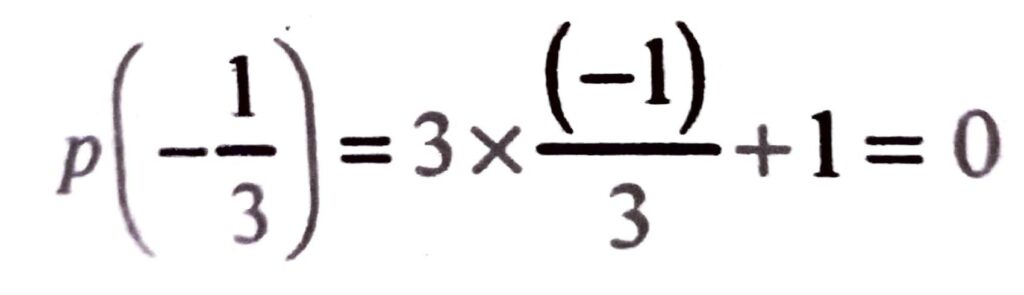
Yes x = – ⅓ is the zero of polynomial p(x)
(ii) P(x) = 5x − π, x = -4/5
Ans: x = – We have given that, p(x) = 5x – π
Therefore, the value of polynomial p(x) at x = 4/5 is

No, x = 4/5 is not the zero of p(x) = 5x – π.
(iii) p(x) = x²-1, x = 1,-1
Ans: We have given that, p(x) = x² – 1
Therefore, the value of polynomial p(x) at x = 1 is
p(1) = 1²- 1 = 0
Again, the value of polynomial p(x) at x = – 1 is
p(- 1) = (- 1)²- 1 = 0
Yes, x = 1, -1 are the zero of polynomial p(x) = x²- 1
(iv) p(x) = (x+1)(x-2), x = – 1,2
Ans: We have given that, p(x) = (x + 1)(x – 2)
Therefore, the value of polynomial p(x) at x = – 1 is
p(- 1) = (- 1 + 1)(- 1 – 2) = 0(- 3) = 0
Again, the value of polynomial p(x) at x = 2 is
p(2) = (2 + 1)(2 – 2) = 3 x 0 = 0
Yes x = – 1, 2 are the zero of polynomial
p(x) = x + 1(x – 2)
Yes x = – 1/3 is the zero of polynomial p(x)
(v) p(x) = x², x=0
Ans: We have given that, p(x) = x²
Therefore, the value of polynomial p(x) at x = 0 is
p(0) = 0² = 0
Yes x = 0 is the zero of polynomial p(x) = x²
(vi) P(x)=lx+m, x=-m/1
Ans: We have given that, p(x) = lx + m
Therefore, the value of polynomial p(x) at x = – m is
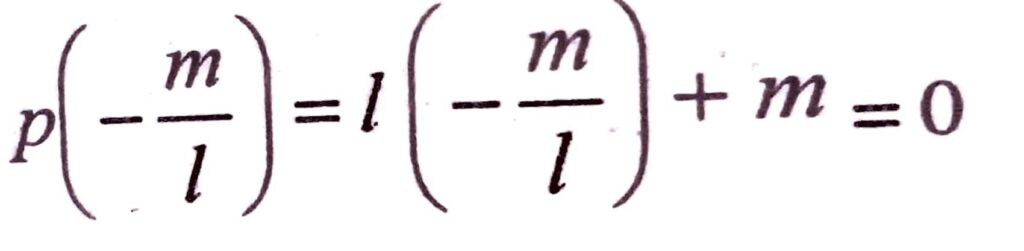
Yes, x = – m/l is the zero of polynomial p(x) = lx + m
(vii) p(x)=3x²-3x²-1,x=1/√3,2-√3
Ans: We have given that, p(x) = 3x² – 1
Therefore, the value of polynomial p(x) at x = – 1/√3 is

Again, the value of polynomial p(x) at x = 2/√3 is

Therefore, x = – 1/√3 is the zero of polynomial and p(x) and x = 2/√3
is not the zero of polynomial p(x).
(viii) p(x) =2x+1,x=1/2
Ans: We have given that, p(x) = 2x + 1
Therefore, the value of polynomial p(x) at x = 1/2 is
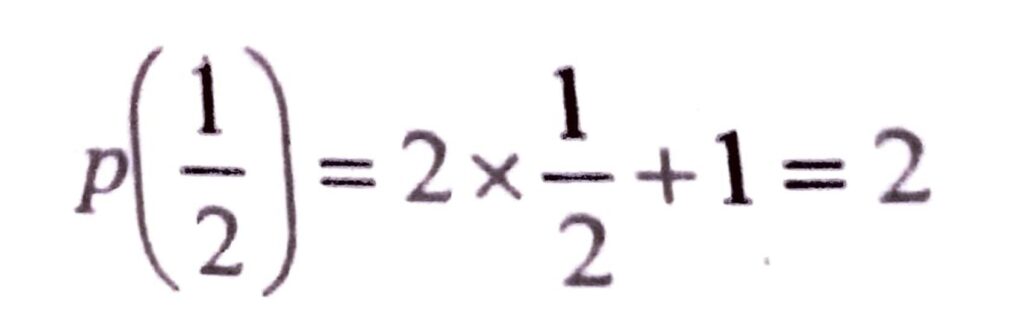
Therefore, x = 1/2 is not the zero of polynomial p(x).
Q.4. Find the zero of the polynomial in each of the following cases:
(i) p(x) = x+5
Ans: We have given that, p(x) = x+5 ..(1)
To find the zero of polynomial p(x), we can take p(x) = 0…(2)
From equations (1) and (2)
x+5=0
∴ x=-5
Therefore, x = -5 is the zero of the polynomial p(x)=x+5.
(ii) p(x) = x-5
Ans: We have given that, p(x)=x-5 …(1)
To find the zero of polynomial p(x) we can take p(x) = 0 …(2)
From equations (1) and (2)
x-5=0
∴ x=5
Therefore x = 5 is the zero of polynomial p(x)=x-5.
(iii) p(x) = 2x+5
Ans: To find the zero of polynomial p(x), we can take p(x) = 0 …(2)
From equations (1) and (2)

Therefore, x = – 5/2 is the zero of polynomial p(x) = 2x+5
(iv) p(x) = 3x – 2
Ans: We have given that, p(x)=3x-2 …(1)
To find the zero of polynomial p(x) we can take p(x)=0 … (2)
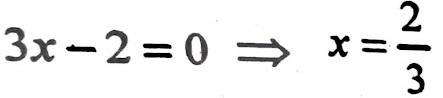
Therefore, x=-5/3 is the zero of polynomial p(x)=3x-2
(v) p(x) = 3x
Ans: We have given that, p(x)= ax, a ≠ 0 …(1)
To find the zero of polynomial p(x) we can take p(x) = 0 …(2)
From equations (1) and (2)
ax = 0
∴ x = 0/a = 0
Therefore, x = 0 is the zero of polynomial p(x) = ax, a ≠ 0.
(vi) p(x) = ax, a ≠ 0
Ans: We have given that, p(x)=3x …(1)
To find the zero of polynomial p(x) we can take p(x)=0 …(2)
From equations (1) and (2), 3x=0 ∴ x=0
Therefore, x = 0 is the zero of polynomial p(x) = 3x
(vii) p(x)=cx+d, c ≠ 0, c; d are real numbers.
Ans: ) We have given that, p(x) = cx + d …(1)
c ≠ 0, c, d are real numbers.
To find the zero of polynomial p(x) we can take
p(x) = 0 …(2)
From equations (1) and (2)
cx + d = 0
x = – d/c x where c ≠ 0x and are real numbers
Therefore, x=-d/c, where c, d and c,d
are real numbers is the solution of polynomial
p(x) = cx + d.
5. Which of the following are the zeroes of the polynomial x²-x-6?
(i) 3
(ii) -3
(iii) 2
(iv) -2
Choose the correct alternative-
(a) (i) and (ii)
(b) (ii) and (iii)
(c) (i) and (iv)
(d) (iii) and (iv)
Ans: x²-x-6= x²-(3-2)x-6
= x² – 3x + 2x-6 = x(x-3)+2(x – 3)
= (x – 3) (x + 2)
Either, x – 3 = 0 or, ⇒ x = 3 ⇒x=-2 x + 2 = 0
Zeroes of the polynomial are 3 & -2
The correct option is (c)


 Buy Now