
SEBA Class 9 Maths Chapter 1 Number Systems Solutions As Per New Syllabus. to each chapter is provided in the list so that you can easily browse through different chapters SEBA Class 9 Maths Chapter 1 Number Systems Notes and select need one. SEBA Class 9 Maths Chapter 1 Number Systems Question Answers Download PDF. SEBA Class 9 General Maths Solutions.
SEBA Class 9 Maths Chapter 1 Number Systems
Also, you can read the SCERT book online in these sections Solutions by Expert Teachers as per State Council of Educational Research and Training (SCERT) Book guidelines. SEBA Class 9 General Mathematics Solutions are part of All Subject Solutions. Here we have given SEBA Solutions For Class 9 Maths for All Chapters, You can practice these here.
Number Systems
Chapter: 1
| Exercise 1.1 |
Q.1. Is zero a rational number? Can you write in the form p/q, where p and q are integers and q ≠ 0
Ans: Yes, zero is a rational number and it can be written in the form of p/q as 0 = 0/1 here p = 0 and q = 1
Notice that q can be any number you wish.
[∵ 0 = 0/2 = 0/4 etc.]
Q.2. Find six rational numbers between 3 and 4.
Ans: Let a = 3, and b = 4
Rational number lying between 3 and 4 is a + b/2 i.e. 3 + 4/2 = 7/2
Now rational number between 3 and

Then required six rational numbers between 3 and 4 are 7/2, 13/4, 15/4, 27/8, 29/8, 31/8
ALITER
We want to find all six at one go. Since we want 6 numbers, so write.
3 = 21/6 + 1 = 21/7 and 4 = 28/6 + 1 = 28/7
Now six rational numbers between 3 and 4 are
22/7, 23/7, 24/7, 25/7, 26/7, 27/7
Q.3. Find five rational numbers between 3/5 and 4/5.
Ans: To find five rational numbers between 3/5 and 4/5, we take 3/5 and 4/5 as a rational number with denominator 30. i.e. 3/5 = 3/5 × 6/6 = 18/30 and 4/5 = 4/5 × 6/6 = 24/30
Then, required six rational numbers between 3/5 and 4/5 are 19/30, 20/30, 21/30 and 23/30.
Q.4. State whether the following statements true or false? Give reasons for your answer.
(i) Every natural number is a whole number.
Ans: Yes, because each natural number is a whole number.
(ii) Every integer is a whole number.
Ans: False, because all negative natural numbers (-1, -2, -3, …) are not whole numbers.
(iii) Every rational number is a whole number.
Ans: False, because the rational numbers of the type 2/5, 2/5, 3/5 etc are not whole numbers.
5. Every Natural number is
(i) a Whole number
(ii) an Integer
(iii) a Rational number
(iv) a Real number
Which one of the following is correct?
(a Only (1)
(b) Only (i), (ii)
(c) Only (i), (ii), (iii)
(d) (i), (ii), (iii) & (iv) are all correct
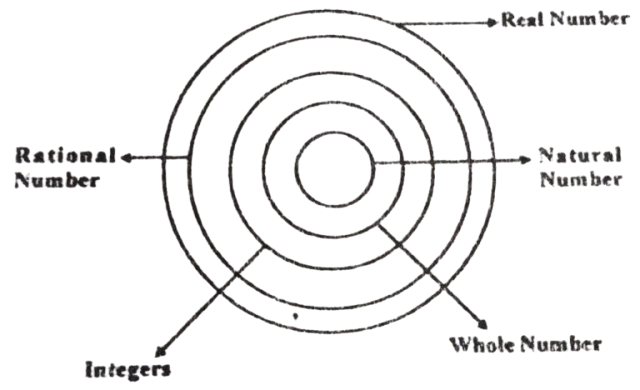
Ans. (d) (i), (ii), (iii) & (iv) are all correct
6. Every Rational number is
Choose the correct option
(a) a Natural number
(b) a Whole number
(c) an Integer
(d) a Real number
Ans. (D) a Real number
Every rational number is a real number.
| Exercise 1.2 |
Q.1. State whether the following statements are true or false. Jus-tify your answer.
(i) Every irrational number is a real number.
Ans: True, because the set of every rational and every irrational number is called a real number.
(ii) Every point on the number line is of the form √m, where m is a natural number.
Ans: False, no negative number can be the square root of any natural number.
(iii) Every real number is an irrational number.
Ans: False, because the real number is the set of every irrational and rational number. For example, 2 is real but not irrational.
Q.2. Are the square roots of all positive integers irrational? If not, give an example of the square root of a number that is a rational number.
Ans: No, the square roots of all positive integers are not always irrational.
For Example √4= 2 is a rational number.
Q.3. Show how √5 can be represented on the number line.
Ans: They represent √5 on the number line, taking 0 at zero on the number line. Again taking OA = 1 unit in the positive direction of the number line.
Then OB = √1² + 1² = √2
Construct OD of unit length perpendicular to OB.
Then OD= √(√2)² +1² = √3
Construct DE of unit length perpendicular to OD.
Then OE = √(√3)² + 1² = √4 = 2
Construct EF of unit length perpendicular to OE. Then
OF = √2² + 1² = √5
Using a compass, with centre) and radius OF, draw an arc which inter- sects the number line in the point R. Then R corresponds to √5.

Q.4. Classroom activity (Constructing the ‘Square root spiral’).
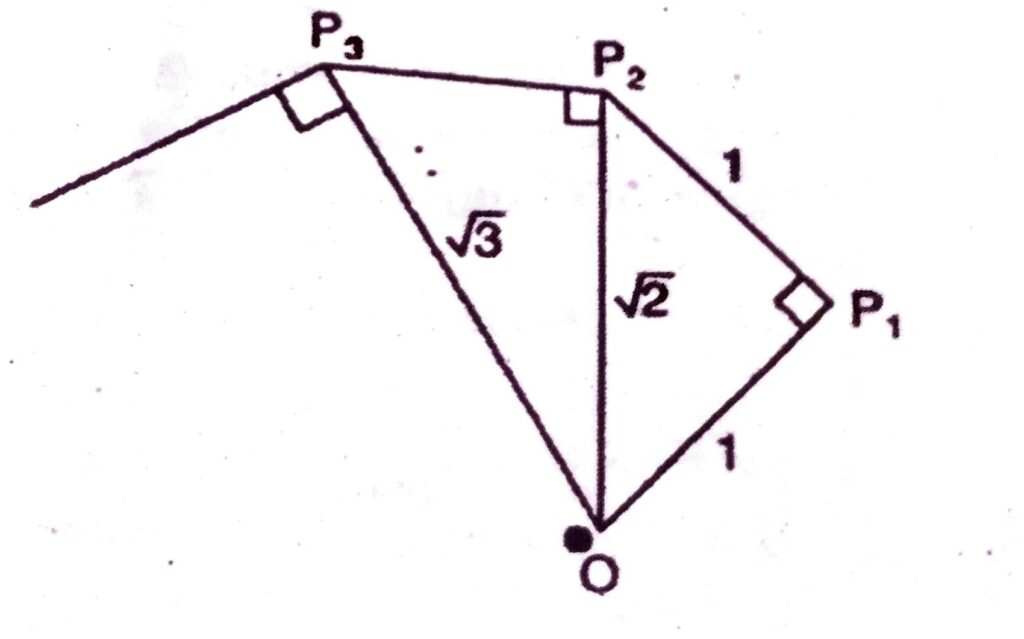
Take a large sheet of paper and construct the ‘square spiral’ in the following fashion. Start with a point O and draw a line segment P1 P2 per-perpendicular to OP1 of unit length. Now draw a line segment P2 P3 perpendicular-lar to OP2. Then draw a line segment P3 P4 perpendicular to OP3.
Continuing in this manner, you can get the line segment Pn Pn by drawing a line segment of unit length perpendicular to Open. In this man-ner, you will have created the points P2, P3,…, Pn, …, and join-ing them to a create beautiful spiral depicting.
√2,√3, √4,…
Ans: For self-practice.
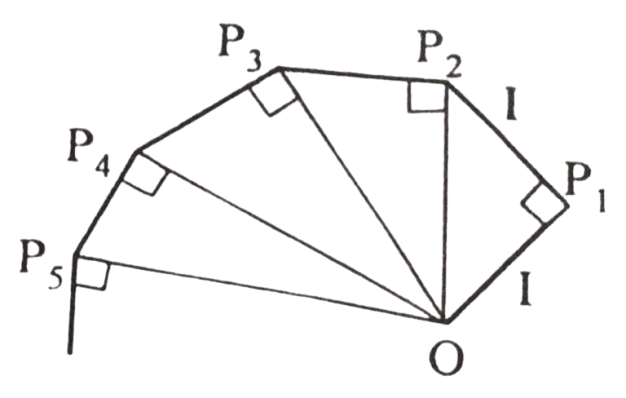
5. In the adjacent construction of square root spiral which perpendicular line represents √5?
(a) OP4
(b) OP2
(c) OPS
(d) OP3.
Ans. (c) OP5
Explanation:
In ΔΟΡ, Ρ2 OP2
= OP2 2 + OP1 2 + P1 P2 2
= 12 + 12
= 1+1
=2
∴ OP₂ = √2
clearly OP3 = √3, OP4 = √4
and OP5 = √5
| Exercise 1.3 |
Q.1. Write the following in decimal form and say what kind of deci- mal expansion each has:
(i) 36/100
Ans: 36/100 = 0.36 terminating decimal.
(ii) 1/11
Ans: 1/11
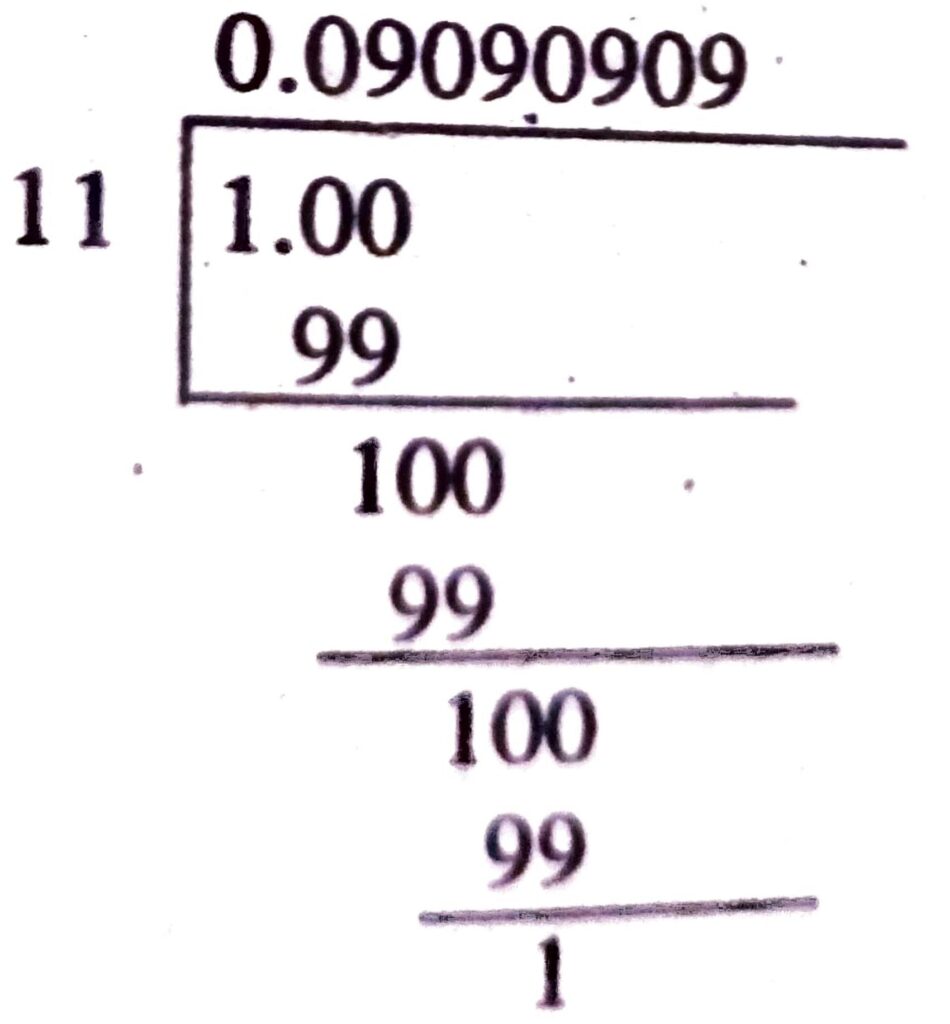
Remainders: 1, 1, 1, 1………, Divisor: 11
∴ 1 11 =0.090909…. = 0.099
The decimal expansion is non-terminating repeating.
(iii) 4 1/8 = 33/8
Ans:
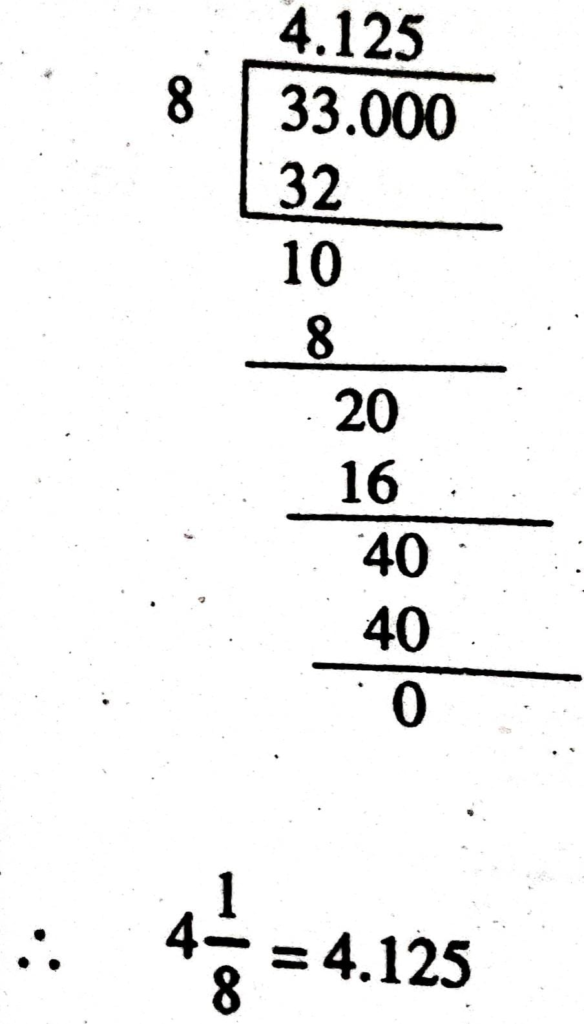
The decimal representation is terminating.
(iv) 3/13
Ans:
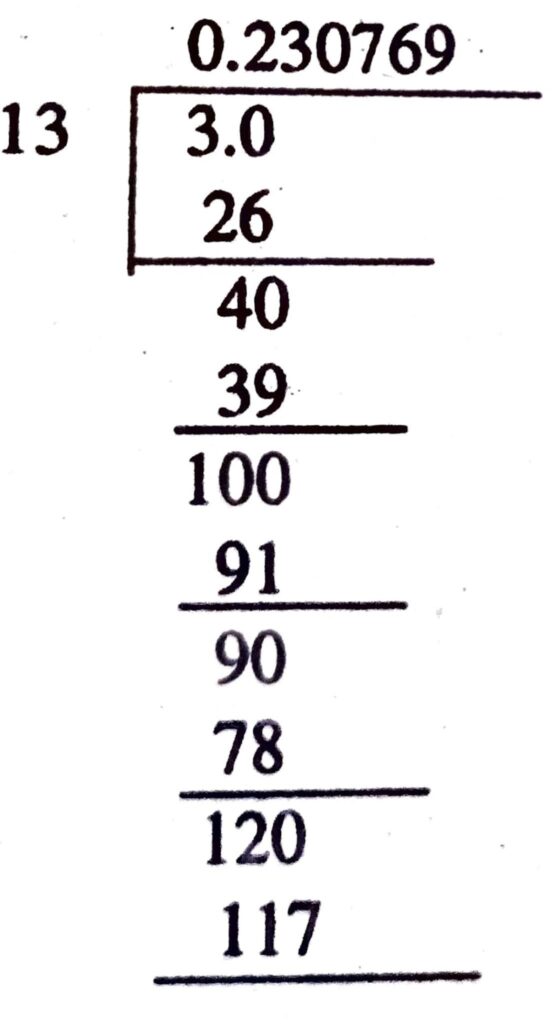
∴ 3/13 = 0.230769.
The decimal expansion is non-terminating repeating.
(v) 2/11
Ans:

Remainders: 9,2,9,2,…………
Divisor: 0.1818…………
We write; 2/11 = 0.1818……..
= 0
(vi) 329/400
Ans: 329/400

Q.2. You know that 1/7 = 0.142857. Can you predict what the decimal expansions of 2/7, 3/7, 4/7, 5/7, 6/7 are without actually doing the long divi- sion? If so, how?
Ans:

Q.3. Express the following in the form p/q, where p and q are inte-gers and q≠0.

Ans: Let x = 0.6 or x=0.66666…(1)
Now, adding 6 both side in equation (1)
x + 6 = 0.66666….+ 6
or x + 6 = 6.6666… (2)
Again, multiplying by 10 both sides in equation (1)
10 x = 0.66666…x 10
or 10 x = 6.6666… (3)
Now, form equations (2) and (3)
X + 6 =10 x or 9 x = 6 ∴ x = 6/9
Therefore, 0.6 = x = 2/3
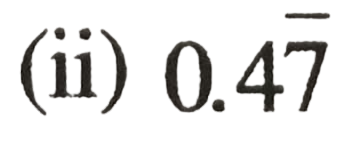
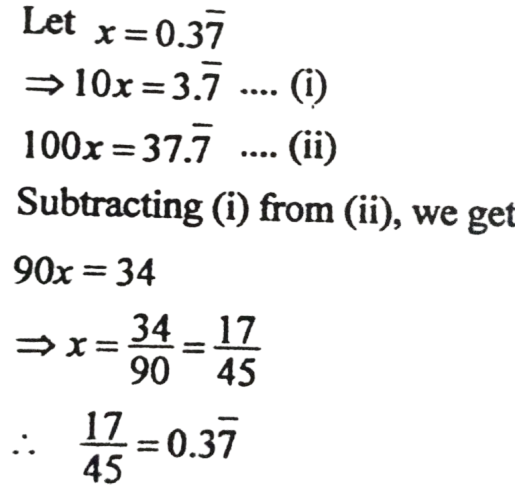
Ans: Let x = 0.47
or x = 0.47777 …(1)
Now, multiply 10th side in equation (1)
10 x = 0.47777…x10
or 10 x = 4.77777… (2)
Again, multiply 100 both side in equation (1)
100 = 0.477777 … X 100
or 100 x = 47.777 …(3)
Subtract equation (2) from equation (3)
90 x = 43.0000
or 90 x = 43 ∴ x = 43/90 Therefore 0.47 = x 43/90
Which is in the form of p/q

Ans: Let x = 0.001
or, x = 0.001001001… (1)
Now, add 1 both side in equation (1)
x + 1= 0.001001001…+1
or x + 1=1.001001001… (2)
Again, multiply 1000 both side in equation (1)
1000 × x =1000 x 0.001001001… (3)
or 1000x = 1.001001001…
From equations (2) and (3) we get
x + 1=1000x or 999x=1 ∴ x = 1/999
Therefore, 0.001 = x = 1/999′ Which is the form of p/q
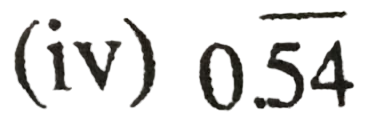
Ans:
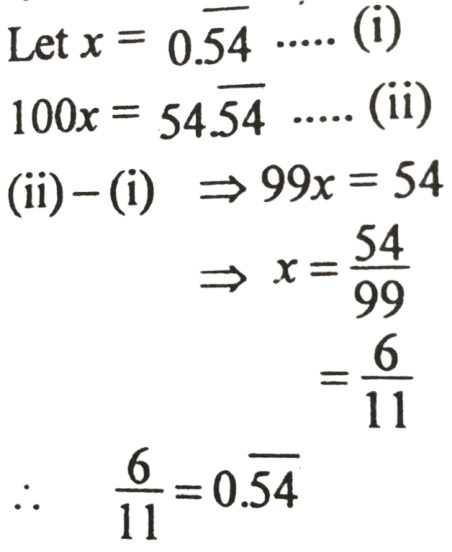
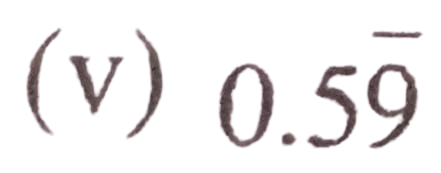
Ans: In a recurring decimal,
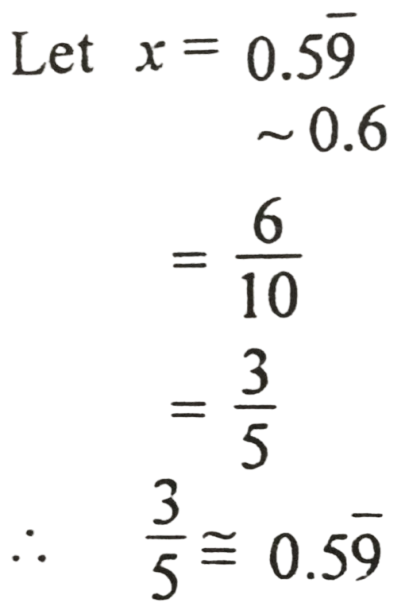
0.999 is considered approximately as 1
because its a very small difference.
Let x =0.5 overline 9 ~0.6 3/5 cong0.5 overline 9 = 3/5 = 6/10
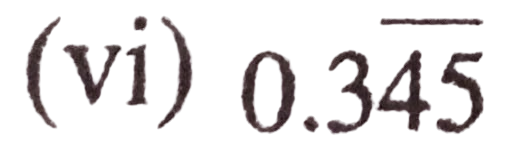
Ans:
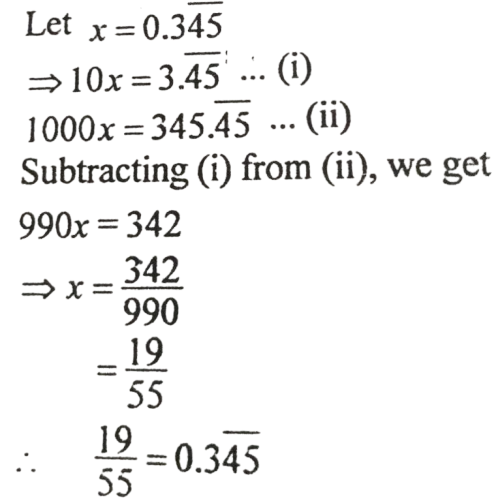
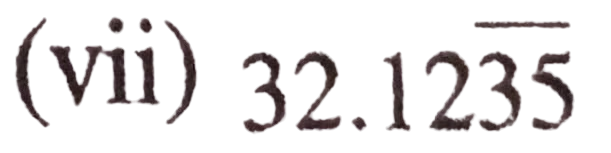
Ans:
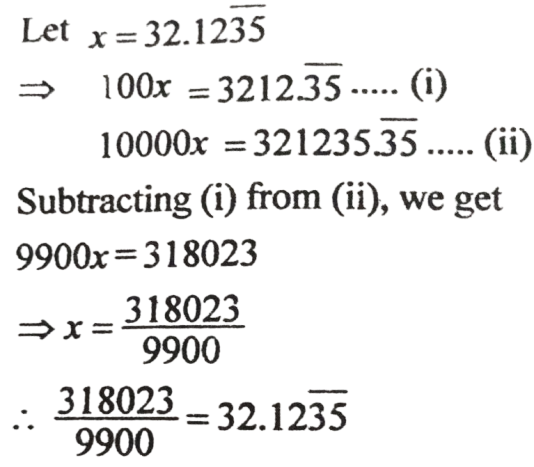
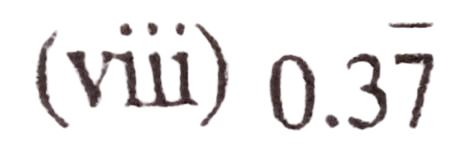
Ans:
Q.4. Express 0.99999… in the form p/q. Are you surprised by your answer? With your teacher and classmates, discuss why the answer makes sense.
Ans: Let x = 0.9999… (1)
Add 9 both side in equation (1)
x + 9 = 9 + 0.99999…
or x + 9 = 9.99999… (2)
Again, multiply 10 both side in equation (1)
10 x = 9.9999… (3)
From equations (2) and (3) we get 10 x = x+9
or 9 x = 9 or x = 1 Therefore, 0.9999 … = 1
It is because there is an infinite 9 coming after the point; which is very- very close to 1.

 Buy Now