
NIOS Class 12 Accountancy Chapter 24 Retirement and Death of a Partner Solutions English Medium As Per New Syllabus. to each chapter is provided in the list so that you can easily browse throughout different chapters NIOS Class 12 Accountancy Chapter 24 Retirement and Death of a Partner Notes and select need one. NIOS Class 12 Accountancy Chapter 24 Retirement and Death of a Partner Question Answers Download PDF. NIOS Study Material of Class 12 Accountancy Paper Code: 320.
NIOS Class 12 Accountancy Chapter 24 Retirement and Death of a Partner
Also, you can read the NIOS book online in these sections Solutions by Expert Teachers as per National Institute of Open Schooling (NIOS) Book guidelines. These solutions are part of NIOS All Subject Solutions. Here we have given NIOS Class 12 Accountancy Solutions English Medium, NIOS Senior Secondary Course Accountancy Notes in English Medium for All Chapter, You can practice these here.
Retirement and Death of a Partner
Chapter: 24
| Module – 4: Partnership Account |
INTEXT QUESTIONS 24.1
(I) Give any three circumstances under which a partner may retire from partnership.
Ans: (i) Old age.
(ii) Poor health.
(iii) Bad relations among partners.
(II) New share of remaining partner is?
Ans: Existing share + Gaining share.
(III) Gain of a Partners Share = New Share – ___________?
Ans: Existing share.
(IV) A B and C were sharing profit in the ratio of 3 : 2 : 1. A retires, his share is
taken by B and C in the ratio of 2 : l. Which of the following is the new ratio
of B and C after A’s retirement?
(a) 3 : 2
(b) 2 : 1
(c) 1 : 2
Ans: (b) 2 : 1
INTEXT QUESTIONS 24.2
State whether the following statements are True or False :
(i) Retiring partner’s share of goodwill is debited to his/her capital account at the time of retirement.
Ans: False.
(ii) Goodwill is recorded in the books only when it is purchased.
Ans: True.
(iii) The retiring partner’s capital account is debited with his/her share of goodwill and remaining partner’s capital account is credited in their gaining ratio.
Ans: False.
(iv) In case goodwill account is written off the capital account of all partners is credited.
Ans: False.
INTEXT QUESTIONS 24.3
I. Fill in the blanks with suitable word or words :
(a) The credit balance of Revaluation account shows __________.
Ans: Gain / Profit.
(b) Reserve shown in the Balance sheet are transferred to the ___________ side of ____________ at the time of retirement of a partner.
Ans: Credit side of Partners’ Capital Account.
(c) The value of the assets has decreased at the time of retirement of a Partner ___________ Account will be debited and ___________ account will be credited with the decrease in amount.
Ans: Revaluation Account, Assets Account.
(II) There was an increase in the value of a creditor at the time of retirement of a partner. What will be the journal entry for the above?
Ans: Revaluation A/c Dr.
To Creditors A/c.
INTEXT QUESTIONS 24.4
I. List the various claims of a retiring partner:
1. ________.
2. _________.
3. _________.
4. _________.
Ans: (i) Balance of Capital Account.
(ii) Share of Goodwill.
(iii) Share in Revaluation Profit.
(iv) Share in General Reserve and Accumulated Profits.
(II) Mention the modes of settling the total claims of the retiring partner:
1. ___________.
2. ___________.
Ans: (i) Lump sum.
(ii) Instalments.
(III) Find the total amount due to Munish, who is retiring as a partner:
1. Credit balance in Munish capital account Rs. 20,000.
2. Munish’s share of goodwill Rs.7,000
3. General reserve balance shown in Balance sheet Rs.10,000
4. Profit on Revaluation of Assets /liabilities Rs. 3,000
5. Interest on drawings Rs. 1,500.
6. Munish share in the profit of the firm ½
Ans: ₹32,000.
INTEXT QUESTIONS 24.5
I. Surinder, Mahinder and Tarun are partners in a firm. After Surinder’s retirement, the profit sharing ratio between Mahinder and Tarun is 5 : 3.
They decide to fix the firm’s capital at ` 80,000. Find the individual capitals of Mahinder and Tarun.
Mahinder’s Capital Rs. _________.
Tarun’s Capitals Rs. ___________.
Ans: Mahinder’s Capital ₹50,000.
Tarun’s Capital ₹30,000.
(ii) Sohan, Amisha and Neena are partners sharing profit in the ratio of 3 : 2 : 1. when Sohan retired, their adjusted capitals were Rs. 90,000, Rs. 60,000 and Rs. 70,000 respectively. Amisha and Neena decided to have their total capital of the firm in the ratio of 5 : 3. Find the capital of each partner and the total capital of firm.
Amisha Capital Rs. __________.
Neena Capital Rs. __________.
Ans: Amisha Capital ₹1,37,500.
Neena Capital ₹82,500.
Total Capital ₹2,20,000.
INTEXT QUESTIONS 24.6
I. Fill in the blanks with suitable words :
(i) The Executor is entitled to all the rights of a ________.
Ans: Deceased partner.
(ii) Share of goodwill of the deceased partner is _________ to his capital account.
Ans: Credited.
(iii) In case of death of a partner, the profit may be estimated on the basis of _________ and __________.
Ans: Time, Sales.
(iv) The balance in the capital account of the deceased partner is transferred to his _________ account.
Ans: Executor’s account.
(v) Interest on drawing due from deceased partner till the date of the death is _________ to his capital account.
Ans: Debited.
| TERMINAL EXERCISE |
1. What is meant by retirement of a partner?
Ans: Retirement of a partner occurs when one or more partners leave a firm while the remaining partners continue to conduct the business. This event brings the existing partnership to an end, leading to the reconstitution of the firm under a new agreement with updated terms and conditions. A partner may retire with the consent of all other partners, in accordance with an existing agreement, or at their own will. Common reasons for retirement include old age, poor health, or strained relationships between partners.
2. Explain the meaning of gaining Ratio.
Ans: The gaining ratio represents the proportion in which the continuing partners acquire the share of profit previously held by the retiring or deceased partner. When a partner leaves, their share is distributed among the remaining partners, which changes the profit-sharing ratio. The gain for an individual partner is calculated using the following formula:
Gain of a Partner = New Share – Existing (Old) Share
3. Explain the accounting treatment of goodwill on retirement of a partner.
Ans: Because goodwill is the result of past efforts by all partners, including the one retiring, the retiring partner is entitled to compensation for their share of it. According to accounting standards (AS-10), goodwill is not raised as an account on its own but is instead adjusted through the partners’ capital accounts.
The accounting treatment involves:
(i) Crediting the retiring partner’s capital account with their specific share of the firm’s goodwill.
(ii) Debiting the remaining partners’ capital accounts in their respective gaining ratios.
(iii) Existing Goodwill: If a goodwill account already appears on the Balance Sheet, it must first be written off by debiting all partners’ capital accounts (including the retiring partner) in their existing profit-sharing ratio and crediting the goodwill account.
4. What problems involving finance arise when a partner dies? How would you deal with them as an accountant?
Ans: When a partner dies, several financial issues arise, primarily concerning the calculation and settlement of the deceased partner’s dues to their legal representatives. These problems include the need for revaluation of assets and liabilities, treatment of goodwill, and the distribution of accumulated reserves or joint life policies.
As an accountant, you would deal with these problems by:
(i) Ascertaining Entitlements: Calculate the total amount due to the deceased partner, which includes their capital balance, interest on capital, share of goodwill, share of reserves/profits, and share of profit up to the date of death (determined on a time or sales basis).
(ii) Applying Deductions: Subtract any drawings, interest on drawings, or shares of revaluation and operating losses incurred up to the date of death.
(iii) Transferring the Balance: The final adjusted balance of the deceased partner’s capital account is transferred to a newly opened Executor’s Account.
(iv) Settling the Claim: If the amount is not paid immediately, the legal representative is typically entitled to interest at 6% p.a. on the remaining balance from the date of death until the final payment is made.
5. Seema, Mohit and Meenakshi were partners in a firm sharing profit in the ratio of 7 : 6 : 7. Mohit retired and his share was divided equally between Seema and Meenakshi. Calculate the new profit sharing ratio of Seema and Meenakshi.
Ans: Old Profit Sharing Ratio (PSR) of Seema : Mohit : Meenakshi = 7 : 6 : 7
Mohit retires, and his share (6 parts) is divided equally between Seema and Meenakshi.
Find Mohit’s share received by each Mohit’s share = 6 parts
Divided equally → each gets 6 ÷ 2 = 3 parts
Add this to their old shares:
| Partner | Old Share | Gain from Mohit | New Share |
| Seema | 7 | +3 | 10 |
| Meenakshi | 7 | +3 | 10 |
New Profit Sharing Ratio
Seema : Meenakshi = 10 : 10
Simplify → divide by 10 1:1
6. Ashu, Ashmita and Meetu are partners sharing profits in the ratio of 4 : 3 : 2. Ashu retires, assuming Ashmita and Meetu will share profits in future in the ratio 5 : 3, determine the gaining ratio.
Ans: Old Profit Sharing Ratio (PSR) = Ashu : Ashmita : Meetu = 4 : 3 : 2
Ashu retires → Remaining partners (Ashmita & Meetu) will share profits in 5 : 3
We must find Gaining Ratio = New Share − Old Share
Convert ratios into fractions:
Total parts (old) = 4 + 3 + 2 = 9
| Partner | Old Share |
| Ashu | 4/9 |
| Ashmita | 3/9 = 1/3 |
| Meetu | 2/9 |
New ratio (5 : 3)
Total parts = 8
| Partner | New Share |
| Ashmita | 5/8 |
| Meetu | 3/8 |
Calculate Gain:
Ashmita:
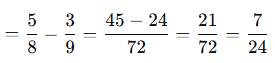
Meetu:
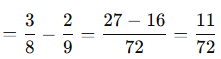
Step 3: Gaining Ratio
7/24 : 11/72
Make denominators same:
= 21/72 : 11/72 = 21:11
| Liabilities | Amount (₹) | Assets | Amount (₹) |
| Sundry Creditors | 38,000 | Plant & Machinery | 70,000 |
| Bills Payable | 10,000 | Building | 90,000 |
| General Reserve | 24,000 | Motor Car | 16,000 |
| Capitals: | Debtors | 32,000 | |
| Ashok | 80,000 | Less: Provision for bad debts | 1,000 |
| Babu | 60,000 | 31,000 | |
| Chinu | 50,000 | Stock | 50,000 |
| 1,90,000 | Cash | 5,000 | |
| Total | 2,62,000 | Total | 2,62,000 |
Babu retires on that date, subject to the following adjustments:
(a) The Goodwill of the firm to be valued at ₹ 36,000.
(b) Plants and Machinery to be depreciated by 10% and Motor Car by 15%.
(c) Stock to be appreciated by 20% and Building by 10%.
(d) Provision for Doubtful debts to be increased by ₹ 3,900. Prepare Revaluation Account and Babu’s Capital account.
Ans: Revaluation Account
Revaluation Adjustments
Decrease (Loss):
| Particulars | Amount (₹) |
| Plant & Machinery Depreciation (10% of ₹70,000) | 7,000 (Loss) |
| Motor Car Depreciation (15% of ₹16,000) | 2,400 (Loss) |
| Increase in Provision for Doubtful Debts | 3,900 (Loss) |
| Stock Appreciation (20% of ₹50,000) | 10,000 (Gain) |
| Building Appreciation (10% of ₹90,000) | 9,000 (Gain) |
- Total Gain = ₹19,000
- Total Loss = ₹13,300
- Net Revaluation Profit = ₹5,700
- This profit is distributed in the old ratio 3 : 2 : 1.
- Ashok = 5,700 × 3/6 = ₹2,850
- Babu = 5,700 × 2/6 = ₹1,900
- Chinu = 5,700 × 1/6 = ₹950
Revaluation A/c:
| Dr. | Amount (₹) | Cr. | Amount (₹) |
| To Plant & Machinery (Depreciation) | 7,000 | By Stock Appreciation | 10,000 |
| To Motor Car (Depreciation) | 2,400 | By Building Appreciation | 9,000 |
| To Increase in Prov. for Bad Debts | 3,900 | ||
| To Profit transferred to: | |||
| Ashok (3/6) | 2,850 | ||
| Babu (2/6) | 1,900 | ||
| Chinu (1/6) | 950 | ||
| Total | 19,000 | Total | 19,000 |
Revaluation Profit = 19,000 − 13,300 = ₹5,700
Net Profit on Revaluation = ₹5,700
Goodwill Adjustment
Goodwill of firm = ₹36,000
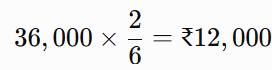
Babu’s Capital Account:
| Particulars | Amount (₹) | Particulars | Amount (₹) |
| To Cash (amount payable) | 81,900 | By Balance b/d | 60,000 |
| By General Reserve | 8,000 | ||
| By Revaluation Profit | 1,900 | ||
| By Goodwill | 12,000 | ||
| Total | 81,900 | Total | 81,900 |
Working:
General Reserve ₹24,000 distributed (3:2:1)
Revaluation Profit = ₹5,700


 Buy Now