
NIOS Class 12 Accountancy Chapter 23 Admission of a Partner Solutions English Medium As Per New Syllabus. to each chapter is provided in the list so that you can easily browse throughout different chapters NIOS Class 12 Accountancy Chapter 23 Admission of a Partner Notes and select need one. NIOS Class 12 Accountancy Chapter 23 Admission of a Partner Question Answers Download PDF. NIOS Study Material of Class 12 Accountancy Paper Code: 320.
NIOS Class 12 Accountancy Chapter 23 Admission of a Partner
Also, you can read the NIOS book online in these sections Solutions by Expert Teachers as per National Institute of Open Schooling (NIOS) Book guidelines. These solutions are part of NIOS All Subject Solutions. Here we have given NIOS Class 12 Accountancy Solutions English Medium, NIOS Senior Secondary Course Accountancy Notes in English Medium for All Chapter, You can practice these here.
Admission of a Partner
Chapter: 23
| Module – 4: Partnership Account |
INTEXT QUESTIONS 23.1
I. Fill in the blanks with appropriate word/words :
(i) Sacrificing ratio is calculated by deducting ________ share of profit from ________ share of profit of the existing partners.
Ans: New, Existing.
(ii) On admission of a new partner, the partnership firm is __________.
Ans: Reconstituted.
(iii) The ratio in which partners surrender their profits is known as _______.
Ans: Sacrificing ratio.
(iv) The new ratio of existing partners is calculated by dividing remaining share
of the profit in their ________.
Ans: Existing ratio.
II. If Tarun and Nisha are partners sharing profits in the ratio of 5:3. What will be their sacrificing ratio if Rahul is admitted for 1/8 share of profit in the firm?
Ans: Sacrificing ratio 5 : 3.
INTEXT QUESTIONS 23.2
I. Fill in the blanks with appropriate word/words :
(i) Goodwill is an _________ asset.
Ans: Intangible.
(ii) The amount of goodwill is generally brought in by ________ Partner.
Ans: Incoming.
(iii) Super Profit = Actual Profit – __________.
Ans: Normal Profit.
(iv) The methods of calculating goodwill are _________ and _________.
Ans: Average profit, Super profit and Capitalisation.
(v) Capital employed = Total assets minus ________.
Ans: Outsider liabilities.
II. (a) From the following information, Calculate average profit :
| Year | Profit (₹) | Loss (₹) |
| 2001 | 80,000 | |
| 2002 | 90,000 | |
| 2003 | — | 30,000 |
| 2004 | 1,10,000 |
Average Profit = ₹
Ans: First convert loss into negative value.
Total Profit =
80,000 + 90,000 − 30,000 + 1,10,000
Total = 2,50,000
Number of years = 4
Average Profit
= Total Profit ÷ Number of Years
= 2,50,000 ÷ 4
= ₹62,500
(b) Calculate value of goodwill at two year’s purchase of average profit, ascertained in II (a) above.
Ans: Formula:
Goodwill = Average Profit × Number of Years Purchase
= 62,500 × 2
= ₹1,25,000
INTEXT QUESTIONS 23.3
I. Fill in the blanks with appropriate word/words:
(a) When Goodwill is paid privately, ___________ will be made.
Ans: No entry.
(b) If the new partner brings amount of goodwill, the amount of goodwill brought by him is _________ to goodwill account.
Ans: Credited.
(c) The amount brought in by the new partner is transferred to the existing partner in the _________ ratio.
Ans: Sacrificing.
(d) Goodwill appearing in the books of the firm is at the time of admission of a new partner ___________ .
Ans: Debited.
(e) If the new partner is not able to bring his share of goodwill, The new partner’s capital account is __________ for his share of goodwill.
Ans: Written off.
II. Match the appropriate entry of Column B with that of Column A by writing the correct numbers of the column B in the space provided.
| Column A | Correct Match |
| 1. Goodwill is paid privately | (i) Existing Partners Capital A/cTo Goodwill A/c |
| 2. New partner unable to bring goodwill | (ii) Goodwill Premium A/c Dr.To Existing partner’s Capital A/c |
| 3. Goodwill appearing in books written off | (iii) New Partner’s Capital A/c Dr.To Existing Partner’s Capital A/cTo Existing Partner’s Capital A/c |
| 4. Goodwill brought by new partner transferred to sacrificing partners | (iv) No Entry |
Ans:
| Column A | Correct Match |
| 1. Goodwill is paid privately | (iv) No Entry |
| 2. New partner unable to bring goodwill | (iii) New Partner’s Capital A/c Dr.To Existing Partner’s Capital A/cTo Existing Partner’s Capital A/c |
| 3. Goodwill appearing in books written off | (i) Existing Partners Capital A/cTo Goodwill A/c |
| 4. Goodwill brought by new partner transferred to sacrificing partners | (ii) Goodwill Premium A/c Dr.To Existing partner’s Capital A/c |
INTEXT QUESTIONS 23.4
I. Fill in the blanks with suitable word/words :
(i) Revaluation account is debited for an increase in the value of ________.
Ans: Liabilities.
(ii) Revaluation account is credited for an increase in the value of ___________.
Ans: Assets.
(iii) Revaluation account is credited for an decrease in the value of _________.
Ans: Assets.
(iv) Revaluation account is debited for an decrease in the value of ________.
Ans: Liabilities.
(v) Profit on revaluation is transferred to the _________ of the partners’ capital account.
Ans: Credit side.
(vi) Reserve should be distributed amongst the existing partners in ___________.
Ans: Old profit sharing ratio.
(vii) Accumulated Losses are ___________ in the existing partner’s capital account in existing profit sharing ratio.
Ans: Debited.
II. Choose the correct option :
(i) On change in the profit sharing ratio on the existing partners the accumulated profit will be transferred to the capital accout/current accounts of the existing partners in
(a) Old Profit Sharing Ratio.
(b) Equally.
(c) New Profit Sharing Ratio.
(d) Gaining/Sacrificing Ratio.
Ans: (a) Old Profit Sharing Ratio.
(ii) On change in the profit sharing ratio of the existing partners the accumulated loss will be:
(a) debited to the capital accounts of the partners in old profit sharing.
(b) credited to the capital accounts of the partners in old profit sharing ratio.
(c) debited to the capital accounts of the partners in new profit sharing ratio.
(d) credited to the capital accounts of the partners in new profit sharing ratio.
Ans: (a) debited to the capital accounts of the partners in old profit sharing.
(iii) If profit sharing ratio of A & B is 3 : 2. They want to share profits equally.
What is the sacrifice of A.
(a) 1/10
(b) 1/20
(c) 1/15
(d) 1/5
Ans: (a) 1/10
(iv) If profit sharing ratio of A & B is 4 : 5. They agreed to share profit equally.
What is the sacrifice of B.
(a) 1/18
(b) 1/10
(c) 5/18
(d) 7/18
Ans: (a) 1/18
(v) If profit sharing ratio of A & B is 5 : 4. They agreed to share profit equally.
What is the Gain of B.
(a) 2/9
(b) 1/18
(c) 1/8
(d) 4/9
Ans: (b) 1/18
III. State whether the revaluation account will be debited or credited on the revaluation of the following assets at the time of change in profit sharing ratio of the existing partners :
(i) Increase in the value of land.
Ans: Credited.
(ii) Increase in the value of stock.
Ans: Credited.
(iii) Decrease in the value of machinery.
Ans: Debited.
(iv) Decrease in the value of furniture.
Ans: Debited.
IV. State whether the following statements are ture :
(i) Revaluation account is credited on depreciation in machinery.
Ans: False.
(ii) Revaluation account is credited for depreciation in plant.
Ans: False.
(iii) Revaluation account is debited for the amount of provision for bad and doubtful debts.
Ans: True.
(iv) For recording the value of an unrecorded assets revaluation account is debited.
Ans: False.
INTEXT QUESTIONS 23.5
I. Tanu and Anu are partner’s sharing profit in the ratio 3:2. They admit Sumit as a new partner for 1/5 share in the profit and brings Rs. 50,000 for his capital.
The Capital of Tanu and Anu after all the adjustments are Rs. 95,000 and Rs. 90,000 respectively. Calculate the total capital of the new firm and capital of each partner on the basis of the new partner’s capital.
Ans: Old ratio of Tanu and Anu = 3 : 2
New partner Sumit share = 1/5
Remaining share = 4/5
New Profit Sharing Ratio
Tanu = 3/5×4/5=12/25
Anu = 2/5×4/5=8/25
Sumit = 1/5=5/25
New ratio = 12 : 8 : 5
Total Capital of the Firm
Summit capital = ₹50,000
His share = 5/25
Total Capital
= 50,000×25÷5
= ₹2,50,000
Capital of Each Partner Tanu
= 2,50,000×12/25
= ₹1,20,000
Anu
= 2,50,000×8/25
= ₹80,000
Sumit
= 2,50,000×5/25
= ₹50,000
| TERMINAL EXERCISE |
1. State the meaning of Sacrificing Ratio.
Ans: At the time of admission of a partner, existing partners have to surrender some of their share in favour of the new partner. The ratio in which they agree to sacrifice their share of profits in favour of incoming partner is called sacrificing ratio. Some amount is paid to the existing partners for their sacrifice. The amount of compensation is paid by the new partner to the existing partners for acquiring the share of profit which they have surrendered in favour of the new partner.
2. State the meaning of Goodwill.
Ans: Over a period of time, a business firm develops a good name and reputation among the customers. This help the business earn some extra profits as compared to a newly set up business. In accounting, capitalised value of this extra profit is known as goodwill. In other words, goodwill is the value of the reputation of a firm in respect of the profit earned in future over and above the normal profit. It may also be defined as the present value of the capacity to earn future profits.
3. Explain the methods of valuation of goodwill.
Ans: The following are the important methods of valuing the goodwill of a firm:
(i) Average Profit Method: Under this method, average of the profits of certain given years is calculated. The value of the goodwill is calculated at an agreed number of years purchase of the average profit. Thus the goodwill is calculated as:
Goodwill = Average Profit × Number of years of purchase.
(ii) Super Profit Method: Super profit is the excess of actual profit over the normal profit. The value of goodwill is calculated by multiplying super profit by the number of years of purchase.
Super Profit = Actual Profit – Normal Profit
Goodwill = Super Profit × Number of years of purchase.
(iii) Capitalisation Method: Under this method, goodwill is calculated by capitalising the average profit or super profit.
Goodwill = Capitalised value of profit – Capital employed
Or
Goodwill = Super Profit × 100 / Normal Rate of Return.
4. Explain ‘Revaluation Account’. Why assets and liabilities are revalued at the time of admission of a new partner?
Ans: A Revaluation Account is prepared at the time of admission of a new partner to record the changes in the value of assets and liabilities. It shows the profit or loss arising from revaluation, which is transferred to the existing partners’ capital accounts in their old profit sharing ratio.
Assets and liabilities are revalued at the time of admission of a new partner to show the true position of the firm. With the passage of time, the value of assets may increase or decrease and some liabilities may change. Revaluation ensures that any gain or loss arising from such changes belongs to the old partners and is not shared by the new partner.
5. Explain the treatment of accumulated profit or losses and Reserves at the time of admission of a new partner.
Ans: At the time of admission of a new partner, accumulated profits, losses and reserves are treated carefully because they belong to the old partners. These items must be adjusted so that the new partner does not get any share in past profits or losses.
(i) These items are distributed among existing partners in their old profit sharing ratio.
(ii) Accumulated profits and reserves are credited to partners’ capital accounts.
(iii) Accumulated losses are debited to partners’ capital accounts.
(iv) If partners decide not to distribute them, an adjustment entry is passed.
(v) In such case, the gaining partner compensates the sacrificing partner.
6. Explain the calculation of the proportionate capital of the new partner in case of admission of a partner.
Ans: The proportionate capital of the new partner is calculated to maintain equality between capital and profit sharing ratio among all partners. It ensures fairness and proper capital structure in the firm after admission.
(i) It is calculated based on the capital of existing partners.
(ii) The total capital of the firm is first determined.
(iii) The new partner’s capital is calculated according to his share of profit.
(iv) Old partners may adjust their capitals if required.
(v) This ensures capitals are in proportion to profit sharing ratio.
7. A and B are partners sharing profit in the ratio of 5 : 3 C is admitted to the partnership for 1/4 share of future profit . Calculate the new profit sharing ratio and sacrificing ratio.
Ans: Given:
Old ratio of A and B = 5 : 3
C is admitted for 1/4 share
Remaining share for A and B = 1 − 1/4 = 3/4
Calculate New Share of A and B
A and B will share 3/4 in their old ratio (5:3)
Total parts = 5 + 3 = 8
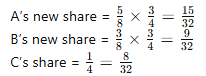
New Profit Sharing Ratio
A : B : C = 15 : 9 : 8
Calculate Sacrificing Ratio
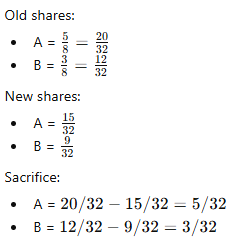
Sacrificing Ratio
A : B = 5 : 3
8. Rohit and Meena are partners sharing profits and losses in the ratio of 7 : 3. Rohit surrenders 1/7 of his share and Meena surrenders 1/3 of her share in favour of Teena,a new partner. Calculate the new profit sharing ratio.
Ans: Given:
Rohit: Meena = 7 : 3
Rohit surrenders 1/7 of his share
Meena surrenders 1/3 of her share
Teena gets the surrendered share
Convert into Fractions
Total = 7 + 3 = 10
Rohit’s share = 7/10
Meena’s share = 3/10
Calculate Sacrifice
Rohit’s sacrifice:
1/7 × 7/10 = 1/10
Meena’s Sacrifice
1/3 × 3/10 = 1/10
New Shares:
Rohit:
7/10 – 1/10 = 6/10
Meena:
3/10 – 1/10 = 2/10
Teena:
1/10 + 1/10 = 2/10
New Profit Sharing Ratio
Rohit : Meena : Teena
= 6 : 2 : 2
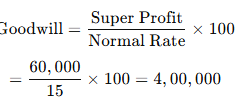
9. A firm has earned `3,00,000 as average profit for the last few years. Normal rate of return in the class of business is 15%. Find out goodwill according to Capitalisation of Super profit, if the value of net assets amounted to `16,00,000.
Ans: Given:
Average Profit = ₹3,00,000
Normal Rate of Return = 15%
Net Assets = ₹16,00,000
Calculate Normal Profit:
Normal Profit=15/100×16,00,000=2,40,000
Calculate Super Profit:
Super Profit=3,00,000−2,40,000=60,000
Calculate Goodwill (Capitalisation of Super Profit)
Formula:
10. The following is the Balance Sheet of Tarun and Ashima sharing profit and losses in the ratio of 2 : 1.
Balance Sheet:
| Liabilities | Amount (₹) | Assets | Amount (₹) |
| Capitals: | Cash | 12,000 | |
| Tarun | 50,000 | Sundry Debtors | 60,000 |
| Ashima | 40,000 | Stock | 12,000 |
| 90,000 | Furniture | 6,000 | |
| Sundry creditors | 20,000 | Building | 20,000 |
| Total | 1,10,000 | Total | 1,10,000 |
They agreed to admit Sunita into partnership on the following terms:
(i) Sunita to pay ₹ 9,000 as Goodwill.
(ii) Sunita bring ₹ 11,000 as her Capital for 1/4 share of profit in the business.
(iii) Building and furniture to be depreciated at 5%. Stock is reduced by ₹ 1,600 and Bad Debt Reserve ₹ 1,300 to be provided for.
Ans:
Working note:
| Particulars | Calculation | Amount (₹) |
| Building depreciated by 5% | 20,000 × 5% | 1,000 |
| Furniture depreciated by 5% | 6,000 × 5% | 300 |
| Stock reduced | Given | 1,600 |
| Bad Debt Reserve on Debtors | Given | 1,300 |
| Total Revaluation Loss | 1,000 + 300 + 1,600 + 1,300 | 4,200 |
Revaluation Account:
| Particulars | Amount (₹) | Particulars | Amount (₹) |
| To Building (5%) | 1,000 | By Loss transferred to: | |
| To Furniture (5%) | 300 | Tarun 4,200 × 2/3 = ₹2,800 | 2,800 |
| To Stock (Reduced) | 1,600 | Ashima 4,200 × 1/3 = ₹1,400 | 1,400 |
| To Bad Debt Reserve | 1,300 | ||
| Total | 4,200 | Total | 4,200 |
Partners’ Capital Accounts
We distribute the Premium for Goodwill in the Sacrificing Ratio. Since no specific sacrifice is mentioned, the old ratio (2:1) is used.
Tarun’s share of Goodwill: 9,000 \times 2/3 = 6,000
Ashima’s share of Goodwill: 9,000 \times 1/3 = 3,000
Partners’ Capital Accounts
| Particulars | Tarun (₹) | Ashima (₹) | Sunita (₹) | Particulars | Tarun (₹) | Ashima (₹) | Sunita (₹) |
| To Revaluation Loss | 2,800 | 1,400 | – | By Balance b/d | 50,000 | 40,000 | – |
| To Balance c/d | 53,200 | 41,600 | 11,000 | By Premium for Goodwill | 6,000 | 3,000 | – |
| By Cash (Capital) | – | – | 11,000 | ||||
| Total | 56,000 | 43,000 | 11,000 | Total | 56,000 | 43,000 | 11,000 |
Calculation of New Cash Balance
New Cash = Old Cash + Sunita’s Capital + Premium for Goodwill
= ₹12,000 + ₹11,000 + ₹9,000
= ₹32,000
Summary of New Balances:
- Tarun’s Capital = ₹53,200
- Ashima’s Capital = ₹41,600
- Sunita’s Capital = ₹11,000
Total Capital = ₹1,05,800
Balance sheet
| Liabilities | Amount (₹) | Assets | Amount (₹) |
| Sundry Creditors | 20,000 | Cash | 32,000 |
| Tarun’s Capital | 53,200 | Sundry Debtors | 58,700 |
| Ashima’s Capital | 41,600 | Stock | 10,400 |
| Sunita’s Capital | 11,000 | Furniture | 5,700 |
| Building | 19,000 | ||
| Total | 1,25,800 | Total | 1,25,800 |
11. A and B are partner in a firm sharing profit in the ratio 2 : 1. C is admitted into the firm with 1/4 share in profits. He will bring in ₹ 60,000 as capital and capital of A and B are to be adjusted in the profit sharing ratio. The Balance Sheet of A and B as on March 31, 2014 was as under:
Balance Sheet of A and B as on March 31, 2014
| Liabilities | Amount (₹) | Assets | Amount (₹) |
| Sundry creditors | 16,000 | Cash in Hand | 4,000 |
| Bills Payable | 8,000 | Cash at Bank | 20,000 |
| General Reserve | 12,000 | Sundry Debtors | 16,000 |
| Capitals: | Stock | 20,000 | |
| A | 1,00,000 | Furniture | 10,000 |
| B | 64,000 | Machinery | 50,000 |
| 1,64,000 | Building | 80,000 | |
| Total | 2,00,000 | Total | 2,00,000 |
Other terms of agreement are as under:
(i) C will bring in ₹ 24,000 as his share of Goodwill.
(ii) Building was valued at ₹ 90,000 and Machinery at ₹ 46,000.
(iii) A provision for bad debts is to be created @ 6% on Debtors.
(iv) The capital account of A and B are to be adjusted through cash.
Prepare necessary accounts and Balance Sheet after C’s admission.
Ans: Working Notes
(i) Revaluation of Assets
Revaluation Account:
We first record the changes in the value of assets.
Building: Increased from ₹ 80,000 to ₹ 90,000 (+ ₹ 10,000).
Machinery: Decreased from ₹ 50,000 to ₹ 46,000 (- ₹ 4,000).
Provision for Bad Debts: 6% × 16,000 = ₹ 960 (Decrease in asset value).
Revaluation Profit
= ₹10,000 − ₹4,000 − ₹960
= ₹5,040
(ii) Distribution of Revaluation Profit (Old Ratio 2 : 1)
- A = ₹5,040 × 2/3 = ₹3,360
- B = ₹5,040 × 1/3 = ₹1,680
Revaluation Account
| Particulars | Amount (₹) | Particulars | Amount (₹) |
| To Machinery A/c (Decrease in Value) | 4,000 | By Building A/c (Increase in Value) | 10,000 |
| To Provision for Bad Debts A/c | 960 | ||
| To Profit transferred to: | |||
| A’s Capital A/c | 3,360 | ||
| B’s Capital A/c | 1,680 | ||
| Total | 10,000 | Total | 10,000 |
Working note
(iii) New Profit-sharing Ratio
C gets 1/4 share.
Remaining share = 3/4
A’s Share = 2/3 × 3/4 = 1/2
B’s Share = 1/3 × 3/4 = 1/4
C’s Share = 1/4
New Ratio = 2 : 1 : 1
(iv) Total Capital of the New Firm
C brings ₹60,000 for 1/4 share.
Total Capital
= ₹60,000 ÷ 1/4
= ₹2,40,000
Partners’ Capital Accounts (Before Adjustment)
Before adjusting for the new profit-sharing ratio, we update the existing balances with General Reserve, Revaluation Profit, and Premium for Goodwill (2:1).
Partners’ Capital Accounts
| Particulars | A (₹) | B (₹) | C (₹) | Particulars | A (₹) | B (₹) | C (₹) |
| To Balance c/d | 1,27,360 | 77,680 | 60,000 | By Balance b/d | 1,00,000 | 64,000 | — |
| By General Reserve | 8,000 | 4,000 | — | ||||
| By Revaluation Profit | 3,360 | 1,680 | — | ||||
| By Premium for Goodwill | 16,000 | 8,000 | — | ||||
| By Bank A/c (Capital Introduced) | — | — | 60,000 | ||||
| Total | 1,27,360 | 77,680 | 60,000 | Total | 1,27,360 | 77,680 | 60,000 |
Capital Adjustment:
The capitals of A and B must be adjusted based on C’s capital for 1/4 share.
Total Capital of the New Firm: 60,000 * 4/1 = ₹ 2,40,000.
New Profit Sharing Ratio:
Remaining share = 1 – 1/4 = 3/4.
A’s new share = 2/3 \times 3/4 = 1/2 (or 2/4).
B’s new share = 1/3 \times 3/4 = 1/4.
New Ratio (A:B:C) = 2:1:1.
Required Capitals:
A: 2,40,000 \times 2/4 = ₹ 1,20,000$.
B: 2,40,000 \times 1/4 = ₹ 60,000$.
C: 2,40,000 \times 1/4 = ₹ 60,000$.
Cash Adjustments:
A: Adjusted balance is ₹ 1,27,360. Required is ₹ 1,20,000. A will withdraw ₹ 7,360.
B: Adjusted balance is ₹ 77,680. Required is ₹ 60,000. B will withdraw ₹ 17,680.
Balance Sheet of the New Firm (After C’s admission and capital adjustments)
| Liabilities | Amount (₹) | Assets | Amount (₹) |
| Capitals: | Building | 90,000 | |
| A | 1,20,000 | Machinery | 46,000 |
| B | 60,000 | Furniture | 10,000 |
| C | 60,000 | Stock | 20,000 |
| Sundry Creditors | 16,000 | Sundry Debtors (16,000 – 960) | 15,040 |
| Bills Payable | 8,000 | Cash in Hand | 4,000 |
| Cash at Bank* | 78,960 | ||
| Total | 2,64,000 | Total | 2,64,000 |
Calculation of New Bank Balance:
Opening Bank (20,000) + C’s Capital (60,000) + Goodwill (24,000) -A’s withdrawal (7,360) – {B’s withdrawal (17,680) = ₹ 78,960.


 Buy Now