
NIOS Class 12 Accountancy Chapter 4 Accounting For Business Transactions Solutions English Medium As Per New Syllabus. to each chapter is provided in the list so that you can easily browse throughout different chapters NIOS Class 12 Accountancy Chapter 4 Accounting For Business Transactions Notes and select need one. NIOS Class 12 Accountancy Chapter 4 Accounting For Business Transactions Question Answers Download PDF. NIOS Study Material of Class 12 Accountancy Paper Code: 320.
NIOS Class 12 Accountancy Chapter 4 Accounting For Business Transactions
Also, you can read the NIOS book online in these sections Solutions by Expert Teachers as per National Institute of Open Schooling (NIOS) Book guidelines. These solutions are part of NIOS All Subject Solutions. Here we have given NIOS Class 12 Accountancy Solutions English Medium , NIOS Senior Secondary Course Accountancy Notes in English Medium for All Chapter, You can practice these here.
Accounting For Business Transactions
Chapter: 4
| Module – 1: Basic Accounting |
INTEXT QUESTIONS 4.1
I. Classify the following into Business and Non-business Transactions:
(i) Manav commences business with cash ₹200000.
Ans: Business transaction.
(ii) He deposited cash into bank ₹160000.
Ans: Business transaction.
(iii) He purchased goods for cash ₹25000.
Ans: Business transaction.
(iv) He took out cash from the shop and handed over to his wife for purchasing household goods ₹3000.
Ans: Non-business transaction.
(v) He attended a family function and got a gift worth ₹1500.
Ans: Non-business transaction.
(vi) He paid monthly salary to his business employees ₹3000.
Ans: Business transaction.
II. Fill in the blanks with suitable word or words:
(i) The accounting vouchers are based on ………………….
Ans: Supporting document.
(ii) Invoice/bill is a …………………. document.
Ans: Source.
(iii) Both debit and credit aspects of a transaction are shown by …………………. vouchers.
Ans: Transfer.
(iv) A credit voucher is prepared for …………………. receipts.
Ans: Cash.
(v) A debit voucher is prepared for …………………. payments.
Ans: Cash.
INTEXT QUESTIONS 4.2
Fill in the blanks with suitable word/words:
(i) Accounting equation satisfies the ………………. concept of accounting.
Ans: Dual.
(ii) Assets = ………………. + Liabilities
Ans: Capital.
(iii) Capital = Assets – ……………….
Ans: Liabilities.
(iv) Accounting Equation serves as a basis for preparing ……………….
Ans: Balance sheet.
(v) Liabilities = ………………. – Capital
Ans: Assets.
INTEXT QUESTIONS 4.3
A list of the accounts is given below. Tick the category to which each of the account belongs:
Type of Account
| Name of Account | Asset | Liability | Capital | Revenue | Expense |
| (i) Wages | |||||
| (ii) Building | |||||
| (iii) Office Machine | |||||
| (iv) Cash | |||||
| (v) Mohan (Supplier) | |||||
| (vi) Krishan (Owner) | |||||
| (vii) Radha (Customer) | |||||
| (viii) Interest Received | |||||
| (ix) Bank Overdraft | |||||
| (x) Commission Earned | |||||
| (xi) Discount Allowed |
Ans:
| Name of Account | Asset | Liability | Capital | Revenue | Expense |
| (i) Wages | ✅ | ||||
| (ii) Building | ✅ | ||||
| (iii) Office Machine | ✅ | ||||
| (iv) Cash | ✅ | ||||
| (v) Mohan (Supplier) | ✅ | ||||
| (vi) Krishan (Owner) | ✅ | ||||
| (vii) Radha (Customer) | ✅ | ||||
| (viii) Interest Received | ✅ | ||||
| (ix) Bank Overdraft | ✅ | ||||
| (x) Commission Earned | ✅ | ||||
| (xi) Discount Allowed | ✅ |
INTEXT QUESTIONS 4.4
I. Answer the following with reference to cash basis of accounting:
(i) How it is simple?
As ____________________________________________________
Ans: As no adjustment entries are required.
(ii) How it is more objective?
As ____________________________________________________
Ans: As very few estimates and personal judgement are required.
(iii) To which business it is more suitable?
Which _________________________________________________
Ans: Which have most of the transactions on cash basis.
(iv) Which is the concept of accounting it does not follow?
The ___________________________________________________
Ans: The matching concept.
(v) Credit sales of ₹10000 taken into account for calculating profit.
Ans: Should not.
II. State whether the following statements are True or False:
(i) Creditors are the internal users of accounting information.
Ans: False.
(ii) Management are the internal users of accounting information.
Ans: True.
(iii) Hybrid basis of accounting has advantages of both the systems (Cash & Accrual) of accounting.
Ans: True.
III. Answer the following questions referring to double entry mechanism:
(i) How possibility of frauds are minimised?
Ans: As complete information is recorded under this system.
(ii) How can arithmetical accuracy of the records be checked?
Ans: By preparing summarised statement of account.
(iii) Name the concept on which to record every transaction one account is debited and other is credited is based.
Ans: Every debit has a credit.
| TERMINAL EXERCISE |
1. State the meaning of business transaction.
Ans: A business transaction is defined as a transaction that involves the exchange of values between two parties. Every transaction contains a “Give and Take” aspect, where a debit represents the “Take” aspect and a credit represents the “Give” aspect. Essentially, these are exchanges of goods or services, the effects of which are recorded in at least two accounts.
2. What is meant by accounting voucher? Explain in brief different types of accounting vouchers.
Ans: An accounting voucher is a written document prepared to record and analyse a business transaction. It serves as documentary evidence and is prepared on the basis of source documents like invoices, cash memos, and receipts.
Types of Accounting Vouchers:
(i) Cash Vouchers: Used for cash transactions.
(ii) Debit Voucher: Prepared for cash payments such as expenses, purchases, and payments to creditors.
(iii) Credit Voucher: Prepared for cash receipts such as cash sales, rent received, interest received, etc.
(iv) Non-Cash (Transfer) Vouchers: Used to record non-cash transactions like credit purchases, credit sales, depreciation, bad debts, and return of goods.
3. State the fundamental rules followed to record the changes in various accounts.
Ans: All accounts are divided into five categories for the purpose of recording of the business transactions:
(i) Assets.
(ii) Liability.
(iii) Capital.
(iv) Expenses/Losses, and
(v) Revenues/Gains.
Two Fundamental Rules are followed to record the changes in these accounts:
(i) For recording changes in Assets/Expenses/Losses:
(a) “Increase in Asset is debited, and decrease in Asset is credited.”
(b) “Increase in Expenses/Losses is debited, and decrease in Expenses/Losses is credited.”
(ii) For recording changes in Liabilities and Capital/Revenue/Gains:
(a) “Increase in Liabilities is credited and decrease in Liabilities is debited.”
(b) “Increase in Capital is credited and decrease in Capital is debited.”
(c ) “Increase in revenue/gains is credited and decrease in revenue/gain is debited.”
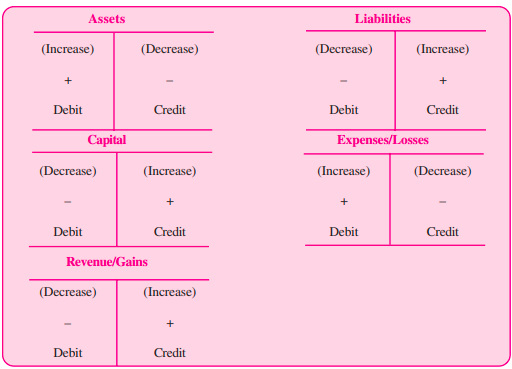
The rules applicable to the five kinds of accounts are summarised in the following chart:
4. Explain in brief cash basis of accounting and differentiate it with accrual basis of accounting.
Ans: This is a system in which accounting entries are recorded only when cash is received or paid. Revenue is recognized only on receipt of cash. Similarly, expenses are recorded as incurred when they are paid. The difference between the total revenues and total expenses represents profit or loss of an enterprise for a particular accounting period. Outstanding and prepaid expenses and income received in advance or accrued incomes are not considered.
Difference between Cash Basis and Accrual Basis of Accounting:
| Basis of Difference | Accrual Basis of Accounting | Cash Basis of Accounting |
| 1. Prepaid, Outstanding and received in advance items | There may be outstanding expense, prepaid expenses, accrued income and income received in advance in the Balance Sheet. | There is no outstanding expense, prepaid expenses, accrued income and income received in advance in the Balance Sheet. |
| 2. Effect on income of prepaid expenses and accrued income | Income statement will show relatively higher income if there are items of prepaid expenses and accrued income. | Income statement will show relatively lower income if there are items of prepaid expenses and accrued income. |
| 3. Effect of outstanding expenses and unearned income | Income statement will show a lower income if there are items of outstanding expenses and unearned income. | Income statement will show a higher income if there are items of outstanding expenses and unearned income. |
| 4. Legal Position | Companies Act 1956 recognizes this basis of accounting. | Companies Act 1956 does not recognize this basis of accounting. |
| 5. Option regarding valuation of inventories and methods of depreciation | The business unit has the option to value the inventories at cost or market, whichever is less. | No such option is available in regard to inventory valuation and method of depreciation. |
| 6. Reliable | It is a reliable basis of accounting as it records all cash as well credit transactions. It ascertains true profit or loss. | It is not a reliable basis of accounting as only cash transactions are recorded. It fails to ascertain true profit or loss. |
| 7. Users | A business unit with a profit motive ascertains its profit or loss as per accrual basis. | Professional people, small ventures of temporary nature, some Not-for-Profit Organizations ascertain their profit or loss as per cash basis. |
5. What is meant by double entry mechanism? Give its advantages.
Ans: Double Entry Mechanism entails recording of transactions keeping in mind the debit and credit aspect of the transaction. To record every transaction, one account is debited and the other is credited. This is based on the principle “every debit has a credit.”
The Double Entry Book-Keeping seeks to record every transaction in money or money’s worth in its dual aspect.
Advantages of Double Entry Mechanism:
(i) Systematic Record: It records, classifies, and synthesizes the business transactions in a systematic manner. It provides reliable information for sound decision making and meets the needs of users of accounting information.
(ii) Complete Record: It maintains a complete record of business transactions. Both aspects of each transaction are recorded along with proper narration.
(iii) Accurate Records: By preparing a summarised statement of accounts, the arithmetical accuracy of the records can be checked.
(iv) Operational Results: By preparing the Income Statement (Profit and Loss Account), the business can know the profit or loss during an accounting period.
(v) Financial Position: By preparing the Position Statement (Balance Sheet), the business can know what it owns and what it owes, i.e., its assets, liabilities, and capital.
(vi) Possibility of Fraud: The possibility of frauds is minimized as complete information is recorded under this system.
6. “Accounting equation remains intact under all circumstances.” Justify the statement with the help of examples.
Ans: The recording of business transactions in the books of account is based on a fundamental equation called Accounting Equation. This equation expresses the equality of assets on one side and equity (i.e., liabilities and capital) on the other side.
Assets = Liabilities + Capital
This equation always remains intact because every transaction has a dual aspect and affects at least two accounts.
Justification with Examples:
1. Capital Introduced:
Sunil started business with cash ₹3,00,000 as capital.
Cash (Asset) = Capital (Equity)
₹3,00,000 = ₹3,00,000
2. Purchase of Assets:
Sunil purchased Machinery ₹40,000 and Furniture ₹20,000.
Cash + Machinery + Furniture = Capital
2,40,000 + 40,000 + 20,000 = 3,00,000
3. Drawings:
Sunil withdrew cash ₹5,000 for personal use.
Cash + Machinery + Furniture = Capital
2,35,000 + 40,000 + 20,000 = 2,95,000
4. Loan Taken:
₹1,50,000 were borrowed from Shipra.
Cash + Machinery + Furniture = Liabilities + Capital
3,85,000 + 40,000 + 20,000 = 1,50,000 + 2,95,000
5. Payment of Expenses:
Salaries paid ₹16,000.
Cash decreases by ₹16,000 and Capital also decreases by ₹16,000.
Conclusion:
From the above examples, it is clear that every transaction affects the accounting equation but does not disturb its equality. Thus, the accounting equation always remains balanced.Hence, “Accounting equation remains intact under all circumstances.”
7. Prepare accounting equation on the basis of the following:
(i) Anup started business with cash ₹2,50,000.
(ii) Purchased goods for cash ₹35,000.
(iii) Purchased office furniture for cash ₹12,000.
(iv) Paid rent ₹7,000.
(v) Sold goods (costing ₹30,000) for ₹50,000 for cash.
Ans: (i) Anup started business with cash ₹2,50,000.
Assets = Cash ₹2,50,000
Capital = ₹2,50,000
Equation:
Assets ₹2,50,000 = Liabilities 0 + Capital ₹2,50,000
(ii) Purchased goods for cash ₹35,000.
Cash decreases, Goods increases (asset remains same)
Cash = 2,50,000 − 35,000 = ₹2,15,000
Goods = ₹35,000
Total Assets = 2,15,000 + 35,000 = ₹2,50,000
Equation:
Assets ₹2,50,000 = Liabilities 0 + Capital ₹2,50,000
(iii) Purchased office furniture for cash ₹12,000.
Cash = 2,15,000 − 12,000 = ₹2,03,000
Furniture = ₹12,000
Assets = Cash 2,03,000 + Goods 35,000 + Furniture 12,000
Total Assets = ₹2,50,000
Equation:
Assets ₹2,50,000 = Liabilities 0 + Capital ₹2,50,000
(iv) Paid rent ₹7,000.
Rent is an expense → Capital decreases.
Cash = 2,03,000 − 7,000 = ₹1,96,000
Capital = 2,50,000 − 7,000 = ₹2,43,000
Assets = Cash 1,96,000 + Goods 35,000 + Furniture 12,000 = ₹2,43,000
Equation:
Assets ₹2,43,000 = Liabilities 0 + Capital ₹2,43,000
(v) Sold goods (cost ₹30,000) for ₹50,000 cash.
Cash increases by ₹50,000
Goods decrease by ₹30,000
Profit = 50,000 − 30,000 = ₹20,000 → Capital increases
Cash = 1,96,000 + 50,000 = ₹2,46,000
Goods = 35,000 − 30,000 = ₹5,000
Furniture = ₹12,000
Total Assets = 2,46,000 + 5,000 + 12,000 = ₹2,63,000
Capital = 2,43,000 + 20,000 = ₹2,63,000
Final Accounting Equation:
Assets ₹2,63,000 = Liabilities 0 + Capital ₹2,63,000

 Buy Now