
NIOS Class 12 Accountancy Chapter 7 Cash Book Solutions English Medium As Per New Syllabus. to each chapter is provided in the list so that you can easily browse throughout different chapters NIOS Class 12 Accountancy Chapter 7 Cash Book Notes and select need one. NIOS Class 12 Accountancy Chapter 7 Cash Book Question Answers Download PDF. NIOS Study Material of Class 12 Accountancy Paper Code: 320.
NIOS Class 12 Accountancy Chapter 7 Cash Book
Also, you can read the NIOS book online in these sections Solutions by Expert Teachers as per National Institute of Open Schooling (NIOS) Book guidelines. These solutions are part of NIOS All Subject Solutions. Here we have given NIOS Class 12 Accountancy Solutions English Medium, NIOS Senior Secondary Course Accountancy Notes in English Medium for All Chapter, You can practice these here.
Cash Book
Chapter: 7
| Module – 1: Basic Accounting |
INTEXT QUESTIONS 7.1
I. Complete the following sentences with the suitable words:
(i) Cash Book starts with the ___________ Balance at the beginning of the period.
Ans: Cash.
(ii) When a Cash Book is maintained, cash transactions are not recorded in ___________.
Ans: Journal.
(iii) Simple Cash Book records only Cash ___________ and Cash ___________.
Ans: Receipts and Payments.
(iv) The total of ___________ side of the Simple column Cash Book is always more than the total of its ___________ side.
Ans: Debit, Credit.
(v) Closing Balance of Cash Book becomes the opening balance of next period and is written as ___________.
Ans: Balance b/d.
II. Some transactions are given below. On which side of the Cash Book would you record them. Tick [√] the correct side:
| S.No. | Transactions | Debit Side | Credit Side |
| (i) | Saniya started business with Cash | ||
| (ii) | Goods Purchased for cash | ||
| (iii) | Goods sold for Cash | ||
| (iv) | Cash deposited into Bank | ||
| (v) | Rent paid | ||
| (vi) | Purchased Computer | ||
| (vii) | Closing Cash Balance | ||
| (viii) | Cash received from Mohit |
Ans:
| S.No. | Transactions | Debit Side | Credit Side |
| (i) | Saniya started business with Cash | √ | |
| (ii) | Goods Purchased for cash | √ | |
| (iii) | Goods sold for Cash | √ | |
| (iv) | Cash deposited into Bank | √ | |
| (v) | Rent paid | √ | |
| (vi) | Purchased Computer | √ | |
| (vii) | Closing Cash Balance | √ | |
| (viii) | Cash received from Mohit | √ |
INTEXT QUESTIONS 7.2
Fill in the blanks with suitable word/words:
(i) In Bank Column Cash Book ___________ columns are shown on each side.
Ans: Bank/Cash.
(ii) The Bank column Cash Book records transactions relating to ___________ as well as ___________.
Ans: Cash and Bank.
(iii) Credit balance of Bank Column of Cash Book is called ___________.
Ans: Overdraft.
(iv) When a cheque is received from a customer but not deposited into the Bank on the same day, it will be recorded on ___________ side in ___________ column.
Ans: Debit side in Cash column.
(v) When transactions relate to both cash and bank side of Bank Column Cash Book, such transactions are known as ___________.
Ans: Contra entry.
(vi) When cheque received from customer is given to some other party it is called ___________.
Ans: Endorsement.
INTEXT QUESTIONS 7.3
Fill in the blanks with suitable word/words:
(i) The assistant of the Head Cashier is known as _________.
Ans: Petty cashier.
(ii) A separate cash book to record small transactions is called _________.
Ans: Petty cash book.
(iii) The amount which is paid to the petty cashier at the beginning of a period is known as __________.
Ans: Imprest amount.
(iv) Under Imprest system of Petty Cash Book, the Petty Cashier is reimbursed with the amount equivalent to what he spent during the _________.
Ans: Previous month.
| TERMINAL EXERCISE |
1. What is Cash Book? Explain the different types of Cash Book.
Ans: Cash Book is a Book in which all cash receipts and cash payments are recorded. It is also one of the books of original entry. It starts with the cash or bank balance at the beginning of the period. In case of new business, there is no cash balance to start with. It is prepared by all organisations. When a cash book is maintained, cash transactions are not recorded in the Journal, and no cash or bank account is required to be maintained in the ledger as Cash Book serves the purpose of Cash Account.
Different types of cash book:
(i) Simple Cash Book: A Simple Cash Book records only cash receipts and cash payments. It has two sides, namely debit and credit. Cash receipts are recorded on the debit side i.e. left hand side and cash payments are recorded on the credit side i.e. right hand side. In this book there is only one amount column on its debit side and on the credit side.
(ii) Bank Column Cash Book: When the number of bank transactions is large in an organisation, it is necessary to have a separate book to record bank transactions. Instead of having a separate book to record bank transactions, a column is added on each side of the Simple Cash Book. This type of cash book is known as Bank column Cash Book. All payments into bank are recorded on the debit side and all withdrawals/payments through the bank are recorded on the credit side of the cash book.
(iii) Petty Cash Book: In big business organisations, a large number of repetitive small payments such as, for conveyance, cartage, postage, telegrams, courier and other expenses are made. These organisations appoint an assistant to the Head Cashier. The appointed cashier is known as petty cashier. He makes payments of these expenses and maintains a separate cash book to record these transactions. Such a cash book is called Petty Cash Book.
2. Draw the format of ‘Bank Column Cash Book’ and write at least five items in it.
Ans: A Bank Column Cash Book is a cash book which has two amount columns on each side—one for Cash and one for Bank transactions.
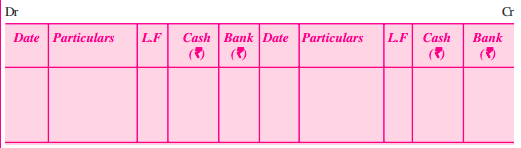
In Bank column Cash Book, the cash transactions are recorded in a similar manner as are recorded in the Simple cash book. The difference is that Bank column cash book records transactions relating to Bank also.
There are some special business transactions which need special treatment in the Bank column of the Cash Book:
(i) Opening balance.
(ii) Receipts of cheques.
(iii) Contra entries.
(iv) Endorsement of cheques.
(v) Bank charges.
3. What is Contra entry? How will you deal with this entry while preparing Bank Column Cash Book?
Ans: A contra entry is an entry which affects both cash and bank columns of the cash book. It occurs when cash is deposited into the bank or withdrawn from the bank for office use.
Treatment in Bank Column Cash Book:
(i) When cash is deposited into the bank:
(a) It is recorded on the credit side in the cash column.
(b) And on the debit side in the bank column.
(ii) When cash is withdrawn from the bank:
(a) It is recorded on the credit side in the bank column.
(b) And on the debit side in the cash column.
(iii) Such entries are marked with the letter “C” in the folio column to indicate that they are contra entries.
4. What do you mean by Petty Cash Book? Explain the imprest system of Petty Cash Book.
Ans: In big business organisations, a large number of repetitive small payments such as for conveyance, cartage, postage, telegrams, courier and other expenses are made. These organisations appoint an assistant to the Head Cashier. The appointed cashier is known as petty cashier. He makes payments of these expenses and maintains a separate cash book to record these transactions. Such a cash book is called Petty Cash Book.
Imprest System of Petty Cash Book:
Under this system, a fixed amount is given to the petty cashier at the beginning of a period. This amount is called imprest money. The petty cashier makes small payments out of this amount during the period.
At the end of the period, he submits the account of expenses to the Head Cashier and gets reimbursed for the amount spent. After reimbursement, the petty cashier again has the full imprest amount at the beginning of the next period.
For example, if ₹4,000 is given and ₹3,850 is spent, then ₹3,850 is reimbursed so that the balance again becomes ₹4,000.
5. Enter the following transactions in the Simple Cash Book of M/s Golden Traders:
| Date | Particulars | ₹ |
| April 1 | Started Business with Cash | 30,000 |
| April 2 | Goods Purchased for Cash | 10,000 |
| April 3 | Furniture Purchased | 1,000 |
| April 6 | Goods Sold for Cash | 7,000 |
| April 9 | Cartage paid | 200 |
| April 10 | Postage | 100 |
| April 12 | Cash Sales | 3,000 |
| April 14 | Cash withdrawn for Personal use | 2,000 |
| April 18 | Deposited into Bank | 10,000 |
| April 22 | Goods purchased for Cash | 13,000 |
| April 25 | Wages paid | 500 |
| April 27 | Rent paid | 3,000 |
| April 28 | Cash Sales | 2,000 |
| April 30 | Commission received | 500 |
Ans: Simple Cash Book of M/s Golden Traders
For the month of April
| Date | Receipts (Particulars) | L.F. | Amount (₹) | Date | Payments (Particulars) | L.F. | Amount (₹) |
| 2024 | 2024 | ||||||
| Apr 1 | To Capital A/c | 30,000 | Apr 2 | By Purchases A/c | 10,000 | ||
| Apr 6 | To Sales A/c | 7,000 | Apr 3 | By Furniture A/c | 1,000 | ||
| Apr 12 | To Sales A/c | 3,000 | Apr 9 | By Cartage A/c | 200 | ||
| Apr 28 | To Sales A/c | 2,000 | Apr 10 | By Postage A/c | 100 | ||
| Apr 30 | To Commission A/c | 500 | Apr 14 | By Drawings A/c | 2,000 | ||
| Apr 18 | By Bank A/c | 10,000 | |||||
| Apr 22 | By Purchases A/c | 13,000 | |||||
| Apr 25 | By Wages A/c | 500 | |||||
| Apr 27 | By Rent A/c | 3,000 | |||||
| Apr 30 | By Balance c/d | 2,700 | |||||
| Total | 42,500 | Total | 42,500 | ||||
| May 1 | To Balance b/d | 2,700 |
6. From the following transactions prepare Simple Cash Book:
| Date | Particulars | ₹ |
| March 1 | Cash in hand | 32,500 |
| March 8 | Cash paid to Rohan | 8,000 |
| March 12 | Goods Purchased | 3,000 |
| March 15 | Cash received from Tanaya | 2,000 |
| March 18 | Cash Sales | 4,000 |
| March 22 | Paid wages | 4,000 |
| March 25 | Salary paid | 3,000 |
| March 28 | Cash paid to Manish | 3,500 |
| March 31 | Rent paid | 2,500 |
Ans:
| Date | Particulars | L.F. | Amount (₹) | Date | Particulars | L.F. | Amount (₹) |
| Mar 1 | To Balance b/d | 32,500 | Mar 8 | By Rohan A/c | 8,000 | ||
| Mar 15 | To Tanaya A/c | 2,000 | Mar 12 | By Purchases A/c | 3,000 | ||
| Mar 18 | To Sales A/c | 4,000 | Mar 22 | By Wages A/c | 4,000 | ||
| Mar 25 | By Salary A/c | 3,000 | |||||
| Mar 28 | By Manish A/c | 3,500 | |||||
| Mar 31 | By Rent A/c | 2,500 | |||||
| Mar 31 | To Balance c/d | 14,500 | |||||
| Total | 53,000 | Total | 53,000 |
7. Prepare Bank Column Cash Book from the following transactions:
| Date | Particulars | ₹ |
| July 1 | Cash in hand | 18,000 |
| July 1 | Cash at Bank | 27,500 |
| July 3 | Goods sold for cash | 10,000 |
| July 6 | Bought Goods by Cheque | 16,000 |
| July 8 | Cash deposited into Bank | 20,000 |
| July 10 | Paid Trade Expenses through Cheque | 2,000 |
| July 12 | Paid Audit Fee for Cash | 1,000 |
| July 14 | Cheque received from Garima and deposited into bank | 4,700 |
| July 18 | Withdrew from bank for personal use | 2,000 |
| July 20 | Purchased office machine by Cheque | 5,000 |
| July 22 | Wages paid | 1,000 |
| July 26 | Cash Sales | 5,000 |
| July 28 | Received Cheque from Mahesh | 2,000 |
| July 29 | Salary Paid | 5,000 |
| July 30 | Mahesh’s Cheque deposited into Bank | |
| July 31 | Rent paid | 2,000 |
Ans:
Dr. Cr. | |||||||||
| Date | Particulars | L.F. | Cash (₹) | Bank (₹) | Date | Particulars | L.F. | Cash (₹) | Bank (₹) |
| July 1 | Balance b/d | 18,000 | 27,500 | July 6 | Purchases | 16,000 | |||
| July 3 | Sales | 10,000 | July 10 | Trade Expenses | 2,000 | ||||
| July 8 | Bank (C) | C | 20,000 | July 12 | Audit Fee | 1,000 | |||
| July 14 | Garima | 4,700 | July 18 | Drawings | 2,000 | ||||
| July 26 | Sales | 5,000 | July 20 | Office Machine | 5,000 | ||||
| July 28 | Mahesh | 2,000 | July 22 | Wages | 1,000 | ||||
| July 30 | Bank (C) | C | 2,000 | July 29 | Salary | 5,000 | |||
| July 31 | Rent | 2,000 | |||||||
| July 8 | By Bank (C) | C | 20,000 | ||||||
| July 30 | By Bank (C) | C | 2,000 | ||||||
| July 31 | Balance c/d | 4,000 | 29,200 | ||||||
| Total | 35,000 | 54,200 | Total | 35,000 | 54,200 | ||||

 Buy Now