
NCERT Class 9 Science Chapter 1 Exploration: Entering the World of Secondary Science Solutions English Medium As Per New Syllabus. NCERT Class 9 Science Chapter 1 Exploration: Entering the World of Secondary Science Notes to each chapter is provided in the list so that you can easily browse throughout different chapter NCERT Class 9 General Science Textual Question Answer Download PDF and select needs one. CBSE Class 9 Science Solutions.
NCERT Class 9 Science Chapter 1 Exploration: Entering the World of Secondary Science
Also, you can read the CBSE book online in these sections Solutions by Expert Teachers as per (CBSE) Book guidelines. NCERT Class 9 Science Textbook Solutions. These solutions are part of NCERT All Subject Solutions. Here we have given NCERT Class 9 Science Notes in English Medium Solutions for All Subject, You can practice these here.
Exploration: Entering the World of Secondary Science
Chapter – 1
| Pause And Ponder |
1. Think of a prediction you or your family made recently (for example, the outcome of a cricket match). Was it based on evidence and reasoning. or mainly on guesswork? How can scientific thinking improve such predictions?
Ans: Recently, my family predicted that our favorite team would win a cricket match. The prediction was mostly based on our feelings and support for the team, not on proper evidence.
Scientific thinking can improve such predictions by using facts and reasoning. For example, we can study the teams’ past performances, players’ current form, pitch conditions, weather, and head-to-head records. By analyzing this evidence, our prediction becomes more logical and reliable, although it still cannot guarantee the exact result.
| Pause And Ponder |
1. Describe one situation where an approximate answer is good enough, and one where you would need a very exact value.
Ans: (i) Situation where an approximate answer is good enough: Estimating the number of students in a school assembly or the time needed to reach the market.
(ii) Situation where a very exact value is needed: Measuring the dose of medicine for a patient or calculating the amount of money in a bank transaction.
| Pause And Ponder |
1. Choose a real-life object (maybe a pressure cooker or a mobile phone) or a problem (maybe a traffic jam near your school). Make a sketch listing what kind of ideas from physics, chemistry, biology, earth science, or mathematics are involved. Show how at least two branches of science connect with your example.
Ans:
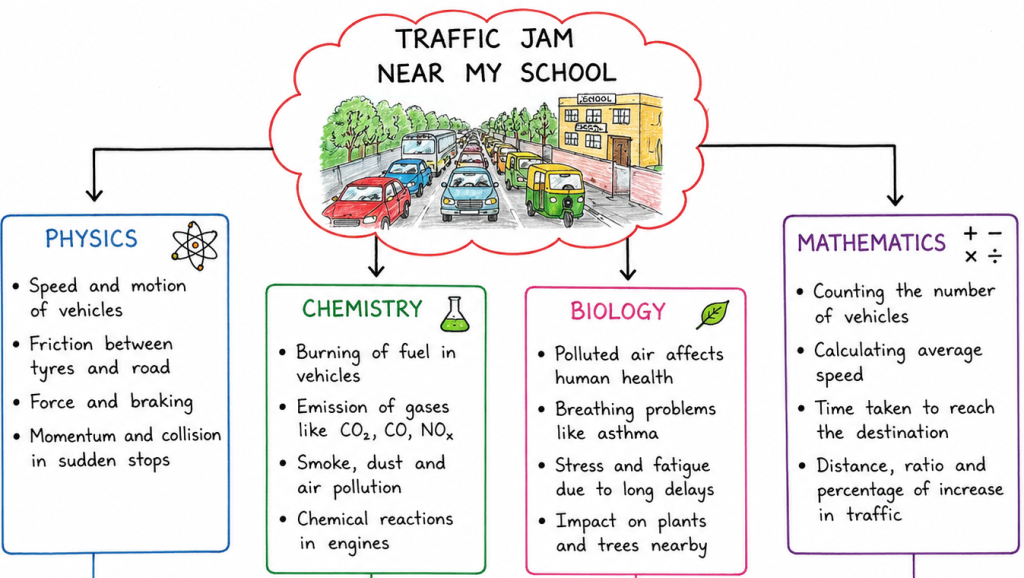
How the branches of science connect:
- Physics explains how vehicles move, stop, and accelerate.
- Chemistry explains how burning fuel produces harmful gases and smoke.
- Biology explains how polluted air affects human health.
- Mathematics helps calculate the number of vehicles, traffic speed, and travel time.
Thus, a traffic jam is a real-life problem that connects Physics, Chemistry, Biology, and Mathematics.
| Additionally Added Questions |
1. What does the magnifying glass symbolise in the textbook’s page numbers?
(a) Wandering aimlessly.
(b) Careful observation.
(c) Finding directions.
(d) Measuring speed.
Ans: (b) Careful observation.
2. In science, what is a “model”?
(a) A perfect, full-detail replica of nature.
(b) A simplified way of looking at real systems to focus on what is important.
(c) A mathematical calculation.
(d) An untested guess.
Ans: (b) A simplified way of looking at real systems to focus on what is important.
3. Which physicist simplified the study of stars by treating their matter as a hot gas?
(a) Isaac Newton.
(b) Albert Einstein.
(c) Meghnad Saha.
(d) C.V. Raman.
Ans: (c) Meghnad Saha.
4. What does the symbol ‘c’ stand for in scientific equations?
(a) Carbon.
(b) Cell.
(c) Speed of light.
(d) Current.
Ans: (c) Speed of light.
5. Why did a passenger aircraft once run out of fuel mid-flight?
(a) A hole in the fuel tank.
(b) A mix-up in units between pounds and kilograms.
(c) Bad weather conditions.
(d) An engine malfunction.
Ans: (b) A mix-up in units between pounds and kilograms.
6. What is a scientific “theory”?
(a) A regular pattern observed in nature.
(b) A broad idea to make sense of a situation.
(c) An explanation based on careful testing and critical examination.
(d) A guess with no measurable evidence.
Ans: (c) An explanation based on careful testing and critical examination.
7. The Latin word ‘celeritas’ means:
(a) Light.
(b) Speed.
(c) Stars.
(d) Observation.
Ans: (b) Speed.
8. What is the approximate estimated volume of one human breath?
(a) 2 litres.
(b) 1 litre.
(c) 0.5 litre.
(d) 10 litres.
Ans: (c) 0.5 litre.
9. Why do weather forecasts sometimes go wrong?
(a) Meteorologists only guess the weather based on clouds.
(b) Tiny differences in conditions can grow over time and change the outcome.
(c) The speed of wind cannot be measured.
(d) Thermometers are highly inaccurate.
Ans: (b) Tiny differences in conditions can grow over time and change the outcome.
10. Understanding how a mask works requires concepts from which branches of science?
(a) Physics and Chemistry.
(b) Biology and Mathematics.
(c) Chemistry and Earth Science.
(d) Physics, Chemistry, Biology, and Mathematics.
Ans: (d) Physics, Chemistry, Biology, and Mathematics.
Short Question Answer:
1. Why are models used in science?
Ans: The natural world is complex, so science uses models as simplified ways of looking at real systems, focusing only on what is most important for a given question.
2. What details might be ignored when studying the motion of a falling object?
Ans: When studying a falling object, air resistance may be neglected to understand the basic effect of gravity.
3. What does the compass symbolise in scientific exploration?
Ans: The compass reminds us that exploration needs direction, which means choosing appropriate models, asking the right questions, and knowing the limits of our ideas.
4. How did Meghnad Saha study the light from stars?
Ans: He treated the matter in the star as a hot gas, ignored complex processes, and focused only on temperature, pressure, and how atoms formed ions.
5. Why is mathematics important in science?
Ans: Mathematics is a language that helps us think more clearly about the world, allowing relationships between quantities to be expressed clearly and tested carefully.
6. What is the difference between a scientific law and a theory?
Ans: A law usually describes a regular pattern observed in nature, whereas a theory provides an explanation of why those patterns occur based on evidence.
7. What is an example of a scientific principle mentioned in the text?
Ans: The principle of conservation of energy is an example of a broad idea that helps make sense of situations, such as climbing up the stairs.
8. Why is it important to use standard (SI) units globally?
Ans: Standard units ensure fairness in daily life and trade, allow scientific results to be compared globally, and help prevent serious errors like the airplane fuel miscalculation.
9. Is it true that food becomes harmful during an eclipse?
Ans: No, this is false because an eclipse is just a play of shadows, and there is no physical, chemical, or biological mechanism that causes food to go bad in a shadow.
10. Why is rough estimation considered an important scientific skill?
Ans: Learning to estimate helps build intuition, detect errors, and develop confidence in thinking by checking whether an answer is reasonable before doing exact calculations.
Long Question Answer:
1. Explain how building a scientific model involves making choices about what details to include and ignore, using the example of a cricket shot.
Ans: Building a model involves deliberately making assumptions and ignoring certain details to keep things simple enough to find answers. When making a simple model of a cricket ball being hit for a six, details like the mass of the ball, and the speed and direction in which it was hit are very important. However, irrelevant details like the brand of the bat, the color of the ball, or the amount of grass on the field make no difference and are ignored. Even factors with smaller effects, like air resistance or the spin of the ball, can be neglected in a simple model.
2. Describe the role of mathematics and equations in scientific exploration.
Ans: In science, mathematics is not meant to be a hurdle or just a calculation tool; it is a powerful language that helps us think clearly. An equation is a compact statement showing how certain things are related. Instead of just memorizing equations, learning to use math in science means understanding the physical situation first, identifying the relevant quantities, and then reasoning carefully. By doing this, math becomes a helpful guide for thinking rather than an obstacle.
3. Discuss the differences between laws, theories, and principles in science with examples.
Ans: A scientific law describes a regular pattern observed in nature and is often expressed in words or mathematical form. For example, Newton’s laws of motion describe how objects move under different forces. A scientific theory explains why these patterns occur and is based on careful observations, experiments, and evidence. For example, atomic theory explains the structure and behaviour of matter. A scientific principle is a broad idea that helps explain or analyse different situations. For example, the principle of conservation of energy helps explain situations such as climbing stairs, where chemical energy is converted into potential energy.
4. How does science handle situations where predictions do not match observations?
Ans: When scientific predictions do not match observations, scientists do not reject ideas based on personal opinion or belief, but rely purely on evidence. Instead, they re-examine their assumptions, models, or measurements to understand what went wrong. This shows that no scientific theory is ever final, and openness to being corrected by nature is one of science’s greatest strengths.
5. How does understanding the function of a COVID-19 mask demonstrate the interdisciplinary nature of science?
Ans: Solving real-world problems often requires combining knowledge from multiple branches of science rather than studying them in isolation. To truly understand how a COVID-19 mask works, one needs physics to understand particle motion and electrostatic attraction, and chemistry to understand the properties of the polymer fibres. Additionally, it requires biology to know the size and behavior of the viruses, and mathematics to model airflow and filtration efficiency.
Subject Ka Complete Video Solution Dekhein
Step-by-step easy concept explanation aur full questions Answer ke liye watch karein ya app download karein:


 Buy Now