
NCERT Class 8 English Chapter 3 The Case of The Fifth Word Solutions As Per New Syllabus to each chapter is provided in the list so that you can easily browse through different chapters NCERT Class 8 English Chapter 3 The Case of The Fifth Word Notes and select need one. NCERT Class 8 English Chapter 3 The Case of The Fifth Word Question Answers Download PDF. NCERT Class 8 English Textbook Solutions.
NCERT Class 8 English Chapter 3 The Case of The Fifth Word
Also, you can read the NCERT book online in these sections Solutions by Expert Teachers as per Central Board of Secondary Education (CBSE) Book guidelines. CBSE Class 8 English Solutions are part of All Subject Solutions. Here we have given NCERT Class 8 English Chapter 3 The Case of The Fifth Word Solutions for All Chapters, You can practice these here.
The Case of The Fifth Word
Chapter: 3
| UNIT 3 MYSTERY AND MAGIC |
I. Work in pairs. Solve the crossword puzzle given below with the clues in the form of anagrams.
Note: An anagram is a word or phrase that is made by rearranging the letters in a different; order to make a new word or phrase. For example, ‘Neat’ is an anagram of ‘a net’.
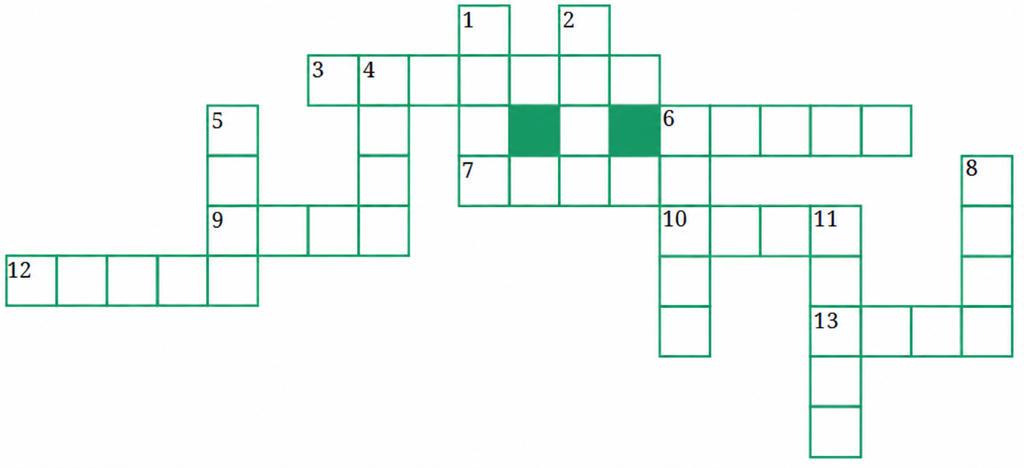
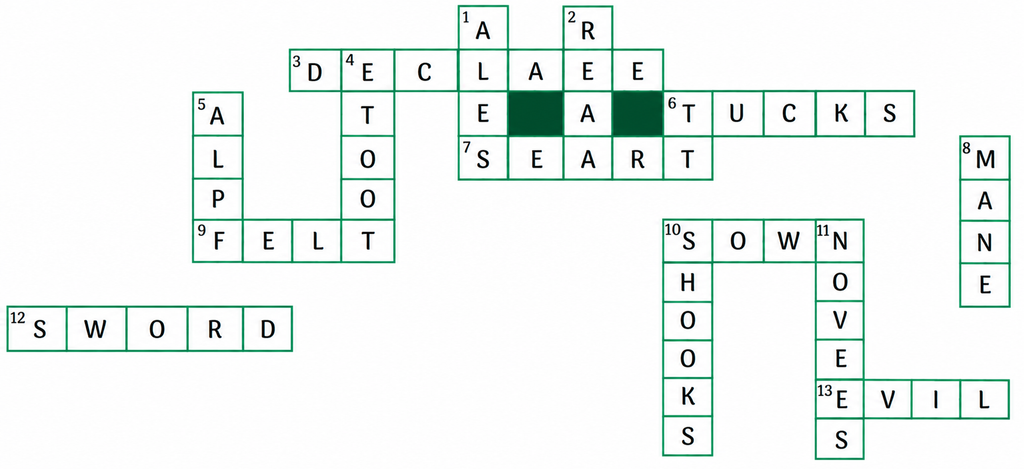
Across: 3. Declare 6. Tucks 7. Heart 9. Felt 10. Sown 12. Sword 13. Evil
Down: 1. Aces 2. Read 4. Tool 5. Alps 6. Hooks 8. Mane 11. Loves
Ans:
II. Work in pairs. Match the different meanings of ‘case’ in Column 2 with the correct usage in the sentences in Column 1. Share your answers with your classmates and teacher.
| Column 1 | Column 2 |
| 1. Lalit said that he could not sing but that was not the case as he sang melodiously later. | (i) writing format |
| 2. The lawyer was waiting for the case to be taken up in court. | (ii) container |
| 3. My pencil case is a gift from my grandmother. | (iii) situation |
| 4. The subject of a formal letter is written in the title case. | (iv) matter |
Now, read the following text and find out which ‘case’ the title refers to.
Ans:
| Column 1 | Column 2 |
| 1. Lalit said that he could not sing but that was not the case as he sang melodiously later. | (iii) Situation |
| 2. The lawyer was waiting for the case to be taken up in court. | (iv) Matter |
| 3. My pencil case is a gift from my grandmother. | (ii) Container |
| 4. The subject of a formal letter is written in the title case. | (i) Writing format |
Let us Discuss
I. Complete the following statements with suitable reasons.
1. Leroy’s nickname was Encyclopedia and everyone called him by that name because_____________.
Ans: He was called Encyclopedia because he knew a lot of facts and information about many different subjects.
2. At the dinner table on Tuesday night, Chief Brown stared at his cream-of-mushroom soup as _______________.
Ans: He was worried and thinking deeply about the difficult case.
3. Encyclopedia sat quietly at the dinner table because_______________.
Ans: He noticed that his father was worried and did not want to disturb him.
4. Nolan put the will on the kitchen table because_____________.
Ans: He wanted Chief Brown to examine it and help him with the case.
II. Do you think Chief Brown would need Leroy’s help to solve this case? If yes, why? If no, why not?
Ans: Yes, Chief Brown would need Leroy’s help to solve this case because Leroy had a vast knowledge of facts and could use his intelligence to find important clues and solve the mystery.
Let us Discuss
I A fact is something that can be proven true or false. A fact is not based on people’s beliefs. An opinion on the other hand is a belief, feeling, or judgement, and can vary from one person to another. An opinion cannot be proven.
Identify which of the following statements from part I and II of the story are facts or opinions. One example has been done for you. Share your answers with your classmates and teacher.
1. Encyclopedia’s father was the Chief of Police.
Ans: Fact.
2. Everyone thought that Chief Brown must be the smartest police chief in the country.
Ans: Opinion.
3. An encyclopedia is a book or set of books filled with facts from A to Z.
Ans: Fact.
4. Leroy’s friends said that he was like a library and computer rolled into one, and more user-friendly.
Ans: Opinion.
5. Two masked men held up the Diamond Mart on Sixth Avenue.
Ans: Fact.
6. Nolan and Davenport had met while both were in prison in South Carolina.
Ans: Fact.
7. Chief Brown’s hunch was that Davenport and Nolan decided to hide the loot until things cooled down.
Ans: True.
8. Nolan wrote a four words code to tell Davenport where he had hidden the stolen jewellery.
Ans: False.
II. Complete the table by choosing the character traits of Leroy given in the box below. There is an extra word that you do not need. One example has been done for you.

| Textual Evidences | Traits |
| 1. He read more books than anyone in Idaville, and he never forgot a fact. | |
| 2. Encyclopedia never spoke of the help he gave his father. He didn’t want to seem different from other boys. | |
| 3. Encyclopedia sat quietly. He knew his mother and father were discussing the case for his benefit. | |
| 4. Usually, he needed to ask only one question to solve a case before dessert. |
Ans:
| Textual Evidences | Traits |
| 1. He read more books than anyone in Idaville, and he never forgot a fact. | Knowledgeable |
| 2. Encyclopedia never spoke of the help he gave his father. He didn’t want to seem different from other boys. | Modest |
| 3. Encyclopedia sat quietly. He knew his mother and father were discussing the case for his benefit. | Patient |
| 4. Usually, he needed to ask only one question to solve a case before dessert. | Intelligent |
Let us think and reflect
I. Read the given extracts and answer the questions that follow.
1. Chief Brown would have liked to tell everyone about his only child. But who would believe him? Who would believe that the best detective alive was an eighth grader? So, he said nothing.
Encyclopedia never spoke of the help he gave his father. He didn’t want to seem different from other boys. But there was nothing he could do about his nickname. He was stuck with it.
Only his parents and teachers called him by his real name, Leroy. Everyone else called him Encyclopedia.
(i) Complete the following sentence with a suitable reason.
Chief Brown’s dilemma can be called unique because he was the father of the best detective alive, but he could not tell anyone that his eighth-grade son was helping him solve cases.
Ans: Chief Brown’s dilemma can be called unique because he knew that his eighth-grade son was an excellent detective, but he could not tell anyone about his son’s abilities.
(ii) What can be inferred about why Encyclopedia never spoke of the help he gave his father?
A. He is shy and lacks confidence in his abilities to share his insights.
B. He wants to avoid the jealousy others might feel about his skills.
C. He desires to blend with the other boys to prevent seeming different.
D. He is embarrassed about being smarter than most adults around him.
Ans: C. He desires to blend with the other boys to prevent seeming different.
(iii) The parents choose not to call their son ‘Encyclopedia’. Select the reason that is false.
A. For them he is more than his unique abilities; he is their child, with a personal identity.
B. Calling him by his real name reflects their affection and the desire to acknowledge him as an ordinary boy.
C. They want him to be remembered as different from the others around.
Ans: C. They want him to be remembered as different from the others around.
(iv) What does the writer mean by the fact that Leroy was ‘stuck with’ the name Encyclopedia?
Ans: It means that Leroy could not get rid of the nickname ‘Encyclopedia’ because everyone except his parents and teachers continued to call him by that name.
2. Chief Brown studied the four words: Nom Utes Sweden Hurts. He shook
his head and passed the notebook to Mrs. Brown again. “Can you figure
it out?”
“Nom is a shortening of nominative, a grammatical term,” stated
Mrs. Brown, who had taught English and other subjects in high school.
“Utes is an American Indian tribe. Sweden is a country in northern
Europe. Hurts is hurts.”
She lifted her gaze to Encyclopedia and shook her head.
“I can’t figure it out,” she confessed.
“Davenport disappeared right after the hold-up,” Encyclopedia reminded her.
(i) What does Chief Brown’s reaction of shaking his head suggest about his understanding of the four words?
A. He is confident that the words are a clue.
B. He is confused, unable to make sense of the words.
C. He believes the words are random and meaningless.
D. He thinks the words are unrelated to the case.
Ans: B. He is confused, unable to make sense of the words.
(ii) Identify whether the given statement is true or false.
Mrs. Brown explained the actual meanings of the individual words rather than decoding the hidden message behind them.
Ans: True.
(iii) What does Mrs. Brown’s inability to decode the words suggest about the message?
Ans: It suggests that the four words contained a hidden or coded message that could not be understood by simply looking at their individual meanings.
(iv) Complete the following sentence suitably.
The purpose of Encyclopedia’s reminder in the last line of the extract was to _________________. (refocus the discussion on the context of the crime/suggest that the coded message was meant for Davenport/imply that the message was likely a clue about the location of the stolen jewellery)
Ans: refocus the discussion on the context of the crime.
II. Answer the following questions.
1. Nolan and Davenport were very close. Support this statement with evidence from the text.
Ans: Nolan and Davenport were very close because they had met in prison in South Carolina and later worked together in the jewellery hold-up. Nolan also wrote a coded message for Davenport, showing that they trusted and depended on each other.
2. Why did Davenport disappear right after the jewellery hold-up? What might his plans have been if Nolan had not died?
Ans: Davenport disappeared because he wanted to avoid being caught by the police after the jewellery robbery. If Nolan had not died, Davenport might have returned to meet him and collected the stolen jewellery according to their plan.
3. What does Mrs. Brown’s interest in the case tell us about her?
Ans: Mrs. Brown’s interest in the case shows that she was intelligent, curious and observant. She tried to understand the coded message and actively participated in the discussion.
4. Explain why Chief Brown was proud of his son.
Ans: Chief Brown was proud of Leroy because he was highly knowledgeable, intelligent and had an excellent ability to solve difficult cases. Leroy often helped his father solve mysteries with his sharp thinking.
5. Why were Chief Brown’s suspicions regarding Nolan and Davenport justified, even when there was a lack of concrete proof?
Ans: Chief Brown’s suspicions were justified because Nolan and Davenport had a history of criminal activities, had met in prison, and disappeared after the jewellery hold-up. The coded message and the circumstances surrounding the robbery also suggested their involvement.
6. Analyse the role of the four-word coded message in the story.
Ans: The four-word coded message, “Nom Utes Sweden Hurts,” was the main clue in the case. Although its individual words seemed meaningless, Encyclopedia realised that they contained a hidden message. Decoding it helped reveal the location of the stolen jewellery and solve the mystery.
7. Write a character sketch on Leroy with the help of the character traits table given in ‘Let us discuss’ section.
Ans: Encyclopedia was a knowledgeable eighth grader who never forgot a fact that he read. He was intelligent and had an excellent ability to solve difficult cases. He was also modest, as he never spoke about the help he gave his father. He was patient and quietly listened to his parents while they discussed the case. His sharp observation, vast knowledge and clever reasoning made him an excellent young detective.
Let us learn
I. Match the phrasal verbs from the text given in Column 1 with their meanings in Column 2. You may refer to a dictionary.
| Column 1 | Column 2 |
| 1. put on | (i) appeared, been discovered |
| 2. cooled down | (ii) solve a problem |
| 3. turned up | (iii) became normal or calmed |
| 4. make of | (iv) wear (clothes, hat, etc.) |
| 5. figure out | (v) escaped without being punished |
| 6. got away with | (vi) have an idea or understanding of something |
Ans:
| Column 1 | Column 2 |
| 1. put on | (iv) wear (clothes, hat, etc.) |
| 2. cooled down | (iii) became normal or calmed |
| 3. turned up | (i) appeared, been discovered |
| 4. make of | (vi) have an idea or understanding of something |
| 5. figure out | (ii) solve a problem |
| 6. got away with | (v) escaped without being punished |
Fill in the blanks with the phrasal verbs given in Column 1.
A. Finally, some important evidence about the case has _______________.
Ans: turned up.
B. After I _______________, I understood that I had made a big mistake.
Ans: cooled down.
C. I couldn’t _______________ why he was angry with me.
Ans: figure out.
D. He _______________ his special coat and went to his friend’s birthday party.
Ans: put on.
E. Ravi forgets to do his homework but he _______________ it as teacher didn’t ask for it that day.
Ans: got away with.
F. I do not know what to _______________ his behaviour.
Ans: make of.
II. Fill in the blanks in the following sentences by choosing the correct word pairs from the box given below.

1. After running for 50 kilometres last ________________, I felt ________________ for two days.
Ans: After running for 50 kilometres last week, I felt worn out for two days.
2. When the committee met yesterday, they brought ________________ local cases to the ________________.
Ans: When the committee met yesterday, they brought several local cases to the table.
3. While learning to drive, Rina used too much force on the _______________, causing the car to _______________ down.
Ans: While learning to drive, Rina used too much force on the brake, causing the car to slow down.
4. He has composed a beautiful ________________ of music in order to bring ________________ to thousands of people.
Ans: He has composed a beautiful piece of music in order to bring joy to thousands of people.
5. She was busy ________________ her hair not caring about the ________________ flowers in her garden.
Ans: She was busy doing her hair not caring about the wilted flowers in her garden.
III. Leroy solved the mystery of the missing fifth word with his critical thinking abilities. Work in pairs to solve the puzzles given in the illustrations below and infer what they say. One example has been done for you.
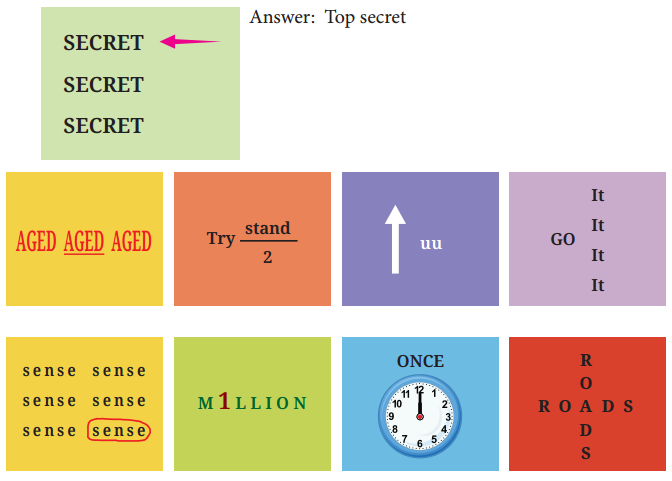
Ans: (i) Aged to perfection.
(ii) Try to understand.
(iii) Up to you.
(iv) Go for it.
(v) Common sense.
(vi) One in a million.
(vii) Once in a blue moon.
(viii) Crossroads.
IV. Spoonerism is a mistake made when speaking, where the first sounds of the words in a phrase or a sentence are exchanged with each other. This usually gives a funny meaning.
Some examples of spoonerism are saying ‘wrong load’ instead of ‘long road’, ‘round of mice’ instead of ‘mound of rice’.
Find the correct order for the following spoonerisms.
1. knowing sits.
Ans: Snowing kits.
2. it’s roaring with pain.
Ans: It’s pouring with rain.
3. plaster man.
Ans: Master plan.
4. blarm wanket.
Ans: Warm blanket.
5. tars and crucks.
Ans: Cars and trucks.
6. shake a tower.
Ans: Take a shower.
7. bead a rook.
Ans: Read a book.
8. mardon me padam.
Ans: Pardon me, madam.
V. Fill in the blanks with the suitable words.

Detective stories are exciting, keeping readers guessing (i) ____________ the real culprit is. They take place in settings (ii) ____________ clues are hidden carefully. (iii) ____________ the mystery seems tricky, a clever detective always finds answers. Readers often wonder (iv) ____________ criminals leave small but important clues. The challenge is to decide (v) ____________ suspect is guilty. (vi) ____________ the truth is revealed, everything makes sense. But one may wonder (vii) ____________ they could have solved it themselves. These stories are fun (viii) ____________ they make readers think till the very end.
Ans: Detective stories are exciting, keeping readers guessing (i) who the real culprit is. They take place in settings (ii) where clues are hidden carefully. (iii) Although the mystery seems tricky, a clever detective always finds answers. Readers often wonder (iv) why criminals leave small but important clues. The challenge is to decide (v) which suspect is guilty. (vi) When the truth is revealed, everything makes sense. But one may wonder (vii) if they could have solved it themselves. These stories are fun (viii) because they make readers think till the very end.
VI. Combine the following pairs of sentences using the word given in brackets. One example has been done for you.
1. We gave him the signal. He was waiting for the signal. (that)
Ans: We gave him the signal that he was waiting for.
2. We went to a place. The incident occurred there. (where)
Ans: We went to a place where the incident occurred.
3. Teacher said she would retire soon. She is now nearly sixty. (who)
Ans: Teacher, who is nearly sixty, said she would retire soon.
4. It was the day. Half the class was absent. (when)
Ans: It was the day when half the class was absent.
VII. Follow these steps to transform the sentences given as examples from direct speech to indirect speech.
Indirect Speech
(i) Mrs. Brown asked, “What has happened?”
Ans: Mrs. Brown asked what had happened.
(ii) Mrs. Brown questioned Leroy, “What does this message mean?”
Ans: Mrs. Brown questioned Leroy what the message meant.
(iii) Mrs. Brown inquired, “Can you solve the mystery?”
Ans: Mrs. Brown inquired whether he could solve the mystery.
(iv) Mrs. Brown asked Chief Brown, “Have you found any clues?”
Ans: Mrs. Brown asked Chief Brown if he had found any clues.
(v) Mrs. Brown inquired, “Where is the missing jewellery?”
Ans: Mrs. Brown inquired where the missing jewellery was.
VIII. Rewrite the following sentences in Reported Speech.
1. “Why did you stop talking to me?” asked Rohan.
Rohan questioned ____________.
Ans: Rohan questioned why I had stopped talking to him.
2. “Did you enjoy the family gathering yesterday?” asked my aunt.
My aunt asked ____________.
Ans: My aunt asked if I had enjoyed the family gathering the previous day.
3. “When will you visit us again?” asked my grandmother.
My grandmother inquired ____________.
Ans: My grandmother inquired when I would visit them again.
4. Madavi said to Ravi, “Will you come with me to meet our old teacher tomorrow?”
Madavi asked Ravi ____________.
Ans: Madavi asked Ravi if he would go with her to meet their old teacher the next day.
5. My friend said, “What gift are you planning to give your brother?”
My friend inquired ____________.
Ans: My friend inquired what gift I was planning to give my brother.
6. “Shall I carry these notebooks to the staffroom, Ma’am?” asked Veenu.
Veenu asked her teacher ____________.
Ans: Veenu asked her teacher if she would carry those notebooks to the staffroom.
IX. Read the conversation between Aditi and Rahul.
Aditi : Did you see anyone leave a package near the lift?
Rahul: I noticed a man wearing a bluejacket drop it off.
Aditi : What time did you see this happen?
Rahul: It was around 6:45 p.m.
Aditi : Were you able to see his face?
Rahul: He wore a hood and so I couldn’t see his face
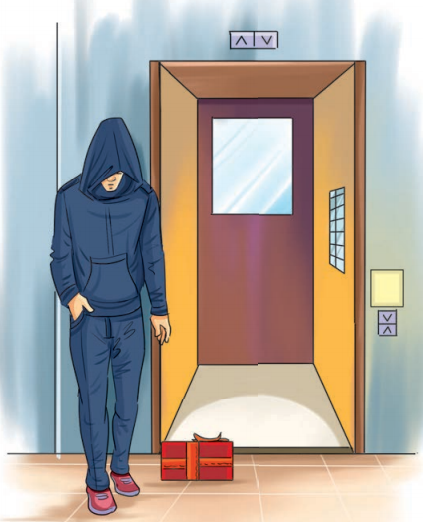
Complete the following paragraph by transforming the dialogue in indirect speech.
Aditi asked Rahul 1 ____________
Rahul replied that he had noticed a man wearing a blue jacket drop it off.
Aditi asked Rahul 2 ____________
Rahul replied that it had been around 6.45 p.m.
Aditi further inquired 3 ____________
Rahul said that he had worn a hood, so he couldn’t see his face.
Ans: 1. if he had seen anyone leave a package near the lift.
2. at what time he had seen that happen.
3. if he had been able to see his face.
Let us Listen
I. You will listen to a podcast about ways of improving observation skills. As you listen, mark the statements 1–4 as true or false. (Transcript for teacher on page 151)
1. Observation skills help improve your common sense.
Ans: False.
2. Rushing through tasks helps you focus better and observe more.
Ans: False.
3. Taking notes or making sketches helps with what you observe.
Ans: True.
4. Incorporating tips on observation skills will soon lead to success.
Ans: False.
II. You will once again listen to the podcast. As you listen, complete the given sentences by filling in the blanks with one to three exact words you hear.
1. It is important to slow down and ___________________ to notice several aspects around you more clearly.
Ans: Take your time.
2. The more senses like hearing and smelling you use, the more ___________________ you absorb.
Ans: Information.
3. People who are ___________________ tend to be better observers because they seek to understand what they notice.
Ans: Curious.
4. When you make a note of things, it helps reinforce the ________________ in your memory.
Ans: Details.
5. Practising mindfulness helps a person stay ___________________ with their surroundings.
Ans: Present.
Let us write
I. A report is written for an event that has already occurred. The purpose of a report is to provide first-hand details of an incident or event. It presents the information in a proper sequence.
Read the sample report written about the ‘Inter-school Football Tournament’ organised by your Vidyalaya.
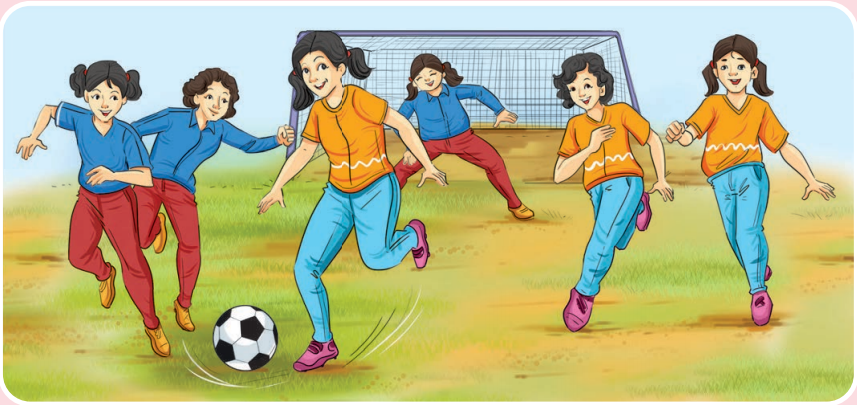
Note the format, content, and language used.
| Inter-school Football Tournament by | Title—Byline (Reporter’s Name and Class) |
| An Inter-school Football Tournament was organised by our Vidyalaya from 21 April 20XX to 24 April 20XX at Motinagar Football Ground. Ten teams participated in the tournament. | Paragraph 1: • What • Who • When • Where Note: Use of past tense, for example, organised, participated, etc. |
| The tournament was declared open by the Chief Guest, Dr. Singh, Honorary Sports Secretary of the State, on Wednesday, 21 April 20XX in the presence of all the teams and spectators from the participating schools. The matches were held from 8:30 a.m. to 11:30 a.m. on all the days of the tournament. Following a tough competition, the teams from ABC Senior Secondary School and XYZ Senior Secondary School emerged as the finalists. For the final match, players from both these teams were cheered by students from their respective schools. After an exciting match, the score was tied at 3–3. Subsequently, a penalty shootout was used as tie breaker by the referee to decide the winner. Finally, the team from ABC Senior Secondary School won the penalty shootout and was declared the winner. | Paragraphs 2 and 3: • Description of the event in detail Note: (i) Use sequence markers: following, after, subsequently, finally (ii) Use of passive form: was declared, were held, were cheered, etc. |
| The winning team was awarded with a trophy, medals, and certificates by the Chief Guest. Addressing the students, he said, “All of you must take up a sport to keep yourself healthy.” The inter-school football tournament was a great success, showcasing exceptional talent, teamwork, and sportsmanship among the participating teams. | Paragraph 4:• Prize giving ceremony• Remarks by the Chief Guest |
Now,as a member of the Art and Craft Club,write a report on an‘Inter-school Art Exhibition’ organised by your school. Include the necessary details.
Ans: Inter-school Art Exhibition
By Ananya Sharma
Our school, Greenwood High, organised an Inter-school Art Exhibition on 15th October 2024 in the school auditorium. More than 15 schools took part in the event, which was organised by the Art and Craft Club.
The exhibition was inaugurated by the well-known artist Ms. Meera Kulkarni. The theme was “Colours of Culture”. Students displayed paintings, sketches, sculptures and eco-friendly crafts. Our 3D mural, “Nature’s Harmony”, was one of the main attractions.
The artworks were judged on creativity, originality and technique. Springdale Public School won the first prize, followed by Oakridge International and Greenwood High. The event ended with a cultural programme and prize distribution.
The exhibition was a great success and gave students a wonderful opportunity to show their creativity and talent.
Let us Explore
I. Work in pairs. Read the words and observe the images given below. Check if your answers match. Share your answers with your classmates and teacher.
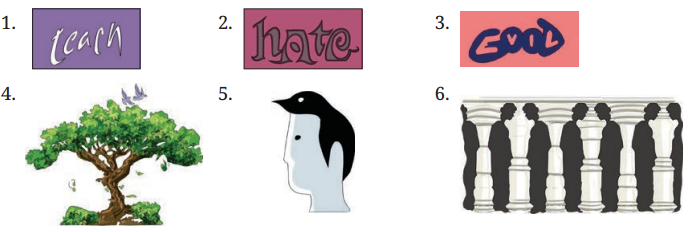
These are optical illusions which may trick the eye and make you think that you can see two different things.
Ans: Do it yourself.
II. Read the steps to play a language game—Name the mystery object.
1. Divide the class into teams.
2. Each team chooses an object and prepares three hints to enable the other teams to name the object.
3. Each team takes turns to name the object given by the other team.
4. If a team names the object with the first hint, they get 20 points, with the second hint 10 points, and with the third hint 5 points.
One example with three hints:
(i) I display information for all to share, with a swipe I’m clean and bare.
(ii) I am rectangular or a square, whom neither teacher nor student can spare.
(in) I am mostly black, sometimes green, now in white too I am seen.
Ans: Do it yourself.
III. Visit the library and look for an encyclopedia. What is it? Check how it is different from a dictionary. Share your answers with your classmates and teacher.
Ans: An encyclopedia is a reference book that gives detailed information about different subjects. It provides facts, explanations and background information. A dictionary mainly gives the meanings, spellings and pronunciations of words, while an encyclopedia gives information about people, places, events and subjects.
IV. A thesaurus is a reference book or digital tool that provides a collection of words with similar meanings, allowing users to find alternative words or phrases to express the same idea. Choose any five words and find out their alternative words from the thesaurus.
Ans:
| Word | Alternative Word |
| Happy | Joyful |
| Big | Large |
| Beautiful | Attractive |
| Clever | Intelligent |
| Fast | Quick |
| THE MAGIC BRUSH OF DREAMS |
Let us do these activities before we read
I Work in pairs. Discuss the following questions. Share your answers with your classmates and teacher.
1. Mention a magical object that you would like to have. Give a reason for your choice.
Ans: I would like to have a magic wand because it could help me make difficult things easier and help people in need.
2. What would you draw for yourself, if you had a magic paint brush? Why?
Ans: I would draw a beautiful house for myself because I would like to have a comfortable and peaceful home.
3. Would you use the magic paint brush to draw for someone else? If yes, why? If no, why not?
Ans: Yes, I would use it to draw things for others because I would like to help people and make them happy.
II. Work in pairs and discuss instances of acts of kindness that you have heard, read, or experienced.
Ans: Once, I saw a student helping an old man cross the road. He patiently held his hand and took him safely to the other side. It was a simple but kind act that made me feel happy.
III. Work in pairs and guess the meanings of the words given below and draw pictures depicting their meanings.

Ans: I once read about a boy who started a small food bank in his community to help hungry people. Another time, my friend gave his new shoes to a child in need. I also remember helping an injured bird and taking it to a vet. These acts of kindness make the world a better place.
Now, arrange these words into different categories as given below
Things: __________________________________.
Actions: __________________________________.
Emotions: __________________________________.
Ans: Things: Paintbrush, Fortress, Feast, Twig, Bows, Drawing
Actions: Winding
Emotions: Joy, Fear
Let us discuss
I. Arrange the events in order of occurrence in the poem. The last one has been marked for you. Share your answers with your classmates and teacher.
1. Gopi paints a bowl of khichdi, which becomes real and amazes the villagers.
2. The Zamindar orders Gopi to paint treasures for him.
3. Gopi is told to gather food but instead sits drawing pictures in the sand.
4. Gopi returns to the village with the Zamindar and his men chasing her.
5. The Zamindar throws Gopi into prison.
6. Gopi paints a road and a horse to escape.
7. Gopi uses the magic brush to paint useful items for the villagers.
8. Gopi paints a wide river, stopping the Zamindar and his men.
9. A man gives a magic brush to Gopi to paint only for the poor.
10. Gopi scares the Zamindar away, and celebrates with the villagers.
Ans: 9 → 3 → 1 → 7 → 2 → 5 → 6 → 4 → 8 → 10.
II. Fill in the blanks by choosing the correct answer from the box given below.

The tone of the poem shifts throughout, reflecting the different moods of the story. Initially, the tone is 1. _________________ as Gopi uses her imagination to draw in the sand, and later when the Zamindar enters the story, the tone shifts to one of 2. _________________. In the final part of the poem, the tone becomes 3. _________________ as Gopi escapes, the Zamindar is defeated, and the villagers rejoice.
Ans: The tone of the poem shifts throughout, reflecting the different moods of the story. Initially, the tone is 1. playful and innocent as Gopi uses her imagination to draw in the sand, and later when the Zamindar enters the story, the tone shifts to one of 2. tension and suspense. In the final part of the poem, the tone becomes 3. triumphant and celebratory as Gopi escapes, the Zamindar is defeated, and the villagers rejoice.
III. Fill in the blanks by choosing the correct option from within the brackets.
1. The poem mostly follows a simple rhyme scheme, _________________, which adds a rhythmic flow. (ABCB, ABBA, ABAB)
Ans: ABCB
2. This poem belongs to the _________________ poetry genre, which tells a story through verse. (descriptive, narrative or ballad, free style)
Ans: narrative or ballad
IV. Give examples from the poem for the following explanations.
1. The poem is rich in imagery, creating clear pictures in the reader’s mind. For example, ___________________.
Ans: The description of Gopi painting the bowl of khichdi, the road, the horse, the river, and the beast creates vivid pictures in the reader’s mind.
2. What is the effect of repetition in the line—‘On you, and you and you!’?
Ans: The repetition emphasizes Gopi’s determination to help everyone and creates a rhythmic and energetic effect in the poem.
V. Match the phrases from the poem in Column 1 with what they symbolise in Column 2.
| Column 1 | Column 2 |
| 1. The magic paintbrush | (i) Greed and the desire for wealth |
| 2. The grand fortress | (ii) Barriers to protect Gopi from the Zamindar’s anger |
| 3. The river and the beast | (iii) The power of art and imagination to change the world |
Ans:
| Column 1 | Column 2 |
| 1. The magic paintbrush | (iii) The power of art and imagination to change the world |
| 2. The grand fortress | (i) Greed and the desire for wealth |
| 3. The river and the beast | (ii) Barriers to protect Gopi from the Zamindar’s anger |
VI. Identify whether the following statement is true or false.
While Gopi uses the magic brush to help others, the Zamindar wants to use it for personal gain. This contrast drives the moral of the story.
Ans: True.
Let us think and reflect
I. Read the given extracts and answer the questions that follow.
1. “But on a stone there sits a man,
A brush is in his hand.
He looks around. He calls to Gopi.
‘Come here!’ he whispers. ‘Hush!
We mustn’t let the village know
About this magic brush.’
He slips the brush into her hand
And tells her to be sure,
‘Paint not for the wealthy ones,
But only for the poor.’”
(i) Fill in the blank by selecting the correct option from those given in the brackets.
The man is whispering and telling Gopi to keep the brush a secret reflects his _______________________ (careful and secretive/magical and delightful) nature.
Ans: careful and secretive
(ii) What is the significance of the man slipping the brush into Gopi’s hand?
Ans: It signifies that the man is secretly giving Gopi the magical brush and trusting her to use its power wisely.
(iii) Complete the following sentence with a suitable reason.
The most likely reason the man instructs Gopi to ‘Paint not for wealthy ones but only for the poor’ is because he ___________________.
Ans: The most likely reason is because he wants the magical brush to be used to help the poor and needy rather than to increase the wealth of the rich.
(iv) Select the most appropriate title for the extract from the two given below.
A. The Magic Brush’s Secret.
B. Gopi’s Special Gift.
Ans: A. The Magic Brush’s Secret
2. “And soon the news spreads far and wide,
Through forests, fields, and plains,
Until the Zamindar himself
Hears of these magic gains.
‘I order you to paint for me,
A fortress tall and grand.
Paint treasures, jewels, and riches rare,
Enough to rule this land.’”
(i) Complete the following sentence with the correct reason.
The news of Gopi’s magic brush spreads ‘through forests, fields, and plains’ because of its _______________________.
Ans: The news spreads because of the extraordinary and magical things Gopi creates with the brush.
(ii) Why does the poet refer to things painted by Gopi’s paintbrush as ‘magic gains’?
Ans: The poet calls them ‘magic gains’ because the things Gopi paints with the magical brush become real and provide valuable benefits.
(iii) Which of the following statements given below is false? Rectify the false statement.
A. Gopi’s magic brush draws the attention of the powerful Zamindar.
B. The Zamindar requests Gopi to paint a grand fortress and jewels.
Ans: Neither statement is false. Both A and B are true.
(iv) What does the Zamindar’s demand for a grand fortress and jewels reveal about his character?
Ans: The Zamindar’s demand reveals that he is greedy, selfish, and ambitious, as he wants to use the magical brush to gain wealth and power for himself.
II. Answer the following questions.
1. Explain why Gopi made the right decision by refusing to paint for the Zamindar.
Ans: Gopi made the right decision because the magic brush was given to her to help the poor, not to satisfy the greed of the wealthy. By refusing the Zamindar, she remained faithful to the man’s instructions and used the brush for the benefit of others.
2. Gopi threatens to draw a beast to scare away the Zamindar. Justify her action. How would you have dealt with the situation differently?
Ans: Gopi’s action was justified because the Zamindar was trying to misuse the magic brush and force her to obey him. Drawing a beast was a clever way to protect herself and escape from his control. I would also try to protect myself without hurting anyone, using the brush to create a safe way to escape.
3. What is the significance of Gopi celebrating with the villagers at the end of the poem?
Ans: Gopi’s celebration with the villagers shows that she has successfully protected the magic brush from being misused. It also highlights her happiness in helping the community and reinforces the poem’s message that kindness and generosity bring happiness.
4. Compare Gopi’s use of the magic brush to how the Zamindar would have used it.
Ans: Gopi uses the magic brush to help the poor and create useful things for the villagers. In contrast, the Zamindar wants to use it to create treasures, jewels, and a grand fortress for his own wealth and power. Their different purposes highlight the difference between generosity and greed.
5. What can be inferred about Gopi’s character based on her refusal to follow the Zamindar’s orders?
Ans: Gopi is brave, kind-hearted, responsible, and determined. Her refusal shows that she is not easily influenced by power or wealth and remains committed to helping the poor.
6. Justify the appropriateness of the title of the poem.
Ans: The title is appropriate because the magic brush is central to the entire story. It gives Gopi the power to create things that become real and helps her support the poor, escape danger, and defeat the Zamindar. Thus, the magic brush drives the main events of the poem.
7. If you had the magic brush, how would you use it in today’s world?
Ans: If I had the magic brush, I would use it to help people in need. I would create food for the hungry, homes for homeless people, books and learning materials for children, and other useful things that could improve people’s lives. I would use its power responsibly rather than for personal wealth.
Let us learn
I. The verb ‘draw’ has different meanings in different contexts. Match the sentences in Column 1 with their appropriate meanings in Column 2.
| Column 1 | Column 2 |
| 1. His speech drew loud applause from the audience. | (i) opened |
| 2. The event will draw huge crowds from all neighbouring places. | (ii) pulled out |
| 3. Plants draw water from the soil. | (iii) got a reaction |
| 4. I reached the station when the train was drawing into the station. | (iv) attract |
| 5. The room was dark, so she drew the curtains to let the sunlight in. | (v) moving |
| 6. He drew a piece of paper from the folder. | (vi) absorb |
Ans:
| Column 1 | Column 2 |
| 1. His speech drew loud applause from the audience. | (iii) got a reaction |
| 2. The event will draw huge crowds from all neighbouring places. | (iv) attract |
| 3. Plants draw water from the soil. | (vi) absorb |
| 4. I reached the station when the train was drawing into the station. | (v) moving |
| 5. The room was dark, so she drew the curtains to let the sunlight in. | (i) opened |
| 6. He drew a piece of paper from the folder. | (ii) pull |
II. Fill in the crossword. Clues have been given below. You will find the words in the poem.
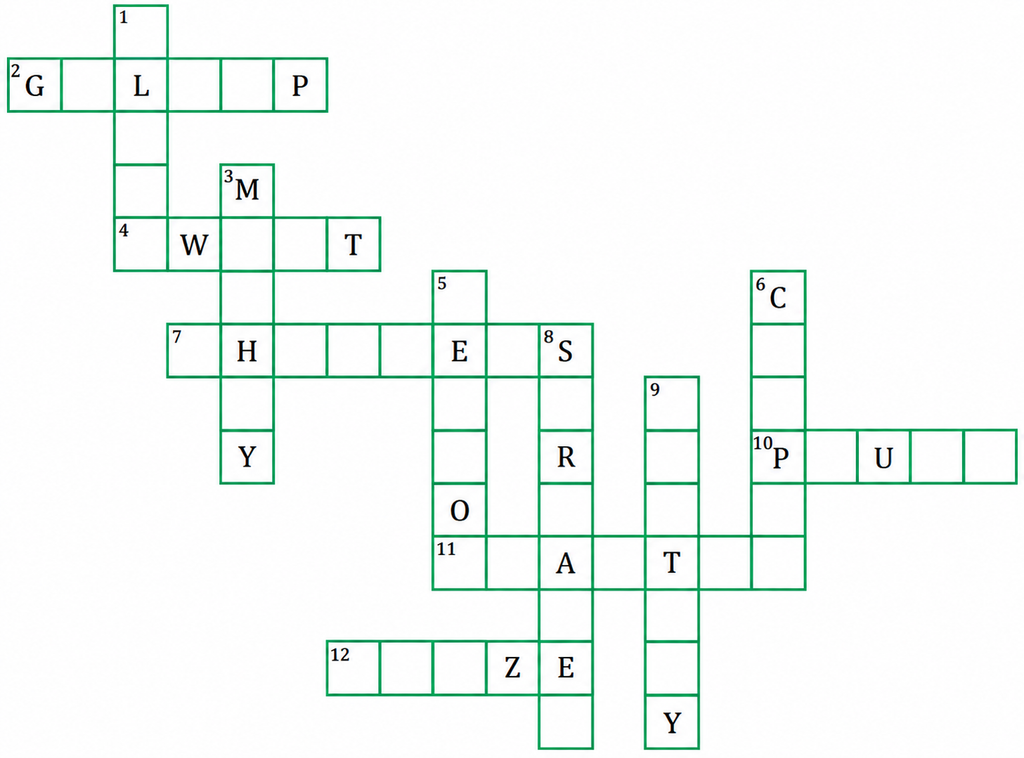
Ans:
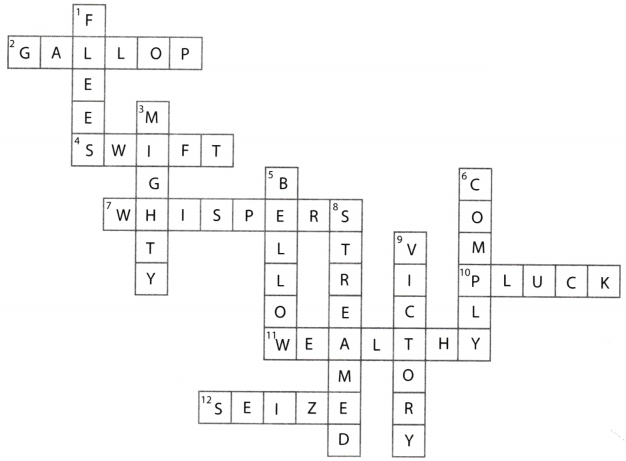
III. There are certain expressions that convey a sudden feeling or reaction. They can be used to express a variety of emotions and thoughts.
Example: … he whispers. “Hush!”
(‘Hush’ denotes the act of silencing someone)
Now, match the expressions in Column 1 with what emotions or reactions they convey, in Column 2.
| Column 1 | Column 2 |
| 1. Phew! | (i) surprise |
| 2. Eek! | (ii) pain |
| 3. Ouch! | (iii) mistake |
| 4. Yippee! | (iv) attract attention |
| 5. Whoa! | (v) relief |
| 6. Oops! | (vi) delight |
| 7. Hey! | (vii) alarm |
Now, create sentences using any five expressions from Column 1.
Ans:
| Column 1 | Column 2 |
| 1. Phew! | (v) relief |
| 2. Eek! | (vii) alarm |
| 3. Ouch! | (ii) pain |
| 4. Yippee! | (vi) delight |
| 5. Whoa! | (i) surprise |
| 6. Oops! | (iii) mistake |
| 7. Hey! | (iv) attract attention |
| Expression | Sentence |
| 1. Phew! | Phew! I finished my homework before dinner. |
| 2. Eek! | Eek! There is a spider on the wall! |
| 3. Ouch! | Ouch! I hurt my finger. |
| 4. Yippee! | Yippee! We won the school competition! |
| 5. Oops! | Oops! I forgot to bring my notebook. |
Let us listen
I. You will listen to five speakers speak about a magical power they wish for. As you listen, match statements 1–7 with speakers (i)–(v). There are two statements you do not need. (Transcript for teacher on page 152)
| Statements | Speaker No. |
| 1. Power of healing ailments | |
| 2. Ability to end poverty in the world | |
| 3. Power to control the weather as per need | |
| 4. Ability to make wise business decisions | |
| 5. Power to predict one’s own future clearly | |
| 6. Ability to remember information quickly | |
| 7. Power to move around without using vehicles |
Ans:
| Statements | Speaker No. |
| 1. Power of healing ailments | (iv) |
| 2. Ability to end poverty in the world | — |
| 3. Power to control the weather as per need | (v) |
| 4. Ability to make wise business decisions | (i) |
| 5. Power to predict one’s own future clearly | (i) |
| 6. Ability to remember information quickly | (ii) |
| 7. Power to move around without using vehicles | (iii) |
Let us explore
II. Words can also play tricks. Read the riddles about things that seem to be unreal and find what they refer to.
1. I can fill a room, but I take up no space. I’m often heard, but never seen. What am I?
Ans: Sound.
2. The more you take, the more you leave behind. What am I?
Ans: Footsteps.
3. I have cities but no houses, I have forests but no trees. What am I?
Ans: A map.
4. I’m tall when I’m young and short when I’m old, in a dark room, my story is told.
Ans: A candle.
III. You are asked to create a magical object. What object would you create? Make a drawing with all its details and mention its special quality on the same sheet. Put up the sheet on the display board.
Ans: I would create a Magic Pen. Whatever I write with this pen becomes real. I would use it to create food, books, medicines, and other useful things to help people.
| SPECTACULAR WONDERS |
Let us do these activities before we read.
I. Look at the pictures given below and sort them into natural and man-made wonders.
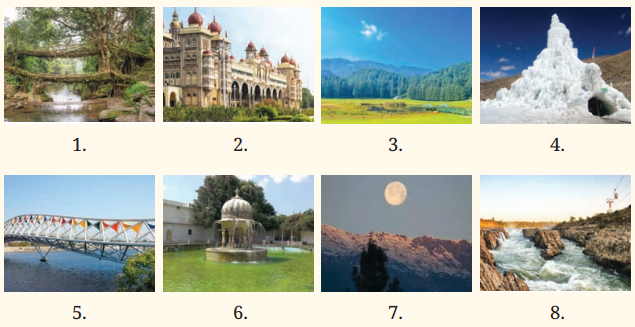
Ans:
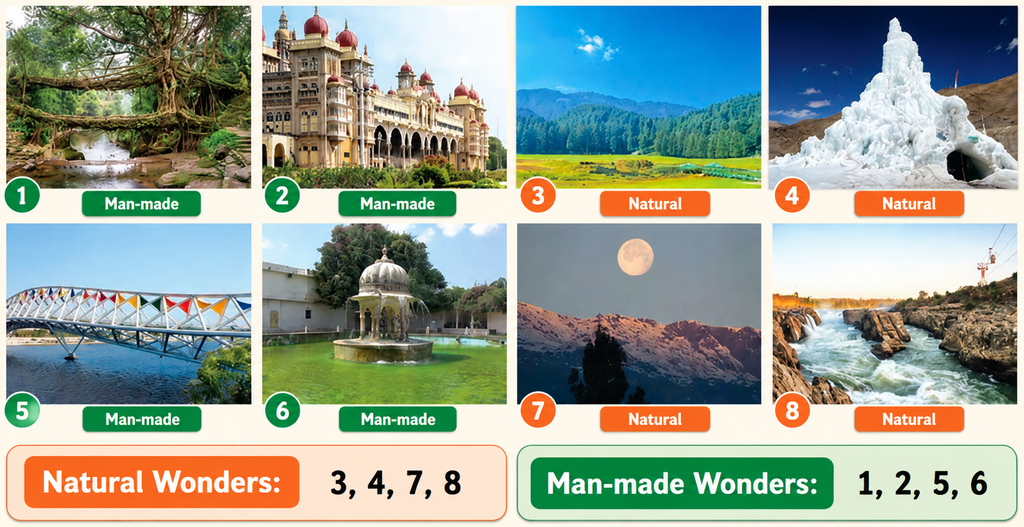
II. Which of these wonders—man-made or natural—are more appealing and why? Share your answers with your classmates and teacher.
Ans: Natural wonders are more appealing to me because they are created by nature and show the beauty and power of the natural world. Mountains, waterfalls, forests, and rivers make us feel amazed and connected to nature.
III. Work in pairs. Write down two wonders of nature that have amazed you. Discuss what makes them impressive. Share your answers with your classmates and teacher.
Ans: The Himalayas – They are impressive because of their enormous height, snow-covered peaks, and breathtaking beauty.
Niagara Falls – It is impressive because of its huge volume of flowing water and the powerful sound and sight of the waterfall.
IV. Work in groups of four. Complete the web chart given below with words that you associate with the phrase, ‘Nature’s Power’. Share your answers with your classmates and teacher.
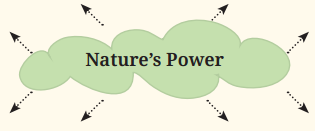
Ans:
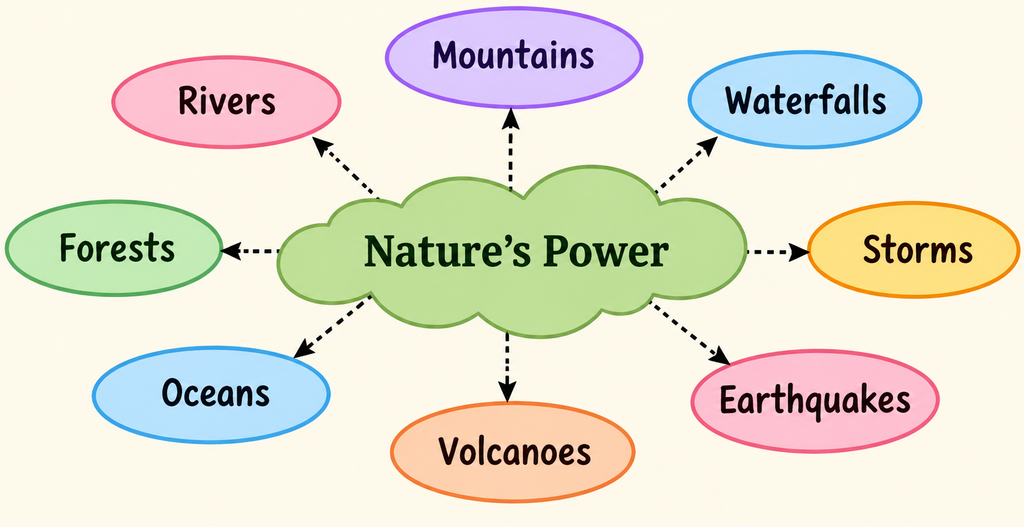
I. Complete the information in the table given below. One example has been done for you. Share your answers with your classmates and teacher.
| Amazing Natural Phenomena | Location | One Unique Feature |
| 1. The Valley of Flowers | Chamoli district, Uttarakhand | Around 600 species of exotic flowers |
| 2. The Living Root Bridges | ||
| 3. | Buldhana district, Maharashtra | |
| 4. Magnetic Hills | ||
| 5. Glowing Waters | ||
| 6. | West Bengal | |
| 7. | Balasore district, Odisha |
Ans:
| Amazing Natural Phenomena | Location | One Unique Feature |
| 1. The Valley of Flowers | Chamoli district, Uttarakhand | Around 600 species of exotic flowers |
| 2. The Living Root Bridges | Meghalaya | Made from intertwined living roots |
| 3. The Lonar Crater Lake | Buldhana district, Maharashtra | Formed by a meteorite impact; has a unique saline lake |
| 4. Magnetic Hills | Leh district, Ladakh | Vehicles appear to move uphill due to an optical illusion |
| 5. Glowing Waters | Kumbalangi, Kerala | Water glows at night due to bioluminescence |
| 6. The Sundarbans | West Bengal | A vast mangrove forest and home to the Bengal tiger |
| 7. The Invisible Chandipur Beach | Balasore district, Odisha | The sea retreats several kilometres during low tide and returns at high tide |
Let us think and reflect
I. Read the given extracts and answer the questions that follow.
1. “India is home to some of the most mystifying natural phenomena that surprise and spark our imagination.”
(i) Replace the underlined phrase with one from the extract. India is the birthplace of several rare species of flora and fauna that thrive in its diverse ecosystems.
Ans: India is home to several rare species of flora and fauna that thrive in its diverse ecosystems.
(ii) What does the phrase ‘nature’s unusual side’ suggest about the phenomena described?
Ans: The phrase ‘nature’s unusual side’ suggests the strange, mysterious, and extraordinary aspects of nature that surprise and amaze people.
(iii) Complete the similarity by choosing the correct option.
spark : imagination : : ______________ : ______________.
A. inspiration; creativity.
B. wonder; amazement.
C. effort; reward.
D. knowledge; books.
Ans: B. wonder; amazement
(iv) Identify whether the following statement is true or false.
Some natural phenomena can surprise people.
Ans: True.
2. “Have you seen things disappearing in front of your eyes? Well, such things happen at times, when we keep things at some place, and just forget where we have kept them. But, what if there’s a sea that disappears?
This happens in Odisha. It is a beach in the Balasore district where one can witness the sea disappearing mysteriously—the Chandipur Beach which is known for its unique feature of playing hide-and-seek with its visitors.”
(i) Complete the following sentence with a suitable reason.
The writer’s most likely purpose to introduce the information about the Chandipur Beach phenomenon with a question is to _______________ (engage the reader’s curiosity and create a sense of suspense/draw the reader to learn more about the unusual phenomenon/set the tone for the surprising nature of the content that follows)
Ans: The writer’s most likely purpose is to engage the reader’s curiosity and create a sense of suspense.
(ii) Select the option that is correct for both Assertion (A) and Reason (R).
(A): Chandipur Beach in Odisha is known for its unique feature of the sea disappearing.
(R): The tides retreat drastically, exposing the Chandipur beach.
A. Both (A) and (R) are true, and (R) is the correct explanation of (A).
B. Both (A) and (R) are true, but (R) is not the correct explanation of (A).
C. (A) is true, but (R) is false.
D. (A) is false, but (R) is true.
Ans: A. Both (A) and (R) are true, and (R) is the correct explanation of (A).
(iii) What does the term ‘unique’ suggest about the beach in Balasore?
A. very popular.
B. one of its kind.
C. ancient place.
D. far from city.
Ans: B. one of its kind.
(iv) What does the writer want to convey with the use of the phrase ‘playing hide-and-seek with its visitors’?
Ans: The phrase means that the sea at Chandipur Beach appears to disappear during low tide and returns during high tide, creating a fascinating and unusual experience for visitors.
II. Answer the following questions.
1. How are the living root bridges a boon for the local people of Meghalaya?
Ans: The living root bridges are a boon for the local people because they provide safe and natural pathways across streams and rivers. They are made from the roots of living trees and become stronger with time. They help people travel between villages, especially during the rainy season.
2. Why is the Lonar Crater Lake considered a remarkable and rare site?
Ans: The Lonar Crater Lake is considered remarkable because it was formed by a meteorite impact. It is a rare natural site with a unique saline and alkaline lake surrounded by a green landscape. Its unusual origin and special ecosystem make it scientifically and naturally important.
3. What might be the writer’s purpose of highlighting the awe-inspiring natural wonders of India?
Ans: The writer’s purpose is to make readers aware of India’s extraordinary natural beauty and unusual phenomena. The writer also encourages readers to appreciate, respect, and protect nature.
4. The writer uses descriptive language and introductory questions for some of the natural phenomena. What impact does it have on the readers?
Ans: Descriptive language helps readers create vivid pictures of the natural phenomena in their minds. Introductory questions create curiosity and suspense. Together, they make the content interesting, engaging, and easier to understand.
5. Which of these unusual phenomena did you find the most interesting and why?
Ans: I found the Chandipur Beach the most interesting because the sea appears to disappear during low tide and returns during high tide. This unusual phenomenon makes the beach seem as if it is playing hide-and-seek with its visitors.
Let us learn
I. Fill in the blanks with the correct expressions from the text given in the box below.

1. I have read many stories _____________________.
Ans: to no end.
2. Do you know when this little town _______________?
Ans: came into existence.
3. His hard work has helped him _________________.
Ans: in full glory.
4. There are no simple solutions to the ________________ of traffic jams.
Ans: age-old problem.
5. He opened the ancient wooden box and stared at the treasure ________________.
Ans: in disbelief.
6. The garden is _____________________ in spring with lots of beautiful flowers in bloom.
Ans: in full glory.
II. Select the correct synonyms from the box given below that match the list of words in 1–5. You may refer to a thesaurus.
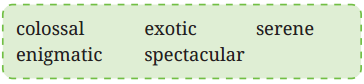
1. mysterious, puzzling, baffling.
Ans: enigmatic
2. mighty, gigantic, huge.
Ans: colossal
3. breath-taking, stunning, awe-inspiring.
Ans: spectacular
4. peaceful, calm, tranquil.
Ans: serene
5. unusual, peculiar, foreign.
Ans: exotic
III. The expressions ‘hide-and-seek’ and ‘flora and fauna’ are used in the text. These are called binomials—a pair of fixed words joined by ‘and’ or ‘or’. The binomials are mostly synonyms, antonyms, rhyming words, same sound words (alliterations), etc.
Match the binomials in Column 1 with their meanings in Column 2.
| Column 1 | Column 2 |
| 1. odds and ends | (i) put different things together to get a range of possibilities |
| 2. on and off | (ii) complete part of or belong to |
| 3. mix and match | (iii) choose only the best (things, people, etc.) |
| 4. all or nothing | (iv) at some time in the future |
| 5. part and parcel | (v) sometimes, occasionally |
| 6. pick and choose | (vi) increase or develop very quickly |
| 7. sooner or later | (vii) small, unimportant things |
| 8. leaps and bounds | (viii) something to be done completely or not at all |
Ans:
| Column 1 | Column 2 |
| 1. odds and ends | (vii) small, unimportant things |
| 2. on and off | (v) sometimes, occasionally |
| 3. mix and match | (i) put different things together to get a range of possibilities |
| 4. all or nothing | (viii) something to be done completely or not at all |
| 5. part and parcel | (ii) complete part of or belong to |
| 6. pick and choose | (iii) choose only the best (things, people, etc.) |
| 7. sooner or later | (iv) at some time in the future |
| 8. leaps and bounds | (vi) increase or develop very quickly |
Now, fill in the blanks using present participle or past participle form of the verbs in the box given below.

1. The _______________ marble monument looks even more spectacular in the moonlight.
Ans: Glowing.
2. The _______________ view of the Himalayas from Darjeeling attracts visitors from all over the world.
Ans: Amazing.
3. The Sun Temple in Konark features intricately _______________ stone wheels and walls.
Ans: Carved.
4. _______________ at a height of 182 m, the Statue of Unity is dedicated to Sardar Vallabhbhai Patel.
Ans: Standing.
5. The _______________ islands of the Andaman and Nicobar offer some of the cleanest beaches in India.
Ans: Scattered.
Underline the gerunds and participles in the following sentences. Write ‘G’ for gerunds and ‘P’ for participles in the space provided. One example has been done for you.
1. Dancing is a great way to express emotions.
Ans: Dancing → G.
2. Travelling can broaden your perspective.
Ans: Travelling → G.
3. The falling leaves signalled the arrival of autumn.
Ans: Falling → P.
4. She enjoys cooking new recipes for her family.
Ans: Cooking → G.
5. Reading helps improve your vocabulary.
Ans: Reading → G.
6. He watched the shimmering stars in the night sky.
Ans: Shimmering → P.
7. Forgetting the keys inside, Kanchan locked the door.
Ans: Forgetting → P.
VI. Combine the following pairs of sentences using participles or gerunds. You may use the clues given in brackets. One example has been done for you.
1. Nitesh entered the room. He saw his friend sitting in the corner. (participle)
Entering the room, Nitesh saw his friend sitting in the corner.
2. Smitha walked carelessly. She slipped on the doormat. (Participle)
Ans: Walking carelessly, Smitha slipped on the doormat.
3. Sleep for eight hours. It is good for health. (Gerund)
Ans: Sleeping for eight hours is good for health.
4. Ranjith felt happy about the result. He called his parents. (Participle)
Ans: Feeling happy about the result, Ranjith called his parents.
5. Father encouraged Meena. Meena joined the dance competition. (Gerund)
Ans: Father encouraged Meena to join the dance competition.
Let us listen
I. You will listen to a brother and sister discuss a natural phenomenon. As you listen, mark the four true statements from 1–6 given below. (Transcript for teacher on page 153)

1. The brother was taken aback to see the posted pictures.
Ans: False.
2. The brother admitted to not knowing about his sister’s favourite picture.
Ans: True.
3. The sister stated that the rainbow mountain was like any other mountain.
Ans: False.
4. The brother was aware of the reason for the formation of colours on the mountain.
Ans: True.
5. The brother was surprised to learn about the mountain being covered with snow till recently.
Ans: True.
6. The sister understood nature’s role in the beauty of the mountain.
Ans: True.
Subject Ka Complete Video Solution Dekhein
Step-by-step easy concept explanation aur full questions Answer ke liye watch karein ya app download karein:


 Buy Now