
NCERT Class 8 English Chapter 5 Feathered Friend Solutions As Per New Syllabus to each chapter is provided in the list so that you can easily browse through different chapters NCERT Class 8 English Chapter 5 Feathered Friend Notes and select need one. NCERT Class 8 English Chapter 5 Feathered Friend Question Answers Download PDF. NCERT Class 8 English Textbook Solutions.
NCERT Class 8 English Chapter 5 Feathered Friend
Also, you can read the NCERT book online in these sections Solutions by Expert Teachers as per Central Board of Secondary Education (CBSE) Book guidelines. CBSE Class 8 English Solutions are part of All Subject Solutions. Here we have given NCERT Class 8 English Chapter 5 Feathered Friend Solutions for All Chapters, You can practice these here.
Feathered Friend
Chapter: 5
| UNIT 5 SCIENCE AND CURIOSITY |
Let us do these activities before we read.
I. Work in pairs and discuss the questions given below.
1. Who can a ‘feathered’ friend be?
Ans: A ‘feathered’ friend can be a bird, such as a parrot, canary, pigeon or sparrow.
2. Which ‘feathered’ friend do you like? Why?
Ans: I like parrots because they are colourful, intelligent and can imitate human speech.
3. If you have a choice between a ‘feathered’ and a ‘furry’ friend, who would you choose? Why?
Ans: I would choose a feathered friend because birds are beautiful, cheerful and interesting to watch.
4. Do you think a ‘feathered’ or a ‘furry’ friend can accompany astronauts to space? If yes, why? If no, why not?
Ans: Yes, a feathered friend can accompany astronauts to space if proper arrangements are made. Birds can adapt to a weightless environment.
II. Complete the words given below by inserting vowels. Refer to their meanings given alongside.
1. Official rule that controls how something is done: R _ G _ L _ T _ _ N
Ans: REGULATION.
2. To not allow something: F _ R B _ D
Ans: FORBID.
3. Join or blend to form a single entity: F _ S _
Ans: FUSE.
4. Suddenly: _ B R _ P T L Y
Ans: ABRUPTLY.
5. Admit one’s mistake: C _ N F _ S S
Ans: CONFESS.
6. A person who advises what to eat to keep healthy: D _ _ T _ T _ _ N
Ans: DIETITIAN.
Let us Discuss
I. Answer the following questions briefly.
1. Why did the narrator think Sven had sneaked a bird aboard? What was Sven’s scientific reason?
Ans: The narrator thought Sven had secretly brought a bird because there was no official need for a pet in the space station. Sven’s scientific reason was to observe how a bird would behave in zero gravity and how it would use its wings when it had no weight.
2. How did Claribel adjust to the new surroundings?
Ans: Claribel adjusted very well to the space station. She quickly learned to move in zero gravity and could float and perform loops without much effort. She also thrived and became healthy.
3. What made the narrator mistake the musical whistle for a sound from the intercom?
Ans: The narrator heard a musical whistle close to his ear and assumed it had come through the station intercom. He did not realise that it was Claribel making the sound.
4. Do you think the presence of the canary would lead the spacers into trouble? If yes, why? If no, why not?
Ans: Yes, the canary could have led the spacers into trouble because Sven had smuggled Claribel onto the space station. If the visitors from Earth discovered her, the crew might have faced problems. However, they managed to hide her successfully.
Let us Discuss
I Identify whether the following statements from parts I and II are true or false.
1. The alarm at the space station failed to work properly because they were not connected.
Ans: False.
2. Claribel was brought to the space station for an official experiment on animal behaviour in space.
Ans: False.
3. The canary’s suffering helped the crew discover a problem with the air purifier.
Ans: True.
4. The air purifier froze because there was a rare eclipse.
Ans: True.
5. Claribel could fly gracefully in the space station, performing loops in the air.
Ans: True.
6. The space station crew was uninterested in Claribel and hardly noticed her presence after she was discovered.
Ans: False.
7. Claribel had fainted and had to be revived with oxygen supply.
Ans: True.
Let us Think and Reflect
I. Read the given extracts and answer the questions that follow.
1. Sven was one of our best construction men, and excelled at the tricky and specialised work of collecting assorted girders as they floated around in free fall, making them do the slow-motion, three-dimensional ballet that would get them into their right positions, and fusing the pieces together when they were precisely dovetailed into the intended pattern: it was a skilled and difficult job, for a space suit is not the most convenient of garbs in which to work.
(i) What can be inferred about Sven’s abilities from his job description?
A. He is good at following instructions but lacks creativity.
B. He possesses a strong understanding of working in space.
C. He struggles with the complexities of construction in space.
D. He prefers working on simpler tasks rather than complex jobs.
Ans: B. He possesses a strong understanding of working in space.
(ii) How can we conclude that Sven was working in zero gravity?
Ans: We can conclude that Sven was working in zero gravity because the girders were floating around in free fall. He had to collect and position these floating girders before joining them together.
(iii) Select the option that is correct for both Assertion (A) and Reason (R).
(A): Sven’s job required him to make girders perform a ‘three-dimensional ballet’ in space.
(R): Working in zero gravity allows objects to float, making precise positioning more challenging.
A. Both (A) and (R) are true, and (R) is the correct explanation of (A).
B. Both (A) and (R) are true, but (R) is not the correct explanation of (A).
C. (A) is true, but (R) is false.
D. (A) is false, but (R) is true.
Ans: A. Both (A) and (R) are true, and (R) is the correct explanation of (A).
(iv) Replace the underlined word with a word similar in meaning from the extract.
During the festival, people wore colourful outfits that represented their culture.
Ans: Garbs.
2. Read the given extract and answer the questions that follow.
“Jim!” There’s something wrong with the air! That’s why Claribel’s passed out. I’ve just remembered that miners used to carry canaries down to warn them of gas.”
“Nonsense!” said Jim. “The alarms would have gone off. We’ve got duplicate circuits, operating independently.”
“Er—the second alarm circuit isn’t connected up yet,” his assistant reminded him. That shook Jim; he left without a word, while we stood arguing and passing the oxygen bottle around like a pipe of peace.
(i) Fill in the blank by selecting the correct option from those given in the brackets.
The narrator references canaries and miners in order to __________.
(highlight the historical use of canaries as warning systems/explain the reason that caused Claribel to faint suddenly)
Ans: highlight the historical use of canaries as warning systems
(ii) Complete the following sentence with a suitable reason.
Jim initially dismisses the warning about the air because __________.
Ans: Jim initially dismisses the warning about the air because he believed that the duplicate alarm circuits would have detected the problem and the alarms would have gone off.
(iii) What does the phrase ‘shook Jim’ mean in the context of the information in the extract?
Jim was _________.
A. physically pushed by someone.
B. startled by unexpected information.
C. cold and needed to warm up.
D. trying to shake off sleepiness.
Ans: B. startled by unexpected information.
(iv) What does the crew’s action of passing the oxygen bottle around ‘like a pipe of peace’ suggest about their response to the situation?
Ans: It suggests that the crew was worried and tense but remained united and cooperative while dealing with the dangerous situation. They passed the oxygen bottle around as they discussed and tried to understand the problem.
II. Answer the following questions.
1. What was the purpose of the alarm? What had caused its failure?
Ans: The alarm was meant to warn the crew about problems with the air supply in the space station. It failed because part of the air purifier had frozen up, and the single alarm in the circuit did not go off. The second alarm circuit was also not connected yet.
2. How does the crew’s reaction to Claribel change over the course of the story?
Ans: At first, the crew was surprised by Claribel’s presence and tried to hide her from visitors. Later, she became a general pet and everyone cared about her. When she fainted, the crew became distressed and tried to revive her with oxygen. Finally, they realised that Claribel had actually saved their lives by warning them about the bad air.
3. What does the last part of the story tell us about the significance of unusual ways of problem solving?
Ans: The last part shows that unusual or unexpected solutions can sometimes save lives. Claribel was brought to the space station as a pet and out of scientific curiosity, but her reaction to the bad air helped the crew discover a serious problem that the alarm had failed to detect.
4. Justify the appropriateness of the title of the story.
Ans: The title “Feathered Friend” is appropriate because Claribel, a small canary, becomes a beloved friend of the space crew. More importantly, she helps the crew discover the dangerous air problem and saves their lives. Thus, she proves to be a true feathered friend.
5. ‘Without Claribel, we should soon have been slightly dead.’ What does this line suggest about uncertainty of life in space?
Ans: The line suggests that life in space can be highly uncertain and dangerous. Even advanced technology and safety systems can fail unexpectedly. Without Claribel’s warning, the crew might not have realised that the air had become dangerous in time.
6. Explain how has the writer presented science fiction with a touch of humour.
Ans: The writer combines space travel and scientific ideas with humorous situations. For example, Sven secretly keeps a canary in the space station, the crew has to hide it from VIP visitors, and the narrator mistakes its song for an intercom announcement. The description of the crew passing the oxygen bottle around “like a pipe of peace” also adds humour to a tense situation.
7. How would Sven reflect on his experience of almost losing Claribel and for saving the lives of the entire crew?
Ans: Sven would likely reflect on the tragic loss of Claribel and acknowledge her role in saving the lives of the entire entire member. The loss of Claribel would be mourned as a personal and profound tragedy, in the light of the affectionate bond she shared with the crew. However, the story also emphasizes the profound impact of her alertness, which highlights her accidental yet significant contribution to their survival.
Let us learn
I Choose the appropriate adjectives from the box given below to match with the words 1–8 that follow
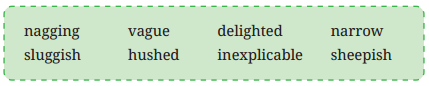
Now, underline the sentences that use these adjectives in the text.
1. _______________ path
Ans: Narrow path.
2. ______________ worry
Ans: Nagging worry.
3. ______________ plan
Ans: Vague plan.
4. ______________ look
Ans: Delighted look.
5. ______________ reason
Ans: Inexplicable reason.
6. ______________ traffic
Ans: Sluggish traffic.
7. ______________ voices
Ans: Hushed voices.
8. ______________ expression
Ans: Sheepish expression.
1. Narrow path: We walked along a narrow path through the forest.
2. Nagging worry: She had a nagging worry about her upcoming examination.
3. Inexplicable plan: His inexplicable plan surprised everyone in the group.
4. Sheepish look: The boy gave a sheepish look after breaking the vase.
5. Vague reason: He gave a vague reason for being absent from school.
6. Sluggish traffic: We were late because of the sluggish traffic on the main road.
7. Delighted voices: The children spoke in delighted voices after winning the competition.
8. Hushed expression: Everyone listened with a hushed expression during the important announcement.
II. The word ‘intercom’ is used in the text. It is called a merged word as it is made by combining the parts of two words ‘internal’ and ‘communication’. Merged words are made by combining two words.
Combine the words in Column 1 with the words in Column 2 to make merged words. Write the merged word and its meaning.
One example has been done for you.
| Column 1 | Column 2 | Merged Word | Meaning |
| Breakfast | Lunch | (i) Brunch | A meal eaten between breakfast and lunch hours. |
| Motor | Hotel | (ii) | |
| Smoke | Fog | (iii) | |
| Situation | Comedy | (iv) | |
| Video | Log | (v) | |
| Spoon | Fork | (vi) | |
| Web | Seminar | (vii) |
Ans:
| Column 1 | Column 2 | Merged Word | Meaning |
| Breakfast | Lunch | Brunch | A meal eaten between breakfast and lunch hours. |
| Motor | Hotel | Motel | A hotel for motorists. |
| Smoke | Fog | Smog | A mixture of smoke and fog. |
| Situation | Comedy | Sitcom | A comedy series based on everyday situations. |
| Video | Log | Vlog | A blog presented through videos. |
| Spoon | Fork | Spork | An eating utensil combining a spoon and a fork. |
| Web | Seminar | Webinar | A seminar conducted over the internet. |
III Read the following sentence from the text and fill in the blank.
It will mean that you’re being doubly safeguarded.
In the given sentence, ‘will’ denotes __________ (past/present/future) time.
There are several ways to use verbs to talk about the future in English. The following table lists some of the usages of future time references.
| S. No. | Tense | Usage | Examples |
| 1. | ‘will’ | When we provide information about future events or discuss possible future occurrences. | • I think the Kailash House will win. |
| 2. | Simple Present Tense | When we talk about the future only in situations that are a part of a regular schedule or planned action. | • My school reopens on 03 January. |
| 3. | Present Progressive Tense | When we use for future actions and events mostly for personal arrangements and fixed plans. | • My exams are getting over this weekend.• I am visiting my grandparents during the vacation. |
| 4. | ‘Going to’ Present Progressive Tense of ‘go’ | This is common in informal style, especially in speech or conversation. | • We’re going to get a new motorbike soon. |
| 5. | Future Perfect (will have + Past Participle) | When we say that something will be finished or completed by a certain time in future. | • The teacher says, she will have completed the portions by next month. |
| 6. | Future Progressive (will + be + -ing) | When we say that something will be in progress at a particular moment in the future. | • This time tomorrow I will be relaxing at home. |
| 7. | Future in the Past | Sometimes, when we talk about the past, we need to mention something that was still in the future at that time—something that had not happened yet. | • I had no time to shop as I was leaving for Chennai in an hour.• Last time I saw you, you were going to start a new business.• In 2024, I arrived in a town where I would spend the rest of my life. |
Ans:
| S. No. | Tense | Usage | Example |
| 1. | ‘Will’ | Used to provide information about future events or discuss possible future occurrences. | I think the Kailash House will win. |
| 2. | Simple Present Tense | Used for future events that are part of a regular schedule or planned action. | My school reopens on 03 January. |
| 3. | Present Progressive Tense | Used for future actions and events, mostly for personal arrangements and fixed plans. | I am visiting my grandparents during the vacation. |
| 4. | ‘Going to’ | Common in informal speech to talk about future plans or intentions. | We’re going to get a new motorbike soon. |
| 5. | Future Perfect | Used when something will be completed by a certain time in the future. | She will have completed the portions by next month. |
| 6. | Future Progressive | Used when something will be in progress at a particular moment in the future. | I will be relaxing at home this time tomorrow. |
| 7. | Future in the Past | Used when talking about something that was still in the future at a particular time in the past. | I arrived in a town where I would spend the rest of my life. |
IV. Fill in the blanks with the correct form (Simple Present, Present Progressive, ‘will’, or ‘going to’) to indicate future time.
1. Our flight __________ (leave) at 10.00 a.m. tomorrow.
Ans: Our flight leaves at 10.00 a.m. tomorrow.
2. They __________ (finish) the project by the end of this week.
Ans: They will finish the project by the end of this week.
3. The weather forecast says it __________ (rain) later today.
Ans: The weather forecast says it will rain later today.
4. We __________ (move) into our new house next month.
Ans: We are going to move into our new house next month.
5. I __________ (start) my new hobby class next Monday.
Ans: I am starting my new hobby class next Monday.
6. She __________ (go) to the mall this afternoon.
Ans: She is going to go to the mall this afternoon.
7. The team __________ (have) a meeting at 3.00 p.m. tomorrow.
Ans: The team has a meeting at 3.00 p.m. tomorrow.
8. I __________ (help) you with your homework after dinner.
Ans: I will help you with your homework after dinner.
V. Fill in the blanks with the suitable forms of verbs given in brackets to express future time reference.

By 2040, artificial intelligence 1. ________ (revolutionise) medical treatments. Researchers 2.________ (develop) AI-powered diagnostic tools that 3. ________ (transform) healthcare by the end of this decade. Next week, the International Science Congress 4. _______ (open) to showcase advancements in AI and robotics. In the coming years, robots 5. _______ (assist) surgeons in performing complex operations. Years ago, experts had predicted that AI would reshape our world, and now, as we approach the future, this 6. _______ (be) our new reality.
Ans: By 2040, artificial intelligence 1. will have revolutionised medical treatments. Researchers 2. will develop AI-powered diagnostic tools that 3. will transform healthcare by the end of this decade. Next week, the International Science Congress 4. will open to showcase advancements in AI and robotics. In the coming years, robots 5. will assist surgeons in performing complex operations. Years ago, experts had predicted that AI would reshape our world, and now, as we approach the future, this 6. will be our new reality.
Let us listen
I. You will listen to a conversation between Monika and Toby. Toby is a Martian and is stranded on Earth. He has become Monika’s friend. As you listen, put a tick mark (√) against the correct statements and a cross against the wrong ones.
1. Toby misses his school.
Ans: ✗ False.
2. Monika accepts Toby as her friend.
Ans: ✓ True
3. Monika asks Toby about one of his facial features.
Ans: ✗ False.
4. Toby tells Monika that she had a banana for breakfast.
Ans: ✗ False.
5. Toby shares that he can see much clearer with a closed eye.
Ans: ✓ True
II. Listen to the conversation again and fill in the blanks with the exact words you hear.
1. Toby: I miss my ____________________ and home.
Ans: People.
2. Toby: Well, we __________________ don’t need to eat anything. We get our __________________ from the Sun.
Ans: Martians; energy.
3. Monika: Oh! Don’t you ever feel like having ice-creams and __________________!
Ans: Chocolates.
4. Monika: Okay, tell me one thing. How are you able to see only with ________________ eye?
Ans: One.
5. Toby: I can see beyond mountains and ____________________, woods and even _____________________.
Ans: Clouds; metals.
Let us speak
I. Read the following words from the text aloud and circle the letters that are not pronounced (silent letters).
1. ballet — l
2. whistle — t
3. alarm — none
4. psychologist — p
Now, read some more words with silent letters. As you read, circle the letters that are not pronounced.

Ans: 1. receipt — p
2. debris — s
3. pneumonia — p
4. almond — l
5. foreign — g
6. island — s
7. wreck — w
8. aisle — s
9. campaign — g
10. fasten — t.
II Work in pairs. Use the given situations to ask for and give suggestions.
• You need to make a model of the solar system for the Science Exhibition but don’t know what materials to use. Ask your friend for suggestions.
• You need to prepare for the inter-class quiz on the topic Chandrayaan-3. Ask your friend for advice on how to prepare.
You may use the prompts given below.
| Asking for Advice | Giving Advice |
| What should I do…? | I feel you should… |
| How can I…? | You should ensure… |
| What are the best ways…? | It’s good to prepare yourself… |
| How can I make sure…? | If you have an issue…, try… |
| What should I…? | It is best to use… |
Ans: I need to make a model of the solar system for the Science Exhibition, but I need your suggestion.
Friend’s suggestions: First, choose a suitable scale and gather materials like craft supplies. Use paints and markers to make the planets look attractive. Research the size, colour, and rings of each planet to represent them accurately.
Ans: I need to prepare for the inter-class quiz on Chandrayaan-3. Can you suggest how I should prepare?
Friend’s suggestions: Focus on the mission’s goals, launch date, landing site, lander, rover, and instruments. Also, learn about the importance of the lunar south pole and the mission’s significance for India.
Let us write
I. Complete the social media web given below with the uses of the internet.

Now, write an article titled ‘The Importance of Internet’ with the help of the social media web.
Points to remember:
Heading/Title
Name of the writer
Paragraph 1: Give a general introduction to the topic.
Paragraph 2: Explain the uses of the internet and why it is important. Give examples to support your view.
Paragraph 3: End with a comment and leave the reader with a thoughtful idea or quote.
Ans Complete the social media web with the uses of the internet.
Entertainment
Social media
Communication
Navigation
Online networking
The Importance of Internet
By __________
The Internet is an important part of our daily life. It helps us to communicate, learn, work and stay connected with people around the world.
The Internet has many uses. We can use it for social media, e-mail, communication, navigation and entertainment. We can also search for information, attend online classes and share ideas with others. For example, students can use the Internet to find study materials and learn new things.
Thus, the Internet has made our lives easier and more connected. However, we should use it wisely and safely. The Internet is a powerful tool when used in the right way.
| MAGNIFYING GLASS |
Let us do these activities before we read.
I. Work in pairs. Answer the questions that follow the pictures given below.
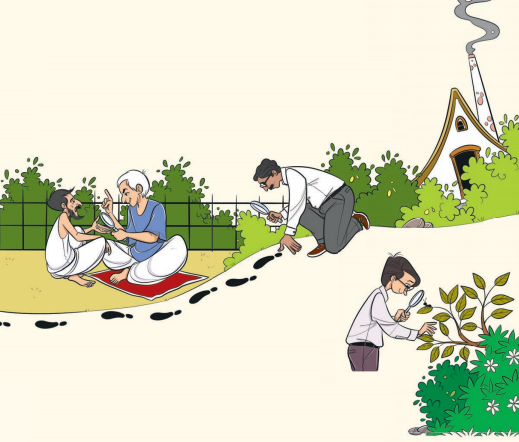
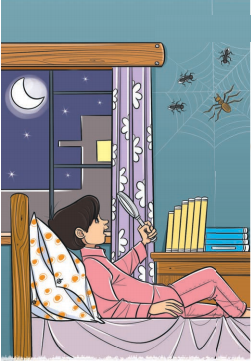
1. What is common in all these pictures?
Ans: All the pictures show people using a magnifying glass to observe small or tiny objects in detail.
2. Select the pictures you are familiar with.
Ans: I am familiar with the pictures of a scientist, a student, and a person observing a small object.
3. Why do you think the people in the pictures need to use a magnifying glass?
Ans: They need to use a magnifying glass to see small objects more clearly and in greater detail.
4. What other instruments magnify objects?
Ans: A microscope, telescope, and binoculars can magnify objects.
II. If you have a magnifying glass, what would you like to use it for and why?
Ans: If I had a magnifying glass, I would use it to observe leaves, insects, and tiny patterns on stones or shells. It would help me see things in nature more clearly and understand how beautiful and complex even the smallest things can be.
Let us Discuss.
I. Complete the summary of the poem given below with suitable words from the poem.
The poem describes the magic of seeing the world through a 1. ______________. It reveals how tiny things like 2. _____________ and 3. _____________ can appear vast and complex. Even a 4. _____________ of water can seem like a hive of 5.____________. The poet is impressed at how the spider spins its 6. _____________ from its 7. _____________. The poem ends with the idea that, through lenses, the 8. _____________ could seem within reach.
Ans: The poem describes the magic of seeing the world through a 1. magnifying glass. It reveals how tiny things like 2. moss and 3. chalk can appear vast and complex. Even a 4. drop of water can seem like a hive of 5. bees. The poet is impressed at how the spider spins its 6. web from its 7. spinnerets. The poem ends with the idea that, through lenses, the 8. moon could seem within reach.
II. Fill in the blanks by choosing the correct answer from the brackets.
1. The main idea of the poem is the transformative power of __________ (wonders in nature/close observation) through the magnifying glass.
Ans: Close observation.
2. The tone of the poem is __________. (wonder and curiosity/peaceful and emotional)
Ans: Wonder and curiosity.
3. The poem has __________ stanzas with __________ lines in each stanza. Hence, it is a quatrain. (four; six/six; four)
Ans: Six; four.
4. The rhyme scheme of the poem is __________. (ABCD; ABCB)
Ans: ABCB.
III. Pick examples from the poem for the following poetic devices.
1. Simile.
Ans: “A drop of water/Like hive of bees.”
2. Alliteration.
Ans: “Will make more marvellous.”
3. Metaphor.
Ans: “With this round glass/I can make Magic talk.”
IV. The poem is rich in visual imagery, painting vivid pictures of small, everyday things magnified into something grand.
1. In the line, ‘A myriad shells show in a scrap of chalk’, the magnifying glass reveals _______________.
Ans: The hidden patterns and tiny shell-like structures inside a piece of chalk.
2. In the line, ‘A forest—flowers and trees’ the poet uses the imagery of nature to emphasise _________________.
Ans: How a tiny patch of moss can appear like a whole forest when magnified.
V. Complete the following sentences with a reason.
1. The poet uses exclamation marks in lines, ‘The tigerish claws he has!’, ‘With all those eyes!’ and ‘In an afternoon!’ because it ________________.
Ans: shows the poet’s excitement, surprise, and wonder.
2. In the phrase, ‘Magic talk’ the poet uses personification to describe the magnifying glass because it ________________.
Ans: makes the magnifying glass seem as if it can talk and reveal magical details.
3. Each stanza follows a repetitive pattern of introducing a small or ordinary object and then describing the extraordinary details revealed through magnification. This is because it supports the theme of ____________ as the speaker reveals ____________.
Ans: curiosity as the speaker reveals the hidden wonders of ordinary things.
4. In the final stanza the poet shifts from small, everyday objects being magnified to a celestial body like moon because _____________.
Ans: it shows that magnification can make even distant objects like the moon seem close and within reach.
Let us think and reflect
I Read the given extracts and answer the questions that follow.
1. With this round glass
I can make Magic talk—
A myriad shells show
In a scrap of chalk;
Of but an inch of moss
A forest—flowers and trees;
1. Read the given extract and answer the questions.
(i) Identify whether the following statement is true or false.
The poet uses his magical powers to make the round glass powerful.
Ans: False.
The poet describes the magnifying glass as magical because it reveals hidden details in ordinary objects. The poet himself does not use magical powers.
(ii) Select the line from the extract that expresses the presence of intricate patterns in ordinary objects.
Ans: A myriad shells show”
(iii) What does the comparison of ‘an inch of moss’ to a ‘forest’ suggest about the speaker’s view of the world through the magnifying glass?
Ans: :It suggests that the magnifying glass makes even tiny and ordinary things appear vast, detailed, and full of wonders, just like a forest.
(iv) How does the poet feel about the ability of the magnifying glass to reveal hidden wonders?
A. Satisfied.
B. Fascinated.
C. Grateful.
D. Determined.
Ans: B. Fascinated.
Explanation: The poet expresses awe and wonder at how the magnifying glass reveals the unseen marvels of the natural world.
II. Answer the following questions.
1. What is the significance of the spider in the poem?
Ans: The spider shows the hidden beauty and intricate details of nature that become visible through the magnifying glass.
2. How might the speaker’s view of the natural world change if there was no use of a magnifying glass?
Ans: Without the magnifying glass, the speaker might not notice the tiny details and hidden wonders present in ordinary things.
3. Why does the poem end with the idea of the moon being within reach?
Ans: The poem ends this way to show how the magnifying glass makes distant and unreachable things seem close and fascinating.
4. What is the speaker’s attitude towards nature and the act of observation?
Ans: The speaker is curious, fascinated, and appreciative of nature and enjoys observing its hidden details.
5. Which is your favourite part of the poem? Why?
Ans: My favourite part is where an inch of moss is compared to a forest because it shows how the magnifying glass transforms a tiny object into a wonderful world.
Let us learn
I Fill in the blanks in the sentences with the words given in the box below.
| Woven myriad deft Stumble surpass marvellous |
With his 1. ____________ description, the author has written the story beautifully 2. ____________with fascinating details. When you read the story, you will surely enjoy the 3. ____________storytelling technique that attracts all kinds of readers. What makes the story interesting is the superb way of describing the 4. ____________emotions and feelings of the characters. The reader will 5. ____________upon the unexpected twists and turns that 6. ____________ all our understanding and make us wonder at the narrative power of the author.
Ans: With his 1. deft description, the author has written the story beautifully 2. woven with fascinating details. When you read the story, you will surely enjoy the 3. marvellous storytelling technique that attracts all kinds of readers. What makes the story interesting is the superb way of describing the 4. myriad emotions and feelings of the characters. The reader will 5. stumble upon the unexpected twists and turns that 6. surpass all our understanding and make us wonder at the narrative power of the author.
II. Match the phrases in Column 1 with suitable words in Column 2 to make collective nouns.
| Column 1 | Column 2 |
| 1. a swarm of | (i) ships |
| 2. a constellation of | (ii) soldiers |
| 3. a grove of | (iii) dancers |
| 4. a troupe of | (iv) locusts |
| 5. a battalion of | (v) trees |
| 6. a fleet of | (vi) stars |
Ans:
| Column 1 | Column 2 |
| 1. a swarm of | (iv) locusts |
| 2. a constellation of | (vi) stars |
| 3. a grove of | (v) trees |
| 4. a troupe of | (iii) dancers |
| 5. a battalion of | (ii) soldiers |
| 6. a fleet of | (i) ships |
III. The poet uses the expression ‘eyeing the moon’ in the poem. Match the idiomatic expressions with ‘eye’ given in Column 1 with their meanings in Column 2.
| Column 1 | Column 2 |
| 1. apple of one’s eye | (i) watch something or someone closely |
| 2. in the blink of an eye | (ii) act as if you do not see or notice |
| 3. keep an eye on something or somebody | (iii) something that happens very quickly |
| 4. turn a blind eye | (iv) an overall look at something |
| 5. see eye to eye | (v) a person who is very precious or important |
| 6. bird’s-eye view | (vi) agree with each other |
Ans:
| Column 1 | Column 2 |
| 1. apple of one’s eye | (v) a person who is very precious or important |
| 2. in the blink of an eye | (iii) something that happens very quickly |
| 3. keep an eye on something or somebody | (i) watch something or someone closely |
| 4. turn a blind eye | (ii) act as if you do not see or notice |
| 5. see eye to eye | (vi) agree with each other |
| 6. bird’s-eye view | (iv) an overall look at something |
IV. The poet uses the adjective form ‘tigerish’ in the poem by adding the suffix -‘ish’ to the noun ‘tiger’. In the same way, we can make adjectives by adding the suffix -‘ish’ to some nouns.
Choose the nouns to which you can add the suffix -‘ish’ to make adjectives.
| Girl glass book silk Boy water moon scrap |
Ans:
| Noun | Adjective with -ish |
| girl | girlish |
| glass | — |
| book | — |
| silk | silkish |
| boy | boyish |
| water | watery |
| moon | moonish |
Let us listen
I. You will listen to a conversation between a father and daughter about lesser-known Indian inventions. As you listen, mark the four true statements from (1)–(6) given below. (Transcript for teacher on page 250)
| No. | Statements | |
| 1. | The father is surprised by the fact that India was involved in the invention of radio broadcasting and fibre optics. | |
| 2. | The daughter appears indifferent when learning the origins of the USB port. | |
| 3. | The father shows little interest in the information about the origin of snakes and ladders. | |
| 4. | The father was simply confirming all the facts shared by the daughter. | |
| 5. | The daughter expresses pride and admiration for India’s role in global inventions. | |
| 6. | The daughter is excited as she shares new discoveries about India’s contributions with her father. |
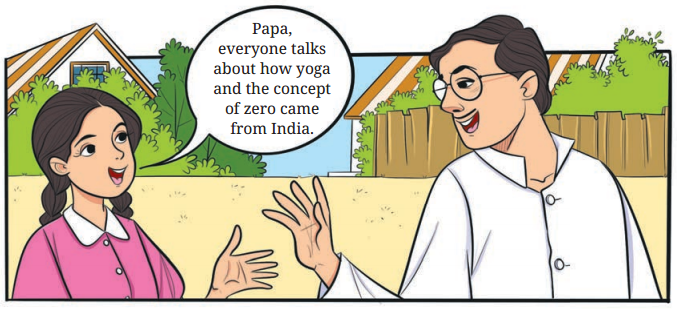
Ans: 1. True ✓
2. False ✗
3. False ✗
4. False ✗
5. True ✓
6. True ✓
Let us Speak
II. If you could travel to space, which planet would you like to visit? Why? What preparations would you like to make? Speak about any five things that you would like to take along.
Ans: If I could travel to space, I would like to visit Mars because it is fascinating and scientists are searching for signs of life there. I would prepare myself by learning about space travel and following the astronauts’ safety instructions. I would like to take a spacesuit, oxygen tank, camera, food and water, and a communication device with me. It would be an exciting and unforgettable experience.
III. If you could invent something, what would you like to invent and how? Give reasons for the choice of your invention. Speak about your wonder invention.
Ans: If I could invent something, I would invent a Pollution Cleaner Drone. It would fly over cities and absorb harmful gases, smoke, and dust particles from the air. I would invent it because pollution is a serious problem today, and clean air is essential for a healthy life. The drone would use smart sensors to find polluted areas and special filters to clean the air. It would be solar-powered, making it eco-friendly and safe for the environment. This invention would help people breathe cleaner air and make our cities healthier. I believe this wonderful invention would truly be a gift to the Earth!
| Bibha Chowdhuri The Beam of Light that Lit the Path for Women in Indian Science |
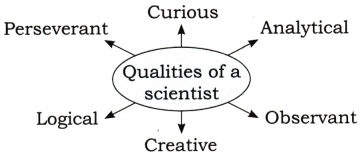
I. Work in pairs. What qualities do you associate with a scientist? Share your answers with your classmates and teacher. Complete the word web given below.
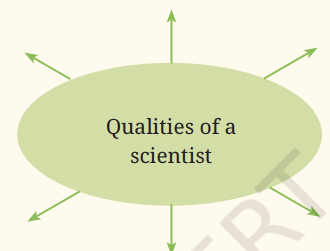
Ans: Some qualities associated with a scientist may include:
II Some pictures of women scientists are given below. What do you know about their work?
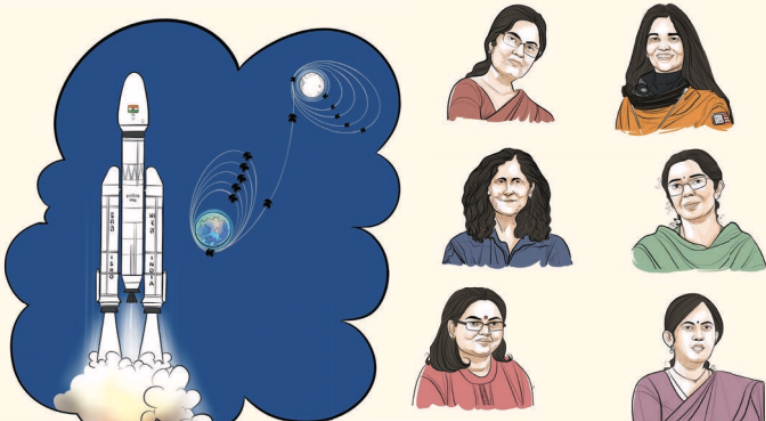
Ans: (i) Dr. Tessy Thomas: Known as the “Missile Woman of India,” she played a key role in the Agni missile project at DRDO.
(ii) Kalpana Chawla: The first woman of Indian origin to go to space. She was a NASA astronaut and died in the Space Shuttle Columbia disaster in 2003.
(iii) Dr. Ritu Karidhal: Known as the “Rocket Woman of India,” she played an important role in ISRO’s Mars Orbiter Mission and Chandrayaan-2.
(iv) Janaki Ammal: A renowned Indian botanist who made important contributions to plant breeding and genetics, especially in improving sugarcane varieties.
(v) Asima Chatterjee: A famous Indian organic chemist who researched plant-based medicines and contributed to the development of medicines for malaria and epilepsy.
(vi) Dr. Gagandeep Kang: A renowned virologist known for her research on vaccines and infectious diseases. She was the first Indian woman elected as a Fellow of the Royal Society.
Let us discuss
I Arrange the following events from Bibha Chowdhuri’s life in the correct order of occurrence.
1. The International Astronomical Union (IAU) honoured her legacy by renaming a star in the constellation Leo—HD 86081—as ‘Bibha’.
2. She became the first woman faculty member at the Tata Institute of Fundamental Research (TIFR).
3. Bibha Chowdhuri was born in pre-independent India.
4. The Government of India declared a chair professorship in Bibha’s name.
5. She joined the University of Manchester under the guidance of the celebrated Nobel Laureate, Patrick M.S. Blackett.
6. She was nominated for a Nobel Prize by Erwin Schrödinger.
Ans: 3 → 5 → 6 → 2 → 4 → 1
Let us Think and Reflect
I. Read the given extracts and answer the questions that follow.
1. In 1945, Bibha’s academic journey took her to the University of Manchester. Under the guidance of the celebrated Nobel Laureate, Patrick M.S. Blackett, she delved deeper into the field of cosmic rays. Her Ph.D. thesis on cosmic rays earned local recognition, with newspapers introducing her as ‘India’s New Woman Scientist—She has an eye for Cosmic Rays’.
(i) Why is the mention of Patrick M.S. Blackett, a Nobel Laureate, significant in this extract?
Ans: The mention of Patrick M.S. Blackett is significant because he was a renowned Nobel Laureate who guided Bibha Chowdhuri in her research on cosmic rays. His guidance helped her deepen her knowledge and strengthen her scientific career.
(ii) What can be inferred about the public perception of women scientists in the 1940s from the title given to her by the press ‘India’s New Woman Scientist’?
A. Women scientists were widely accepted and celebrated at that time.
B. The world was still doubtful about the capabilities of women scientists.
C. Women scientists were as common and renowned as men in the 1940s.
D. Women were not allowed to study sciences or pursue scientific careers.
Ans: B. The world was still doubtful about the capabilities of women scientists.
(iii) In the phrase ‘celebrated Nobel Laureate,’ the word ‘celebrated’ refers to all of the following EXCEPT someone who is
A. famous and highly respected.
B. frequently seen in public.
C. renowned for their achievements.
D. well-regarded in their field.
Ans: B. frequently seen in public.
(iv) Complete the following sentence suitably.
The phrase ‘She has an eye for Cosmic Rays’ suggests that __________.
Ans: The phrase ‘She has an eye for Cosmic Rays’ suggests that she has a special talent and keen interest in studying cosmic rays.
2. The journey from Bibha Chowdhuri’s era to today’s women scientists has been long and arduous, but it is also inspiring. The struggles Chowdhuri faced are a stark reminder of how far we’ve come—and how much further we have to go. But with every cosmic achievement— be it landing on the moon or reaching Mars—these women prove that the journey is well worth it.
Bibha Chowdhuri’s legacy lives on. Her story continues to inspire young women to pursue their passions, break barriers, and leave their mark on the world. As the stars of Indian science shine brighter, Bibha Chowdhuri, the beacon–‘beam of light,’ will always guide the way.
(i) What can be inferred about the challenges faced by women
scientists today, as compared to Bibha Chowdhuri’s era?
A. Women scientists no longer face any barriers.
B. The challenges remain, but progress has been made.
C. The struggles have become more difficult over time.
D. The struggles are the same as they were for Chowdhuri.
Ans: B. The challenges remain, but progress has been made.
(ii) The phrase ‘Bibha Chowdhuri’s legacy lives on’ suggests that __________.
Ans: The phrase ‘Bibha Chowdhuri’s legacy lives on’ suggests that her achievements and contributions continue to inspire young women scientists.
(iii) Why is Bibha Chowdhuri referred to as a ‘beacon’ and a ‘beam of light’ in the extract?
Ans: Bibha Chowdhuri is referred to as a ‘beacon’ and a ‘beam of light’ because her life and achievements inspire and guide young women to pursue science and overcome barriers.
(iv) State whether the following sentence is a fact or an opinion.
Bibha Chowdhuri was the beacon, the ‘beam of light’ whose story continues to inspire young women.
Ans: Opinion.
II. Answer the following questions.
1. Why is Bibha Chowdhuri considered a pioneer in the field of science?
Ans: Bibha Chowdhuri is considered a pioneer because she was one of the early Indian women scientists who made important contributions to the study of cosmic rays. She broke barriers for women in science and inspired future generations.
2. What does Bibha Chowdhuri’s nomination by Erwin Schrödinger tell us about her abilities?
Ans: Her nomination by the renowned scientist Erwin Schrödinger shows that Bibha Chowdhuri was a highly talented and capable scientist whose work was recognised by leading scientists of her time.
3. Bibha Chowdhuri never worked for awards or recognition. Support this statement with evidence from the text.
Ans: Bibha Chowdhuri was deeply interested in scientific research rather than fame or awards. She continued her work in cosmic rays despite facing many challenges and received greater recognition only later in her life and after her death.
4. How does the renaming of a star as ‘Bibha’ serve as both a literal and symbolic recognition of her contributions to science?
Ans: Literally, a star was named ‘Bibha’ in her honour. Symbolically, the star represents her lasting contribution to science and shows that her legacy will continue to shine and inspire others.
5. How do the roles of women in ISRO today reflect broader changes in societal attitudes towards women in STEM in India?
Ans: Women scientists in ISRO are now taking important roles in space missions, research, and leadership. This shows that society has become more accepting of women in STEM and recognises their abilities and contributions.
6. What is the writer’s purpose of highlighting the contributions of Bibha Chowdhuri and other modern women scientists?
Ans: The writer aims to honour their achievements, highlight the challenges they overcame, and inspire young women to pursue careers in science and technology.
7. How might this text help shape people’s perception of the role of women in other traditionally male-dominated fields?
Ans: The text shows that women are equally capable of achieving success in challenging fields. It can encourage people to challenge gender stereotypes and support women in traditionally male-dominated professions.
Let us learn
I. Complete the crossword puzzle by filling in the antonyms from the clues given below in the table. You may refer to the text.
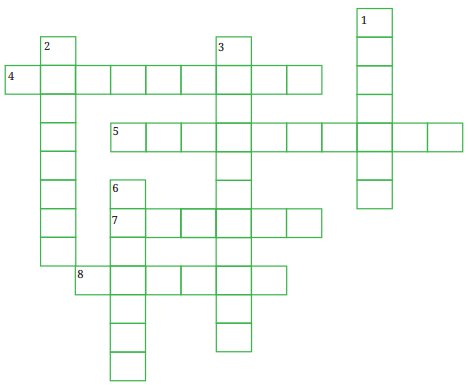
| Across | Down |
| 4. core | 1. effortless |
| 5. dependent | 2. weakness |
| 7. extinguish | 3. neglect |
| 8. terrestrial | 6. trivial |
Ans:
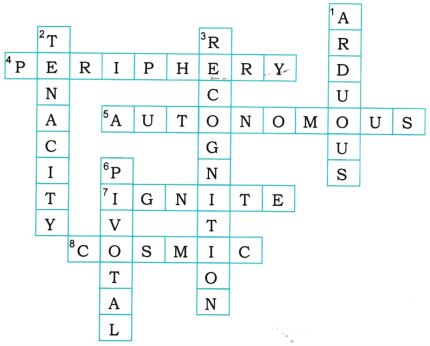
II. Substitute the underlined phrase in the sentences with the suitable words from the box given below.

1. They are considered to be the first people to start the online markets.
Ans: Pioneers.
2. A scientist who studies matter, energy, light, etc.
Ans: Physicist.
3. Most of my friends are my classmates and are my age.
Ans: Peers.
4. We first welcomed all the famous and important people in folk song for the award ceremony.
Ans: Luminaries.
5. My brother finally succeeded in his business because of his continuous efforts and determination.
Ans: Persistence.
6. We should remove all the things that block our way in achieving success.
Ans: Barriers.
III The words ‘professorship’, ‘mentorship’, and ‘leadership’ are used in the text. These words are made by adding the suffix ‘-ship’ to the words ‘professor’, ‘mentor’ and ‘leader’. Similarly, we can make words by adding -ment and -hood to certain words.
Now, make words by adding suitable suffixes -ship, -ment, and -hood to the words given below. One example has been done for you.
achieve + ment = achievement
1. member + _______________ = _________________
2. govern + _______________ = _________________
3. partner + _______________ = _________________
4. child + _______________ = _________________
5. citizen + _______________ = _________________
6. entertain + _______________ = _________________
7. brother + _______________ = _________________
8. agree + _______________ = _________________
Ans: 1. member + ship = membership.
2. govern + ment = government.
3. partner + ship = partnership.
4. child + hood = childhood.
5. citizen + ship = citizenship.
6. entertain + ment = entertainment.
7. brother + hood = brotherhood.
8. agree + ment = agreement.
IV The abbreviations—ISRO and STEM— used in the text are called acronyms because they are read or pronounced as full words.
The grid given below has acronyms for the following. Circle the acronyms in the grid.
1. National Aeronautics and Space Administration
2. All India Institute of Medical Sciences
3. Ayurveda, Yoga and Naturopathy, Unani, Siddha, and Homoeopathy
4. National Institute of Pharmaceutical Education and Research
5. World Health Organization
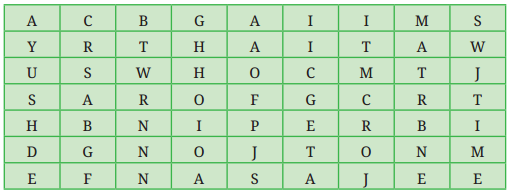
Clipping
The short form of laboratory is lab. In making this short form, the front part of the word is retained and the end part is removed or clipped.
Clipping is a method of making words from larger words in English. There are three clipping methods.
1. Back clipping: a word is made by removing the end part of a word and retaining the front part (exam—examination, ad—advertisement, gas—gasoline, memo—memorandum, gym—gymnasium, photo—photograph, etc.).
2. Front clipping: a word is made by removing the front part of a word and retaining the end part (phone—telephone,net—internet, bike—motorbike, net—internet, etc.).
3. Middle clipping: a word is made by removing the front and the end parts of the word and retaining the middle part (flu—influenza, fridge—refrigerator, etc.).
Ans:
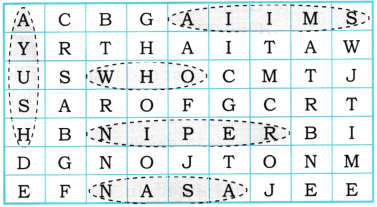
V. Read the following sentence from the text and the table that follows. …, the foundation was laid by early pioneers like Bibha Chowdhuri…
| Subject | Verb | Object |
| The foundation | was laid | early pioneers like Bibha Chowdhuri… |
Here the verb is expressed in passive form.
Verbs can be expressed in either active voice or passive voice.
When the subject performs the action, the sentence is said to be in active voice. On the other hand, when the subject receives the action, the sentence is in passive voice.
Generally, sentences written in active voice are considered effective. However, passive voice is used when the
action is more important than the doer,
A cure for the disease was discovered.
(The focus is on the discovery, not on who discovered it.)
doer of the action (agent) is obvious,
The national anthem is sung at the beginning of the event.
(It is clear that people sing it, so mentioning the doer is unnecessary.)
doer of the action is unknown.
The car was stolen last night.
(The identity of the thief is unknown.)
Now, complete the following news report with the passive form of verbs given in the box below. (Remember that the verb must agree with the subject.)

Last year, significant advancements in medical science 1. __________ in leading medical journals when a new vaccine for malaria 2. __________. The vaccine 3. __________ through several clinical trials and results 4. _________ in those journals. During the trials, blood samples 5. __________ regularly from participants to monitor their immune response. The amount of antibodies produced 6. __________ carefully to assess the effectiveness of the vaccine.
Ans: Last year, significant advancements in medical science 1. were published in leading medical journals when a new vaccine for malaria 2. was discovered. The vaccine 3. was tested through several clinical trials and results 4. were recorded in those journals. During the trials, blood samples 5. were taken regularly from participants to monitor their immune response. The amount of antibodies produced 6. was measured carefully to assess the effectiveness of the vaccine.
VI Read the following report of an experiment. Rewrite the report using passive verbs wherever necessary.
I conducted an experiment to investigate the effects of light on plant growth. I placed various plants under different light conditions and measured their growth over several weeks. I recorded data daily to track the height of each plant. At the end of the experiment, I analysed the results and found that plants exposed to natural light grew significantly taller than those under artificial light. I concluded that sunlight plays a crucial role in plant development. I presented my findings to the class, highlighting the importance of light in enhancing photosynthesis and overall plant health.
You may begin like this.
An experiment was conducted…
Ans: An experiment was conducted to investigate the effects of light on plant growth. Various plants were placed under different light conditions, and their growth was measured over several weeks. Data was recorded daily to track the height of each plant. At the end of the experiment, the results were analysed, and it was found that plants exposed to natural light grew significantly taller than those under artificial light. It was concluded that sunlight plays a crucial role in plant development. The findings were presented to the class, highlighting the importance of light in enhancing photosynthesis and overall plant health.
VII Read the instructions given in the box on landing of Chandrayaan. Complete the passage by choosing the correct answer from the options given.
• Launch the spacecraft towards the Moon from Earth.
• Position the spacecraft to enter the Moon’s orbit.
• Adjust the spacecraft’s path for landing.
• Slow down the spacecraft as it nears the Moon’s surface.
• Release the rover to explore the surface and collect valuable data.
Chandrayaan’s landing mission involves several key steps. First, the spacecraft 1. ________ towards the Moon from the Earth. Then, it 2. ________ to enter the Moon’s orbit. After reaching the Moon’s orbit, the spacecraft’s path 3. ________ for landing. Next, the spacecraft 4. ________ as it nears the Moon’s surface. Finally, the rover 5. ________ to explore the surface and collect valuable data.
(i) A. launched.
B. were launched.
C. was launched.
D. is launched.
(ii) A. position.
B. was positioned.
C. is positioned.
D. has positioned.
(iii) A. adjusted.
B. was adjusted.
C. is adjusted.
D. were adjusted.
(iv) A. slowed down.
B. was slowed down.
C. is slowed down.
D. were slowed down.
(v) A. is released.
B. has released.
C. were released.
D. was released.
Ans: Chandrayaan’s landing mission involves several key steps. First, the spacecraft 1. was launched towards the Moon from the Earth. Then, it 2. was positioned to enter the Moon’s orbit. After reaching the Moon’s orbit, the spacecraft’s path 3. was adjusted for landing. Next, the spacecraft 4. was slowed down as it nears the Moon’s surface. Finally, the rover 5. was released to explore the surface and collect valuable data.
(i) C. was launched.
(ii) B. was positioned.
(iii) B. was adjusted.
(iv) B. was slowed down.
(v) D. was released.
Let us listen
I. You will listen to a podcast about Artificial Intelligence. As you listen, answer the following questions by selecting the correct options.
1. What is one of the key benefits of AI in the healthcare sector?
(i) Helps doctors communicate faster with patients.
(ii) Provides personalised treatments and faster diagnoses.
(iii) Focuses on cosmetic surgeries to improve appearance.
Ans: (ii) Provides personalised treatments and faster diagnoses.
2. How did AI play a crucial role during the global pandemic?
(i) AI robots monitored patient behaviour in hospitals.
(ii) AI assisted in speeding up the discovery of new medicines.
(iii) AI developed different types of vaccines by itself.
Ans: (ii) AI assisted in speeding up the discovery of new medicines.
3. What example was given regarding AI’s role in renewable energy?
(i) AI is optimising the placement of wind turbines and solar panels in cities.
(ii) AI is promoting alternative energy from wind turbines and solar panels.
(iii) AI is improving the performance of wind turbines and solar panels.
Ans: (i) AI is optimising the placement of wind turbines and solar panels in cities.
4. What does AI offer to teachers in the field of education?
(i) Helps teachers assign grades more quickly.
(ii) Allows teachers to communicate better with students.
(iii) Helps teachers analyse student performance.
Ans: (iii) Helps teachers analyse student performance.
5. What is one of the user-friendly features that AI is enhancing for people with disabilities?
(i) Helps them find better jobs in the mainstream.
(ii) Improves speech recognition and voice command technologies.
(iii) Trains individuals to interact with robots.
Ans: (ii) Improves speech recognition and voice command technologies.
Let us write
I. Your school recently hosted the Zonal Science Exhibition, in which teams of students from 25 schools participated enthusiastically. As the student editor, write a report on the exhibition to be published in your school magazine. Use the cues given below with your own ideas to compose this report.
Who was the organiser and who hosted the exhibition?
When (date and time) and where was it held?
Why was it held?
Who participated?
Who was the Chief Guest?
What were the competitions held? For example: Science Quiz, Science Models, etc.
What were the topics of models exhibited? Give details.
Which team got the trophy for best exhibit?
What were the observations of the Chief Guest and other visitors?
Points to remember:
1. Write the report in past tense, passive voice, and third person.
2. Follow proper format with a headline, reporter’s name, and three paragraphs.
Ans: Young Innovators Shine at the Zonal Science Exhibition By: Aarav Mehta, Student Editor The Zonal Science Exhibition 2025 was successfully hosted by Green Valley Public School on 10th August 2025 in the school auditorium. The event was organised under the guidance of the Science Department in collaboration with the District Education Office. The purpose of the exhibition was to promote scientific curiosity, creativity, and innovation among school students. Participation and Events A total of 25 schools from across the zone participated with great enthusiasm. The Chief Guest, Dr. Anjali Rao, a renowned scientist from the Indian Institute of Science, inaugurated the event. The exhibition featured various competitions such as the Science Quiz, Model Display, and Poster Making Contest.
Students presented models on topics like Renewable Energy, Space Technology, Water Conservation, and Artificial Intelligence. Among all entries, the model titled “Smart Irrigation System” by Springdale Public School won the Best Exhibit Trophy for its innovation and practical application.
Subject Ka Complete Video Solution Dekhein
Step-by-step easy concept explanation aur full questions Answer ke liye watch karein ya app download karein:


 Buy Now