
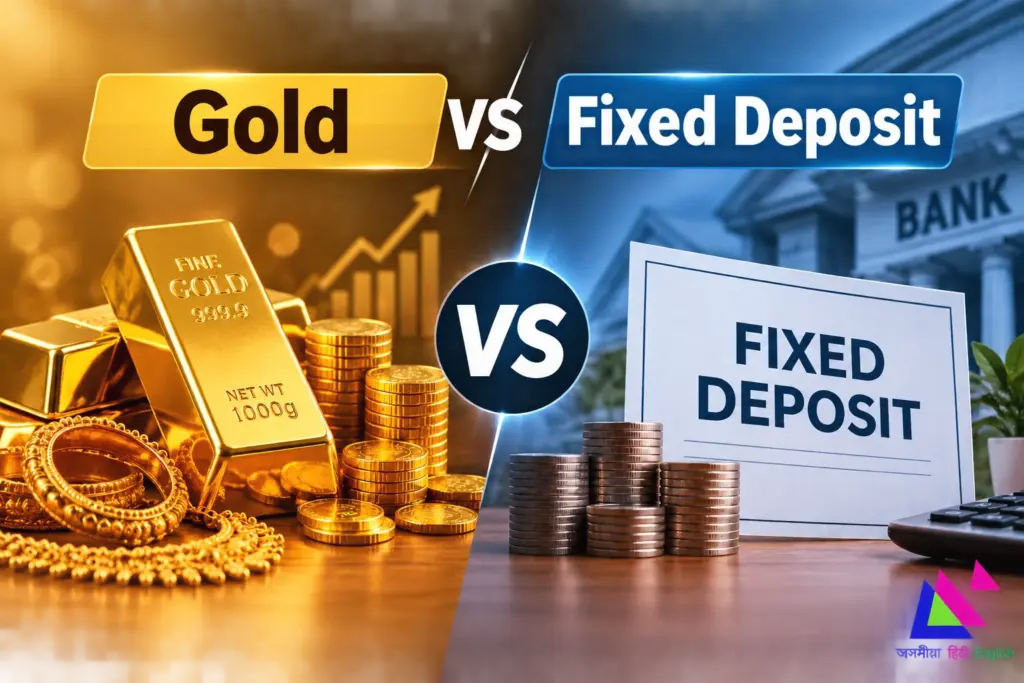
Choosing the right investment can help you achieve your financial goals and secure your future. In India, gold and fixed deposits (FDs) are popular investment options. The Gold vs Fixed Deposit comparison helps investors understand the differences between these two options. Gold attracts investors who want to preserve wealth and benefit from rising prices, while FDs offer predictable interest returns. But which option is better for your money? Let’s explore Gold vs Fixed Deposit in detail and find out which investment suits your financial goals.
What Is Gold Investment?
Gold investment involves buying gold to preserve wealth or earn returns when its market price increases. You can invest in physical gold, gold coins, or Gold Exchange-Traded Funds (ETFs). Gold has traditionally attracted investors during economic uncertainty and inflation.
However, gold prices fluctuate according to global demand, currency movements, and market conditions. Physical gold may also involve making charges, storage expenses, and resale deductions. Therefore, gold does not guarantee profits.
Also Read: ETF Investment Guide: How ETFs Work, Benefits, Risks & More
What Is a Fixed Deposit (FD)?
A fixed deposit allows you to deposit a lump sum with a bank for a specific period at an agreed interest rate. You receive the principal and applicable interest according to the deposit terms.
FDs offer predictable returns, making them suitable for people who prefer stability over market fluctuations. You can also select different tenures and interest payout options according to your financial needs.
Gold vs Fixed Deposit: Key Differences
| Feature | Gold | Fixed Deposit (FD) |
| Returns | Depend on market prices. | Earns fixed interest. |
| Risk | Prices can fluctuate. | Generally lower risk with eligible banks. |
| Regular Income | No regular income. | Interest payout options available. |
| Liquidity | Can be sold anytime, subject to buyers. | Early withdrawal may incur a penalty. |
| Capital Protection | No guaranteed value. | Deposit protection subject to applicable rules. |
| Inflation | May help diversify investments. | Returns may not beat inflation. |
| Best For | Diversification and long-term goals. | Predictable returns and savings. |
Which Investment Offers Better Returns?
Gold can generate attractive returns when prices rise, but investors cannot predict future prices with certainty. During periods of falling prices, gold investments may lose value.
FDs offer more predictable returns because banks determine the interest rate when you open the deposit.
For example, if you invest ₹1,00,000 in an FD at an illustrative interest rate of 7% per year, compounded annually, your investment could grow to approximately ₹1,40,255 after five years, before tax. Actual returns depend on the bank’s terms and compounding frequency.
Gold has no fixed maturity value, so your final return depends on its selling price and associated costs.
Gold vs Fixed Deposit : Which Is Safer?
FDs generally suit investors who prioritise predictable returns and capital stability. In India, DICGC insures eligible bank deposits up to ₹5 lakh per depositor per bank, including principal and interest, subject to applicable rules.
Gold carries market risk because its price can rise or fall. Physical gold also requires secure storage, while gold ETFs involve market-related expenses and risks.
Pros and Cons of Gold and FD
Gold – Pros:
- Offers portfolio diversification.
- May appreciate during periods of strong demand.
- Provides exposure to gold prices.
Gold – Cons:
- Prices can fluctuate significantly.
- Does not generate regular interest income.
- May involve storage and transaction costs.
FD – Pros:
- Offers predictable interest returns.
- Helps plan for future expenses.
- Provides options for regular interest income.
FD – Cons:
- Interest is generally taxable.
- Inflation may reduce real returns.
- Premature withdrawals may attract penalties.
Conclusion
Gold vs Fixed Deposit is a common investment comparison for people who want to grow their savings and secure their financial future. An FD may suit you if you prefer predictable returns and stability, while gold may help diversify your investment portfolio. Rather than choosing only one, you can consider both according to your financial goals, investment period, and risk tolerance.
Before investing, compare taxes, costs, and inflation. Ultimately, the right choice in the Gold vs Fixed Deposit comparison is the investment that matches your financial needs, not simply the one that delivered higher returns in the past.
FAQs
1. Is gold better than an FD?
Ans: Neither is always better. Gold offers market-linked returns, while FDs provide predictable interest.
2. Can gold offer higher returns than an FD?
Ans: Yes, gold can outperform an FD when prices rise sufficiently, but returns are not guaranteed.
3. Is an FD safe in India?
Ans: Eligible bank deposits receive DICGC insurance up to ₹5 lakh per depositor per bank, subject to applicable rules.
4. Is FD interest taxable?
Ans: Yes, FD interest is generally taxable according to applicable income-tax rules.
5. Should I invest in both gold and FD?
Ans: You can consider both to balance predictable savings with investment diversification, depending on your financial goals and risk tolerance.
Disclaimer: This article is for educational purposes only and does not constitute financial advice. Investment returns vary, and readers should assess their financial goals and risks before investing in gold or FDs.
Subject Ka Complete Video Solution Dekhein
Step-by-step easy concept explanation aur full questions Answer ke liye watch karein ya app download karein:



 Buy Now