
NCERT Class 8 English Chapter 2 A Tale of Valour Major Somnath Sharma and the Battle of Badgam Solutions As Per New Syllabus to each chapter is provided in the list so that you can easily browse through different chapters NCERT Class 8 English Chapter 2 A Tale of Valour Major Somnath Sharma and the Battle of Badgam Notes and select need one. NCERT Class 8 English Chapter 2 A Tale of Valour Major Somnath Sharma and the Battle of Badgam Question Answers Download PDF. NCERT Class 8 English Textbook Solutions.
NCERT Class 8 English Chapter 2 A Tale of Valour Major Somnath Sharma and the Battle of Badgam
Also, you can read the NCERT book online in these sections Solutions by Expert Teachers as per Central Board of Secondary Education (CBSE) Book guidelines. CBSE Class 8 English Solutions are part of All Subject Solutions. Here we have given NCERT Class 8 English Chapter 2 A Tale of Valour Major Somnath Sharma and the Battle of Badgam Solutions for All Chapters, You can practice these here.
A Tale of Valour Major Somnath Sharma and the Battle of Badgam
Chapter: 2
| UNIT 2 VALUES AND DISPOSITIONS |
Let us do these activities before we read
I. Work in pairs
1. What do you think about the Republic Day Parade on 26 January?
Ans: The Republic Day Parade is a grand and patriotic event that showcases India’s military strength, cultural diversity and national pride.
2. What are the highlights of this parade?
Ans: The main highlights are the march-past by the Armed Forces, colourful tableaux of different states and ministries, cultural performances, military displays and the bravery award ceremonies.
3. What bravery awards are given on this day, and who receives them?
Ans: Gallantry awards such as the Param Vir Chakra, Maha Vir Chakra and Vir Chakra are given to military personnel for displaying extraordinary courage and bravery in the line of duty.
II. Work in groups of four
1. What qualities do you think a soldier should have?
Ans: A soldier should have courage, discipline, patriotism, dedication, loyalty, determination, leadership and a spirit of self-sacrifice.
2. If you had to share a message with a soldier, what would it be?
Ans: I would say, “Thank you for your courage and sacrifice. Your dedication to protecting our nation inspires us. We are proud of you and deeply grateful for your service.”
Let us discuss
I. Arrange the following events in chronological order. The first and the last events have been marked for you. Share your answers with your classmates and teacher.
1. Major Somnath Sharma was born in 1923 in Kangra, Himachal Pradesh. (1)
2. Even after losing Major Somnath Sharma, the soldiers fought bravely to save Srinagar for India.
3. The D Company, under the command of Major Somnath Sharma, was flown into Srinagar.
4. Major Somnath Sharma underwent training at the Royal Military College, Sandhurst.
5. Major Somnath Sharma requested air strikes to combat the enemy at Badgam.
6. Major Somnath Sharma was commissioned into the 19th Hyderabad Regiment in 1942.
7. Major Somnath Sharma was killed immediately after a mortar shell hit him.
8. Major Somnath Sharma was the first recipient of the Param Vir Chakra.
Ans: The correct chronological order is:
1. Major Somnath Sharma was born in 1923 in Kangra, Himachal Pradesh.
2. Major Somnath Sharma underwent training at the Royal Military College, Sandhurst.
3. Major Somnath Sharma was commissioned into the 19th Hyderabad Regiment in 1942.
4. The D Company, under the command of Major Somnath Sharma, was flown into Srinagar.
5. Major Somnath Sharma requested air strikes to combat the enemy at Badgam.
6. Major Somnath Sharma was killed immediately after a mortar shell hit him.
7. Even after losing Major Somnath Sharma, the soldiers fought bravely to save Srinagar for India.
8. Major Somnath Sharma was the first recipient of the Param Vir Chakra.
Let us think and reflect
I. Read the given extracts and answer the questions that follow.
1. Vastly outnumbered and facing devastating fire, Major Somnath Sharma and his men stood resolute. The air was thick with the sound of gunfire and the cries of battle, but Major Somnath Sharma’s voice cut through the chaos, urging his men to fight with tenacity and valour. Despite heavy casualties and his own injuries, Major Somnath Sharma displayed unparalleled bravery. He moved fearlessly through the battlefield, directing fire, filling magazines for his gunners, and encouraging his men to hold their ground.
(i) What can be inferred about the conditions from the line: ‘The air was thick with gunfire…’?
A. The gunshots had stopped for a while.
B. There was intense fighting on the battlefield.
C. The invaders were retreating from the fight.
D. The Indian soldiers had achieved victory.
Ans: B. There was intense fighting on the battlefield.
(ii) Complete the sentence with a suitable reason.
Despite heavy casualties, Major Somnath Sharma continued to lead his men because ________________________________.
Ans: Despite heavy casualties, Major Somnath Sharma continued to lead his men because he was courageous and determined to defend his position and encourage his soldiers to fight bravely.
(iii) Select the correct option for both Assertion (A) and Reason (R) given below:
(A): Major Somnath Sharma moved fearlessly through the battlefield, even though he was injured.
(R): He believed his courage was important to motivate the soldiers.
A. Both (A) and (R) are true, and (R) is the correct explanation of (A).
B. Both (A) and (R) are true, but (R) is not the correct explanation of (A).
C. (A) is true, but (R) is false.
D. (A) is false, but (R) is true.
Ans: A. Both (A) and (R) are true, and (R) is the correct explanation of (A).
(iv) Fill in the blank with the correct word from those given in the brackets:
Major Somnath Sharma was filling magazines, and encouraging his men to hold their ground despite ___________________________. (injuries/worry)
Ans: injuries.
2. Born on 31 January 1923, in the picturesque town of Dadh in Kangra, Himachal Pradesh, Somnath Sharma belonged to a family with a rich military legacy. His father, Major General Amar Nath Sharma, had served the nation with distinction, and young Somnath was deeply inspired by the valorous tales of the Mahabharata, imparted to him by his grandfather.
(i) What can be inferred about Somnath Sharma’s early influences on his career?
A. He was primarily influenced by his father’s achievements in the military.
B. His inspiration came solely from the tales of the Mahabharata.
C. His family and heritage inspired his bravery and sense of duty.
D. He decided to join the military out of necessity rather than passion.
Ans: C. His family and heritage inspired his bravery and sense of duty.
(ii) Identify whether the following statement is true or false:
Somnath Sharma belonged to a wealthy family.
Ans: False. The extract states that he belonged to a family with a rich military legacy, not that his family was wealthy.
(iii) What does the phrase ‘served the nation with distinction’ tell us about Major General Amar Nath Sharma?
A. He performed his duties with exceptional dedication, honour, and excellence.
B. He was highly respected for his contributions to the country.
Ans: He performed his duties with exceptional dedication, honour, and excellence.
(iv) Replace the underlined phrase with a word from the extract that has a similar meaning.
My family and I visited a popular hill station and stayed in an old but visually charming house surrounded by trees.
Ans: picturesque.
II. Answer the following questions
1. ‘Major Somnath’s legacy of courage and devotion to the nation remains forever alive, forever alive…’ What is the significance of the repetition in this line?
Ans: The repetition of “forever alive” shows that Major Somnath Sharma’s courage and sacrifice will never be forgotten. His bravery will continue to inspire people for generations.
2. Why do you think Major Somnath’s leadership was critical during the Battle of Badgam?
Ans: Major Somnath’s leadership was very important because he kept his men motivated even when they were heavily outnumbered. He led from the front, encouraged his soldiers and helped them hold their position until reinforcements arrived.
3. What were Major Somnath’s last words? What do they reflect about his sense of duty?
Ans: His last words were, “I shall not withdraw an inch but will fight to the last man and the last round.” These words show his great courage, determination and deep sense of duty towards his men and the nation.
4. What might have been the outcome of the Battle of Badgam if Major Somnath and his company had not held their ground?
Ans: If Major Somnath and his company had not held their ground, the enemy might have captured the Srinagar airfield and surrounding areas. This could have put Srinagar and the Kashmir Valley in serious danger.
5. Why do you think Major Somnath’s story continues to inspire soldiers and civilians today?
Ans: Major Somnath’s story inspires people because he showed extraordinary courage and dedication to his country. Even when he was injured and faced a much larger enemy force, he did not give up. His sacrifice is an example of true patriotism.
6. How can the values demonstrated by Major Somnath Sharma—courage, duty, and self-sacrifice—be applied in our daily lives?
Ans: We can follow these values by facing difficulties bravely, doing our duties honestly and helping others whenever we can. We should also learn to put the needs of others and our responsibilities before our own comfort when necessary.
Let us learn
I Match the expressions from the text in Column 1 with the most suitable situations given in Column 2.
| Column 1 | Column 2 |
| 1. Fight to the last man | (i) A sports team scores a last-minute goal, giving them the lead and shaking the opponent’s confidence. |
| 2. Foil the plan | (ii) The soldiers fought valiantly until each one laid down his life for the nation. |
| 3. Deliver a blow | (iii) Soldiers stay in their position and fight back, even though the enemy is stronger. |
| 4. Hold their ground | (iv) A spy disrupts the enemy’s efforts to invade a country by intercepting their communications. |
Ans:
| Column 1 | Column 2 |
| 1. Fight to the last man | (ii) The soldiers fought valiantly until each one laid down his life for the nation. |
| 2. Foil the plan | (iv) A spy disrupts the enemy’s efforts to invade a country by intercepting their communications. |
| 3. Deliver a blow | (i) A sports team scores a last-minute goal, giving them the lead and shaking the opponent’s confidence. |
| 4. Hold their ground | (iii) Soldiers stay in their position and fight back, even though the enemy is stronger. |
Now, complete the following sentences using the expressions from Column 1.
A. The detective managed to ______________ by finding the hidden evidence before the culprit could get rid of it.
Ans: The detective managed to foil the plan by finding the hidden evidence before the culprit could get rid of it.
B. The company’s new advertising campaign was meant to ______________ to their competitors’ sales.
Ans: The company’s new advertising campaign was meant to deliver a blow to their competitors’ sales.
C. The hikers chose to ______________ despite the heavy rain, refusing to turn back on their journey.
Ans: The hikers chose to hold their ground despite the heavy rain, refusing to turn back on their journey.
D. Despite being heavily outnumbered, the soldiers vowed to defend their homeland and ______________, refusing to surrender to the enemy forces.
Ans: Despite being heavily outnumbered, the soldiers vowed to defend their homeland and fight to the last man, refusing to surrender to the enemy forces.
II Read the highlighted words in the following sentence from the text.
A contingent of troops posted to Jammu and Kashmir was air-lifted into Srinagar…
There are many such collective nouns used in the context of armed forces. Match the collective nouns in Column 1 to their meanings in Column 2. You may refer to a dictionary.
| Column 1 | Column 2 |
| 1. Regiment | (i) A large body of troops ready for battle, especially an infantry unit. |
| 2. Squadron | (ii) A permanent unit of an army typically commanded by a lieutenant colonel/colonel and divided into several companies. |
| 3. Fleet | (iii) A small unit, typically comprising 12–24 aircraft and their crews used in air force, naval, or army aviation services. |
| 4. Battalion | (iv) A group of ships sailing together, engaged in the same activity, or under the same ownership. |
Ans:
| Column 1 | Column 2 |
| 1. Regiment | (ii) A permanent unit of an army typically commanded by a lieutenant colonel/colonel and divided into several companies. |
| 2. Squadron | (iii) A small unit, typically comprising 12–24 aircraft and their crews, used in air force, naval, or army aviation services. |
| 3. Fleet | (iv) A group of ships sailing together, engaged in the same activity, or under the same ownership. |
| 4. Battalion | (i) A large body of troops ready for battle, especially an infantry unit. |
Now, fill in the blanks suitably with words from Column 1 in the table.
A. The commanding officer addressed the entire ________ of soldiers during the morning assembly.
Ans: The commanding officer addressed the entire regiment of soldiers during the morning assembly.
B. The admiral ordered the entire ________ to set sail for battle.
Ans: The admiral ordered the entire fleet to set sail for battle.
C. The ________ of infantry advanced slowly through the dense forest.
Ans: The battalion of infantry advanced slowly through the dense forest.
D. A ________ of fighter jets was sent to intercept the enemy planes.
Ans: A squadron of fighter jets was sent to intercept the enemy planes.
III. Read the following words from the text and fill in the blanks with the correct words by taking clues from the meanings given below in the box.
overwhelm — overthrow — overrun
Meanings
1. To take and seize control: ____________
Ans: overthrow
2. To invade or occupy an area in large numbers: ____________
Ans: overrun
3. To flood or overpower someone or something emotionally: ____________
Ans: overwhelm
Now, create a list of at least five other verbs that begin with ‘over’ and frame sentences of your own.
Ans: Overcome — She worked hard to overcome her fear.
Overtake — The car managed to overtake the bus.
Overlook — Do not overlook the importance of hard work.
Overload — We should not overload the truck with heavy.
Overuse — We should not overuse mobile phones.
IV. In the following pairs of words, ‘c’ is used for nouns, while for verbs. while ‘s’ is used
advice (noun) and advise (verb)
practice (noun) and practise (verb)
device (noun) and devise (verb)
council (noun) and counsel (verb)
Now fill in the blanks correctly with the words given in the brackets.
1. The teacher’s (i) ____________ is always helpful, and she continues to (ii) ____________ students on their career choices. (advice/advise)
Ans: The teacher’s (i) advice is always helpful, and she continues to (ii) advise students on their career choices.
2. The musician believes that daily (i) ____________ helps a lot, so she is always ready to (ii) ____________ her harmonium lessons. (practice/practise)
Ans: The musician believes that daily (i) practice helps a lot, so she is always ready to (ii) practise her harmonium lessons.
3. The scientist uses a strange (i) ____________ for experiments and plans to (ii) ____________ new methods for his analysis. (device/devise)
Ans: The scientist uses a strange (i) device for experiments and plans to (ii) devise new methods for his analysis.
4. The village (i) ____________ met to discuss issues and decided to (ii) ____________ the villagers on important matters. (council/counsel)
Ans: The village (i) council met to discuss issues and decided to (ii) counsel the villagers on important matters.
V. Read the highlighted words in the following sentences from the text.
• …ended with echoes of courage that serve as an inspiration…
• A contingent of troops posted to Jammu and Kashmir was airlifted into Srinagar…
• D Company with 90 soldiers was the last and they were expected to return by 2:00 p.m.
• The life and sacrifice of Major Somnath Sharma embody the highest ideals of duty, honour, and patriotism.
The highlighted words are either singular verbs or plural verbs. They are in agreement with the subject of the sentence. This is called Subject-Verb Agreement.
Now, fill in the blanks for the following sentences by choosing the correct verb given within brackets.
1. The bouquet of flowers __________ (is/are) beautiful.
Ans: The bouquet of flowers is beautiful.
2. Neither the teacher nor the students __________ (was/were) aware of the change in the schedule.
Ans: Neither the teacher nor the students were aware of the change in the schedule.
3. Each of the participants __________ (has/have) submitted their projects on time.
Ans: Each of the participants has submitted their projects on time.
4. The data collected by the researchers __________ (shows/show) significant trends.
Ans: The data collected by the researchers shows significant trends.
5. One of the players __________ (was/were) injured during the match.
Ans: One of the players was injured during the match.
6. Either the children or their guardian __________ (has/have) to attend the meeting.
Ans: Either the children or their guardian has to attend the meeting.
7. A pair of shoes __________ (is/are) missing from the rack.
Ans: A pair of shoes is missing from the rack.
8. Neither of the statements __________ (is/are) true.
Ans: Neither of the statements is true.
9. The members of the jury __________ (has deliver/have delivered) their verdict to the court.
Ans: The members of the jury have delivered their verdict to the court.
10. Mathematics __________ (is/are) an interesting subject for many students.
Ans: Mathematics is an interesting subject for many students.
VI. Read the following passage and correct the incorrect usage of verbs. One example has been done for you.
A. A battalion of soldiers stand at attention as the National flag are raised.
Ans: A battalion of soldiers stands at attention as the National flag is raised.
B. Each soldier salute with pride while the commander and his assistants inspects the parade.
Ans: Each soldier salutes with pride while the commander and his assistants inspect the parade.
C. The sound of marching feet echo through the air as a group of cadets prepare for their drill.
Ans: The sound of marching feet echoes through the air as a group of cadets prepare for their drill.
D. Meanwhile, a convoy of military vehicles pass by, drawing cheers from the gathered crowd.
Ans: Meanwhile, a convoy of military vehicles passes by, drawing cheers from the gathered crowd.
Let us listen
I. You will listen to a talk about the Param Vir Chakra. As you listen, complete the sentences by filling in the blanks with one or two exact words or phrases you hear.
1. The Param Vir Chakra signifies the ‘Wheel of the Ultimate ____________’.
Ans: The Param Vir Chakra signifies the “Wheel of the Ultimate Brave.”
2. The Param Vir Chakra is awarded to someone who shows exemplary bravery while fighting with the ____________.
Ans: The Param Vir Chakra is awarded to someone who shows exemplary bravery while fighting with the enemy.
3. The Param Vir Chakra was introduced as a Gallantry Medal in 1947 by the ____________.
Ans: The Param Vir Chakra was introduced as a Gallantry Medal in 1947 by Dr. Rajendra Prasad.
4. The design of the Param Vir Chakra is inspired by Sage Dadhichi, who was a ____________.
Ans: The design of the Param Vir Chakra is inspired by Sage Dadhichi, who was a Vedic rishi.
5. The state emblem in the centre of the Param Vir Chakra is surrounded by the Vajra and ____________.
Ans: The state emblem in the centre of the Param Vir Chakra is surrounded by the Vajra and lotus flowers.
Let us write
I. Write a letter of enquiry. Your school wishes to organise a visit to a Memorial in your state/region. Write a letter to the in-charge of that memorial requesting information regarding available dates for visits, the duration of the tour, any entry fees, and guidelines for student groups. Follow the given layout.
Ans:
ABC Public School
Guwahati, Assam
2 September 2026
The In-charge
National War Memorial
New Delhi
Subject: Enquiry about a School Visit to a Memorial
Dear Sir,
I am writing on behalf of our school to enquire about organising a visit to the National War Memorial for our students. We are planning to bring a group of students and teachers to the memorial as part of an educational trip.
Firstly, I request you to kindly provide us with the available dates for school visits and the duration of the tour. Secondly, please let us know if there is any entry fee for students and teachers. I would also be grateful if you could provide us with the guidelines and rules that student groups need to follow during the visit.
An early reply will be greatly appreciated as it will help us make the necessary arrangements for the trip. I look forward to your guidance and support in making this visit meaningful for our students.
Yours sincerely,
Rahul Sharma
Class Teacher
ABC Public School
| SOMEBODY’S MOTHER |
Let us do these activities before we read.
I. Recall a time you helped someone. Write two words describing:
1. What were your feelings after you did so?
Ans: I felt happy and proud after helping someone.
2. What might have been the feelings of the person whom you helped?
Ans: The person might have felt grateful and relieved after receiving my help.
II. Work in pairs.
Read the words given below. Circle the words you would associate with an elderly person and underline the words you would associate with a school student.
| strong worried trembling hastening firm bent merry grey slow guide helpful |
Ans:
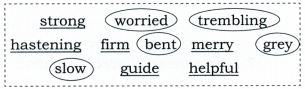
Reasons: Elderly people may be trembling, bent, grey, slow and may guide others through their experience. School students are usually strong, hastening, merry and helpful.
Let us discuss
I Arrange the events of the poem in the correct order of occurrence. Share your answers with your classmates and teacher.
1. The boy returned to his friends, feeling proud of what he had done.
2. The old woman stood alone at the crossing, hesitant to move.
3. A group of schoolboys passed by, playing, and laughing.
4. The boy offered to help the old woman cross the street.
5. The woman prayed for the boy who helped her.
6. The children hurried past the old woman without offering help.
7. The woman placed her hand on the boy’s arm, and he guided her safely across the street.
8. The boy thought about his own mother and hoped someone would help her one day.
Ans: The correct arrangement is:
2. The old woman stood alone at the crossing, hesitant to move.
3. A group of schoolboys passed by, playing and laughing.
6. The children hurried past the old woman without offering help.
4. The boy offered to help the old woman cross the street.
7. The woman placed her hand on the boy’s arm, and he guided her safely across the street.
8. The boy thought about his own mother and hoped someone would help her one day.
5. The woman prayed for the boy who helped her.
1. The boy returned to his friends, feeling proud of what he had done.
II. Fill in the blanks by choosing the correct answer from the options given in the brackets.
1. The central theme of the poem is _____________. (kindness and empathy/ adventure and courage)
Ans: kindness and empathy.
2. The tone of the poem is _____________. (humorous and playful/ sympathetic and hopeful)
Ans: sympathetic and hopeful.
3. The poem is written in couplets with _____________ lines in each stanza. (four/two)
Ans: two.
4. The structure of the poem gives a rhythmic flow that reflects both the _____________. (narrative and emotions/ story’s pace and message)
Ans: narrative and emotions.
5. The poem follows a rhyme scheme of _____________. (AABB/ABAB)
Ans: AABB.
III. Pick examples from the poem for the following poetic devices.
1. Simile.
Ans: “Her face was like a frowning cloud.”
2. Alliteration.
Ans: “The cold winds blew.”
3. Repetition.
Ans: “And she prayed for the boy.”
“God bless you, my boy.”
Let us discuss
IV. Complete the following sentences appropriately explaining the imagery.
1. The poem uses imagery to describe scenes of a bustling street. We know this by the phrase ___________________.
Ans: “The crowded street was full of people.”
2. The line ‘The street was wet with a recent snow’ suggests a cold and __________________ weather, emphasising the woman’s helplessness.
Ans: wet.
V. Complete the following sentence with a suitable reason.
The poet repeats the phrase “Somebody’s mother” because it ___________________.
Ans: reminds us that the old woman is also someone’s mother and deserves care and kindness.
VI. Complete the analogy.
The old woman: vulnerable and neglected :: The young boy: ____________________.
Ans: kind and helpful.
Let us think and reflect
I. Read the given extracts and answer the questions that follow.
1. The woman was old and ragged and grey
And bent with the chill of the Winter’s day.
The street was wet with a recent snow
And the woman’s feet were aged and slow.
(i) What does the phrase ‘ragged and grey’ refer to?
A. The woman’s emotional state that day.
B. The woman’s old and worn-out appearance.
C. The weather conditions of the particular day.
D. The colour of the street and the surroundings.
Ans: B. The woman’s old and worn-out appearance
(ii) Complete the following sentence with a suitable reason:
The woman was ‘bent’ with the chill of the Winter’s day because she was __________________.
Ans: old and weak, and the cold weather made her bend down.
(iii) Identify the fact and opinion from the following sentences:
A. The street was wet with recent snow. _______________
Ans: Fact
B. The woman was too weak to cross the street on her own. _______________
Ans: Opinion
(iv) Why do you think the woman’s feet were described as ‘aged and slow’?
Ans: The woman was very old and weak, so she could not walk quickly. Her old and tired feet made her movement slow
2. He guided the trembling feet along,
Proud that his own were firm and strong.
Then back again to his friends he went,
His young heart happy and well content.
(i) What does the contrast between the ‘trembling feet’ of the old woman and the ‘firm and strong’ feet of the boy emphasise?
Ans: It emphasises the old woman’s weakness and the boy’s youth and strength. It also shows that the boy was able to help her because he was strong.
(ii) Fill in the blank given below by selecting the correct option from the brackets.
The poem tells us that the boy was ‘proud’ that his feet were strong.
This tells us that the boy was ________. (arrogant about being strong/grateful for his ability to help)
Ans: grateful for his ability to help
(iii) What is the boy most likely to tell his friends on getting back?
A. I’m so glad I could help her.
B. I’m worried about her safety.
C. I’m surprised she forgot to thank me.
D. I’m thankful for all your support.
Ans: A. I’m so glad I could help her.
(iv) Rectify the false sentence given below.
The young boy’s actions were driven by a logical decision.
Ans: The young boy’s actions were driven by kindness and empathy towards the old woman.
II. Answer the following questions.
1. What might be the old woman’s fears as she waited for a long time at the crossing?
Ans: She could be afraid of falling on the slippery road or getting hit by carriages and horses.
2. How does the poet show the helplessness of the old woman? Support your answer with evidence from the poem.
Ans: The poet shows the helplessness of the old woman by describing her as timid, meek, and afraid to stir, standing alone and uncared for.
3. Why does the boy decide to help the old woman? What does this tell us about him?
Ans: The boy does so because he is kind-hearted and empathetic. It shows he values others’ needs and acts compassionately.
4. How was the boy’s approach towards the old woman different from that of the other boys in the group?
Ans: While the other boys ignored the old woman, he noticed her difficulty and chose to help, showing empathy.
5. Justify the appropriateness of the title of the poem.
Ans: The title of the poem is appropriate as it reminds us that every elderly person is the mother of someone like ours and deserves our respect and care.
6. What does the poem suggest about the role of empathy and humanity in society?
Ans: The poem suggests that small acts of kindness reflect the best of human nature and can have a deep, lasting impact.
Let us Learn
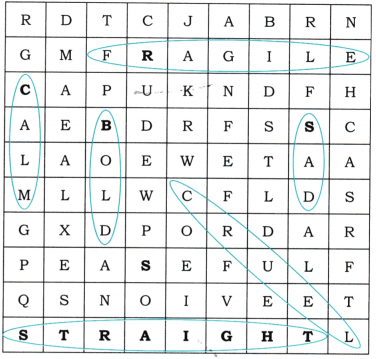
I The grid given below has the antonyms of the words from the text. Locate these words in the grid horizontally, vertically, and diagonally. One example has been done for you. You may refer to a dictionary.
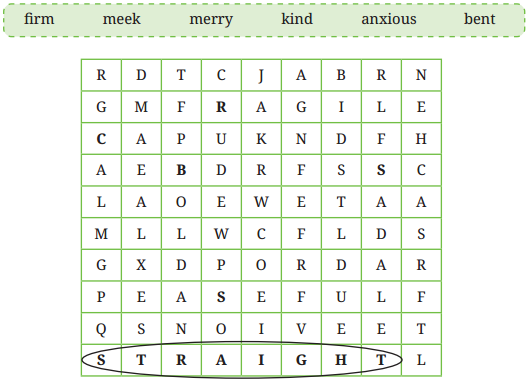
Ans:
II. Match the words from the text given in Column 1 with the underlined phrases in Column 2.
| Column 1 | Column 2 |
| 1. hastened | (i) The mother heard the baby move slightly in the cradle at night. |
| 2. heeded | (ii) It is our duty to give support to the poor. |
| 3. stir | (iii) The students worked quickly to complete the project and submit it on time. |
| 4. lend | (iv) All the boxes were kept in a heap at one place. |
| 5. piled | (v) They came forward to help us when we were in need. |
| 6. offered | (vi) The stranded people were brought to safety because they paid attention to our advice. |
Ans:
| Column 1 | Column 2 |
| 1. Hastened | (iii) The students worked quickly to complete the project and submit it on time. |
| 2. Heeded | (vi) The stranded people were brought to safety because they paid attention to our advice. |
| 3. Stir | (i) The mother heard the baby move slightly in the cradle at night. |
| 4. Lend | (ii) It is our duty to give support to the poor. |
| 5. Piled | (iv) All the boxes were kept in a heap at one place. |
| 6. Offered | (v) They came forward to help us when we were in need. |
III In the poem, the poet uses the idiom ‘lend a hand’ which means ‘help somebody’. Some more idioms using ‘hand’ are given in Column 1. Match these idioms with their meanings in Column 2. You may refer to a dictionary.
| Column 1 | Column 2 |
| 1. get out of hand | (i) do something new |
| 2. try your hand at something | (ii) applaud somebody |
| 3. give somebody a free hand | (iii) work together |
| 4. give somebody a big hand | (iv) become difficult to control |
| 5. work hand in hand | (v) be very busy |
| 6. have your hands full | (vi) allow somebody to do something with full freedom |
Ans:
| Column 1 | Correct Meaning |
| 1. Get out of hand | (iv) Become difficult to control |
| 2. Try your hand at something | (i) Do something new |
| 3. Give somebody a free hand | (vi) Allow somebody to do something with full freedom |
| 4. Give somebody a big hand | (ii) Applaud somebody |
| 5. Work hand in hand | (iii) Work together |
| 6. Have your hands full | (v) Be very busy |
IV. Complete the following analogy by filling in the blanks with the correct words from the poem.
1. ___________ : winter :: heat : summer
Ans: cold.
2. hurt : ___________ :: old : aged
Ans: injured.
3. whispered : shouted :: humble : ___________
Ans: proud.
4. eyes : ___________ :: legs : walk
Ans: see.
5. having a lot of money : wealthy :: densely packed people : ___________
Ans: crowded.
Let us listen
Read the lines from the poem given below.
Lest the carriage wheels or the horses’ feet
Should crowd her down in the slippery street.
‘Lest’ is a conjunction that means to prevent something bad or unpleasant from happening. To better understand its usage in a sentence, we can replace ‘lest’ with ‘just in case’.
For example, in the sentence ‘She showed all the documents lest we doubt her’, the word ‘lest’ can be replaced with ‘just in case’ to mean that she showed the documents to prevent any doubt.
I. You will listen to a woman read the special broadcast of the news. As you listen, arrange the pictures in the correct sequence of the events that took place.
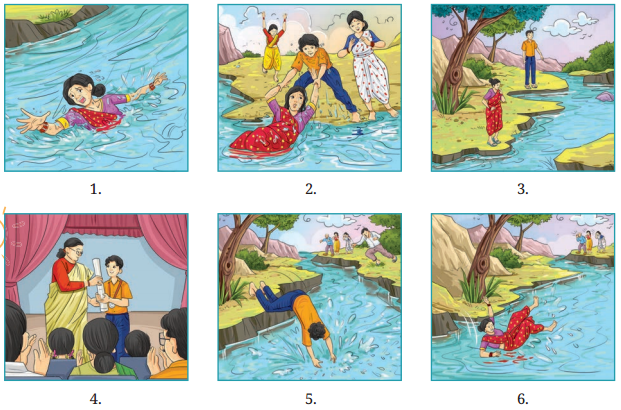
Ans:
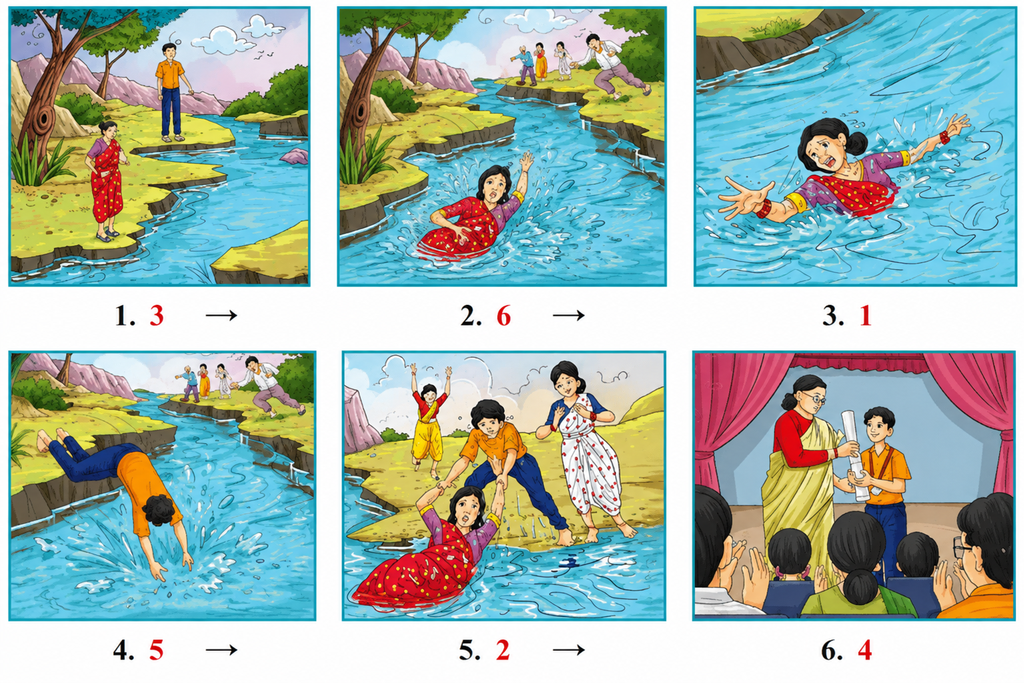
II. You will once again listen to the special broadcast of the news. As you listen, complete the following sentences with one to three exact words.
1. The woman was having a difficult time staying afloat due to the _____________.
Ans: strong currents.
2. Rohan leapt into the river to save the woman without any _____________.
Ans: moment’s hesitation.
3. Rohan’s act of bravery was witnessed by _____________.
Ans: onlookers.
4. Rohan was honoured at the Vigyan Bhawan for his incredible courage and _____________.
Ans: selfless act.
5. Rohan proved that when it comes to saving lives, age is _____________.
Ans: no barrier.
Let us Speak
I. Read aloud the list of words from the poem that end in ‘-ed As you read, focus on the final sound of each word and place them in the appropriate columns. One example has been done for you.
| ragged aged waited heeded offered paused guided whispered |
| /ɪd/ Sound | /d/ Sound | /t/ Sound |
| ragged | heeded | paused |
Note: Adjectives that come before a noun and end with ‘-ed’ have /id/as the final sound.
Ans:
| /ɪd/ Sound | /d/ Sound | /t/ Sound |
| ragged | heeded | paused |
| aged | whispered | waited |
| guided | offered | — |
II Work in pairs. Narrate an incident where you helped someone in the past. Take turns to speak and use the cue cards given below.
| at school classmate explaining a concept | in the neighbourhood cleanliness campaign |
| at the market place elderly carrying bags | in the playground a friend gets injured |
You may use the following prompts.
| Beginning the Story | Describing the Experience |
| It all started when…The day began like any other…I still remember…At that moment, I realised… | At that moment, I realised…I was completely taken by surprise…The next few hours were…I couldn’t believe my eyes when I saw… |
| Beginning the Story | Describing the Experience |
| I was overjoyed/thrilled/extremely satisfiedA wave of relief/joy/excitement washed over me…I felt a mixture of emotions…I have never felt… | From that day on…This memory reminds me to always…This experience taught me the value of…In the end, I realised… |
Ans: Do it yourself.
Let us write
I Write a diary entry of a day you helped someone in need. Remember to include the following points while writing it.
Start with a sentence describing the day.
Mention whom you helped.
Explain the situation in which the other person needed help.
Add the place and time of the day when the situation arose.
Describe how you helped the other person.
Describe the reaction of the person you helped.
Mention how you felt during and after helping the person.
Conclude by mentioning why you would do something like this again.
Ans: 26 April 20xx, Saturday, 8:00 p.m.
Dear Diary,
Today, I feel was a special day. In the afternoon, I helped an elderly man at the market. He was carrying several heavy bags and was finding it difficult to walk. I offered to carry his bags and helped him reach the nearby bus stop safely. He thanked me with a warm smile and blessed me. I felt happy and proud that I could be of help to someone in need.
I learned that a small act of kindness can make a big difference in someone’s life. I would always like to help others whenever I get the opportunity.
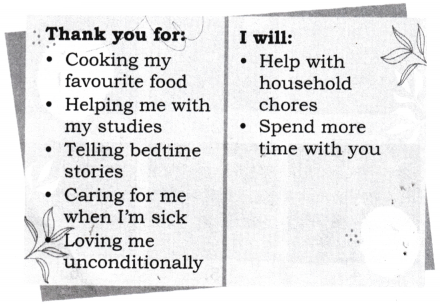
IV. Make a gratitude card for your mother/grandmother to thank her for at least five things that she does for you. Also write two things that you would do regularly to help them. Use recycled material to make and decorate the card.

Ans:
| VERGHESE KURIEN-I TOO HAD A DREAM |
I Arrange the worldwide means of communication given below in the timeline provided. Share your answers with your classmates and teacher.
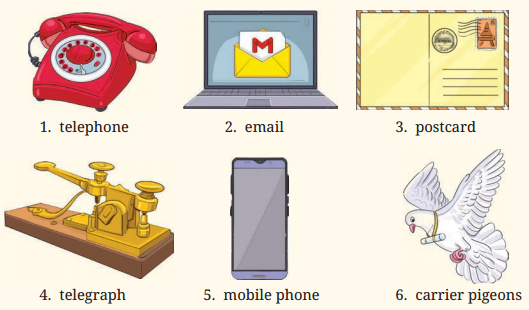
Ans:
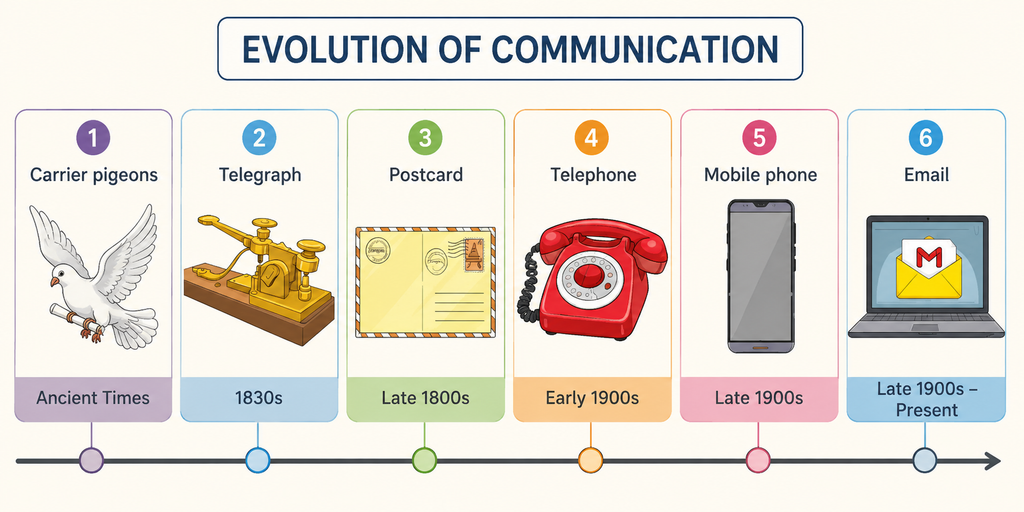
II. Work in pairs and discuss the following things. Share your answers with your classmates and teacher.
1. The reasons for change in the means of communication over the years.
Ans: TDue to technological advancements, ease of use, and the need for faster communication.
2. The means of communication that you prefer to use and the reason for your choice.
Ans: I prefer to use mobile phones and messaging apps because they are fast, convenient and easy to use. They allow me to communicate with people instantly.
3. Communication through social media: its benefits and precautions that one should take against its misuse.
Ans: Social media is beneficial for connecting people, but we must guard against fake news, cyberbullying, and overuse.
Let us discuss
A fact is something that can be proven true or false. A fact is not based on people’s beliefs. An opinion on the other hand is a belief, feeling or judgement, and can vary from one person to another. An opinion cannot be proven.
Identify which of the following statements are facts and which are opinions. Share your answers with your classmates and teacher.
1. But speaking on the telephone only gives us an immediate but fleeting joy.
Ans: Opinion.
2. I started my working life soon after our country became independent.
Ans: Fact.
3. To be quite honest, service to our nation’s farmers was not the career I had envisioned for myself.
Ans: Opinion.
4. I knew I could make a more meaningful contribution by working here in Anand, Gujarat.
Ans: Opinion.
5. … values that I saw in my mentor and supporter here in Anand—Tribhuvandas Patel.
Ans: Fact.
6. Life is a privilege, and to waste it would be wrong.
Ans: Opinion.
7. I hope that you, too, will discover, as I did, that failure is not about not succeeding.
Ans: Opinion.
8. … the magnificent ceremony in which the President awarded me the Padma Vibhushan in 1999?
Ans: Fact.
Let us think and reflect
I. Read the given extract and answer the questions that follow.
1. In today’s fast-paced world we have become so addicted to instant communication that we prefer to use a telephone. But speaking on the telephone only gives us an immediate but fleeting joy. Writing is different. Writing—even if it is a letter—not only conveys our present concerns and views of the events taking place around us but it becomes a possession that can be treasured and reread over the years, with great, abiding pleasure.
(i) Fill in the blank given below by selecting the correct option from the brackets.
When the writer refers to a ‘fast-paced world’, he is speaking of a world where _________________. (communication happens quickly but lacks depth/people have more time to write and reflect)
Ans: communication happens quickly but lacks depth
(ii) Select the option that applies correctly to both Assertion (A) and Reason (R).
(A): Writing letters can be treasured and re-read over the years.
(R): Speaking on the telephone provides long lasting joy.
A. Both (A) and (R) are true, and (R) is the correct explanation of (A).
B. Both (A) and (R) are true, but (R) is not the correct explanation of (A).
C. (A) is true, but (R) is false.
D. Both (A) and (R) are false.
Ans: C. (A) is true, but (R) is false.
(iii) Identify whether the statement given below is true or false.
The writer feels that letter-writing is a class apart from other kinds of writing.
Ans: True
(iv) Which of the following is the most appropriate title for the given extract?
A. The Rise of Instant Communication.
B. The Fleeting Delight of Phone Calls.
C. The Lasting Joy of Written Words.
D. Living in a Fast-paced World.
Ans: C. The Lasting Joy of Written Words
2. Read the given extract and answer the questions that follow.
(i) How can we say that the grandmother shared her husband’s dedication to a greater cause?
Ans: The grandmother supported her husband’s decision to live and work in Anand, even though life there lacked many basic comforts. Her support shows that she shared his dedication to serving a greater cause.
(ii) Complete the following with the correct option from the two given in brackets.
The fact that the writer (grandfather) praises his wife tells us that he _____________________ (truly values/quietly accepts) her role in his life.
Ans: truly values
(iii) Complete the following sentence with the correct option from those given below.
Based on the information in the extract, we can infer that the grandmother had all of the following traits EXCEPT ____________.
A. encouraging.
B. understanding.
C. comforting.
D. thoughtful.
Ans: C. comforting.
(iv) Select the phrase that conveys— ‘showed grace under pressure and carried out my duties with dignity and confidence’.
Ans: “shouldered my responsibilities with poise.”
II. Answer the following questions.
1. What event does Dr. Kurien refer to when he mentions receiving the Padma Vibhushan?
Ans: Dr. Kurien refers to the ceremony in 1999 when the President of India awarded him the Padma Vibhushan for his contribution to the nation.
2. How did Dr. Kurien’s decision to join the cooperative in Anand affect his life?
Ans: His decision to join the cooperative in Anand changed the course of his life. He dedicated himself to serving the farmers and working for their welfare. This work gave his life a greater purpose and lasting satisfaction.
3. Dr. Kurien’s decision to work in Anand reveals his values and sense of duty. Explain.
Ans: Dr. Kurien’s choice to stay in Anand, rather than pursue a more lucrative or comfortable career, reveals his deep sense of responsibility, commitment to social justice, and empathy for farmers. Despite being a government employee posted elsewhere, he decided to serve the rural community, reflecting his selflessness, patriotism, and belief in grassroots development.
4. Why did Dr. Kurien write the letter to his grandson?
Ans: Dr. Kurien wrote the letter to share his experiences, values and life lessons with his grandson. He wanted to encourage him to understand the importance of purpose, responsibility and meaningful service.
5. According to Dr. Kurien, “life is a privilege and it is wrong to waste it”. What is your opinion on this?
Ans: I agree with Dr. Kurien. Life offers each of us a chance to make a difference, however small. It is a gift filled with opportunities to grow, serve, and leave a positive mark. Wasting it on selfish pursuits or indifference not only limits our own potential but also denies society the benefits of our contributions. Living purposefully, like Dr. Kurien did, brings fulfilment and uplifts others.
6. What message does Dr. Kurien want to convey about selfless service and its long-term impact on society?
Ans: Dr. Kurien conveys that selfless service can create a lasting positive impact on society. When people work sincerely for the welfare of others, their efforts can improve lives and inspire future generations.
Let us Learn
I. Replace the underlined words in each sentence with the correct synonym from the box. You may refer to a dictionary.
| essential swift lifelongMomentary useful splendid |
1. He received the award in a magnificent ceremony.
Ans: Magnificent → Splendid
2. I felt a fleeting joy when I received the appreciation for my song.
Ans: Fleeting → Momentary
3. With today’s instant communication, we can share information across the world in seconds.
Ans: Instant → Swift
4. Our school focuses on the core values—collaboration, innovation, and unity.
Ans: Core → Essential
5. My teacher’s advice on time management is a valuable reminder of the importance of
planning.
Ans: Valuable → Useful
6. Reading books and listening to music can give abiding pleasure that will last forever.
Ans: Abiding → Lifelong
II Match the expressions from the text in Column 1 with their meanings in Column 2.
| Column 1 | Column 2 |
| 1. in all humility | (i) to speak in a truthful way |
| 2. hold their heads high | (ii) doing something using all your skills, talents, and knowledge |
| 3. to be quite honest | (iii) observed with great respect and wonder |
| 4. to the best of your ability | (iv) being humble and having no feeling of self-importance |
| 5. looked at in awe | (v) in the innermost part of the self |
| 6. somewhere deep down | (vi) be confident and have a positive feeling |
Ans:
| Column 1 | Column 2 |
| 1. in all humility | (iv) being humble and having no feeling of self-importance |
| 2. hold their heads high | (vi) be confident and have a positive feeling |
| 3. to be quite honest | (i) to speak in a truthful way |
| 4. to the best of your ability | (ii) doing something using all your skills, talents, and knowledge |
| 5. looked at in awe | (iii) observed with great respect and wonder |
| 6. somewhere deep down | (v) in the innermost part of the self |
III. Make as many words as you can out of the following words. One example has been done for you.
1. community — city, toy, tune, unity, mutiny, cot.
2. Important.
Ans: port, part, pot, art, main, mint, rain, train, paint.
3. Magnificent.
Ans: sign, fine, magic, giant, magnet, fact, face, mine, game.
4. Satisfied.
Ans: side, safe, sit, sad, fat, fit, state, date, aid.
5. Generation.
Ans: nation, ration, region, generation, train, rain, age, rate, gain.
6. Achievement.
Ans: achieve, active, chief, meat, heat, team, time, item, theme.
IV. Let us play a word game—Antakshari.
1. Write the synonym of the word according to the clues given below.
Ans: The synonym of each word should begin with the last letter of the previous synonym.
Example:
IMPORTANT → SIGNIFICANT → TROUBLE → …
For the complete Antakshari sequence, the clues/words given in the textbook are needed.
2. For example, the synonym of the first word, ‘IMPORTANT’ ends with the letter ‘T”. The synonym of the second word begins with ‘T’, ‘TROUBLE’. Then write the synonym of the third word starting with the letter ‘E’.
3. Now, continue with the word game.

(i) major (synonym)
(ii) problem (synonym)
(iii) uneven (antonym)
(iy) related to post office
(v) our moral duty
(vi) related to time
(vii) prosperous (synonym)
(viii) related to being alive
Ans:
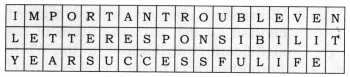
V. Read the sentences below and insert either an em dash (—) or an en dash (–) suitably.
(i) The conference will be held from March 15 March 20.
(ii) I have lived in Kanpur Raipur for five years now.
(iii) The artist known for her vibrant paintings will be showcasing her work in Guwahati.
(iv) The scores for the final match were 2 3.
(v) My favourite snacks samosas, pakoras, and jalebis are all from India.
(vi) The train journey from Belagavi Bengaluru takes less than ten hours.
(vii) I just finished reading the book it was absolutely amazing!
(viii) The event will take place on September 1 September 5.
Ans: (i) The conference will be held from March 15–March 20.
(ii) I have lived in Kanpur–Raipur for five years now.
(iii) The artist—known for her vibrant paintings—will be showcasing her work in Guwahati.
(iv) The scores for the final match were 2–3.
(v) My favourite snacks—samosas, pakoras, and jalebis—are all from India.
(vi) The train journey from Belagavi–Bengaluru takes less than ten hours.
(vii) I just finished reading the book—it was absolutely amazing!
(viii) The event will take place on September 1–September 5.
Fill in the blanks by choosing the correct word from the options given in the brackets.
(i) Please remember to bring ___________ (your/you’re) assignment book.
Ans: Your.
(ii) The team celebrated ___________ (their/they’re) victory after the match.
Ans: Their.
(iii) ___________ (its/it’s) important to stay hydrated during the hot summer days.
Ans: It’s.
(iv) I can’t believe ___________ (your/you’re) going to the mango festival today.
Ans: You’re.
(v) The students said ___________ (they’re/their) excited for the field trip tomorrow.
Ans: They’re.
(vi) The tree lost ___________ (its/it’s) leaves in the winter.
Ans: Its.
VII. Complete the following sentences with suitable prepositional phrases.
(i) The children played happily in _________________________________.
Ans: The children played happily in the park.
(ii) Nisha placed the vase on _________________________________.
Ans: Nisha placed the vase on the table.
(iii) We discussed the project in _________________________________.
Ans: We discussed the project in the classroom.
(iv) Preethi found the lost book under _________________________________.
Ans: Preethi found the lost book under the bed.
(v) The cat slept on _________________________________.
Ans: The cat slept on the sofa.
VIII. Rearrange the following jumbled words and phrases into meaningful sentences.
1. barked/at the strangers/the dog/loudly/the house/walking by.
Ans: The dog barked loudly at the strangers walking by the house.
2. wrote/my classmate/during the/a story/summer vacations.
Ans: My classmate wrote a story during the summer vacations.
3. enjoyed/under the trees/they/by the lake/a picnic.
Ans: They enjoyed a picnic under the trees by the lake.
4. in his/grandfather’s room/hung/he/the painting.
Ans: He hung the painting in his grandfather’s room.
5. studied/with great determination/for/students/the/exam.
Ans: The students studied with great determination for the exam.
Let us listen
I. You will listen to the passage about Evelyn Glennie’s journey in overcoming her hearing loss through music and turning a physical disability into a success story. (Transcript for teacher on page 100)
After listening, match the words given in Column 1 with their meanings given in Column 2.
| Column 1 | Column 2 |
| 1. percussionist | (i) a person who plays drums and similar instruments |
| 2. impaired | (ii) the ability to keep going despite difficulties |
| 3. vibrations | (iii) slow and steady over time |
| 4. determination | (iv) physical sensations caused by sound |
| 5. gradual | (v) damaged or weakened |
Ans:
| Column 1 | Column 2 |
| 1. percussionist | (i) a person who plays drums and similar instruments |
| 2. impaired | (v) damaged or weakened |
| 3. vibrations | (iv) physical sensations caused by sound |
| 4. determination | (ii) the ability to keep going despite difficulties |
| 5. gradual | (iii) slow and steady over time |
II. Listen to the passage once again and state whether the statements given below are true or false.
1. Evelyn Glennie became deaf suddenly.
Ans: False.
2. Her headmistress ignored the signs of her hearing loss.
Ans: False.
3. Ron Forbes was a percussionist who helped Evelyn.
Ans: True.
4. Evelyn used her skin and bones to sense music.
Ans: True.
5. She gave up on music after her diagnosis.
Ans: False.
III. Answer the following questions in one or two words.
1. How did Evelyn turn her disability into strength?
Ans: Through determination and hard work.
2. What role did Ron Forbes play in her life?
Ans: He guided and encouraged her.
3. What lessons can we learn from Evelyn’s story about how to treat others who have different abilities or challenges?
Ans: We should encourage and support them.
II Read the highlighted words in the following sentence from the text.
…but it becomes a possession that can be treasured and re-read over the years, with great, abiding pleasure.
treasure [treh-Zhuh] pleasure [pleh-Zhuh]
In the highlighted words, -sure has a ‘Zhuh’ sound. There are some words which end in -sure, but have a ‘shuh’ sound as in pressure [preh-shuh].
Now, read aloud the words given below with the ‘shuh’ or ‘zhuh’ so

Ans:
| Word | Sound Type | Pronunciation |
| measure | Zhuh | meh-ZHUR |
| leisure | Zhuh | lee-ZHUR |
| reassure | Zhuh | ree-ah-ZHUR |
| enclosure | Zhuh | en-CLO-zher |
| exposure | Zhuh | ex-PO-zher |
| ensure | Shuh | en-SHUR |
| seizure | Zhuh | SEE-zher |
| fissure | Shuh | FISH-er |
| composure | Zhuh | com-PO-zher |
| unsure | Shuh |
III. Pausing and chunking are techniques used when speaking, to organise information for the listener. Speakers can split what they say into smaller segments-either individual words or groups of words to convey ideas or emphasise key points clearly.
1. Read aloud the following lines from the poem.
Don’t Quit
When things go wrong, as they sometimes will,
when the road you’re trudging seems all uphill,
when the funds are low and the debts are high,
and you want to smile but you have to sigh,
when care is pressing you down a bit —rest if you must,
but don’t you quit.
Edgar Albert Guest
Now, read the lines of the poem once again by taking a shorter pause (/) or a long pause (//).
Ans: When things go wrong,/as they sometimes will,//
when the road you’re trudging/seems all uphill,//
when the funds are low/and the debts are high,//
and you want to smile/but you have to sigh,//
when care is pressing you down a bit/
—rest if you must,/
but don’t you quit.//
2. Chunk the stanzas with (/) or (//) and read it aloud.
Life is queer with its twists and turns.
As everyone of us sometimes learns.
And many a fellow turns about when he might
have won had he stuck it out.
Don’t give up though the pace seems slow—
you may succeed with another blow.
Often the goal is nearer than it seems to a faint and faltering man.
Ans: Life is queer with its twists and turns, /
As everyone of us sometimes learns. / /
And many a fellow turns about /
when he might have won /
had he stuck it out. / /
Don’t give up / though the pace seems slow— /
you may succeed / with another blow. / /
Often the goal is nearer than it seems /
to a faint and faltering man. / /.
I. Write a letter to your grandparents thanking them for the valuable lessons they have taught you. Include how their wisdom has shaped your values and behaviour in life.
1. Thank them for teaching you important lessons, sharing stories, or helping others in the neighbourhood.
2. Share how their actions inspire you to contribute to the betterment of the society.
Ans: 24, Green Park
Guwahati, Assam
2 September 2026
Dear Grandparents,
I hope you both are keeping well. I am writing this letter to thank you for all the valuable lessons you have taught me. Your stories, advice, and kind words have always guided me in my life.
You have taught me to be honest, kind, respectful, and helpful to others. I have also learned from the way you help people in our neighbourhood. Your actions have shown me that even a small act of kindness can make a big difference.
Your wisdom has shaped my values and behaviour. Whenever I face a difficult situation, I remember your advice and try to make the right choice. You have inspired me to help others and contribute to making our society a better place.
Thank you for being a wonderful source of love, guidance, and inspiration. I feel very lucky to have grandparents like you.
With lots of love,
Your loving grandchild,
[Name]
Discuss in groups.
1. The importance of learning about money and saving from a young age. Share one example of it.
Ans: Learning about money and saving from a young age is important because it helps children develop responsible financial habits. For example, if a child saves a part of their pocket money regularly, they can later use it to buy something important, such as a book or a toy.
2. Imagine you received some money as a gift. How would you decide whether to save it, spend it, or invest it? What factors would you consider?
Ans: If I received money as a gift, I would consider my needs, future goals, and opportunities before deciding. I would save some money for future needs, spend a small part on something useful, and invest a portion to grow the money. I would consider my needs, savings, and available investment options.
3. If you were in charge of planning a small event at school with a limited budget, how would you manage the money?
Ans: I would first make a list of the essential items and estimate their costs. I would give priority to important expenses, look for low-cost options, and keep a record of all spending. I would also keep some money aside for unexpected expenses.
4. Why is financial literacy important for everyone?
Ans: Financial literacy is important because it helps people make informed decisions about saving, spending, budgeting, and investing. It helps people manage money responsibly, deal with financial challenges, and maintain long-term financial security.
Subject Ka Complete Video Solution Dekhein
Step-by-step easy concept explanation aur full questions Answer ke liye watch karein ya app download karein:


 Buy Now