
NCERT Class 7 Social Science Chapter 20 Banks and the Magic of Finance Solutions English Medium As Per New Syllabus. to each chapter is provided in the list so that you can easily browse through different chapters NCERT Class 7 Social Science Chapter 20 Banks and the Magic of Finance and select need one. NCERT Class 7 Social Science Chapter 20 Banks and the Magic of Finance Question Answers Download PDF. NCERT Class 7 Social Science Texbook Solutions in English.
NCERT Class 7 Social Science Chapter 20 Banks and the Magic of Finance
Also, you can read the NCERT book online in these sections Solutions by Expert Teachers as per Central Board of Secondary Education (CBSE) Book guidelines. CBSE Class 7 Social Science Textual Solutions in English Medium are part of All Subject Solutions. Here we have given NCERT Class 7 Social Science Notes, CBSE Class 7 Social Science in English Medium Textbook Solutions for All Chapters, You can practice these here.
Banks and the Magic of Finance
Chapter: 20
| Part – 2: Exploring Society India and Beyond |
The Big Questions:
1. What is financial infrastructure, and what does it comprise?
Ans: Financial infrastructure is a network of banks, payment systems, stock markets, and other financial institutions. It comprises systems that help people, businesses, and the government facilitate financial transactions and manage money.
2. What are the main functions performed by banks and how do they impact people’s lives?
Ans: Banks perform main functions such as holding deposits safely, offering savings, current, and fixed deposit accounts, and lending money or credit to borrowers. These functions impact people’s lives by encouraging them to save money and earn extra income through interest. They also allow farmers to start small businesses, workers to receive wages directly, students to receive scholarships, and individuals to fund their education, buy houses, or purchase vehicles.
3. How does financial infrastructure contribute to a nation’s progress?
Ans:Financial infrastructure contributes to a nation’s progress by promoting savings, credit, and investment, which in turn boosts economic activity and ultimately leads to the nation’s prosperity.
Think About It:
1. Why does Navdeep think that saving at the bank is better than keeping cash at home?
Ans: Navdeep thinks that saving his surplus money in a cupboard at home might not be safe, whereas banks not only keep the money safe but also pay interest, which helps the saved money grow over time.
2. Can Navdeep and Rima lend to each other directly without the bank? What could happen in that case? Discuss.
Ans: While Navdeep and Rima could theoretically lend to each other directly, doing so without a bank means Navdeep’s money lacks formal safety and guaranteed interest, and Rima might not get the exact large amount she needs for her business. Banks act as a vital middleman, safely transforming depositors’ ideas and savings into reality for borrowers through credit.
Think about it:
1. How does one track so many transactions of deposits and withdrawals? The bank provides a diary-like document called a passbook that keeps a record of all the receipts and payment transactions. This can be updated regularly at the bank.
Ans: To track numerous transactions of deposits and withdrawals, the bank provides a diary-like document called a passbook. This passbook keeps a complete record of all your receipts (money coming in, or credits) and payment transactions (money going out, or debits). You can regularly update this physical passbook by visiting the bank.
Additionally, with modern technology, you no longer have to rely solely on a physical passbook. You can now use internet banking or mobile payment applications like UPI to easily check your account balance and track your transaction history at any time directly on your computer or smartphone.
2. Look at the passbook in Fig. 8.7. Observe all the particulars under the expenses (debit) and income (credit). Why is keeping records of financial transactions important? Discuss in the class.
Ans: Keeping records is important because it allows individuals to track their debit (money taken out) and credit (money received) history, such as salary deposits, rent payments, and UPI expenses. This tracking ensures transparency and helps account holders manage their balances and verify the interest credited by the bank.
Questions and Activities:
1. What is financial infrastructure? How does it complement physical infrastructure?
Ans: Financial infrastructure is the network of banks, payment systems, stock markets, and other financial institutions. It complements physical infrastructure (like roads and railways) by funding its development and maintenance.
2. How does having a bank account help people? Should everyone be required to have a bank account?
Ans: Having a bank account helps people save their money safely, earn interest, access loans, and securely receive direct funds like wages or scholarships without middlemen. Based on the success of the Pradhan Mantri Jan Dhan Yojana, extending bank account access to everyone is highly beneficial, as it brings low-income earners into the formal economy and empowers them financially.
3. What could be the possible advantages and disadvantages of compound interest for savers and borrowers?
Ans: For savers, the advantage of compound interest is that their money grows exponentially over time because they earn interest not just on the original deposit, but on the accumulated interest from previous years. For borrowers, the disadvantage is that if a loan is subjected to compounding, the total debt can grow extremely fast and become a massive burden to repay.
4. How does financial infrastructure enable the flow of money between households and businesses? Can you think of how the government can facilitate this flow?
Ans: Financial infrastructure enables this flow because individuals (households) deposit their surplus savings into banks, and banks then lend a portion of those deposits to businesses for purposes like buying machinery or launching new products. The government facilitates this flow through institutions like the Reserve Bank of India (RBI), which supervises the banking system, sets benchmark interest rates, and maintains clear rules.
5. What could be the reason for the higher interest rate earned on fixed deposits as compared to a savings account?
Ans: A fixed deposit is a one-time deposit kept with the bank for a fixed, uninterrupted period (like 3 or 5 years). Because the bank knows it can hold and use this money for a longer, guaranteed period compared to a savings account (where money can be withdrawn frequently), it offers a higher interest rate to the depositor.
6. Sahil received ₹10,000 as a prize in a poster-making competition. His father promises to pay him 12 per cent interest per year if he does not spend the amount. After 3 years, how much money would Sahil have?
Ans: Based on the process of compounding, Sahil’s money will grow as follows:
(i) End of Year 1: ₹10,000 + (12% of 10,000) = ₹10,000 + ₹1,200 = ₹11,200.
(ii) End of Year 2: ₹11,200 + (12% of 11,200) = ₹11,200 + ₹1,344 = ₹12,544.
(iii) End of Year 3: ₹12,544 + (12% of 12,544) = ₹12,544 + ₹1,505.28 = ₹14,049.28.
7. How does the stock market help mobilise the savings of individuals? In what ways do companies benefit by issuing shares to people?
Ans: The stock market mobilises savings by allowing individuals to buy shares of companies, investing their money where they expect to see an increase in value over time. Companies benefit by issuing shares because it helps them raise the necessary funds for their business operations and expansions.
8. How can we balance the convenience of digital payments with the risk of cyber fraud?
Ans: We can balance this by being cautious and following safety measures, such as never sharing personal information (phone numbers, account numbers, passwords, or OTPs) with strangers. Additionally, users should avoid clicking on unknown links or videos, refrain from storing sensitive banking details on their devices, and immediately report any fraud to the 1930 helpline or the National Cybercrime Reporting Portal.
9. Ask your family members or neighbours about—
(i) how they save money?
Ans: Student Do yourself.
(ii) whether they use UPI, ATM or cheques, the kinds of transactions they perform through UPI; do they find UPI better than using cash or not, and why.
Ans: Student Do yourself.
(iii) if they or their acquaintance have experienced digital fraud, for instance, through a fake call or message asking for bank details. What did they do when they realised it was a scam, and what did they learn from that experience?Summarise your findings in a table or short report. Share one surprising insight with your class.
Ans: Student Do yourself.
10. Create a Financial Safety Poster.
Design the poster with dos and don’ts of digital banking safety (for example, not sharing OTPs, reporting frauds).
Ans: Your poster should clearly highlight warnings like “Never share OTPs” and “Do not click unknown links”. Make sure to prominently feature the cybercrime helpline (1930) and website (https://cybercrime.gov.in).
11. Cheques are often used to pay utility bills. Ask your parents to allow you to fill out the cheques for a few monthly payments.
Ans: Student Do yourself.
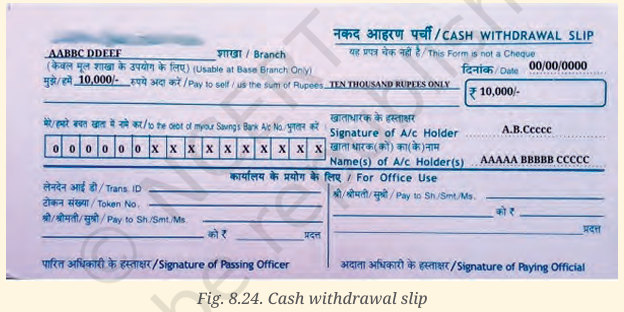
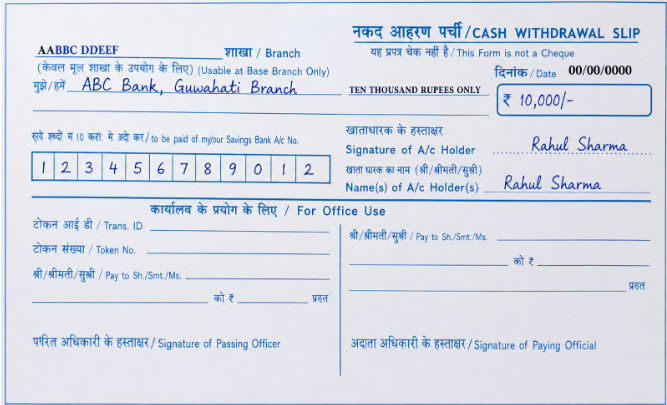
12. Suppose you have to withdraw ₹10,000 from your bank account, how would you fill out the cash withdrawal slip at your bank? Let us try below!
Ans:
Subject Ka Complete Video Solution Dekhein
Step-by-step easy concept explanation aur full questions Answer ke liye watch karein ya app download karein:


 Buy Now