
NCERT Class 7 Social Science Chapter 16 Turning Tides: 11th and 12th Centuries Solutions English Medium As Per New Syllabus. to each chapter is provided in the list so that you can easily browse through different chapters NCERT Class 7 Social Science Chapter 16 Turning Tides: 11th and 12th Centuries and select need one. NCERT Class 7 Social Science Chapter 16 Turning Tides: 11th and 12th Centuries Question Answers Download PDF. NCERT Class 7 Social Science Texbook Solutions in English.
NCERT Class 7 Social Science Chapter 16 Turning Tides: 11th and 12th Centuries
Also, you can read the NCERT book online in these sections Solutions by Expert Teachers as per Central Board of Secondary Education (CBSE) Book guidelines. CBSE Class 7 Social Science Textual Solutions in English Medium are part of All Subject Solutions. Here we have given NCERT Class 7 Social Science Notes, CBSE Class 7 Social Science in English Medium Textbook Solutions for All Chapters, You can practice these here.
Turning Tides: 11th and 12th Centuries
Chapter: 16
| Part – 2: Exploring Society India and Beyond |
The Big Questions:
1. Why are the 11th and 12th centuries seen as a period of transition in Indian history?
Ans: The 11th and 12th centuries are considered a transitional period because they marked the beginning of deep penetrations and eventual foreign rule in North India by Turkic powers. This period introduced Islam as a new creed in India’s religious landscape and altered profound power equations due to the destruction of temples, cities, and major centers of learning. However, it was also a time of continuity and resilience; large parts of northern India and all of South India remained under native kingdoms that continued to thrive in trade, arts, literature, and monumental architecture.
2. Which new powers emerged during this period? What were the essential features of their economic, military and administrative systems?
Ans: Several prominent native powers emerged or thrived during this period:
The Kakatiyas (South India): They developed a strong local administration system based on village self-governance. Economically, they promoted an efficient revenue system and built extensive irrigation infrastructure to support agricultural prosperity.
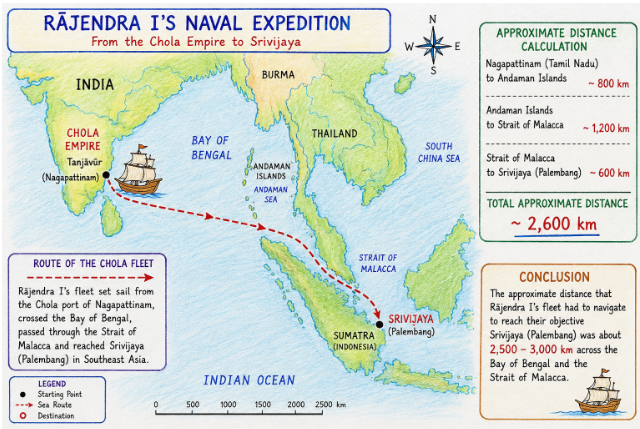
The Cholas (South India): They possessed exceptional naval military power, which they used to conquer the Maldives, northern Sri Lanka, and launch a successful punitive expedition against the Srivijaya Empire in Southeast Asia to protect their maritime trade. They also engaged in massive public works, building roads, tanks, wells, and artificial lakes.
The Paramaras (Central India): Centered in Malwa, they were known for efficient governance, public works (like the massive Bhojtal lake for water management), and deep patronage of scholars and sciences.
The Senas (Eastern India): They replaced the Palas in Bengal and actively promoted Hindu thought and literature.
The Chahamanas/Chauhans (North/West India): They were a powerful military dynasty that conquered Delhi, Haryana, and parts of Punjab, and frequently repelled foreign invaders until the end of the 12th century.
3. What high accomplishments in art, architecture, literature, science, etc., do we come across during this period?
Ans: Science and Mathematics: Bhaskaracharya authored Lilavati, a brilliant text combining complex mathematical problems with engaging poetry.
Literature: Notable works include Jayadeva’s Gitagovindam, Paramara King Bhoja’s encyclopedic works on architecture, town planning (Samarāṅgaṇa Sūtradhāra), and medicine. The Chalukya ruler Someshvara III wrote the Manasollasa, a comprehensive guide to royal life, while the saint Basavanna composed spiritual Kannada poetry known as vachanas.
Architecture: This era saw the creation of architectural marvels like the Brihadishvara Temple by the Cholas, the elaborate Hoysala temples, the Chandellas’ Kandariya Mahadeva and Lakshmana temples at Khajuraho, the Kakatiyas’ stone gateways (toranas), and the incomplete but impressive Bhojeshwar Temple.
Questions and Activities:
1. Why is the period under consideration in this chapter regarded as a major transition in Indian history? Give two examples each of change and continuity from this period.
Ans: Reason for transition: It marked the arrival of Turkic invaders who established a lasting political and religious impact on the subcontinent.
Examples of Change: (i) The establishment of foreign rule and the introduction of Islam in parts of North India.
(ii) The destruction of major ancient educational institutions, such as the Nalanda university, by invaders.
Examples of Continuity: (i) Large parts of India, especially the South, remained completely outside the control of Turkic invaders.
(ii) Internal and external maritime trade with Southeast Asia and China continued to thrive and expand.
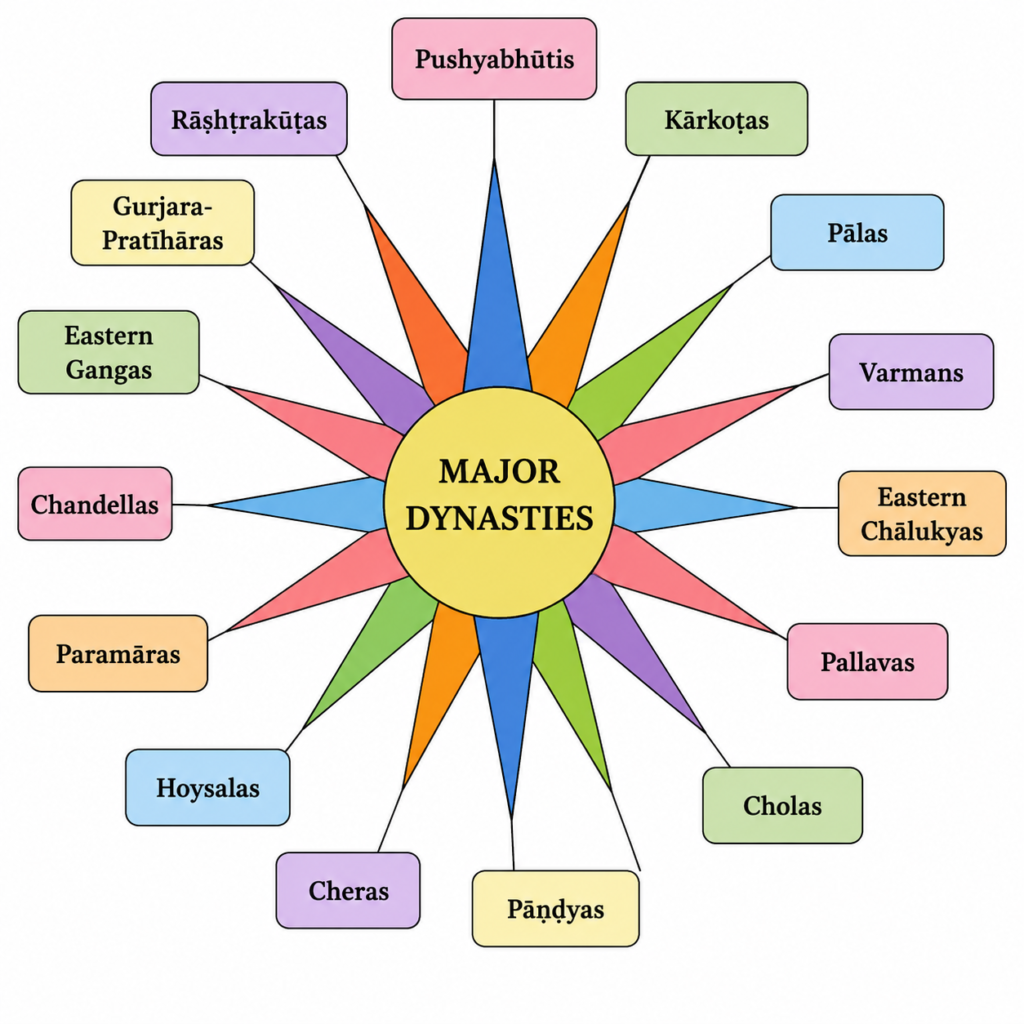
2. Observe Fig. 3.27 in the previous chapter and draw a similar ‘star of dynasties’ gathering all or most of the dynasties that appear in this chapter.
Ans: Student do yourself.
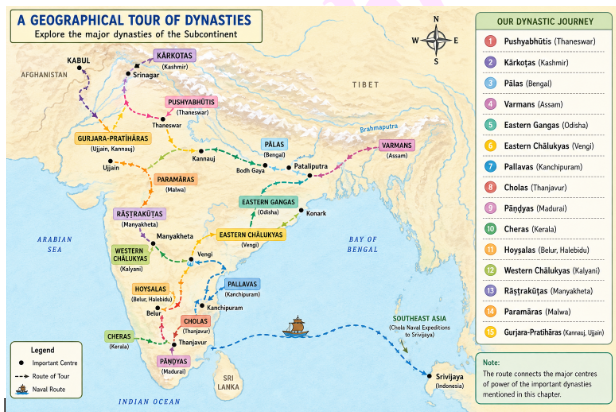
3. Taking a map of the Subcontinent, draw a geographical tour that covers all or most dynasties in this chapter (you may draw inspiration from some of the ‘travels’ the chapter’s narration follows).
Ans:
4. With the help of a map of India and Southeast Asia, can you calculate the approximate distance that Rājendra I’s fleet of ships had to navigate to reach their objective?
Ans:
5. Match these two pairs:
| Column A | Column B |
| (a) Eastern Gangas | (i) Belur |
| (b) Chandellas | (ii) Bṛihadīśvara Temple |
| (c) Paramāras | (iii) Konark Sun Temple |
| (d) Hoysalas | (iv) Kandāriyā Mahādeva Temple |
| (e) Cholas | (v) Bhojeshwar Temple |
Ans:
| (a) Eastern Gangas | (iii) Konark Sun Temple |
| (b) Chandellas | (iv) Kandāriyā Mahādeva Temple |
| (c) Paramāras | (v) Bhojeshwar Temple |
| (d) Hoysalas | (i) Belur |
| (e) Cholas | (ii) Bṛihadīśvara Temple |
6. Working in groups, compare the dynasties in this chapter and in the preceding one; create a table to list the dynasties present in both, those that disappear from the preceding period, and those that appear in this chapter’s period.
Ans: Student do it yourself.
7. Using the chapter and any additional reading, prepare a short note explaining (1) why centres of learning like Nālandā were important; (2) how their destruction may have affected education and culture in India.
Ans: Importance: Nalanda (Nalanda Mahavihara) was a massive educational hub featuring a library spread over three multi-storey buildings containing hundreds of thousands of manuscripts. It attracted international scholars and pilgrims, such as Yijing and Xuanzang from China, and scholars from Tibet.
Impact of Destruction: When Bakhtiyar Khilji attacked, the monks and teachers were slain, and the grand library burned for months. Surviving scholars fled to places like Tibet with whatever manuscripts they could carry. This effectively crippled a major hub of Indian scientific and philosophical learning, leaving it in ruins and ending its legacy of mass education.
8. Why do you think Mahmūd of Ghazni carry out repeated raids from Afghanistan into India, while Muhammad Ghūrī sought territorial expansion into India and long-term control? Write a short note on how their motives shaped the outcomes of their campaigns.
Ans: Mahmud of Ghazni’s Motives: Mahmud was primarily interested in plundering the immense wealth accumulated in Indian temples (like Mathura and Somnath) and spreading his version of Islam by destroying non-Muslim sacred spaces and enslaving or killing “infidels.” Because he only wanted wealth and religious dominance, his outcome was mass destruction without establishing a permanent political base beyond Punjab.
Muhammad Ghuri’s Motives: Unlike Mahmud, Ghuri sought actual territorial conquest. He aimed to build an empire. As a result, after winning battles (like the Second Battle of Tarain against Prithviraja III) and capturing Delhi, he didn’t just take the wealth and leave. He left behind trusted military commanders, like Qutb-ud-din Aibak, to consolidate and govern his newly acquired territories, which ultimately led to the foundation of the Delhi Sultanate.
Subject Ka Complete Video Solution Dekhein
Step-by-step easy concept explanation aur full questions Answer ke liye watch karein ya app download karein:


 Buy Now