
SEBA Class 9 Health Care Chapter 4 Personal Hygiene and First AID Solutions English Medium As Per New Syllabus. to each chapter is provided in the list so that you can easily browse through different chapters SEBA Class 9 Health Care Chapter 4 Personal Hygiene and First AID Notes and select need one. SEBA Class 9 Health Care Chapter 4 Personal Hygiene and First AID Question Answers Download PDF. SEBA Class 9 Elective Health Care Textual Solutions.
SEBA Class 9 Health Care Chapter 4 Personal Hygiene and First AID
Also, you can read the SEBA book online in these sections Solutions by Expert Teachers as per Board of Secondary Education, Assam (SEBA) Book guidelines. SEBA Class 9 Health Care Notes. are part of All Subject Solutions. Here we have given Class 9 Health Care Question Answer for All Chapters, You can practice these here.
Personal Hygiene and First AID
Chapter: 4
| SESSION 1: GOOD HYGIENE PRACTICE |
| Check Your Progress |
A. Fill in the Blanks
1. Hygiene is a set of practices performed for the _______________.
Ans: preservation of health.
2. Good grooming and good health is the first step of _______________.
Ans: personal hygiene.
3. Hair is humans head _______________.
Ans: crowning glory.
B. Match the following Columns
| Column A | Column B |
| 1. Skin | (a) Made up of keratin |
| 2. Nails | (b) To prevent genital disease |
| 3. Health education | (c) Clean and healthy |
| 4. Menstrual hygiene | (d) Community hygiene |
Ans:
| Column A | Column B |
| 1. Skin | (c) Clean and healthy |
| 2. Nails | (a) Made up of keratin |
| 3. Health education | (d) Community hygiene |
| 4. Menstrual hygiene | (b) To prevent genital disease |
C. Multiple Choice Questions
1. Daily brushing is protect from getting oral disease
(a) Gingivitis.
(b) Yellowish teeth and cavity.
(c) Mouth smell.
(d) all the above.
Ans: (d) all the above.
2. Health and hygiene education play an important role in the community hygiene.
(a) To prevent illness.
(b) Health promotion.
(c) Both a and b.
(d) To promote causing disease.
Ans: (c) Both a and b.
3. Healthy skin, hair and nails are indicators of…
(a) Good nutritional status and personal hygiene.
(b) Poor nutritional status.
(c) Malnutrition.
(d) Poor personal hygiene.
Ans: (a) Good nutritional status and personal hygiene.
C. Short Answer Questions
1. What is personal hygiene?
Ans: Personal hygiene refers to the activities we perform to keep our bodies clean, which helps prevent disease-causing germs from entering the body. It involves daily routines such as taking a bath, washing hands, cleaning hair, and maintaining dental hygiene. Good grooming and good health are considered the very first steps of personal hygiene.
2. What are the daily grooming routines to be followed to make sure good health?
Ans: Daily grooming routines require the basic care and cleanliness of all external body parts. To ensure good health, the following routines should be followed:
(i) Hair: Wash hair at least twice a week using soap or shampoo, dry it well, brush it daily with a clean comb, and oil the scalp weekly.
(ii) Skin: Bathe daily with soap and water to keep the skin healthy, dry off with a clean towel, wear freshly washed underwear, and apply moisturizing cream.
(iii) Teeth: Brush teeth twice a day (especially before sleeping) using a vertical zigzag motion, and rinse the mouth well after every meal to prevent oral diseases.
(iv) Hands and Nails: Wash hands thoroughly with soap and water before and after meals and after using the toilet. Nails should be kept short, regularly trimmed, and clean to prevent them from carrying disease-causing germs.
(v) Feet: Clean and dry the spaces between the toes after bathing, and wear a fresh pair of clean, breathable cotton socks every day to reduce sweat and fungal infections.
3. Write short notes on menstrual hygiene.
Ans: Menstrual hygiene is crucial for preventing genital diseases and ensuring comfort during menstruation. Women can use sanitary pads, tampons, or reusable menstrual cups to manage menstrual blood. It is important to change pads or tampons frequently—they should not be left unchanged beyond six hours—to prevent odor and harmful bacteria, such as Staphylococcus aureus. Bathing and cleaning the private parts during menses is a must, but the use of perfumed pads or powders in the genital area is strictly not recommended.
4. Write the relation between health and hygiene.
Ans: Health and hygiene are directly related, as good hygienic habits and healthy living are the primary ways to achieve good health. Cleanliness is described as one of the main defenses against both infectious and self-generated diseases. Hygiene acts as health promotion; by adopting hygiene practices and improving environmental conditions at the household level, individuals and communities can effectively reduce hazards and improve their overall health.
5. Write the various important aspects of personal hygiene.
Ans: The various important aspects of personal hygiene are:
(i) Personal Aspect: Hygiene reflects our ability to care for ourselves. Having clean teeth and healthy skin, hair, and nails indicates good nutritional status and gives a person confidence in their daily life.
(ii) Social Aspect: People generally dislike interacting with unhygienic individuals. Maintaining a clean, well-presented body projects a positive image, reflects a good personality, and reduces the risk of being bullied.
(iii) Health Reasons: Maintaining strict hygiene, such as prioritizing hand washing and cleaning wounds, prevents the spread of communicable diseases and protects both the individual and the people around them from serious illnesses.
(iv) Psychological Issues: Being neat and clean makes a person feel more energetic and confident. Personal hygiene heavily impacts first impressions in social situations and job interviews, ultimately affecting a person’s self-esteem and chances of success.
| SESSION 2: HAND WASHING |
| Check Your Progress |
A. Multiple Choice Questions
1. The most essential measures for preventing the spread of pathogen.
(a) Contaminated hands.
(b) Rubbing hands.
(c) Washing hands.
(d) Clean hands.
Ans: (c) Washing hands.
2. All Healthcare staff should be hand washing
(a) Before and after direct patient contact.
(b) After any medical procedure.
(c) Wearing and removing gloves.
(d) All the above.
Ans: (d) All the above.
B. Short Answer Questions
1. What is hand hygiene?
Ans: Hand hygiene refers to the act of cleaning one’s hands using water (or another liquid) and soap to remove dirt, soil, and microorganisms. In healthcare, medical hand hygiene involves self-care practices related to immediate medical care and the administration of medicine, which significantly decreases the spread of infections and prevents disease.
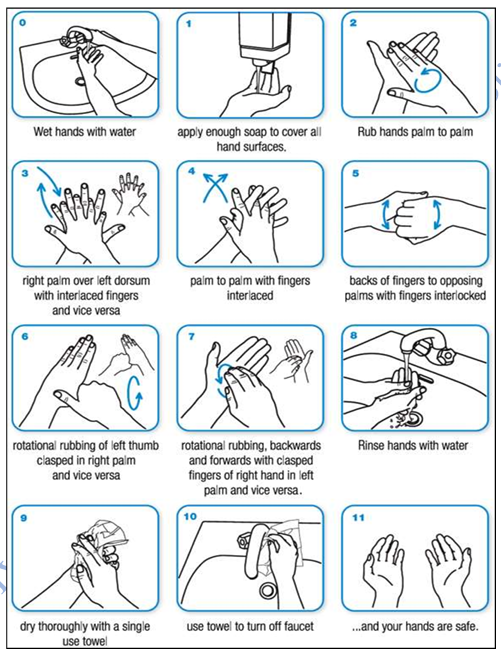
2. Write the all steps of hand hygiene.
Ans: The complete steps for proper hand washing are:
(i) Apply enough soap to cover all hand surfaces.
(ii) Rub hands palm to palm.
(iii) Rub the right palm over the left dorsum with interlaced fingers, and vice versa.
(iv) Rub palm to palm with fingers interlaced.
(v) Rub the backs of fingers to opposing palms with fingers interlocked.
(vi) Perform rotational rubbing of the left thumb clasped in the right palm, and vice versa.
(vii) Perform rotational rubbing, backwards and forwards, with clasped fingers of the right hand in the left palm, and vice versa.
(viii) Rinse hands with water.
(ix) Dry thoroughly with a single-use towel.
(x) Use the towel to turn off the faucet..
3. Write the importance of hand hygiene.
Ans: The hands normally have a “resident” population of micro-organisms apart from those accumulated during everyday activities termed “transient” organisms. Most of the germs on our hands are harmless, but some causes cold, flu, skin infections or diarrhea. Forgetting to wash our hands causes spreading of these germs to other people; also infect ourselves when we touch our eyes, mouths or open cuts. Hand washing prevents the microorganisms getting displaced to other surfaces, patient or vulnerable areas on the patient.
4. Make a beautiful picture of the steps of hand washing.
Ans:
| SESSION 3: DEMONSTRATE PERSONAL GROOMING |
| Check Your Progress |
A Fill in the Blanks
1. Personal grooming is also called ____________.
Ans: titivating and preening.
2. Use effective ____________ while speaking to the patient relatives.
Ans: communication.
B. Short Answer Questions
1. What is personal grooming?
Ans: Personal grooming (sometimes referred to as titivating and preening) is the practice that involves the cleaning of body parts, as well as the trimming of nails and hair, in order to improve and maintain an individual’s personal hygiene
2. Write the importance of personal grooming.
Ans: Importance of Personal Grooming:
(i) Personal grooming encourages the resident to maintain a pleasing and attractive appearance and develop a positive self -image.
(ii) It makes a person neat and personally appealing.
(iii) Grooming indicates the readiness of a person for work.
Subject Ka Complete Video Solution Dekhein
Step-by-step easy concept explanation aur full questions Answer ke liye watch karein ya app download karein:

 Buy Now