
SEBA Class 9 Health Care Chapter 1 Human Body Structure and Functions Solutions English Medium As Per New Syllabus. to each chapter is provided in the list so that you can easily browse through different chapters SEBA Class 9 Health Care Chapter 1 Human Body Structure and Functions Notes and select need one. SEBA Class 9 Health Care Chapter 1 Human Body Structure and Functions Question Answers Download PDF. SEBA Class 9 Elective Health Care Textual Solutions.
SEBA Class 9 Health Care Chapter 1 Human Body Structure and Functions
Also, you can read the SEBA book online in these sections Solutions by Expert Teachers as per Board of Secondary Education, Assam (SEBA) Book guidelines. SEBA Class 9 Health Care Notes. are part of All Subject Solutions. Here we have given Class 9 Health Care Question Answer for All Chapters, You can practice these here.
Human Body Structure and Functions
Chapter: 1
| SESSION 1: HUMAN CELL AND TISSUE |
| Check Your Progress |
A. Fill in the Blanks
1. The cell is the basic unit of ________________.
Ans: body structure.
2. The outer layer of cell membrane like a ________________.
Ans: brick of a wall.
3. ________________ is also called power house of cell.
Ans: Mitochondria .
4. The study of human tissue is called ________________.
Ans: histology.
5. Brain is situated in a bony case called ________________.
Ans: cranium
B. Multiple Choice Questions
1. Study of cells is ________________.
(a) Mycology.
(b) Osteology.
(c) Cytology.
(d) Arthrology.
Ans: (c) Cytology.
2. The cells metabolize food and oxygen they release ________________.
(a) CO2 and other wastes.
(b) O2 and energy.
(c) Nitrogen and wastes.
(d) All the above.
Ans: (a) CO2 and other wastes.
3. Which organelle is not found in human cell?
(a) Cytoplasm.
(b) Centrosome.
(c) Chloroplast.
(d) Golgi bodies.
Ans: (c) Chloroplast.
4. Chromosomes are present in human cells.
(a) 23 Chromosomes.
(b) 46 Chromosomes.
(c) 21 Chromosomes.
(d) 47 Chromosomes.
Ans: (b) 46 Chromosomes.
5. Functions of the human cells.
(a) Protection.
(b) Absorption.
(c) Secretion and sensory reception.
(d) All the above.
Ans: (d) All the above.
6. Which type of division are four cells.
(a) Mitosis.
(b) Meiosis.
(c) Nucleus.
(d) Protoplasm.
Ans: (b) Meiosis.
7. All tissues except one are__________.
(a) Epithelial.
(b) Connective.
(c) Nucleus.
(d) Sclerous.
Ans: (c) Nucleus.
8. There are all types of connective tissue except one.
(a) Collagen fibres.
(b) Elastic fibres.
(c) Reticular fibres.
(d) Nerve fibres.
Ans: (d) Nerve fibres.
9. Skeletal muscles are __________.
(a) Voluntary muscle.
(b) Involuntary muscle.
(c) Both a & b.
(d) None of the above.
Ans: (a) Voluntary muscle.
C. Match the Column A and B
| Column A | Column B |
| 1. Epithelium tissue | (a) Act as store house of calcium |
| 2. Connective tissue | (b) Present on the heart |
| 3. Sclerous tissue | (c) Neurons and connective tissue |
| 4. Smooth muscles | (d) Reticular fibres |
| 5. Nervous tissue | (e) Involuntary muscle |
| 6. Cardiac muscles | (f) Stratified |
Ans:
| Column A | Column B |
| 1. Epithelium tissue | (f) Stratified |
| 2. Connective tissue | (d) Reticular fibres |
| 3. Sclerous tissue | (a) Act as store house of calcium |
| 4. Smooth muscles | (e) Involuntary muscle |
| 5. Nervous tissue | (c) Neurons and connective tissue |
| 6. Cardiac muscles | (b) Present on the heart |
D. Write the Short Answer Questions
1. Define the human cell and tissue.
Ans: Human Cell: The cell is the fundamental and basic structural unit of the human body, much like bricks are used to build a wall. Cells are specialized to form various organs and tissues, and they metabolize food and oxygen while releasing carbon dioxide and other wastes.
Tissue: As human development proceeds, groups of cells differentiate from one another and arrange themselves in different patterns to form the tissues of the body. These basic tissues are built up in varying proportions to form the body wall, appendages, and the internal organs.
2. Write the functions of animal cell.
Ans: The essential functions of the animal cell include protection, absorption, secretion, and sensory reception. Furthermore, cells are responsible for metabolizing food and oxygen for energy, and they undergo cell division (mitosis and meiosis) for the body’s growth, maintenance, and reproduction.
3. Write a short note on following parts of animal cell.
Ans: Cell membrane: It forms the outer protective wall of the cell and facilitates the exchange of substances between the inside protoplasm and the outside tissue fluid.
Protoplasm & Cytoplasm: Protoplasm is the mass of living substance inside the cell, consisting of a solid nucleus and a jelly-like fluid component known as cytoplasm.
Nucleus: Serving as the control center that directs cell activities, the nucleus contains chromatin granules which condense into chromosomes that carry hereditary genes.
Chondriosomes (Mitochondria): These are minute particles (rods or granules) that act as the store-houses of energy, often called the power house of the cell.
Endoplasmic reticulum & Golgi bodies: The endoplasmic reticulum is a network involved in protein synthesis, while Golgi bodies process and concentrate these proteins for secretion.
Centrosome: A small mass near the nucleus containing centrioles, which play a crucial role during cell division.
4. Write the important functions of sclerous tissue.
Ans: Bones perform important functions:
(i) Give support to the body.
(ii) Act as lever for the action of muscles.
(iii) Provide the sites of formation of blood cells.
(iv) Act as storehouses of calcium.
5. Write short note on nervous tissue.
Ans: Nervous tissue consists of neurons and connective tissue. Connective tissue of nervous system is called neuroglia. Neuron consist of cell body and its processes called nerve fibres.
Nerve fibres are of two types:
(i) Dendrites which carry the impulses to the cell body.
(ii) Axons which carry the impulses away from the cell body.
Nervous system consists of a central nervous system and peripheral nervous system. Central nervous system includes brain and spinal cord.
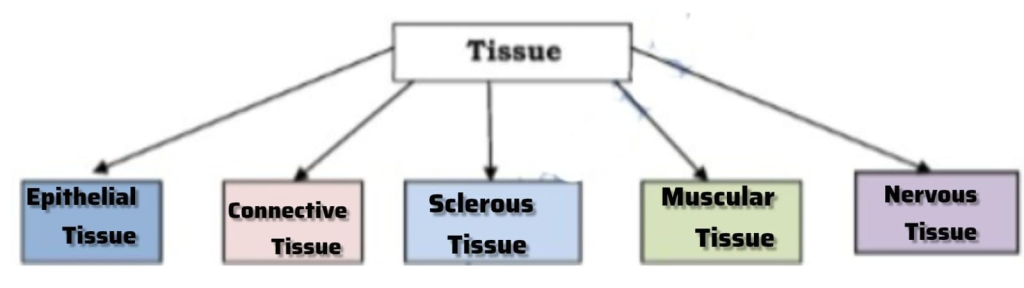
E. Write the Name of the Primary Tissues
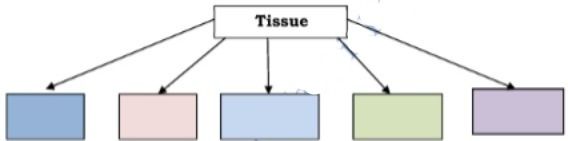
Ans:
| SESSION 2: HUMAN ANATOMY AND PHYSIOLOGY |
| Check Your Progress |
A. Fill in the Blanks
1. The functional relation of different parts to each other is known as _____________.
Ans: Anatomy.
2. Secretion of HCL in the _____________.
Ans: Stomach.
3. The small intestine starts from _____________ of the stomach.
Ans: pyloric orifice.
4. Peritoneum is the largest of the _____________ in human body.
Ans: serous membranes.
5. The lever is situated below the _____________.
Ans: Diaphragm.
6. Pancreatic juice and exocrine secretion secreted by the _____________.
Ans: Pancreas.
7. The pulmonary vein is carry _____________ from lungs.
Ans: oxygenated blood.
8. _____________ is prevent the foods from entering in to the lungs.
Ans: Epiglottis.
9. Kidney is bean shaped organs situated _____________ of abdomen.
Ans: lumber region.
B. Multiple Choice Questions
1. The following term are used to study the eye.
(a) Neurology.
(b) Gynecology.
(c) Ophthalmology.
(d) Endocrinology.
Ans: (c) Ophthalmology.
2. Choose the human teeth correct sequence
(a) Incisors- canine- premolars- molars
(b) Canine- incisors – premolars- molars
(c) Incisors- canine- molars- premolar
(d) Molars- Incisors- canine- premolars
Ans: (a) Incisors- canine- premolars- molars
3. Choose the correct meaning of the superior
(a) Nearer to the skin and surface.
(b) Nearer to the head, also called skull.
(c) Nearer to the foot.
(d) Nearby to the median line.
Ans: (b) Nearer to the head, also called skull.
4. The length of the small intestine is
(a) 16 feet.
(b) 20 feet.
(c) 18 feet.
(d) 24 feet
Ans: (c) 18 feet.
5. The largest gland in human body
(a) spleen.
(b) Liver.
(c) Gall bladder.
(d) Salivary gland.
Ans: (b) Liver.
6. Pancreas is secreted
(a) Pancreatic juice
(b) pepsin
(c) HCL
(d) bile
Ans: (a) Pancreatic juice
7. The heart is a hollow muscular organ that is the weight of the heart in an adult
(a) 360 grams.
(b) 250 grams.
(c) 280 grams.
(d) None of the above.
Ans: (b) 250 grams.
8. The lungs are situated in human body
(a) Thoracic cavity.
(b) Pelvic cavity.
(c) Peritoneal cavity.
(d). Nasal cavity.
Ans: (a) Thoracic cavity.
9. The functional unit of kidney is called
(a) Capillary.
(b) Nephron.
(c) Bowman’s capsule.
(d) Glomerulus.
Ans: (b) Nephron.
10. The dark pigment melanin is present in the deep layers of skin
(a) Hypodermis.
(b) Dermis.
(c) Epidermis.
(d) All of the above.
Ans: (c) Epidermis.
Subject Ka Complete Video Solution Dekhein
Step-by-step easy concept explanation aur full questions Answer ke liye watch karein ya app download karein:

 Buy Now