
SEBA Class 9 Health Care Chapter 3 Role of Home Health Aide Solutions English Medium As Per New Syllabus. to each chapter is provided in the list so that you can easily browse through different chapters SEBA Class 9 Health Care Chapter 3 Role of Home Health Aide Notes and select need one. SEBA Class 9 Health Care Chapter 3 Role of Home Health Aide Question Answers Download PDF. SEBA Class 9 Elective Health Care Textual Solutions.
SEBA Class 9 Health Care Chapter 3 Role of Home Health Aide
Also, you can read the SEBA book online in these sections Solutions by Expert Teachers as per Board of Secondary Education, Assam (SEBA) Book guidelines. SEBA Class 9 Health Care Notes. are part of All Subject Solutions. Here we have given Class 9 Health Care Question Answer for All Chapters, You can practice these here.
Role of Home Health Aide
Chapter: 3
| SESSION 1: IDENTIFY THE ROLE OF HOME HEALTH AIDE (HHA) |
| Check Your Progress |
A. Fill in the Blanks
1. HHA provides physical ________________ care and services to sick patient.
Ans: Mental, emotional.
2. HHA must be empathetic and have ________________ to care for patient in a home.
Ans: Good communication and nursing skills.
B. Multiple Choice Questions
1. Essential roles and responsibilities of HHA.
(a) Maintain patient safety.
(b) Perform administrative function.
(c) Maintain necessary skills and competencies.
(d) All the above.
Ans: (d) All the above.
2. Organizational duties of HHA
(a) Good interpersonal and communication skills.
(b) To manage and support internal and external client.
(c) Both a and b.
(d) Only a.
Ans: (c) Both a and b.
3. HHA is provide a special care in the area of
(a) Therapeutic care.
(b) Geriatric care and pediatric care.
(c) Post operative care.
(d) Adult care.
Ans: (b) Geriatric care and pediatric care.
C. Shorts Answer Questions
1. Define HHA.
Ans: Home Health Aide (HHA) provides nursing and technical care to patients under the supervision of nurses in a hospital or home nursing care facility. Home Health Aide might spend more time with patients than other healthcare providers in a hospital or home. HHAS must be empathetic and have good communication and nursing skills to care for patients in a home.
2. Write the role and function of HHA in the field Healthcare.
Ans: The role and functions of HHAs in healthcare are:
(i) Assisting with Daily Needs: Helping patients perform personal hygiene, grooming, and Activities of Daily Living (ADLs) such as exercise and ambulation.
(ii) Supporting Healthcare Staff: Assisting professionals with physical examinations and procedures, which includes checking, measuring, and recording vital signs (temperature, pulse, respiration) and liquid intake/output.
(iii) Monitoring Patients: Promptly reporting any unusual findings or changes in a patient’s data to the registered nurse and health team.
(iv) Maintaining Patient Safety: Keeping the patient’s room and treatment areas neat and clean, performing light housekeeping and meal preparation, and completing equipment safety checks.
(v) Administrative Support: Maintaining medical files, keeping records, managing supply inventory, and scheduling diagnostic procedures.
(vi) Maintaining Competencies: Actively setting goals for self-improvement, undertaking mandatory training, and learning to use new equipment.
3. What are the organizational duties of HHA to provide Healthcare services?
Ans: HHAs have organizational responsibilities for providing healthcare services:
(i) Using good interpersonal skills and proper communication: Communicating with patients and hospital staff in a positive, professional, and timely manner. This also involves resolving interpersonal conflicts using proper organizational resources and modeling behaviors that build a positive workplace.
(ii) Serving, managing, and supporting clients: Maintaining strict privacy for patient and employee information, taking the initiative to meet or exceed customer expectations, and consistently demonstrating the organizational mission and values of respect, integrity, and excellence.
(iii) Participating in performance improvement activities: Taking part in skill improvement workshops, demonstrating the initiative to diagnose and solve problems, and supporting positive transformation.
(iv) Participating as a team member and taking responsibility: Setting time to avoid workflow interruptions, helping others solve problems to facilitate positive team dynamics, showing accountability for daily actions and decisions, and accepting feedback in a positive way.
| SESSION 2: ACTIVITIES OF PATIENT’S CARE |
| Check Your Progress |
A. Fill in the Blanks
1. The daily self care activities is provided individuals at ____________.
Ans: Home and outdoor environment.
2. Feeding is the process of ____________.
Ans: Ingesting food.
3. Ryle’s tube is also called ____________.
Ans: Nasal gastric tube.
B. Multiple Choice Questions
1. Bedpan is used for the patient who is ____________.
(a) Unable to get out of bed easily.
(b) Able to walking.
(c) Both a and d.
(d) Bed ridden patient.
Ans: (c) Both a and d.
2. Intravenous fluid is given the patient directly in to the blood stream through
(a) Artery.
(b) Vein.
(c) Oral.
(d) None the above.
Ans: (b) Vein.
3. If a patient is unable to take food orally, what methods are used to provide nutrition?
(a) Oral feeding.
(b) Intravenous route.
(c) Nasal gastric tube feeding.
(d) All of the above.
Ans: (c) Nasal gastric tube feeding.
4. The environment around the patient needs to
(a) Hostile.
(b) Suspicious.
(c) Relaxed and friendly.
(d) All the above.
Ans: (c) Relaxed and friendly.
5. What is the responsibility of HHA to deliver medicines to the patient
(a) Right patient and right drug.
(b) To give the right dosage and right method.
(c) Check drug expiry.
(d) All the above.
Ans: (d) All the above.
C. Identify the following Pictures.
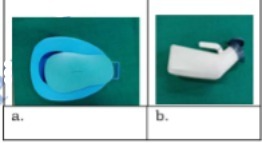
Ans: (i) Bed pan.
(ii) Urinal pot.
D. Write the full form of following Words
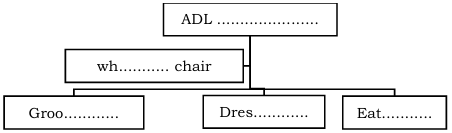
Ans: (i) Activities of daily Living.
(ii) Wheel chair.
(iii) Grooming.
(iv) Dressing.
(v) Eating.
E. Shorts Answer Questions
1. Write the importance of bathing and routine personal hygiene.
Ans: Bathing and routine personal hygiene are essential to keep the patient clean and remove dirt, dust, or other external agents from their skin. Additionally, regular bathing helps to increase blood circulation, reduce body odor, promote the patient’s confidence, and encourage movement.
2. Write the various types and methods of feeding.
Ans: Different types and methods of feeding are:
(i) Oral feeding: This involves providing food or fluids directly through the mouth using items like spoons and plates, and is suited for patients who can swallow and respond to instructions.
(ii) Nasogastric Tube feeding: This method delivers external nutrition in a liquid form directly into the digestive system using a tube (such as a Ryle’s tube) that is typically inserted through the nose or throat.
(iii) Intravenous (IV) Fluid: This is used for patients unable to take food orally and involves delivering fluids with essential nutrients directly into the bloodstream through a vein.
3. Prepare a list of resources used to assist the patient. Which is used to move the patient from one place to another?
Ans: There are many resources and pieces of equipment used to assist patients with their daily needs, including bedpans, urinals, diapers, and Foley catheters for elimination, as well as room accessories like bedside lockers, IV stands, calling bells, and special beds.
To move a patient from one place to another, the specific resources used are stretchers (for seriously ill or bedridden patients) and wheelchairs (for patients who are moveable but too weak to walk)
4. Write the role of HHA in transferring and shifting the patient.
Ans: The role of an HHA in moving and shifting a patient from one place to another is as follows:
(i) Understanding the patient’s specific medical condition beforehand and consulting the nurse to plan a safe transfer technique.
(ii) Identifying any damaged or weak areas of the patient’s body and ensuring those parts are protected and not affected during the move.
(iii) Carefully moving any attached support equipment (such as medication drips or breathing support) along with the patient.
(iv) Ensuring that all necessary documentation and equipment are ready, and utilizing the help of experienced staff or at least two other assistants.
(v) Preparing the receiving ward and organizing the facilities required for the patient’s arrival
| SESSION 3: BASIC REQUIREMENTS FOR PATIENT COMFORT |
| Check Your Progress |
A. Fill in the Blanks
1. A safe bed prevents many complications of a bedridden patient such as _______________
Ans: bed sores and foot drop.
B. Multiple Choice Questions
1. A 45 year old person suffering from heart disease will need which bed to rest admission to the hospital.
(a) Open bed.
(b) Occupied bed.
(c) Cardiac bed.
(d) Amputation bed.
Ans: (c) Cardiac bed.
C. Shorts Answer Questions
1. Prepare the list of beds according to the requirement of the patient present in the hospital.
Ans: There is a list of beds based on the needs of the patients present in the hospital.
(i) Open bed.
(ii) Closed bed.
(iii) Admission bed.
(iv) Occupied bed.
(v) Cardiac bed.
(vi) Fracture bed.
(vii) Amputation bed.
(viii) Blanket bed.
2. Write the factors that affects humans adversely.
Ans: Factor that affects humans adversely:
(i) Climate and weather change.
(ii) High temperature of the surrounding surface.
(iii) Humidity of air.
(iv) Air motion.
(v) Odorous.
(vi) Dust.
(vii) Aesthetics.
(viii) Acoustics.
(ix) Lighting.
(x) Room hygiene.
(xi) Sound.
(xii) Bed comfort.
(xiii) Patient’s hygiene.
3. Write the principle of bed making.
Ans: Principle involved in Bed Making:
(i) Micro-organisms are found every place in the environment especially in places that deals with diseases. Care should be taken to reduce the transference of microorganisms from the source to other and prevent the multiplication of the micro-organisms.
(ii) A safe bed will ensure and prevent several disease complications in bedridden clients e.g. bedsore, foot drop, etc.
(iii) Maintain Good body mechanism ensures the body alignment and prevent from unnecessary fatigue.
(iv) Systematic methods of bed making save both time and energy.
B. Write the Purposes of following
| Additional articles | Purposes |
| Laundry Bag | |
| Dusters | |
| A bowl with antiseptic lotion |
Ans:
| Additional articles | Purposes |
| Laundry Bag | To dispose the used bed sheets and to send the soiled linen to the laundry |
| Dusters | One dry duster to clean the mattress. One damp duster cleans the furniture. |
| A bowl with antiseptic lotion | To carbolise the furniture. |
Subject Ka Complete Video Solution Dekhein
Step-by-step easy concept explanation aur full questions Answer ke liye watch karein ya app download karein:



 Buy Now