
SEBA Class 7 Science Chapter 7 Measurement of Time And Motion Solutions English Medium As Per SCERT New Syllabus to each chapter is provided in the list so that you can easily browse through different chapters SEBA Class 7 Science Chapter 7 Measurement of Time And Motion Notes and select need one. SEBA Class 7 Science Textual Notes Download PDF. SCERT Class 7 Science New Textbook Question Answer in English.
SEBA Class 7 Science Chapter 7 Measurement of Time And Motion
Also, you can read the NCERT book online in these sections Solutions by Expert Teachers as per Central Board of Secondary Education (CBSE) Book guidelines. SCERT Class 7 Amar Bijnan (Science) Textual Solutions are part of All Subject Solutions. Here we have given SCERT Class 7 Amar Bijnan (Science) Question Answer for All Chapters, You can practice these here.
Measurement of Time And Motion
Chapter: 7
| PART – II |
| EXERCISES |
1. Darken the circle of correct answer:
(i) Speed of a car that covers 300 m distance in 30 s is:
(a) 10 m/s
(b) 20 m/s
(c) 30 m/s
(d) 40 m/s
Ans: (a) 10 m/s
(ii) Speed 72 km/h can be expressed as:
(a) 40 m/s
(b) 60 m/s
(c) 10 m/s
(d) 20 m/s
Ans: (d) 20 m/s
(iii) Sl unit of average speed is:
(a) Km/s
(b) m/h
(c) m/s
(d) mm/s
Ans: (c) m/s
(iv) Smallest time interval that can be measured in a normal wall clock is:
(a) 1 Hour.
(b) 1 Minute.
(c) Half an hour.
(d) 1 Second.
Ans: (d) 1 Second.
2. Fill up the blanks:
(a) An object moving along a straight line with a constant speed is said to be in _________ motion.
Ans: Uniform.
(b) If the speed of an object moving along a straight line keeps changing, it is said to be in ______________ motion.
Ans: Non-uniform.
3. A bus travels at a speed of 20 m/s and covers a distance of 288 km. How much time does it take? Find the answer in hour, minute and second.
Ans: Given:
Speed of the bus = 20 m/s
Distance covered = 288 km
Convert distance into metres
288 km = 288 × 1000 = 288,000 m
Use the formula:
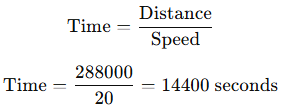
Convert seconds into hours, minutes and seconds
1 hour = 3600 seconds
14400 / 3600 = 4 hours
4. Write three examples of non-uniform motion from your daily life.
Ans: Non-uniform motion occurs when an object moving along a straight line keeps changing its speed.
Three examples from daily life include:
(i) A car or motorcycle driving through traffic: The vehicle does not maintain a constant speed because it must frequently speed up or slow down due to various external factors.
(ii) A train traveling between stations: A train represents non-uniform motion because it must make several stops at intermediate stations, causing its speed to vary and include intermittent halts.
(iii) An athlete running a race: As seen in track activities, a runner’s speed often changes throughout the duration of the run to reach the finish line.
5. Why is uniform motion over a long distance considered an ideal case? Explain with examples.
Ans: Uniform motion—where an object moves at a constant speed along a straight line—is considered an ideal case because, in real-world conditions, objects rarely maintain the same speed over long distances.
Complexity of Environment: In daily life, factors like traffic, road conditions, and the need to stop at specific destinations make it difficult to determine a fixed value of speed for an entire journey.
Example of Trains: The sources contrast an “ideal” Train A, which travels at a constant speed without any stops, with a “real-world” Train B, which slows down, speeds up, and stops at multiple stations. Because maintaining a perfectly consistent speed requires an absence of all obstacles and interruptions, it is generally treated as a simplified theoretical scenario rather than a common occurrence.
6. Make list of 5 animals or objects and compare their speed with average walking and running speed of human.
Ans: Average human speeds (for reference):
Average walking speed of human: ≈ 5 km/h
Average running speed of human: ≈ 10–12 km/h
| Animal / Object | Speed (approx.) | Comparison with Human Walking | Comparison with Human Running |
| Snail | 0.05 km/h | Much slower than walking | Much slower than running |
| Dog | 45 km/h | Faster than walking | Faster than running |
| Horse | 60 km/h | Much faster than walking | Much faster than running |
| Car (city speed) | 50 km/h | Much faster than walking | Much faster than running |
| Bicycle | 15 km/h | Faster than walking | Slightly faster than running |
7. Assertion: A car moving through crowded city streets often has non-uniform motion.
Reason: In non-uniform motion, an object travels unequal distances in equal intervals of time.
Choose the correct option:
(a) Both Assertion and Reason are true, and Reason is the correct explanation of Assertion.
(b) Both Assertion and Reason are true, but Reason is not the correct explanation of Assertion.
(c) Assertion is true, but Reason is false.
(d) Assertion is false, but Reason is true.
Ans: (a) Both Assertion and Reason are true, and Reason is the correct explanation of Assertion.
8. Choose any track and field event, such as the 100 m, 200 m, or 400 m race. Using the Internet, find the current national record and the Olympic record for the same event. Compare the timings.
| Event | National Record | Olympic Record | Difference |
| 100 m | |||
| 200 m | |||
| 400 m |
Ans:
| Event | National Record (India) | Olympic Record | Difference |
| 100 m | Women – 11.17 s (Dutee Chand) | 10.61 s (Olympic) | 0.56 s |
| 200 m | 20.32 s (Animesh Kujur) | 19.30 s (Olympic) | 1.02 s |
| 400 m | 50.79 s (Hima Das) | 48.17 s (Olympic) | 2.62 s |

Hi, I’m Dev Kirtonia, Founder & CEO of Dev Library. A website that provides all SCERT, NCERT 3 to 12, and BA, B.com, B.Sc, and Computer Science with Post Graduate Notes & Suggestions, Novel, eBooks, Biography, Quotes, Study Materials, and more.
Subject Ka Complete Video Solution Dekhein
Step-by-step easy concept explanation aur full questions Answer ke liye watch karein ya app download karein:


 Buy Now