
NCERT Class 9 Science Chapter 8 Journey Inside the Atom Solutions English Medium As Per New Syllabus. NCERT Class 9 Science Chapter 8 Journey Inside the Atom Notes to each chapter is provided in the list so that you can easily browse throughout different chapter NCERT Class 9 Science Chapter 8 Journey Inside the Atom Question Answer Download PDF and select needs one. CBSE Class 9 Science Textual Solutions.
NCERT Class 9 Science Chapter 8 Journey Inside the Atom
Also, you can read the CBSE book online in these sections Solutions by Expert Teachers as per (CBSE) Book guidelines. NCERT Class 9 Science Chapter 8 Journey Inside the Atom Solutions. These solutions are part of NCERT All Subject Solutions. Here we have given NCERT Class 9 Science Textbook Solutions English Medium Solutions for All Subject, You can practice these here.
Journey Inside the Atom
Chapter – 8
| Pause And Ponder |
1. Suppose you made up your own ‘atom’, as Thomson described, using clay for the positive charge and small beads for the electrons spread through it. What will happen if:
(i) The positive charge on the clay is lesser than the total negative charge of the beads?
Ans: The model would have an overall negative charge and would not represent a neutral atom.
(ii) By mistake, the clay itself carries a bit of negative charge? Would your model still represent a neutral atom?
Ans: No. The extra negative charge would make the model negatively charged, so it would not represent a neutral atom.
2. Could an orange or a lemon, which also contain seeds inside soft pulp, be a good comparison? In what ways does it match Thomson’s idea and where does it fall short?
Ans: It matches Thomson’s idea because the seeds resemble electrons embedded in the pulp, like electrons embedded in positive charge. However, it falls short because the pulp is not positively charged, and the seeds are not uniformly distributed.
3. Why did Thomson conclude that electrons are present in all atoms?
Ans: Thomson observed that cathode rays were produced from all gases and electrodes, showing that electrons are present in all atoms.
| Pause And Ponder |
1. What do you think would happen if a-particles were replaced with negatively charged particles in Rutherford’s gold foil experiment?
Ans: The negatively charged particles would be attracted towards the positively charged nucleus, giving different results from the original experiment.
2. Rutherford found that a few a-particles bounced back sharply. How does this single surprising result completely rule out Thomson’s ‘plum pudding model’ of the atom?
Ans: It showed that the positive charge and most of the mass are concentrated in a tiny nucleus, not spread uniformly as suggested by Thomson’s model.
3. If you could ask Rutherford one question about his work, what would it be?
Ans: How did you first think of using α-particles to study the structure of the atom?
| Pause And Ponder |
1. Assertion (A): Rutherford concluded that most of the mass of an atom is concentrated in a small region at the centre called the nucleus.
Reason (R): According to Thomson’s model, electrons are embedded in a uniformly distributed positive charge sphere.
Choose the correct option:
(i) Both A and R are true, and R is the correct explanation of A.
(ii) Both A and R are true, but R is not the correct explanation of A.
(iii) A is true, but R is false.
(iv) A is false, but R is true.
Ans: (ii) Both A and R are true, but R is not the correct explanation of A.
| Pause And Ponder |
1. Imagine you are a scientist who has discovered a new element. Name this element after yourself and justify that the symbol you have chosen follows the IUPAC rules.
Ans: I would name the element Devium with the symbol Dv. The symbol starts with a capital D followed by a small v, following IUPAC rules.
2. What problems could arise if every scientist used different symbols for the same element?
Ans: It would create confusion, misunderstandings, and difficulties in scientific communication.
| Pause And Ponder |
1. An atom with an atomic number of 26 has 56 nucleons. Find out its number of electrons, protons and neutrons.
Ans: Protons = 26
Electrons = 26
Neutrons = 56 − 26 = 30
2. The nucleus of an atom contains 20 protons. If its mass number is 41, find the number of neutrons in it.
Ans: Neutrons = 41 − 20 = 21
3. An atom has 18 neutrons and an atomic number of 17. What is its mass number?
Ans: Mass number = 17 + 18 = 35
4. An atom “A has 11 electrons. Find the number of neutrons in it.
Ans: The number of neutrons cannot be determined because the mass number is not given.
| Pause And Ponder |
1. Identify the number of electrons in the outermost shell of the following elements:
(i) ¹²₆C
Ans: ¹²₆C → 4
(ii) ¹⁹₉F
Ans: ¹⁹₉F → 7
(iii) ²⁸₁₄Si
Ans: ²⁸₁₄Si → 4
2. Write the electronic configuration of the elements having atomic numbers 12, 16 and 18.
Ans: 12 → 2, 8, 2
16 → 2, 8, 6
18 → 2, 8, 8
3. Solve this riddle: I am an atom with a mass number of 23 and 11 protons. I am a soft metal and react vigorously with water. Who am I and how many neutrons do I have? You can also create one such riddle.
Ans: It is Sodium (Na).
Neutrons = 23 − 11 = 12
| Pause And Ponder |
1. Two different atoms have 11 protons each, but one has 12 neutrons, and the other has 13 neutrons. How do their atomic numbers and mass numbers compare? Are they the same element or different elements?
Ans: Both atoms have the same atomic number (11) but different mass numbers (23 and 24). They are isotopes of the same element.
2. If a bromine atom is available in the form of, say two isotopes, Br (49.7%) and Br (50.3%), calculate the average atomic mass of the bromine atom.
Ans: Average atomic mass:
= (79 × 49.7 + 81 × 50.3) ÷ 100
= 39.263 + 40.743
= 80.006 u ≈ 80.0 u
| Revise, Reflect, Refine |
1. Choose the correct options and explain the reason for the correct and incorrect options in the context of Ernest Rutherford’s gold foil experiment:
(i) The experiment clearly showed the existence of neutrons in the nucleus.
Ans: Incorrect. Neutrons were discovered much later by James Chadwick in 1932. Rutherford’s experiment only demonstrated the existence of a dense, positively charged nucleus.
(ii) The results disproved the plum pudding model and led to the idea of a nucleus at the centre of the atom.
Ans: Correct. The fact that some alpha particles were sharply deflected or bounced back completely ruled out Thomson’s plum pudding model, which assumed a uniformly spread positive charge.
(iii) The large deflection of a few alpha particles indicated that most of the mass of the atom and positive charge are packed into a tiny centre.
Ans: Correct. Rutherford concluded that the concentrated positive charge and mass in a tiny central region (the nucleus) was responsible for forcefully repelling and deflecting the positively charged alpha particles.
(iv) The way alpha particles were deflected showed that electrons move around the nucleus.
Ans: Incorrect. The deflection of the alpha particles was caused by the heavy, positively charged nucleus, not by the light, negatively charged electrons.
2. Which of the following statements are correct or incorrect according to the Bohr’s atomic model? Give a reason for each statement.
(i) Electrons lose energy while moving in fixed orbits and slowly fall into the nucleus.
Ans: Incorrect. Bohr specifically proposed that electrons do not lose energy while revolving in their fixed allowed shells (stationary states).
(ii) Electrons can exist anywhere around the nucleus with no fixed energy.
Ans: Incorrect. Bohr stated that electrons revolve only in fixed circular paths called stationary states or energy levels, and each shell has a definite amount of energy.
(iii) Electrons revolve around the nucleus in orbits of fixed energy without losing energy.
Ans: Correct. This is the core postulate of Bohr’s model, which explained atomic stability.
(iv) Electrons can be found between energy levels as they move around the nucleus.
Ans: Incorrect. According to Bohr, electrons can revolve only in these allowed shells and not in the spaces between them.
3. The composition of the nuclei of three atomic species X, Y, and Z are given as follows:
| X | Y | Z | |
| Number of protons | 18 | 17 | 17 |
| Number of neutrons | 19 | 18 | 20 |
Explain the relation between the following:
(i) Y and Z.
Ans: Species Y has 17 protons and Z has 17 protons. Because they have the same atomic number but a different number of neutrons (18 and 20 respectively), they are isotopes of the same element.
(ii) Z and X.
Ans: The mass number of Z is 37 (17 protons + 20 neutrons). The mass number of X is also 37 (18 protons + 19 neutrons). Because they have different atomic numbers (17 and 18) but the same mass number, they are isobars.
4. What conclusion did Rutherford draw about the position and characteristics of the atom’s positively charged part based on the few alpha particles that bounced back or were deflected at large angles in the gold foil experiment?
Ans: Based on the large deflections and bouncing back of a few alpha particles, Rutherford concluded that the positive charge is not spread out evenly. Instead, it is concentrated in an extremely small, dense region at the center of the atom called the nucleus, which also contains almost all of the atom’s mass.
5. Explain and arrange the following statements in the correct chronological order to show how atomic models have evolved over time:
(i) Bohr’s model proposed that electrons move in fixed orbits around the nucleus, each with a definite energy.
(ii) Thomson’s model depicted the atom as a ʻplum puddingʼ with electrons embedded in a sphere of positive charge.
(iii) Rutherford’s model proposed that atoms have a dense central nucleus.
(iv) Dalton’s model described atoms as indivisible particles.
Ans: (iv) Dalton’s model described atoms as indivisible particles (1808).
(ii) Thomson’s model depicted the atom as a ʻplum puddingʼ with electrons embedded in a sphere of positive charge.
(iii) Rutherford’s model proposed that atoms have a dense central nucleus (1911).
(i) Bohr’s model proposed that electrons move in fixed orbits around the nucleus, each with a definite energy (1913).
6. Electrons move around the nucleus in orbits. Why do they not fly away from the atom? Explain what keeps them attracted to the nucleus.
Ans: Electrons do not fly away from the atom because they are attracted to the positively charged nucleus by the electrostatic (Coulomb) force. The nucleus contains positively charged protons, while electrons are negatively charged. Since opposite charges attract, this strong electrostatic force keeps the electrons bound to the nucleus. As a result, electrons remain in their allowed energy levels (orbits/shells) instead of escaping from the atom.
7. Assertion (A): The discovery of subatomic particles helped in understanding the atomic structure.
Reason (R): The number of electrons is equal to the number of protons in an atom.
Choose the correct option:
(i) Both A and R are true, and R is the correct explanation of A.
(ii) Both A and R are true, but R is not the correct explanation of A.
(iii) A is true, but R is false.
(iv) A is false, but R is true.
Ans: (ii) Both A and R are true, but R is not the correct explanation of A.
Reasoning: The discovery of subatomic particles (electrons, protons, neutrons) indeed helped scientists build accurate models of atomic structure, proving Dalton’s indivisibility theory wrong. It is also a true fact that in a neutral atom, electrons equal protons. However, the equality of protons and electrons (R) is not the reason why discovering subatomic particles improved our understanding of the atomic structure (A).
8. Magnesium is essential for many biological processes, including muscle contraction. For an atom of magnesium with a mass number of 24 and atomic number 12, determine the number of:
(i) Protons.
Ans: 12 (since atomic number = number of protons).
(ii) neutrons.
Ans: 12 (Mass number – Atomic number = 24 – 12 = 12).
(iii) Electrons, and also illustrate the arrangement of electrons in a magnesium atom.
Ans: 12 (In a neutral atom, the number of electrons equals the number of protons).
9. Find the following information for the elements shown in Fig. 8.17 (image in the book):
(i) Name of the element.
(ii) Symbol.
(iii) Total number of electrons.
(iv) Number of valence electrons.
(v) Valency of the element.
(vi) Number of protons.
(vii) Atomic number.
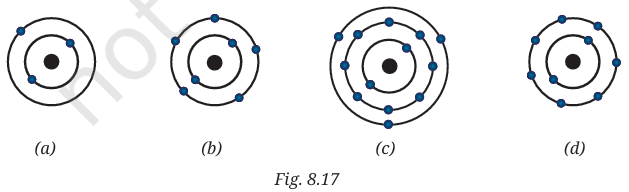
Ans:
| Figure | Element Name | Symbol | Total Electrons | Valence Electrons | Valency | Protons | Atomic Number |
| (a) | Lithium | Li | 3 | 1 | 1 | 3 | 3 |
| (b) | Nitrogen | N | 7 | 5 | 3 | 7 | 7 |
| (c) | Magnesium | Mg | 12 | 2 | 2 | 12 | 12 |
| (d) | Sodium | Na | 11 | 1 | 1 | 11 | 11 |
10. Both Rutherford’s and Bohr’s models have electrons orbiting the nucleus. Why did Rutherford’s model fail to explain atomic stability, while Bohr’s model succeeded?
Ans: In Rutherford’s model, a revolving electron is constantly accelerating and changing direction. According to physics, such an accelerating charged particle would continuously lose energy, causing it to spiral inward and eventually crash into the nucleus, making the atom unstable. Bohr succeeded by proposing “stationary states”—fixed orbits where an electron can revolve without radiating or losing any energy.
11. An atom 70X has 31 electrons. How many neutrons are there in its nucleus?
Ans: In a neutral atom, the number of protons equals the number of electrons (31 protons). The mass number is 70. Number of neutrons = Mass number – Number of protons = 70 – 31 = 39 neutrons.
12. An atom has 79 protons and a mass number of 197. Calculate (i) the number of neutrons, and (ii) the number of electrons.
Ans: (i) Number of neutrons: Mass number – Protons = 197 – 79 = 118 neutrons.
(ii) Number of electrons: Because it is a neutral atom, it has the same number of electrons as protons = 79 electrons.
13. Complete the Table 8.5:
| Atomic number | Mass number | Number of neutrons | Number of Protons | Number of electrons | Name of the elements |
| 5 | – | 6 | – | – | – |
| – | 14 | – | – | 7 | Nitrogen |
| – | 24 | – | 12 | – | – |
| 15 | – | 16 | – | – | – |
| – | 1 | 0 | – | – | – |
Ans:
| Atomic Number | Mass Number | Number of Neutrons | Number of Protons | Number of Electrons | Name of the Element |
| 5 | 11 | 6 | 5 | 5 | Boron |
| 7 | 14 | 7 | 7 | 7 | Nitrogen |
| 12 | 24 | 12 | 12 | 12 | Magnesium |
| 15 | 31 | 16 | 15 | 15 | Phosphorus |
| 1 | 1 | 0 | 1 | 1 | Hydrogen |
14. Aman was discussing the structure of atom with his classmates. During the discussion, he learnt that an element X has a mass number of 35 and contains 18 neutrons. Based on this information, answer the following questions:
(i) How many electrons and protons does element X have?
Ans: Protons = Mass number – Neutrons = 35 – 18 = 17. Because it’s neutral, it also has 17 electrons.
(ii) What is its atomic number?
Ans: 17 (equal to the number of protons).
(iii) Identify the element X.
Ans: Chlorine (Cl).
(iv) Write its electronic configuration.
Ans: 2, 8, 7.
(v) How many valence electrons does it have?
Ans: 7 (electrons in the outermost shell).
(vi) What will be the mass number if two neutrons are added to its nucleus?
Ans: New number of neutrons = 20. New Mass Number = 17 protons + 20 neutrons = 37.
(vii) What will be the relation of X with the new atom?
Ans: Because they have the same atomic number (17) but different mass numbers (35 and 37), they are isotopes of each other.
15. In an atom, there are 12 protons and 12 neutrons in the nucleus. Now, imagine that all the electrons are replaced with some hypothetical particles that have the same charge as electrons but are 500 times heavier. What effect will this replacement have on the atom’s:
(i) Atomic number.
Ans: No change. The atomic number depends only on the number of protons, which remains 12.
(ii) Atomic mass.
Ans: The atomic mass will increase because the new particles are 500 times heavier than electrons. Although the number of protons and neutrons remains unchanged, the total mass of the atom increases.
(iii) Mass number.
Ans: No change. The mass number is the sum of the number of protons and neutrons only.
Mass Number=12+12=24
(iv) Overall charge.
Ans: No change. The new particles have the same negative charge as electrons, so they exactly balance the positive charge of the 12 protons. Therefore, the atom remains electrically neutral.
Subject Ka Complete Video Solution Dekhein
Step-by-step easy concept explanation aur full questions Answer ke liye watch karein ya app download karein:


 Buy Now