
NCERT Class 9 Science Chapter 5 Exploring Mixtures and their Separation Solutions English Medium As Per New Syllabus. NCERT Class 9 Science Chapter 5 Exploring Mixtures and their Separation Notes to each chapter is provided in the list so that you can easily browse throughout different chapter NCERT Class 9 Science Chapter 5 Exploring Mixtures and their Separation Question Answer Download PDF and select needs one. CBSE Class 9 Science Solutions.
NCERT Class 9 Science Chapter 5 Exploring Mixtures and their Separation
Also, you can read the CBSE book online in these sections Solutions by Expert Teachers as per (CBSE) Book guidelines. NCERT Class 9 Science Textbook Solutions. These solutions are part of NCERT All Subject Solutions. Here we have given NCERT Class 9 Science Notes in English Medium Solutions for All Subject, You can practice these here.
Exploring Mixtures and their Separation
Chapter – 5
| Pause And Ponder |
1. A common talcum powder contains 4% * m / m zinc oxide, which acts as an antiseptic. How much zinc oxide is present in 300 g of the talcum powder?
Ans: Zinc oxide = 4% of 300 g
= (4 × 300) ÷ 100
= 12 g
2. Your mother gives you a bottle of orange juice concentrate to mix with water and serve it to your visiting friends. She asks you to mix two tablespoons of the concentrate with water in a glass tumbler. If each tablespoon measures 15 mL and you make 150 mL of juice per person, what is the % v/v of orange juice concentrate in the mixture you prepared?
Ans: Volume of concentrate = 2 × 15 = 30 mL
% v/v = (30 ÷ 150) × 100
= 20% v/v
3. Vinegar, used as a food preservative and additive, contains 5% v/v acetic acid. Glacial acetic acid is a liquid, i.e., 100% acetic acid. If you want to make vinegar from glacial acetic acid, how would you proceed?
Ans: Mix 5 mL of glacial acetic acid with 95 mL of water to prepare 100 mL of vinegar (5% v/v acetic acid).
| Pause And Ponder |
1. Refer to the solubility curves given in Activity 5.2. If equal masses of hot, saturated solutions of compounds ‘A’ and ‘B’ are cooled from 80 °C to 60 °C, which solution is likely to deposit more solid?
Ans: The solution of the compound whose solubility decreases more on cooling from 80°C to 60°C will deposit more solid.
2. Will there be any change in the size of common salt crystals if the rate of evaporation is increased or decreased? Explain.
Ans: Yes. Slow evaporation produces larger crystals, while fast evaporation produces smaller crystals because the crystals get less time to grow.
| Pause And Ponder |
1. State whether the following statements are True or False. Also, correct the False statements.
(i) Salt can be separated from a salt solution by evaporation or distillation.
Ans: True.
(ii) Distillation can be used for separation of two liquids even when these have the same boiling point.
Ans: False – Distillation can separate two liquids only if they have different boiling points.
(iii) In paper chromatography, the solvent level should be above the sample spot at the beginning of the experiment.
Ans: False – In paper chromatography, the solvent level should be below the sample spot at the beginning of the experiment.
(iv) Evaporation and crystallization are the same processes.
Ans: False – Evaporation removes the solvent, whereas crystallization forms pure crystals of the solute.
| Pause And Ponder |
1. Why do immiscible liquids form two separate layers in a separating funnel?
Ans: Immiscible liquids do not mix with each other and have different densities, so they form two separate layers.
2. Is sublimation different from evaporation? Justify.
Ans: Yes. In sublimation, a solid changes directly into vapour without becoming a liquid. In evaporation, a liquid changes into vapour.
| Pause And Ponder |
1. Clouds are made up of tiny water droplets or ice crystals floating in the air. Based on what you know about solutions, suspensions and colloids, what type of mixture do you think clouds are and why?
Ans: Clouds are colloids because tiny water droplets or ice crystals remain uniformly dispersed in air without settling quickly.
2. Why do cities with a lot of smoke and dust in the air often look hazy?
Ans: Smoke and dust particles remain suspended in the air and scatter light, making the surroundings appear hazy.
| Revise, Reflect, Refine |
1. Which of the following mixtures are correctly classified as homogeneous (Hm) and heterogeneous (Ht)? Choose the correct option.
(i) Air — Hm, Milk — Ht, Sugar solution — Hm, Smoke — Hm.
(ii) Brass — Ht, Fog — Ht, Vinegar — Ht, Muddy water — Hm.
(iii) Copper sulfate solution — Hm, Salt solution — Hm, Milk — Hm, Bronze — Hm.
(iv) Muddy water — Ht, Milk — Ht, Blood — Ht, Brass — Hm.
Ans: (iv) Muddy water — Ht, Milk — Ht, Blood — Ht, Brass — Hm.
2. Choose the correct options, and explain the reason for the correct and incorrect options.
Which among the following mixtures show the Tyndall Effect?
A mixture of:
(a) air and dust particles.
(b) copper sulfate and water.
(c) starch and water.
(d) acetone and water.
(i) a and b.
(ii) b and d.
(iii) a and c.
(iv) c and d.
Ans: (iii) a and c.
3. A mixture can be categorised as a solution, a suspension, or a colloid, each possessing distinct properties. Utilise the words or phrases provided in the box to fill in the Table 5.2. Words and phrases may be used more than once.
| Words and Phrases: Large-sized particles; Particles remain evenly distributed; Small-sized particles (less than 1 nm diameter); Moderate-sized particles (1 – 1000 nm); Settles down when left undisturbed (more than 1000 nm in diameter); Does not settle down; Scatters light; Separates by filtration; Transparent; Salt solution; Milk; Sand in water; Smoke; Heterogeneous mixture; Cannot be separated by filtration; Mud; Butter; Brass. |
Complete the Table 5.2.
| Solution | Suspension | Colloid |
| Properties_____________________ _____________________ | Properties ____________________ _____________________ | Properties _____________________ _____________________ |
| Examples _____________________ _____________________ | Examples_____________________ _____________________ | Examples_____________________ _____________________ |
Ans:
| Solution | Suspension | Colloid |
| Properties | Properties | Properties |
| Small-sized particles (less than 1 nm diameter) | Large-sized particles | Moderate-sized particles (1–1000 nm) |
| Particles remain evenly distributed | Settles down when left undisturbed | Scatters light |
| Does not settle down | Separates by filtration | Does not settle down |
| Cannot be separated by filtration | Heterogeneous mixture | Cannot be separated by filtration |
| Transparent | Heterogeneous mixture | |
| Examples | Examples | Examples |
| Salt solution | Mud | Milk |
| Brass | Sand in water | Smoke |
| Butter |
4. Solve the following problems:
(i) A cake recipe uses dry ingredients, namely 75 g of sugar for 420 g of all-purpose flour and 5 g of sodium hydrogencarbonate. Express the concentration of each component in the mixture using an appropriate method.
Ans: Mass of sugar = 75 g, Mass of flour = 420 g, Mass of sodium hydrogencarbonate = 5 g. Total mass of mixture = 75 + 420 + 5 = 500 g. Using the mass by mass percentage (% m/m) method:
Concentration of sugar:
75/500 ×100= 15%
Concentration of flour: 420/500 × 100= 84%
Concentration of sodium hydrogencarbonate: 5/500 ×100= 1%
(ii) A brass alloy contains 70% copper by mass. Calculate the quantities of copper and zinc present in 120 g of brass.
Ans: Brass alloy contains 70% copper by mass. Total mass = 120 g.
Mass of copper: 70% of 120 g = 70/100 ×120= 84 g
Mass of zinc: Total mass – Mass of copper =120−84= 36 g (or 30% of 120 g).
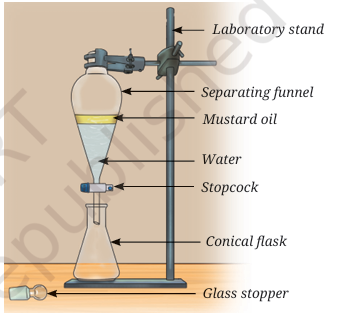
5. The label on a cooking oil pack says one litre (910 g). If this oil is mixed with water, will it form a separate layer? If so, which substance will be on top? How will you separate the two layers? Also, draw the diagram of the apparatus used.
Ans: Yes, the cooking oil will form a separate layer when mixed with water because oil and water do not mix with each other (they are immiscible liquids).
The oil layer will remain on the top because oil is lighter (less dense) than water. The density of the oil is about 0.91 g/mL, while the density of water is 1 g/mL.
The two liquids can be separated by using a separating funnel. In this method, the mixture is poured into the funnel and allowed to stand for some time. The water settles at the bottom and the oil remains at the top. The lower water layer is then drained out slowly by opening the stopcock, leaving the oil behind.
6. Assertion (A): Solutions do not exhibit the Tyndall effect.
Reason (R): The particles in solutions are larger than 100 nm, so they cannot scatter light.
Choose the correct option:
(i) Both A and R are true, and R is the correct explanation of A.
(ii) Both A and R are true, but R is not the correct explanation of A.
(iii) A is true, but R is false.
(iv) A is false, but R is true.
Ans: (iii) A is true, but R is false.
7. How would you separate the mixtures given in Table 5.3? Mention the reason for choosing your method. If a mixture cannot be separated, explain why.
| Mixture | Method of separation | Reason for Selection |
| Mud from muddy water | ||
| Plasma from other components in the blood sample | ||
| Naphthalene and sand | ||
| Chalk powder and common salt | ||
| Common salt and water | ||
| Oil from water | ||
| Pigments of the flower |
Ans:
| Mixture | Method of Separation | Reason for Selection |
| Mud from muddy water | Centrifugation, filtration, or coagulation (using alum) | Mud particles are heavy and suspended, so they can settle by gravity/centrifugal force or clump together. |
| Plasma from other components in the blood sample | Centrifugation | Rapid spinning forces heavier blood cells downward, leaving the lighter plasma at the top. |
| Naphthalene and sand | Sublimation | Naphthalene changes directly into vapour on heating, while sand does not. |
| Chalk powder and common salt | Dissolve in water, filtration, and evaporation | Salt dissolves in water, but chalk powder does not. The chalk is filtered out and salt is obtained after evaporation. |
| Common salt and water | Evaporation or distillation | Water evaporates on heating, leaving the salt behind. |
| Oil from water | Separating funnel | Oil and water are immiscible liquids and form separate layers due to difference in density. |
| Pigments of the flower | Paper chromatography | Different pigments move at different speeds on the paper depending on their solubility in the solvent. |
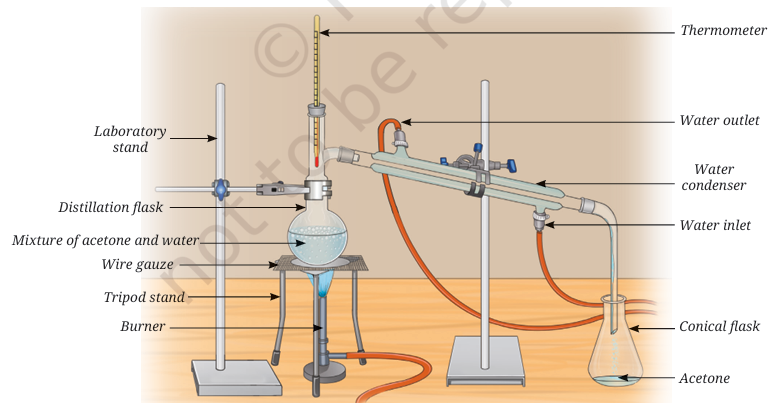
8. Two miscible liquids, A and B, are present in a mixture. The boiling point of A is 60 °C and the boiling point of B is 90 °C. Suggest a method to separate them. Also, draw a labelled diagram of the method suggested.
Ans: Method: Distillation. This method is effective because they are miscible liquids and their boiling points differ by more than 25°C (90 – 60 = 30°C),. Liquid A will vaporize first and condense in a separate flask.
9. Compare evaporation, crystallization and distillation. In which situation, would you prefer each of these over the others?.
Ans: Evaporation is used when you only want to recover the dissolved solid (solute) and do not need to keep the liquid solvent.
Crystallization is preferred over evaporation when you need to purify a solid. It forms pure, well-shaped crystals and removes unwanted soluble impurities that would be left behind by simple evaporation.
Distillation is preferred when you want to recover both the solvent and the solute, or when separating two miscible liquids with a boiling point difference greater than 25°C-.
10. Blood is an example of a colloidal mixture.
(i) What would happen if blood behaved like a true suspension inside the body?
Ans: If blood behaved like a true suspension, the heavier blood cells would settle down in the blood vessels due to gravity over time (just as sand settles in water). This would stop uniform blood circulation and cause major blockages.
(ii) In a blood sample, identify the dispersed phase and the dispersion medium.
Ans: Dispersed phase: Red blood cells, white blood cells, and platelets. Dispersion medium: Plasma.
11. You are given a mixture of sand, common salt and naphthalene (Fig. 5.25a). The Fig. 5.25b depicts various steps used to separate the components of this mixture. Identify and write down the correct sequence of separation techniques.
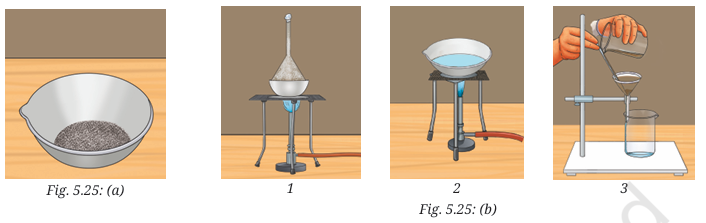
Ans: (i) Step 1: Sublimation. Heat the mixture. Naphthalene will sublime into vapor and can be collected, leaving sand and salt behind.
(ii) Step 2: Dissolution and Filtration. Add water to the sand and salt. The salt will dissolve. Filter the mixture; sand stays on the filter paper as residue.
(iii) Step 3: Evaporation / Crystallization. Heat the remaining salt water filtrate to vaporize the water and obtain the salt crystals.
12. Why is distillation an effective method for separating a mixture of water and acetone?
Ans: Distillation is effective because water and acetone are miscible liquids with a sufficient difference in their boiling points (more than 25°C). Acetone boils at ~56°C and water at 100°C. This large difference allows acetone to vaporize and condense fully before the water turns into vapor.
13. Answer the following questions with the help of the data given in Table 5.4.
Table 5.4 Solubility of various salts (in g per 100 g of water) at different temperatures
Salts | Temperature | |||||
| 10 °C | 20 °C | 30 °C | 40 °C | 60 °C | 80 °C | |
| Potassium nitrate | 21 | 32 | 45 | 62 | 106 | 167 |
| Sodium chloride | 36 | 36 | 36.3 | 36.5 | 37 | 37 |
| Potassium chloride | 35 | 35 | 37.4 | 40 | 46 | 54 |
| Ammonium chloride | 24 | 37 | 41 | 41 | 55 | 66 |
(i) What mass of potassium nitrate would be needed to prepare its saturated solution in 50 g of water at 40 °C?.
Ans: At 40°C, 62 g of potassium nitrate dissolves in 100 g of water. For 50 g of water, exactly half of this mass is needed: 31 g.
(ii) A student makes a saturated solution of potassium chloride in water at 80 °C and leaves the solution to cool at room temperature (25 °C). What would she observe as the solution cools? Explain.
Ans: At 80°C, the solubility of KCl is 54 g. As the solution cools to 25°C, its solubility decreases to roughly 36 g (based on table values for 20-30°C). The student will observe excess dissolved potassium chloride precipitating/depositing out of the liquid as solid crystals.
(iii) What is the effect of a change in temperature on the solubility of salts? Also, compare the changes in the solubility of the four given salts with increasing temperature from 10 °C to 80 °C.
Ans: An increase in temperature generally increases the solubility of solid salts in water.
Comparison: As temperature rises from 10°C to 80°C, Potassium nitrate shows the highest increase in solubility (21 g to 167 g), while Sodium chloride shows the least change (36 g to 37 g).
14. Three students, A, B and C, are preparing sugar solutions for an experiment:
- Student A dissolves 20 g of sugar in 80 g of water.
- Student B dissolves 20 g of sugar in 100 g of water.
- Student C dissolves 30 g of sugar in 80 g of water.
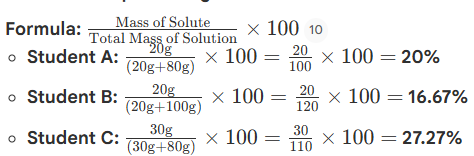
(i) Calculate the mass percentage (% m/m) concentration of sugar in each student’s solution.
Ans:
(ii) Whose solution is the most concentrated? Explain why.
Ans: Student C’s solution is the most concentrated because it has the highest mass percentage (27.27%) of sugar dissolved in it.
15. Examine Fig. 5.26.
(i) Identify the separation technique marked as ‘S’.
(ii) Label the apparatus A, B and C.
(iii) Which of the following mixtures can be separated by the technique identified above? Use the data given in Table 5.5. Mixtures:
(a) water—acetone.
(b) water—salt.
(c) acetone—alcohol.
(d) sand—salt.
(e) alcohol—chloroform.
(f) alcohol—benzene.
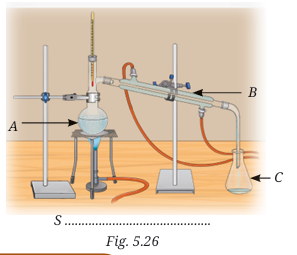
Table 5.5 Boiling points of some compounds:
| Solvent | Water | Acetone | Alcohol | chloroform | Benzene |
| Temperature(°C) | 100 °C | 56 °C | 78 °C | 61 °C | 80°C |
Ans: (i) Separation technique ‘S’: Distillation.
(ii) A: Distillation flask
B: Water condenser (Liebig condenser)
C: Conical flask (Receiving flask)
(iii) Distillation is used for separating a liquid from dissolved solids or two miscible liquids having a boiling point difference greater than 25°C.
Therefore, the suitable mixtures are:
(a) Water and acetone (Boiling point difference = 44°C)
(b) Water and salt (Water can be distilled, leaving salt behind.)
Subject Ka Complete Video Solution Dekhein
Step-by-step easy concept explanation aur full questions Answer ke liye watch karein ya app download karein:

 Buy Now