
NCERT Class 9 Arts Chapter 11 Dance as Visual Storytelling Solutions English Medium As Per New Syllabus. to each chapter is provided in the list so that you can easily browse through different chapters NCERT Class 9 Arts Chapter 11 Dance as Visual Storytelling Notes and select need one. NCERT Class 9 Arts Chapter 11 Dance as Visual Storytelling Question Answers Download PDF. NCERT Class 9 Arts Madhurima Texbook Solutions.
NCERT Class 9 Arts Chapter 11 Dance as Visual Storytelling
Also, you can read the NCERT book online in these sections Solutions by Expert Teachers as per Central Board of Secondary Education (CBSE) Book guidelines. CBSE Class 9 Arts Madhurima Textual Solutions in English Medium are part of All Subject Solutions. Here we have given NCERT Class 9 Arts Madhurima Notes, CBSE Class 9 Arts Madhurima Textbook Solutions for All Chapters, You can practice these here.
Dance as Visual Storytelling
Chapter: 11
| TEXTUAL SOLUTIONS |
| Activity 11.1 |
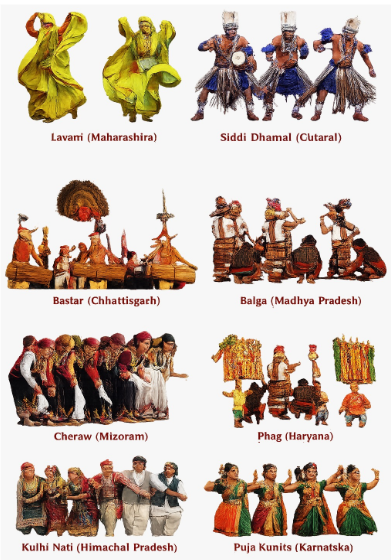
Spot the āhārya and identify the dance.
(i) In Figs. 11.9–11.16, identify the dance form based on the costume, make-up, and accessories, and write its name below.
(ii) The dance forms (in no particular order) are: Lāvaṇī (Maharashtra), Cheraw (Mizoram), Kullu Nāṭī (Himachal Pradesh), Baigā (Madhya Pradesh), Pūjā Kunitā (Karnataka), Siddi Dhamāl (Gujarat), Bastar (Chattisgarh) and Phāg (Haryana).
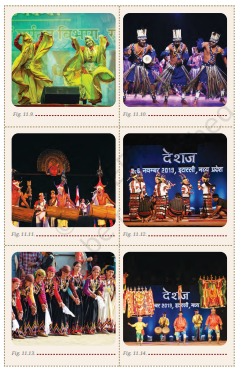
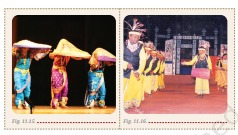
Ans:
| EXERCISES |
1. Describe and show how you can use these elements in your Āṅgika Abhinaya.
Choose any two of the following.
(i) Chārī/ gati
(ii) Utplavana and bhramarī
(iii) Hastas – Hand gestures (Grade 8 Textbook Kriti)
Ans: The provided text defines Āṅgika Abhinaya as the use of the body as a tool for communication and articulation, which includes stylised movements such as chārī, gati, utplavana, bhramarī, and hastas. However, the textbook excerpt does not describe the specific techniques for these terms.
To answer how to use them, I must provide information from outside of your sources, which you may want to independently verify:
(i) Chārī/gati (Gaits and Walks): These are stylised lower-body movements and walks. You can use them to depict a specific character’s identity, age, or mood (for example, using a heavy, grounded gati for a warrior, or a light, swift chārī for a deer).
(iii) Hastas (Hand Gestures): You can use these gestures as a visual vocabulary to spell out specific words, ideas, objects, or emotions to the audience, turning your hand movements into visual storytelling.
2. Which of the Vāchika Abhinaya elements have you explored? Describe how each of them helped you communicate your idea and thoughts?
Ans: Since this question asks for your personal reflection, you can construct an answer using the definitions provided in the text. Vāchika Abhinaya involves verbal elements like speech, poetry, lyrics, narration, dialogue, and the recitation of rhythmic syllables.
“I explored the recitation of rhythmic syllables like dha, ta, ka, dhin as well as dancing to lyrical music. Reciting the syllables helped me create a soundscape that shaped the energy and timing of my movements. Dancing alongside songs with lyrics helped me better understand and communicate the emotional essence of the story to the audience.”
3. In which Indian dance forms do the dancers simultaneously sing and dance, either solo or in group. Give three examples and mention the states they belong to.
Ans: The sources explicitly identify one example:
Bauls (West Bengal): The performers sing, narrate, and dance to Bhakti songs. To complete the three examples, I am providing two additional dances using outside knowledge (which you may want to independently verify), though the first is listed as a dance form in your sources:
Lāvaṇī (Maharashtra): Mentioned in your text as a regional dance, it is traditionally performed by women who simultaneously sing live and dance.
Kummi (Tamil Nadu): A folk dance where women dance in a circle and sing simultaneously, often clapping their hands to keep the rhythm.
4. Explain the elements of Āhārya Abhinaya in two dance forms you have learnt in class. Can you connect any of the āhārya elements with what you have learnt in Visual Arts?
Ans: Using examples from the text, you can explain that Āhārya Abhinaya involves using visual elements like costumes, make-up, and props to convey narratives, cultural context, and mood.
Dance 1 (Lezim from Maharashtra): Features a specific prop called the Lezim (an instrument with metal cymbals) that provides aural accompaniment and adds visual flair to the energetic dance.
Dance 2 (Bhangra from Punjab): Utilises the chikkā, a wooden clapper, to add both visual and rhythmic complexity to the performance. Connection to Visual Arts: The text states that a dance form can often be identified simply by its costume, as it is deeply reflective of a region’s textile and jewellery traditions. You can connect this to Visual Arts by noting that the creation, colour theory, and design of these regional textiles, garments, and jewellery are themselves visual art practices.
5. Do you think appropriate costume enhances the movement or the āṅgika of any dance form?
Ans: Yes, an appropriate costume significantly enhances the movement. According to the text, Indian dance is a form of visual storytelling (dṛiśhya-kāvya), and the integrated use of all abhinayas is necessary to transmit emotion and intent to the audience. The āhārya (costumes and props) visually grounds the āṅgika (body movements) by establishing the mood, cultural context, and narrative. For example, in harvest dances, the movements imitating farming activities are directly enhanced and made more legible by the use of representative props.
Subject Ka Complete Video Solution Dekhein
Step-by-step easy concept explanation aur full questions Answer ke liye watch karein ya app download karein:

 Buy Now