
NCERT Class 9 Arts Chapter 1 Introduction to the History of Arts Solutions English Medium As Per New Syllabus. to each chapter is provided in the list so that you can easily browse through different chapters NCERT Class 9 Arts Chapter 1 Introduction to the History of Arts Notes and select need one. NCERT Class 9 Arts Chapter 1 Introduction to the History of Arts Question Answers Download PDF. NCERT Class 9 Arts Madhurima Texbook Solutions.
NCERT Class 9 Arts Chapter 1 Introduction to the History of Arts
Also, you can read the NCERT book online in these sections Solutions by Expert Teachers as per Central Board of Secondary Education (CBSE) Book guidelines. CBSE Class 9 Arts Madhurima Textual Solutions in English Medium are part of All Subject Solutions. Here we have given NCERT Class 9 Arts Madhurima Notes, CBSE Class 9 Arts Madhurima Textbook Solutions for All Chapters, You can practice these here.
Introduction to the History of Arts
Chapter: 1
| TEXTUAL SOLUTIONS |
Let us explore:
1. Which artistic practices and traditions around you can be categorised as either tangible or intangible cultural heritage?
Ans: Tangible cultural heritage includes physical, material objects such as monuments, artworks, traditional clothing, jewellery, masks, musical instruments, and pottery. Examples around you might include local historical temples, traditional regional paintings, or hand-crafted items like Ḍhokrā metalware. Intangible cultural heritage refers to living traditions passed down from ancestors, such as performing arts, oral storytelling, social practices, rituals, and the skills needed to make traditional crafts. Examples include regional dance forms, traditional harvest songs, or narrative traditions like Ramlila or Kavaḍ Kathā.
Discussion circle:
1. How do various art forms enrich our lives?
Ans: Art forms enrich our lives by providing meaningful ways to express ideas, thoughts, and feelings. Engaging with the arts links our present to the past, nurtures a vision for the future, and instils a sense of pride and awareness in our cultural heritage. Furthermore, the arts ignite curiosity about the people who created them and help us interpret creative ideas from different perspectives.
| Activity 1.1 |
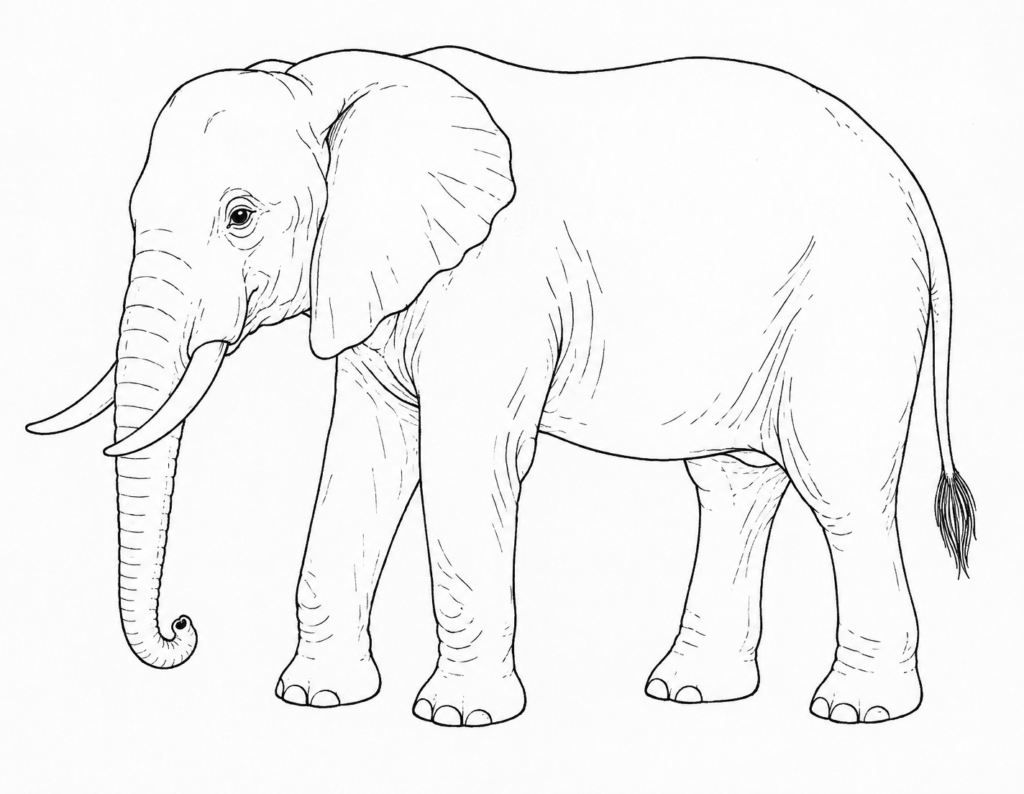
1. Create a line drawing of an animal:
(i) Make a line drawing of any animal from observation or memory.
(ii) Pay attention to the proportions and details of other features.
(iii) Is your animal identifiable?
(iv) Analyse the artistic qualities in your drawing.
(v) The facilitator — a teacher, special teacher, or other learners can help children with special needs to draw or sketch.
Ans:
Discussion circle:
1. What do you think is portrayed by the pose in the figure above?
Ans: The bronze figurine from Mohenjo-Daro portrays a pose with one knee bent, one hand resting firmly on the waist, and a slightly lifted chin. This posture is often interpreted as depicting a confident, relaxed, or dance-like stance.
| Activity 1.2 |
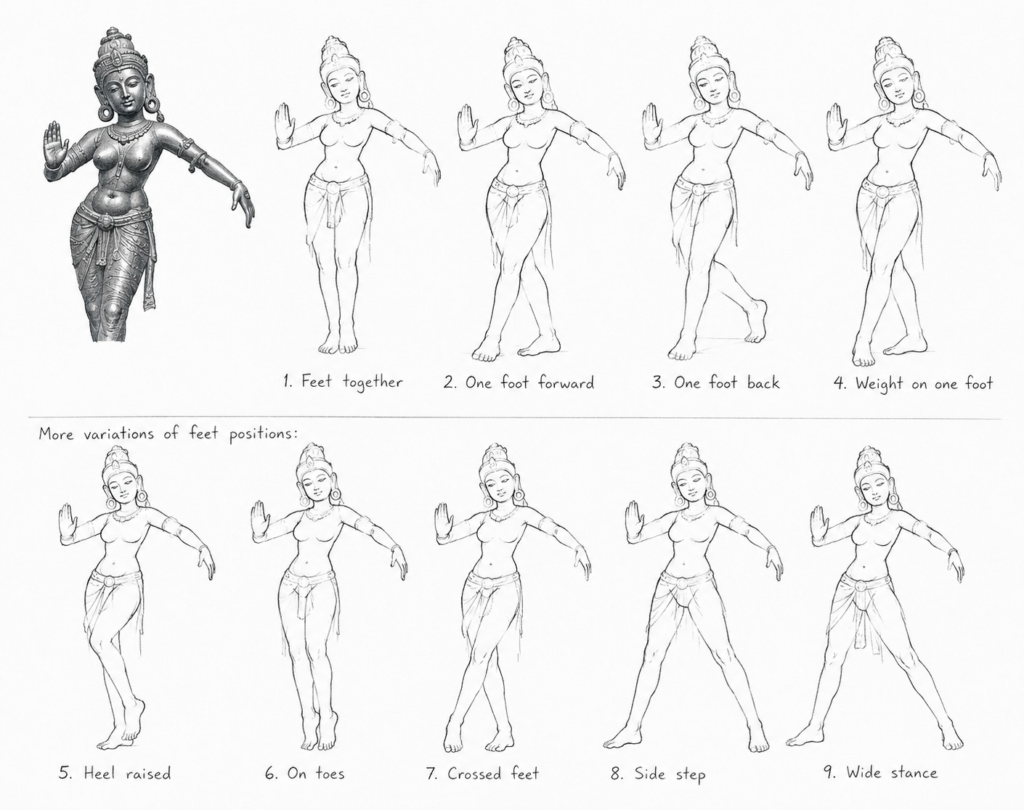
1. Visualise, pose, and draw:
(i) The feet of the bronze figurine are not visible.
(ii) Take turns to mimic the pose while imagining various positions of her feet.
(iii) Quickly sketch the pose and various feet positions.
Ans:
Discussion circle:
1. Compare pottery from the Sindhu-Sarasvatī civilisation with pottery from other ancient civilisations and discuss your observations.
Ans: When comparing pottery, you will notice that the painted terracotta pot from the Sindhu-Sarasvatī civilisation is decorated with distinct geometric shapes and leaf motifs. In contrast, pottery from other ancient civilisations, such as the red clay bowl from the Majiayao culture in ancient China, features stylized human figures holding hands in a dance formation. Both examples illustrate how early civilisations used earthen materials to create functional objects beautifully decorated with motifs relevant to their culture.
Let us explore:
1. Which category of instruments do you think the harp belongs to? What role might this instrument have played in Egyptian culture?
Ans: The arched harp from ancient Egypt belongs to the category of stringed instruments, as it is constructed from wood with attached strings. In ancient Egyptian culture, it likely played a significant role in accompanying religious festivals, royal entertainment, or ritual enactments, such as the musical and dramatic processions dedicated to the god Osiris mentioned in the Ikhernofret stela.
Discussion circle:
1. Why do you think ancient scholars composed treatises that codified the arts?
Ans: Ancient scholars composed treatises to document and preserve the highly specialized knowledge, techniques, and ideas developed by artists across diverse regions. These texts provided structured, in-depth guidance on drama, dance, music, and the visual arts, ensuring that artistic conventions and complex theories, like the rasa theory, were systematically passed down to future generations.
2. On what basis do you think they devised theories, and do you think they remained constant over time?
Ans: Theories were likely devised based on deep observation of human emotions (such as bhāvas and rasas), regional performance styles, and spiritual beliefs. These theories did not remain constant; they evolved significantly over time. For instance, later scholars wrote detailed commentaries (like Abhinavagupta’s Abhinavabhāratī) that expanded upon earlier texts, and new treatises incorporated folk and regional influences (deśhī) alongside classical traditions (mārga).
| Activity 1.3 |
1. Watch performances and make notes in your journal.
Watch short videos of two different performances of Indian dance, music, or theatre.
As you watch the performance, note down the following-
(i) Postures, formations, steps, rhythms, movements, gestures, sounds, costumes, props, etc.;
(ii) Emotions and rasas. and
(iii) Aspects that you found special in the performances.
Ans: Students do it yourselves.
Do you know?
1. Kauṭilya’s Arthaśhāstra recognises naṭa, nartakī, gāyaka/ vādaka as professional performers who contribute towards the state’s economy.
Ans: Yes, this indicates that in ancient times, artists such as actors (naṭa), dancers (nartakī), and singers/musicians (gāyaka/vādaka) were officially recognized as professionals. Their arts were valued not just culturally, but as a recognized occupation that supported the state’s economy.
Let us recall:
1. You have read about the stūpa at Sanchi in Chapter 5 of the Grade 7 Social Science textbook Exploring Society: India and Beyond.
Ans: The Stūpa No.1 at Sanchi is famous for its four large gateways (Toraṇas) which feature intricate relief carvings. These carvings depict important episodes from the life of the Buddha, as well as stories from various Jātakas, providing a visual history of Buddhist beliefs.
| Activity 1.4 |
1. Find the Buddha in the relief panels:
During the early phase of Buddhism, the Buddha was not represented in human form but through symbols like the platform under a Bodhi tree, stūpa, elephant, lotus, and many more. Find the symbols in these reliefs.
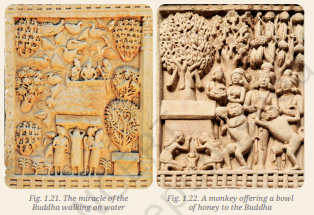
Ans: In early Buddhist art, the Buddha was not depicted as a human figure. To find the Buddha in these relief panels, you must look for specific symbols that represent him, such as a platform under a Bodhi tree, a stūpa, footprints, an elephant, or a lotus.
| Activity 1.5 |
A. Imagine the music:
This relief panel depicts musicians playing a variety of instruments.
1. What do you think is the occasion?
2. Identify the instruments or their categories.
3. What kind of music might they have played?
Ans: Based on the relief panel showing a group of performers:
Occasion: The occasion is likely a joyous celebration, a religious festival, or a royal procession.
Instruments: The musicians appear to be playing a mix of percussion instruments, like drums being beaten, and wind instruments that resemble long horns or trumpets.
Music: The music they played was likely loud, rhythmic, and energetic to suit a festive public gathering.
Let us recall:
1. In Chapter 15 of the Grade 7 Art Education textbook, Kriti, you learnt how objects can have symbolic meanings. Symbols are objects or images that have a deeper meaning than what they visually represent. For example, the wheel represents the Chakra of Dharma.
Ans: Symbolism is a key element in understanding ancient art, where objects hold deeper meaning beyond their literal form. Just as the wheel symbolizes the Chakra of Dharma, other objects and animals in Indian art are used as iconography to represent specific deities, qualities, or spiritual concepts.
Discussion circle:
Observe the captions in the pictures and discuss these points:
1. What are the various animals you see, and what are their symbolic meanings?
Ans: The pillar capitals feature lions, elephants, and bulls. The lion often symbolizes royalty and the Buddha himself, the elephant symbolizes wisdom and the Buddha’s conception, and the bull represents strength and steadfastness.
2. What qualities of these animals do you associate with staying on the path of Dhamma?
Ans: Qualities associated with these animals—such as courage, strength, and gentle endurance—reflect the virtues required to stay committed to the path of Dhamma.
3. What other details do you appreciate in the capitals?
Ans: A notable detail is the incredible craftsmanship, particularly the highly polished, reflective surface known as “mirror polish” seen on the Sarnath lion capital.
Let us recall:
1. Discuss artworks of the Kuṣhāṇa empire that you studied about in Chapter 6 of your Grade 7 Social Science textbook Exploring Society: India and Beyond.
Ans: During the Kuṣhāṇa empire, significant art centers developed in Mathura and Gandhara. This period is notable for a major shift in art: the Buddha was no longer represented just by symbols, but was depicted in human form. Mathura sculptures featured red spotted sandstone and rounded body forms, while Gandhara sculptures used grey schist and displayed realistic anatomy and features similar to Greek or Roman art.
Subject Ka Complete Video Solution Dekhein
Step-by-step easy concept explanation aur full questions Answer ke liye watch karein ya app download karein:

 Buy Now