
NCERT Class 9 Arts Chapter 10 Components of Dance Solutions English Medium As Per New Syllabus. to each chapter is provided in the list so that you can easily browse through different chapters NCERT Class 9 Arts Chapter 10 Components of Dance Notes and select need one. NCERT Class 9 Arts Chapter 10 Components of Dance Question Answers Download PDF. NCERT Class 9 Arts Madhurima Texbook Solutions.
NCERT Class 9 Arts Chapter 10 Components of Dance
Also, you can read the NCERT book online in these sections Solutions by Expert Teachers as per Central Board of Secondary Education (CBSE) Book guidelines. CBSE Class 9 Arts Madhurima Textual Solutions in English Medium are part of All Subject Solutions. Here we have given NCERT Class 9 Arts Madhurima Notes, CBSE Class 9 Arts Madhurima Textbook Solutions for All Chapters, You can practice these here.
Components of Dance
Chapter: 10
| TEXTUAL SOLUTIONS |
| Activity 10.1 |
Explore geometry through your body.
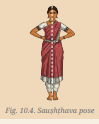
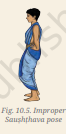
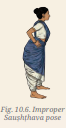
(i) Sauṣhṭhava pose: Hold your body with poise and alignment. Imagine the central meridian line passing vertically through your body. Try aligning your ears, shoulders, and waist in one line.
(ii) Stand upright with your feet joined together. Distribute your body weight evenly on both
feet. (Observe if you are leaning slightly forward or backward?)
(iii) Place your hands on your waist. The elbows, shoulders, and head are in a natural position (as shown in the Fig 10.4).
(iv) Keep your torso upright and lifted. Stand balanced and alert, body erect yet relaxed, ready to move with control and grace. This poised stance of a dancer is called sauṣhṭhava.
(v) Now try simple dancing actions whilst maintaining sauṣhṭhava like walking, turning, jumping, and using your limbs.
Ans: When performing this activity, I stood upright with my feet together and ensured my body weight was evenly distributed. I placed my hands on my waist and aligned my ears, shoulders, and waist vertically. Maintaining this poised and alert sauṣhṭhava stance made simple actions like walking, turning, and jumping feel much more balanced, controlled, and graceful.
| Activity 10.2 |
Visual composition in dance: explore shapes and emotions.
(i) Create lines and shapes with different parts of your body — a diagonal line with your arms, a quadrangle with your lower body, or an arc with your torso, etc.
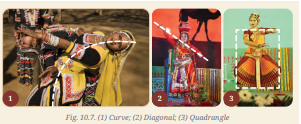
(ii) Try forming shapes with your entire body — stretching, balancing, creating curves, and arcs through bends, etc.
(iii) These linear or curved forms, created through the coordination of your body parts, are called rekhā in dance.
(iv) With bright, expressive eyes and a pleasant face, reflect your joy, or any emotion. This is your disposition or rūpa.
Ans: To explore visual composition, I created a diagonal line with my arms and a slight arc with my torso, experimenting with the concept of rekhā (linear or curved forms created through the coordination of body parts). To complement this physical shape, I kept a bright, expressive face with a smile to reflect a feeling of joy, which represents my disposition or rūpa. Developing clear lines (rekhā) and a good disposition (rūpa) made the posture feel much more expressive and confident.
| Activity 10.3 |
Combine and connect to create a flow in dance.
(i) Divide yourselves into groups of four.
(ii) Choose any five shapes created in Activity 10.2 and connect each of these consciously to form a continuous, uninterrupted flow of movement.
(iii) Decide on an intention or mood, such as joy, sorrow, excitement, etc.
(iv) Based on this, decide how you will connect the shapes. Will they be slow, swift, sharp, or gentle? This is called the transition.
(v) Now, try moving from one shape to another with a suitable seamless transition. This is what makes a dance movement! 143 144Madhurima.
(vi) Choose a rhythmic cycle from any beats (3, 4, 5, 7, 9), decide on a tempo, and repeat the movement as stated in the previous step.
(vii) Present your creation to the class.
Ans: (Sample Group Response) Our group chose “excitement” as our core intention or mood. We connected five different shapes we had created and used swift and sharp transitions to match our energetic mood. We then set this continuous flow of movement to a 4-beat rhythmic cycle (tāla) at a fast tempo (laya), repeating the movements seamlessly to create a complete, uninterrupted dance sequence.
| Activity 10.4 |
Experience dance: one of the best ways to learn is to observe!
Watch a live dance performance, or watch the video screening of a dance performance in school.
It is time to begin your journey with journalling.
(i) Describe the dance form you watched or the music you heard.
(ii) After watching the programme document in your journal.
(iii) Describe whether you enjoyed the song, rhythm, and tempo.
(iv) Mention the different āṅgika elements used (do not miss the hand gestures).
(v) Which part of the dance did you enjoy most? Did it bring to mind any particular emotion in you? Describe your feelings.
(vi) Describe the costume, props, and stage decor (if any). Could you connect it to any particular region of the country? Explore these further.
Ans: Sample Journal Entry:
Dance form and music: I watched a recorded video of an Odissi dance performance.
Enjoyment of rhythm: I thoroughly enjoyed the rhythmic music and the medium tempo (laya) that gradually accelerated toward the end.
Āṅgika elements: The dancer beautifully utilized āṅgika abhinaya (body gestures), particularly using intricate hand gestures and fluid torso curves to tell a story.
Favorite part and emotion: My favorite part was the expressive facial communication, which evoked a strong feeling of serene joy.
Costume and region: The dancer wore traditional silver jewelry and a bright, stylized silk saree (āhārya abhinaya). This visual presentation connects directly to the state of Odisha.
| Activity 10.5 |
Your journal entry of cinematic dance.
(i) Pick a dance sequence from a film and watch it with your classmates. It could be your favourite dance performance, a dance form belonging to your region or any of the above mentioned film dances.
(ii) Discuss and correlate the performance to an Indian dance form.
Ans: Sample Journal Entry: I picked a popular dance sequence from the Hindi movie Devdas to watch with my classmates. While discussing the performance, we were able to directly correlate the cinematic choreography to the Indian classical dance form of Kathak. We observed the rapid footwork, spins, and traditional expressive storytelling that are characteristic of this classical form. (Alternatively, you could correlate ‘Jab We Met’ to Bhangra, ‘Padmavat’ to Ghoomar, or ‘Manichitrathazhu’ to Bharatanatyam, as all are featured in Indian cinema).
| EXERCISES |
1. Which of these are not essential for proper body alignment?
(i) Sauṣhṭhava.
(ii) Vāchika.
(iii) Rūpa iv. Rekhā.
Ans: (ii) Vāchika.
2. Explain any one of these.
(i) Nṛitta and Nṛitya.
(ii) Rhythm (tāla) and Tempo (laya).
(iii) Sauṣhṭhava.
Ans: (i) Nṛitta and Nṛitya: Nṛitta is pure, non-narrative dance comprising pure dance movements that express joy without conveying any specific meaning.Nṛitya is a dance that narrates a story or expresses a meaning. It blends the pure movements of nṛitta with expressive communication called abhinaya to make the dance both beautiful and meaningful.
(ii) Rhythm (tāla) and Tempo (laya): Rhythm (tāla) refers to the basic rhythmic patterns or cycles upon which dances are based. In Indian dance, these are typically cycles of 3, 4, 5, 7, or 9 beats. Tempo (laya) refers to the speed of that rhythm, which is generally categorized into slow, medium, and fast speeds, much like the natural regulation of a human heartbeat.
(iii) Sauṣhṭhava: Sauṣhṭhava is the foundational, poised stance of a dancer, achieved by holding the body with proper alignment. It involves standing balanced, alert, and relaxed, with an upright torso where the ears, shoulders, and waist are vertically aligned along a central meridian line.
Subject Ka Complete Video Solution Dekhein
Step-by-step easy concept explanation aur full questions Answer ke liye watch karein ya app download karein:

 Buy Now