
NCERT Class 10 Health and Physical Education Chapter 10 Safety Measures for Healthy Living Solutions English Medium As Per New Syllabus. to each chapter is provided in the list so that you can easily browse through different chapters NCERT Class 10 Health and Physical Education Chapter 10 Safety Measures for Healthy Living and select need one. NCERT Class 10 Health and Physical Education Chapter 10 Safety Measures for Healthy Living Question Answers Download PDF. CBSE Class 10 Health and Physical Education Solutions in English.
NCERT Class 10 Health and Physical Education Chapter 10 Safety Measures for Healthy Living
Also, you can read the NCERT book online in these sections Solutions by Expert Teachers as per Central Board of Secondary Education (CBSE) Book guidelines. CBSE Class 10 Health and Physical Education Notes English Medium are part of All Subject Solutions. Here we have given NCERT Class 10 Health and Physical Education Notes, CBSE Class 10 Health and Physical Education Solutions for All Chapters, You can practice these here.
Safety Measures for Healthy Living
Chapter: 10
| ASSESSMENT |
Activity 10.1 (Page 182)
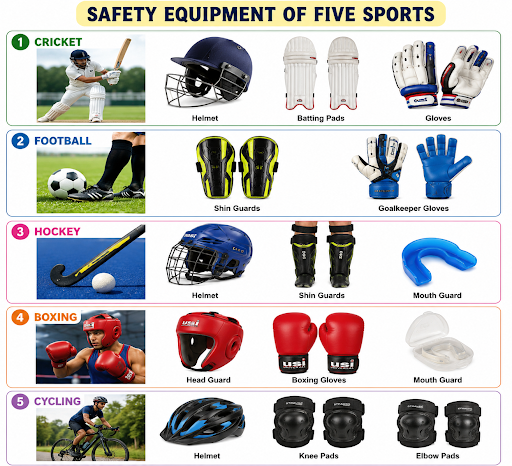
1. Enlist and paste pictures of the safety equipments or gadgets of any five sports of your choice.
Ans:
2. Name the tablets kept in grain containers to control grain insect.
Ans: Aluminium Phosphide tablets (Celphos tablets).
3. Enlist five household insecticides.
Ans: Five household insecticides are:
(i) Mosquito spray.
(ii) Cockroach spray.
(iii) Ant killer powder.
(iv) Mosquito coil.
(v) Mosquito liquid vaporizer.
Activity 10.2 (Page 184)
1. Discuss with your classmates the need of first aid.
Ans: First aid is essential because it is the immediate and temporary care given to a wounded, injured, or sick person in an emergency situation before professional medical assistance is available. The primary need for first aid is to reduce the suffering of the patient and to prevent any further complications of their injury or sickness.
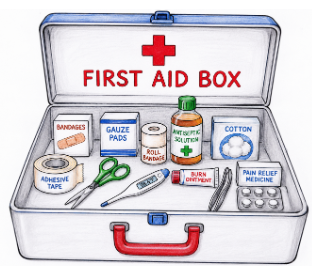
2. List the most essential items in a First Aid Box and draw a diagram.
Ans: Essential items in a First Aid Box:
(i) Adhesive bandages (Band-Aids).
(ii) Sterile gauze pads.
(iii) Cotton.
(iv) Antiseptic lotion/solution.
(v) Adhesive tape.
(vi) Crepe bandage.
(vii) Scissors.
(viii) Tweezers.
(ix) Disposable gloves.
(x) Thermometer.
(xi) Pain relief medicine.
(xii) Burn ointment.
Activity 10.5 (Page 187)
1. What is the use of vitamins in our body?
Ans: Vitamins are essential nutrients that:
(i) Help in normal growth and development.
(ii) Strengthen the immune system.
(iii) Keep the eyes, skin, bones and teeth healthy.
(iv) Help in energy production and metabolism.
(v) Protect the body from diseases and deficiency disorders.
Activity 10.6 (Page 190)
1. Discuss how a substance abuser’s life gets affected.
Ans: Substance abuse affects a person’s life in many ways:
(i) Damages physical and mental health.
(ii) Causes addiction and dependence.
(iii) Reduces concentration and memory.
(iv) Affects studies and work performance.
(v) Leads to poor relationships with family and friends.
(vi) Increases the risk of accidents, diseases and infections.
(vii) Causes financial problems.
(viii) May lead to crime and legal issues.
(ix) Lowers self-confidence and quality of life.
(x) In severe cases, it can result in serious illness or even death.
| ASSESSMENT |
1. State three precautions one should take while working with a machine.
Ans: Three precautions to take while working with a machine are:
(i) Wash your hands to remove oil and grease, or use chalk powder for proper handling.
(ii) Avoid wearing loose clothes because they can get entangled with the machines.
(iii) Concentrate on your work, avoid talking, and switch off the electricity when the machine is not in use.
2. While opening a bottle containing liquid insecticide, the liquid fell on your clothes. How can you prevent its harmful effects on you?
Ans: If liquid insecticide accidentally falls on my clothes, I will remove those clothes immediately so the chemical doesn’t reach my skin. After that, I will wash the affected body parts thoroughly with plenty of water and soap to protect myself from any harmful effects.
3. Electrical gadgets are used in all households. What are the requirements of these gadgets which will prevent you from getting an electric shock?
Ans: To prevent electric shocks from household electrical gadgets, ensure the following requirements are met:
(i) Always use government-approved (ISI mark) electrical gadgets and fittings.
(ii) Always use MCBs (Miniature Circuit Breakers) installed at the main switchboard.
(iii) Immediately change any heated sockets or switches if there is sparking.
(iv) Always wear shoes or rubber slippers while using a gadget, and never touch an electric switch or gadget with moist hands.
4. What do you understand by First Aid? What are the priorities you should keep in mind before administering first aid?
Ans: First Aid: First aid is the immediate and temporary help we give to an injured or sick person in an emergency before proper medical help arrives. The main goal of first aid is to reduce the patient’s pain and prevent their condition from getting worse.
Priorities before administering first aid: Before giving first aid, I must keep the following priorities in mind:
(i) Maintain ABC: This is the most important step.
It stands for:
(a) Airway: Clear the airway if it is blocked.
(b) Breathing: Check their breathing and give artificial respiration if needed.
(c) Circulation: Give chest compressions if their heart has stopped.
(ii) Check for any bleeding and stop it by applying direct pressure.
(iii) Keep any broken bones still (immobilise them).
(iv) Cool down any burns.
(v) Treat any specific injuries to the eyes, nose, and ears.
(vi) Tie simple bandages and dressings over open wounds.
(vii) Finally, transfer the patient to the nearest hospital or health centre as quickly as possible.
5. What is CPR? When and how is it practised?
Ans: CPR: CPR stands for Cardio Pulmonary Resuscitation, which is a life-saving measure to revive a person.
When it is practised: It is required when a person is unconscious, and their heart and breathing have stopped. It is crucial to start CPR within three minutes of the heart stopping, otherwise, the brain will be damaged.
How it is practised:
(i) Circulation (Chest Compressions): Draw a line between the two nipples, keep the heel of one hand over the centre of this line, place the other hand over it, and press down the breastbone 1.5 to 2 inches.
(ii) Breathing: Artificial breathing is given using the mouth-to-mouth technique. Keep a handkerchief over the unconscious person’s mouth, pinch their nose, tilt their head backwards, lift their chin upwards, and breathe into their mouth.
(iii) The ratio of chest compressions to breathing should be 30:2 (30 compressions and 2 artificial breaths) to maintain a heart rate of approximately 100 beats per minute.
Subject Ka Complete Video Solution Dekhein
Step-by-step easy concept explanation aur full questions Answer ke liye watch karein ya app download karein:

 Buy Now