
AI Jobs Are on the Rise: Which Careers Will Be in High Demand Next?
AI Jobs are gaining attention even as the wider hiring market remains challenging. Companies may be hiring more cautiously, but many are still investing in artificial intelligence to automate tasks, improve productivity, and build new products and services.
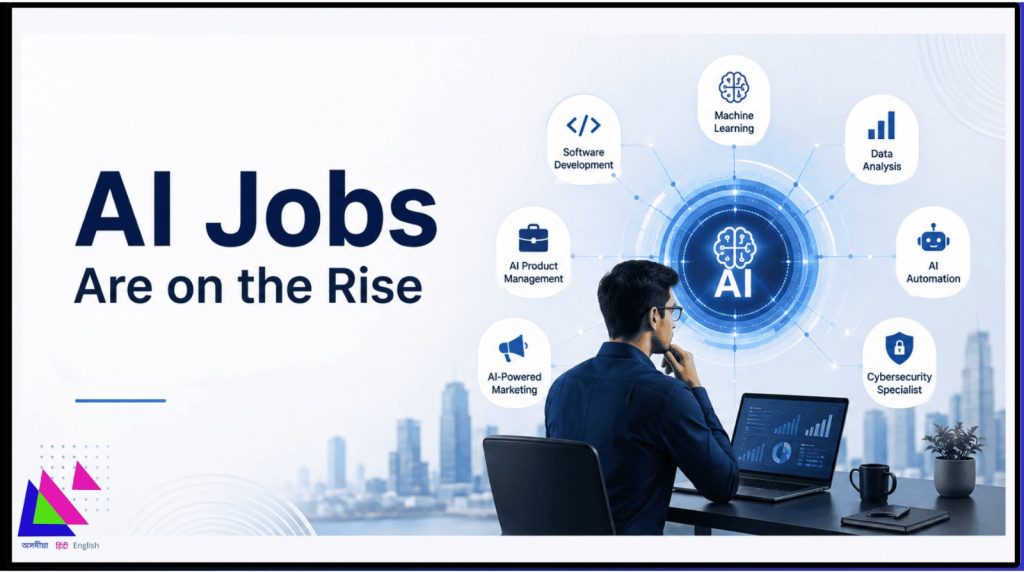
What makes this trend interesting is that the demand isn’t limited to technology companies. Businesses in finance, healthcare, marketing, education, software, and customer service are also looking for professionals who can work effectively with AI.
This doesn’t mean everyone needs to become an AI engineer. In many cases, combining AI knowledge with an existing profession may be enough to open new career opportunities.
Why Are AI Jobs Growing?
Companies are adopting AI to automate repetitive tasks, analyze data, improve customer experiences, and help employees work more efficiently.
This is creating opportunities for professionals who can combine AI with practical industry knowledge.
Some growing areas include:
- AI and machine learning
- Software development
- Data analysis
- AI automation
- Cybersecurity
- AI product management
- AI-powered marketing
The important thing is that companies don’t always need someone who only understands AI. They increasingly need people who understand AI plus a specific business or professional field.
Read Also: Multimodal AI: How Image, Video, and Voice AI Are Transforming Creativity
AI Is Changing Existing Jobs
AI isn’t only creating new job titles. It’s also changing how existing jobs are performed.
A marketer can use AI for research and campaign planning. Developers can use AI coding tools to speed up software development. Analysts can use AI to work with large datasets, while customer-service teams can automate routine queries.
Which AI Jobs Are Growing?
Some areas attracting increasing attention include:
1. AI Engineer: AI engineers build and integrate AI systems into products and business applications.
2. Machine Learning Engineer: These professionals develop and maintain systems that learn from data and improve their performance.
3. AI Product Manager: AI product managers connect technical teams with business goals and help turn AI capabilities into useful products.
4. AI Data Analyst: They use data and AI-powered tools to identify patterns and support business decisions.
5. AI Automation Specialist: These professionals build AI-powered workflows that automate repetitive business processes.
6. AI Cybersecurity Specialist: AI is increasingly being used to detect unusual activity and identify potential security threats.
What Should Job Seekers Learn?
You don’t need to learn every new AI tool that appears. Technology changes quickly, so it is better to develop practical abilities that can be applied across different platforms.
Useful areas include:
- Understanding how AI works.
- Using AI tools effectively.
- Building automated workflows.
- Working with data.
- AI-assisted coding.
- Critical thinking and fact-checking.
- Communication and problem-solving.
The strongest candidates are likely to be those who can combine technical knowledge with strong human skills.
Is AI Experience Enough to Get a Job?
Not necessarily.
Simply writing “AI experience” on a resume won’t guarantee an interview. Employers want to see how you can actually use AI to solve problems.
For example, a candidate might demonstrate an automated workflow, an AI-powered project, a data-analysis project, or an application built with AI assistance.
In other words, showing what you can do with AI can be more valuable than simply listing AI tools you have used.
What Does This Mean for Students?
Students don’t need to start with advanced machine learning immediately.
A better approach is to combine AI with an area they already enjoy.
- Computer students: AI coding and machine learning
- Business students: AI automation and data analysis
- Marketing students: AI content and marketing automation
- Finance students: AI-powered analytics
- Creative students: AI design, video, and content creation
This makes learning more practical and gives students something useful to demonstrate when applying for internships or jobs.
The Future of AI Jobs
The workplace is likely to become increasingly focused on people who can work effectively with AI.
AI may automate certain repetitive tasks, but it is also creating new responsibilities and roles. At the same time, employers continue to value communication, creativity, judgment, and problem-solving.
That means the future may not be about AI replacing every job. Instead, many roles are likely to change as AI becomes part of everyday work.
Professionals who understand both their industry and AI could be particularly well positioned for this shift.
Opportunities and Challenges
Opportunities
- New career paths are emerging.
- AI can increase workplace productivity.
- Existing professionals can add AI to their current careers.
- Remote and technology-focused opportunities may expand.
- AI knowledge can complement many different industries.
Challenges
- Entry-level competition can remain high.
- AI tools and technologies change quickly.
- Some repetitive roles may face automation.
- Employers still expect strong communication and problem-solving skills.
- Not every AI-related role offers the same salary or long-term stability.
Conclusion
The growth of AI Jobs is happening at a time when the wider hiring market remains challenging. But the opportunity isn’t limited to people who want to become machine learning engineers or AI researchers.
For many professionals, the smarter approach is to combine AI with the career they already understand.
Learn the tools relevant to your field, build practical projects, and continue developing human skills such as communication, creativity, and critical thinking. As AI becomes a normal part of the workplace, this combination could become one of the most valuable career advantages.
FAQs
1. Why are these Jobs growing?
Ans: Companies are using AI for automation, software development, data analysis, customer service, and productivity, creating demand for professionals who can work with these technologies.
2. Which role are best for beginners?
Ans: AI automation, AI-assisted content creation, data analysis, and AI-supported software development can be practical starting points, depending on your background.
3. Do I need coding for an AI career?
Ans: Not always. Some roles require strong programming skills, while others focus on automation, content, analytics, product management, or business applications.
4. Are AI Jobs only available in technology companies?
Ans: No. AI is being adopted across finance, healthcare, education, marketing, manufacturing, retail, and many other industries.
5. Will AI replace human workers?
Ans: AI will automate some tasks, but it is also creating new roles and changing existing ones. Human judgment, creativity, communication, and problem-solving will remain important.







 Buy Now