
NIOS Class 12 Employability Skills Chapter 7 Leading, Not Bossing Solutions English Medium As Per New Syllabus to each chapter is provided in the list so that you can easily browse throughout different chapters NIOS Class 12 Employability Skills Chapter 7 Leading, Not Bossing Notes and select need one. NIOS Class 12 Employability Skills Chapter 7 Leading, Not Bossing Question Answers Download PDF. NIOS Study Material of Class 12 Employability Skills Notes Paper Code: 350.
NIOS Class 12 Employability Skills Chapter 7 Leading, Not Bossing
Also, you can read the NIOS book online in these sections Solutions by Expert Teachers as per National Institute of Open Schooling (NIOS) Book guidelines. These solutions are part of NIOS All Subject Solutions. Here we have given NIOS Class 12 Employability Skills Solutions in English, NIOS Senior Secondary Course Employability Skills Notes in English Medium for All Chapter, You can practice these here.
Leading, Not Bossing
Chapter: 7
| Module – II: Expression and Communication |
INTEXT QUESTIONS 7.1
1. Let us peep into the offices of a leader and a boss and see their working style!
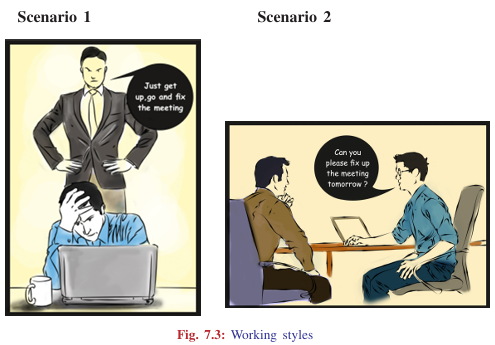
(a) Which body language is more supportive of inviting suggestion amongst the two? What makes you say that? _______________________________________________
Ans: Standing or sitting straight
Arms open or relaxed (not crossed).
Looking at the person speaking.
Nodding and smiling a little.
Leaning slightly forward.
(b) What are the words used in Scenario 1 that depicts commanding tone and what are the words used in Scenario 2 that depicts a tone of request? ______________________________________________
Ans: The words used in Scenario 1 that depicts commanding is Just get up, go and fix the meeting and the words used in Scenario 2 that depicts a tone of request is Can you please fix up the meeting Tomorrow?
(c) What kind of boss would you like to be or would like to have? ______________________________________
Ans: If I were a boss, I’d like to be:
(i) Kind: Treat everyone nicely.
(ii) Helpful: Support my team when they need me.
(iii) Good listener: Listen to others’ ideas and problems.
(iv) Fair: Do what’s right for everyone.
4. Neena went to hospital 4 day before and she saw something which moved her emotionally. She met her friend the next day and thought of sharing it with her.
Before – refers to what time frame – present, past or future __________.
Saw – signifies what time frame – present, past or future __________.
Met – would have been ________.when talking in present.
Now you help Neena to tell her story to Riya by selecting the correct verb.
Riya , you know when I-
(a) ____________ (go/went) to the hospital that day, I. (b) ____________ (witnessed/ witness) something which. (c) ___________ (is/was) really heart-warming. There. (d) ___________ (was/is) an old haggard man dressed in a sweeper’s uniform walking in the corridor. He (e) ____________ (seemed/ seems) disturbed and (f) ____________ (is/ was) blabbering. Another guy who (g)__________ (was/is) probably a doctor (h) __________ (passing/ passed) by him. A while later, I (i) _____________ (see/ saw) this guy (j) ____________ (hug/ hugging) that old man. That old man was at first (k) ____________ (tried/ trying) to free himself from the grip of that man , but then he just (l) ___________ (broke/break) down and tears (m) __________ (roll/rolled)down his eyes. He (n) ___________ (hugs/ hugged) the man back and (o) ___________ (tell/ told) him that he (p) ___________ (has been/had been) working in that hospital for past thirty years but no one ever (q) ___________ (notice/ noticed) him or his contribution in that hospital. Everyone in the corridor (r) ____________ (looked/ looks) at him and (s) ____________ (thanking/ thanked) him for his work. It just (t) ____________ (struck/ strike) me that we never thank or show our gratitude to the people who (u) ____________ (was/are) essential for smooth (v) ____________ (function/ functioning) of an institution but (w) ____________ (is/are) not part of the upper tier or management.
Ans: Riya, you know when I went to the hospital that day, I witnessed something which was really heart-warming. There was an old haggard man dressed in a sweeper’s uniform walking in the corridor. He seemed disturbed and was blabbering. Another guy who was probably a doctor passed by him. A while later, I saw this guy hugging that old man. That old man was at first trying to free himself from the grip of that man, but then he just broke down and tears rolled down his eyes. He hugged the man back and told him that he had been working in that hospital for the past thirty years, but no one ever noticed him or his contribution in that hospital. Everyone in the corridor looked at him and thanked him for his work. It just struck me that we never thank or show our gratitude to the people who are essential for the smooth functioning of an institution but are not part of the upper tier or management.
Let us listen 7.1
(a) First speech is by Sundar Pichai, first India-born CEO of Google. He was born in Madurai, Tamil Nadu to Laxshmi and Regunatha Pichai, a stenographer and an electrical engineer respectively. He grew up in a two-room apartment in Ashok Nagar, Chennai. Sundar completed schooling in JawaharVidyalaya, a Central Board of Secondary Education school in Ashok Nagar, Chennai and completed Class XII from VanaVani school in the Indian Institute of Technology Madras. Pichai earned his degree from Indian Institute of Technology Kharagpur in Metallurgical Engineering. He holds an M.S. from Stanford University in Material Sciences and Engineering, and an MBA from the Wharton School of the University of Pennsylvania.
| Transcription of Pichai’s Speech: ‘You will have many-many opportunities to re-invent yourself, so I think it’s worthwhile taking risks, trying to do something you’re really excited by. If in first attempt you do not do it, you can try again and things tend to work out in the long run. In Silicon Valley, part of the reason so many people start up a company is that after failing, you can wear it like a badge of honor. I think it’s important culturally if risk is rewarded. I remember when I started working at Google, if I went and people were discussing ideas, there are other people who heard those ideas and tried to build on those ideas. They encourage you. So the culture of optimism and risk taking is very important. If in life you have to work in a place where you feel a bit insecure, it is essential because it means that you [are] working with people who are better than you and always encourage you and push you. If you feel very secure in your job that means you are doing something comfortable and not pushing yourself. When I see entrepreneurs here, there is no difference in the people, I meet in valley. It means India can do same kind of things, as internet becomes more mainstream, people become more confident. We have large domestic market to tackle, this will give you confidence to tackle global market. At Google we always think about solving problems and how that solution can apply to I Billion people. We think of a product we think will it work for a billion people? These are the questions we always ask, even when we do simple things such as Google books. We thought what if we scan all the books in the world and bring them online, so there was an inherent assumption of scaling everything, it helps in shaping thinking, so think big. In Google to do a product well, building a product is just one aspect of it, you want to build it ,scale it ,take it to the market. How do you market it or sell it in certain cases that end to end work makes it a product. It’s a cross-functional thing. So we hire people from all kinds of background. There are language majors, people who have done history, done business and commerce. I am confident, in fact majority of people working in Google haven’t done computer sciences at undergrad level. So follow your dream and reach where you want. |
A. What does Pichai says about taking risk? ________________________________________________________
Ans: Pichai says that is worth taking risk as it gives us multiple opportunities to re-invent ourselves.
B. Why do you think it is important to have culture of optimism? ________________________________________________________
Ans: As per Pichai it is important to have culture of optimism as it encourages people to take risk and re- invent themselves.
C. How is feeling insecure in a job seen positively by Pichai? ________________________________________________________
Ans: We should feel insecure in job because there are people who are better than you. They encourage you and push you to realize your full potential.
D. Why it is important to think big? ________________________________________________________
Ans: It is important to think big as it can help millions of people find solutions to their problems.
(b) Second Speech is by Deepa Malik: You must have heard about her or seen her pictures swarming national newspapers. She is the first Indian woman to win a medal in Paralympic Games (games for differently abled athletes) at Rio de Janeiro and won a silver medal at the 2016 Summer Paralympics in shot put. She is associated with Himalayan Motorsports Association (H.M.A.) and Federation of Motor Sports Clubs of India (F.M.S.C.I.). She has undertaken an 8-day, 1700-km drive in sub-zero temperatures which included a climb to 18000 feet. It was—‘Raid De Himalaya’. This journey covers many difficult paths including remote Himalayas, Leh, Shimla and Jammu.She did all this and more without legs but with great spirit.
| Thank you for such a warm welcome and thank you for this opportunity to come and meet you. Bahut accha lag rha hai aur itna bhara hua hall dekh kar aur accha lag rha hai (and it feels so good to see such a big audience). Ab main chahunga ke char behad handsome men (four very handsome men please come forward) [while she is saying this four men lifts her wheel chair and keeps it on the dais]. Wheelchair par aksar log mujhe dekh kar kehte hain, kaibaar main wheelchair par aise hi utha kar rakhi jati hoon because mostly we have infrastructure as the biggest challenge. Jab main paralyze huithi tab logon ne khatha ki yeh toh ghar mein rehjayegi kyunki chati ka nichla hissa bilkul hi apang ho chuka hai. She will be home bound, she will be wheelchair bound. Bahut log jab mujhe aise uthakar rakte huye dekhte hain to haksar kehte hain bicharike saath kya hua, aisa lagta hai nakichaar log iske sharir ki arthi utharahehainaur main palat ke kehti hoon ki kyunma haraniyon ki palkiyanbhitohchaar log uthatehain. So basically I am here to tell you, get up and break the stereotypes, think outside the box, create opportunities, continue to learn kyunki yeh kuch mantra shainjo maine meri life apnaye hainaur kyunki maine apnaye hain, is sharir mein, is wheelchair par baithe huye bhi main aapke saamne hoon. With due respect ‘main as talker and motivational speaker bulayigayihoon’. There are lot of people who showed doubt ‘ki bacchek aise palegi…Deepa toh itna bahar rehti thi, yeh ab kaise jiyegi’. So many questions and that is when I decided that I have to stand up and remove these stereotypical doubts against me because my body was paralyzed; my soul was not paralyzed. ‘kadmon ko rukna Manzoor na tha rahein aur bhi toh hain, tay to karna hain to hkyun na haskar, zindagi ek safar hi tihhai.’ ‘abaapusko English wala suffer bnaye yahin diwalasuhana safar bnayein yeh apke haath mein hai.’ It’s all about how you make your choices. When I was in the hospital I could have cried and cried because I was not going to walk again but with all this also and at my age I look hot. I looked inside me and asked ‘Deepa what all can you do with this body to send out a loud and clear message that there is ability beyond disability and it is all about mind over body? I started investing in happy thoughts. I think this word ‘investing’ will mean a lot to you. I was ready to learn and to invest only in positivity so I started doing that. So setting a target and setting out to achieve it |
| by convincing people of what you have to say about your product is huge challenge. ‘toh aapki duty hai samjhana ki guru bin gyan nahin, so you are the gurus. You are the advisors. After 58 National Golds and 17 international medals at the age of 42 which is the highest age ever in India to get Arjuna award for the active sports. ‘Mere father army se hain, mere father- in- law army se hain’, my husband is from the army…my brother is from the army. All four of them that day were wearing their ceremonial outfits and wearing ‘chotha medal’ and going to the President’s house, who is head of the defense services, not because of their uniform but because of my Arjuna award. ‘Aur maze ki baat yeh hai ki jo yeh Olympic ke medal main aapke liye layi hoon is me bhi mere coach mere husband hi rahe the.’ ‘Agar maine motorcycle chalayi-toh-Limca world record bana, swimming karitoh Yammuna nadi par kari, gadi chalayi toh highest motorable roads par chlake world record bnaya, athlete bani toh pehli Indian mahilajo Paralympics se Indiakeliye medal layi. If I can why can’t you, what is stopping you to from not dreaming big and achieving it.’ |
A. How does Deepa view her handicap? ________________________________________________________ .
Ans: Deepa doesn’t view her handicap as an impediment or a hinderance. For it is an opportunity to break the stereotypes and convince people that handicap is a mindset and has nothing to do with body
B. Does her idea of handicap fit Pichai’s idea of optimism? ________________________________________________________ .
Ans: Yes it does, as both look at failure or hurdle as an opportunity.
C. What are the things that we need to do to succeed as per Deepa? Are they similar to Pichai’s idea of thinking Big?
________________________________________________________
Ans: Success as per Deepa is about making choices, breaking stereotypes, setting targets and achieving them. Yes, it does agree with Pichai’s idea of thinking big.
D. What is the importance of perseverance and commitment in life? ________________________________________________________
Ans: Perseverance and commitment helps the person to overcome the obstacles which come in path of our success.
E. What makes Deepa and Sundar Pichai a motivational or inspirational speaker? ________________________________________________________
Ans: Commitment, perseverance, time management, never say die attitude etc.

Hi, I’m Dev Kirtonia, Founder & CEO of Dev Library. A website that provides all SCERT, NCERT 3 to 12, and BA, B.com, B.Sc, and Computer Science with Post Graduate Notes & Suggestions, Novel, eBooks, Biography, Quotes, Study Materials, and more.
Subject Ka Complete Video Solution Dekhein
Step-by-step easy concept explanation aur full questions Answer ke liye watch karein ya app download karein:

 Buy Now