
NIOS Class 12 Employability Skills Chapter 15 Who is an Entrepreneur? Solutions English Medium As Per New Syllabus to each chapter is provided in the list so that you can easily browse throughout different chapters NIOS Class 12 Employability Skills Chapter 15 Who is an Entrepreneur? Notes and select need one. NIOS Class 12 Employability Skills Chapter 15 Who is an Entrepreneur? Question Answers Download PDF. NIOS Study Material of Class 12 Employability Skills Notes Paper Code: 350.
NIOS Class 12 Employability Skills Chapter 15 Who is an Entrepreneur?
Also, you can read the NIOS book online in these sections Solutions by Expert Teachers as per National Institute of Open Schooling (NIOS) Book guidelines. These solutions are part of NIOS All Subject Solutions. Here we have given NIOS Class 12 Employability Skills Solutions in English, NIOS Senior Secondary Course Employability Skills Notes in English Medium for All Chapter, You can practice these here.
Who is an Entrepreneur?
Chapter: 15
| Module – IV: Be Your Own Boss |
INTEXT QUESTIONS 15.1
So learners, have you understood who is an entrepreneur? Let’s answer the following questions to find out about our own learning.
1. Read the following statements about different people and see who can be considered an entrepreneur and why? Mark them as true or false, give reason for your answer.
(i) Ramesh, the fruit and vegetable seller. ____________________________________.
Ans: No, a fruit and vegetable seller is self-employed.
(ii) Satish selling used mobile phones on his website. ______________________________________.
Ans: Yes, because Satish employed some resources to establish the website, set up a supply and delivery channel, marketing efforts and so on.
(iii) Anshuman, a college-level cricketer, who started his own cricket academy for young learners. ___________________________________________.
Ans: Yes. He is an entrepreneur as he is employing people to help in its functioning. Not only that, he also took loan from the bank with which he built the infrastructure.
(iv) Neha who has opened her own beauty parlour and has hired two girls to help her. _____________________________________.
Ans: Yes, since she is also generating employment for others.
(v) Ahmed who has joined his father’s furniture shop. ___________________________________.
Ans: No, because he isn’t establishing something new or bringing about a change in the already existing establishment.
INTEXT QUESTIONS 15.2
1. So, are you enjoying these new terms and concepts? Is your brain ringing with ideas? Let’s explore these ideas and further understand the ways of income generation. Match the following.
| A | B |
| Entrepreneurship | Chef and owner of a restaurant |
| Employment | Freelance photographer |
| Self-Employment | Doctor at a government dispensary |
| Profession | A private doctor |
| A travel company owner | |
| A lady running a tiffin service | |
| A photographer working with a leading newspaper | |
| A civil lawyer |
Ans:
| A | B |
| Entrepreneurship | Chef and owner of a restaurant; a travel company owner. |
| Employment | Doctor at a government dispensary; a photographer working with a leading newspaper. |
| Self-Employment | Freelance photographer; a lady running a tiffin service. |
| Profession | Private doctor; civil lawyer. |
INTEXT QUESTIONS 15.3
Classify the given activities into: Primary, Secondary and Tertiary Sector. Place the activity against each dot and wait to see what you discover.
| Flower Farmer | Priest | Carpenter |
| Milk Vendor | Poultry Farmer | Pizza Delivery Boy |
| Quilt Maker | Book Binder | Wood Cutter |
| Mine Worker | Call Center Employee | Bio Gas Plant Worker |
| Textile Mill Worker | Bee Keeper | Beautician |
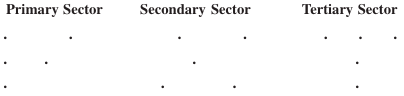
Ans: (i) Primary Sector – Flower Farmer, Mine Worker, Bee Keeper, Wood Cutter, Poultry Farmer.
(ii) Secondary Sector – Milk Vendor, Textile Mill Worker, Carpenter, Bio Gas Plant Worker, Book Binder.
(iii) Tertiary Sector – Quilt Maker, Priest, Call Center Employee, Pizza Delivery Boy, Beautician.
INTEXT QUESTIONS 15.4
1. Classify the following activities and help complete this 2 × 2 matrix. Give reasons for the placement of the activity in the matrix.
| Economy → | Organized Sector | Unorganized Sector |
| Formal Economy | ||
| Informal Economy |
(i) Self-Employed Plumber ________________________.
Ans: Self-Employed Plumber – Informal Economy, Unorganized Sector.
(ii) Police officer _______________________.
Ans: Police officer – Formal Economy, Organized Sector.
(iii) Potato Farmer _______________________.
Ans: Potato Farmer – Informal Economy (because income isn’t taxed), Organized Sector.
(iv) Private Tuition Teacher __________________.
Ans: Private Tuition Teacher – Formal Economy, Unorganized Sector.
(v) Government School Teacher _________________.
Ans: Government School Teacher – Formal Economy, Organized Sector.
(vi) Household Help ____________________.
Ans: Household Help – Informal Economy, Unorganized Sector.
(vii) Kaun Banega Crorepati Winner _______________.
Ans: Kaun Banega Crorepati Winner – Formal Economy (because the winner is liable to pay tax), Unorganized Sector.
(viii) OLA Taxi Driver _______________________.
Ans: OLA Taxi Driver – Formal Economy, Organized Sector.
(ix) NGOs and Charitable Trusts _________________.
Ans: NGOs and Charitable Trusts – Informal Economy (all revenue is tax exempted), Organized Sector.
(x) Sweeper in Municipal Corporation ____________________.
Ans: Sweeper in Municipal Corporation – Formal Economy, Organized Sector.

Hi, I’m Dev Kirtonia, Founder & CEO of Dev Library. A website that provides all SCERT, NCERT 3 to 12, and BA, B.com, B.Sc, and Computer Science with Post Graduate Notes & Suggestions, Novel, eBooks, Biography, Quotes, Study Materials, and more.
Subject Ka Complete Video Solution Dekhein
Step-by-step easy concept explanation aur full questions Answer ke liye watch karein ya app download karein:

 Buy Now