
NIOS Class 12 Accountancy Chapter 32 Accounting Ratios – I Solutions English Medium As Per New Syllabus. to each chapter is provided in the list so that you can easily browse throughout different chapters NIOS Class 12 Accountancy Chapter 32 Accounting Ratios – I Notes and select need one. NIOS Class 12 Accountancy Chapter 32 Accounting Ratios – I Question Answers Download PDF. NIOS Study Material of Class 12 Accountancy Paper Code: 320.
NIOS Class 12 Accountancy Chapter 32 Accounting Ratios – I
Also, you can read the NIOS book online in these sections Solutions by Expert Teachers as per National Institute of Open Schooling (NIOS) Book guidelines. These solutions are part of NIOS All Subject Solutions. Here we have given NIOS Class 12 Accountancy Solutions English Medium, NIOS Senior Secondary Course Accountancy Notes in English Medium for All Chapter, You can practice these here.
Accounting Ratios – I
Chapter: 32
| Module – 6: Analysis of Financial Statements |
INTEXT QUESTIONS 32.1
I. Select the current assets from the list given below:
(i) Cash at bank Debtors.
(ii) Inventory Prepaid expenses.
(iii) Short term investment Goodwill.
(iv) Building Cash in hand.
(v) Furniture.
(vi) Bill Receivables.
Ans: (i) Cash at bank, Debtors.
(ii) Inventory, Prepaid expenses.
(iii) Short term investment.
(iv) Cash in hand.
(v) None.
(vi) Bills receivable.
II. Fill in the blanks with suitable words or figures :
(i) Current Ratio = __________/ Liabilities.
Ans: Current assets.
(ii) The ideal current ratio is __________.
Ans: 2 : 1.
(iii) The ideal liquid ratio is _________.
Ans: 1 : 1.
(iv) Liquid assets = __________ – (Stock + prepaid expenses)
Ans: Current assets.
III. State whether the following statements are true or false :
(i) Ratios are not helpful in business planning and forecasting.
Ans: False.
(ii) Accounting ratios are useful for understanding the financial position of the enterprise.
Ans: False.
INTEXT QUESTIONS 32.2
Fill in the blanks with suitable word/words :
(i) Inventory turnover ratio is __________ divided by average inventory.
Ans: Cost of revenue from operations.
(ii) Average inventory = Opening inventory + ________/2
Ans: Closing inventory.
(iii) Inventory turnover ratio = 10,000/ _____ = 5 times.
Ans: 2000.
(iv) Inventory turnover ratio = 30,000/10,000 = _______.
Ans: 3 times.
INTEXT QUESTIONS 32.3
I. Fill in the blanks with suitable word or words.
(i) Low trade receivables turnover ratio indicates _________ collection.
Ans: Delay in collection of debt.
(ii) Debtors turnover ratio = __________/ Average trade payables.
Ans: Net credit revenue from operations.
(iii) ? = Net credit purchase/ Average trade payables.
Ans: Trade payables turnover ratio.
(iv) Trade Receivable Turnover Ratio = _______/ 50,000 = 4.
Ans: 2,00,000.
(v) Trade Receivable turnover ratio = 1,50,000 / ? = 3
Ans: 50,000.
(vi) Trade Payables turnover ratio = 75000/15000 = ?
Ans: 5 times.
(viii) Trade Payables turnover ratio = 100000/? = 4
Ans: 25,000.
II. Fill in the blanks with suitable word or words :
(i) Working capital = _________ – current liabilities.
Ans: Current assets.
(ii) _______ = Cost of Revenue from operations / Average working capital.
Ans: Working capital turnover ratio.
(iii) Average working capital = Opening Working Capital + Closing Working Capital / _______.
Ans: 2.
(iv) Working Capital Turnover Ratio = Cost of Revenue from Operations / Average working capital.
Ans: Average working capital.
| TERMINAL EXERCISE |
1. What are the Advantages and uses of ratio analysis? Explain in detail.
Ans: The advantages and uses of ratio analysis are as follows:
(i) Useful in Analysis of Financial Statements: Accounting ratios are very useful for understanding the financial position of an enterprise. Various parties like bankers, investors and creditors analyse Balance Sheet and Profit and Loss Account with the help of ratios to take decisions.
(ii) Useful in Simplifying Accounting Figures: Accounting ratios simplify, summarise and systematise a large number of accounting figures. They help in making the data understandable and show the inter-relationship between different items of financial statements.
(iii) Useful in Judging the Operating Efficiency of Business: Ratios help in analysing the operating efficiency of a business. They assist in evaluating profitability, liquidity and solvency and thus help in judging the financial health of the enterprise.
(iv) Useful for Forecasting: Ratios are helpful in planning and forecasting. Trend ratios of past years are used as a guide for future planning and decision-making.
(v) Useful in Locating the Weak Spots: Ratios help in identifying weak areas of the business. Even if overall performance is good, ratios can highlight specific weaknesses so that corrective action can be taken.
(vi) Useful in Inter-firm and Intra-firm Comparison: Ratios are very useful for comparing the performance of one firm with another firm (inter-firm) and also between different departments of the same firm (intra-firm). They also help in comparing performance over different years.
2. Explain the significance of trade receivable turnover ratio and liquid ratio.
Ans: (i) Significance of Trade Receivable
Turnover Ratio: Trade receivable turnover ratio indicates the efficiency with which a company collects its debts. It shows the speed at which trade receivables are converted into cash.
A high ratio indicates that debts are collected quickly and the collection period is short, which is favourable for the business. It shows efficient management of receivables. On the other hand, a low ratio indicates slow collection of debts and a longer collection period, which may affect liquidity and indicate inefficiency.
(ii) Significance of Liquid Ratio:
Liquid ratio (quick ratio): measures the ability of a business to pay its current liabilities immediately out of its liquid assets.
It indicates the extent to which liquid resources are available to meet short-term obligations. A higher ratio shows better liquidity position of the business. However, a very high ratio may indicate idle funds. The ideal liquid ratio is 1 : 1, which is considered satisfactory.
3. Explain the meaning and significance of the following ratios.
(a) Current ratio.
Ans: Current ratio is the ratio between current assets and current liabilities of a business. It establishes a relationship between short-term assets and short-term liabilities.
Significance: It indicates the ability of the firm to meet its short-term obligations. A higher ratio shows better liquidity and solvency, while a lower ratio indicates difficulty in meeting short-term liabilities. However, too high a ratio may indicate idle resources. The ideal current ratio is 2 : 1.
(b) Trade Payables turnover ratio.
Ans: Trade payables turnover ratio is the ratio between net credit purchases and average trade payables. It shows how quickly the business pays its suppliers.
Significance: This ratio helps in judging the efficiency in payment of dues to suppliers. A high ratio indicates quicker payment and a shorter payment period, whereas a low ratio indicates delayed payment and a longer credit period.
(c) Inventory turnover ratio.
Ans: Inventory turnover ratio is the ratio between cost of revenue from operations and average inventory. It shows how efficiently inventory is managed.
Significance: It indicates the number of times inventory is sold or used during a period. A high ratio shows efficient inventory management and quick turnover, whereas a low ratio indicates overstocking or slow-moving goods, which is not desirable for the business.
4. From the following compute current ratio and quick ratio :
| Particulars | ₹ |
| Fixed Assets | 100000 |
| Inventory | 30000 |
| Debtors | 20,000 |
| Cash | 40,000 |
| Prepaid expenses | 10,000 |
| Creditors | 30,000 |
| Reserves | 10,000 |
Ans: Given Data:
Current Assets:
- Inventory = 30,000
- Debtors = 20,000
- Cash = 40,000
- Prepaid Expenses = 10,000
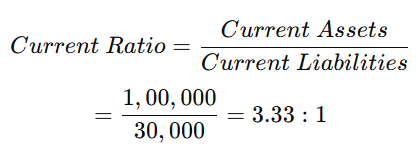
Current Assets=30,000+20,000+40,000+10,000=1,00,000
- Creditors = 30,000
(Reserves are NOT current liabilities.)
Current Liabilities=30,000Current\ Liabilities = 30,000Current Liabilities=30,000
(a) Current Ratio:
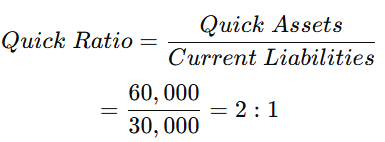
(b) Quick Assets:
Quick Assets = Current Assets − Inventory − Prepaid Expenses
=1,00,000−30,000−10,000=60,000
Quick Ratio
Subject Ka Complete Video Solution Dekhein
Step-by-step easy concept explanation aur full questions Answer ke liye watch karein ya app download karein:


 Buy Now