
AI in Learning: Why Schools Are Rethinking Student Assessments
AI in Learning is changing the way students study and how teachers evaluate what they actually understand. Earlier, students mainly depended on textbooks, classroom teaching, search engines, and practice materials. Today, AI tools can explain difficult concepts, create practice questions, provide feedback, and help students explore topics in a more interactive way.
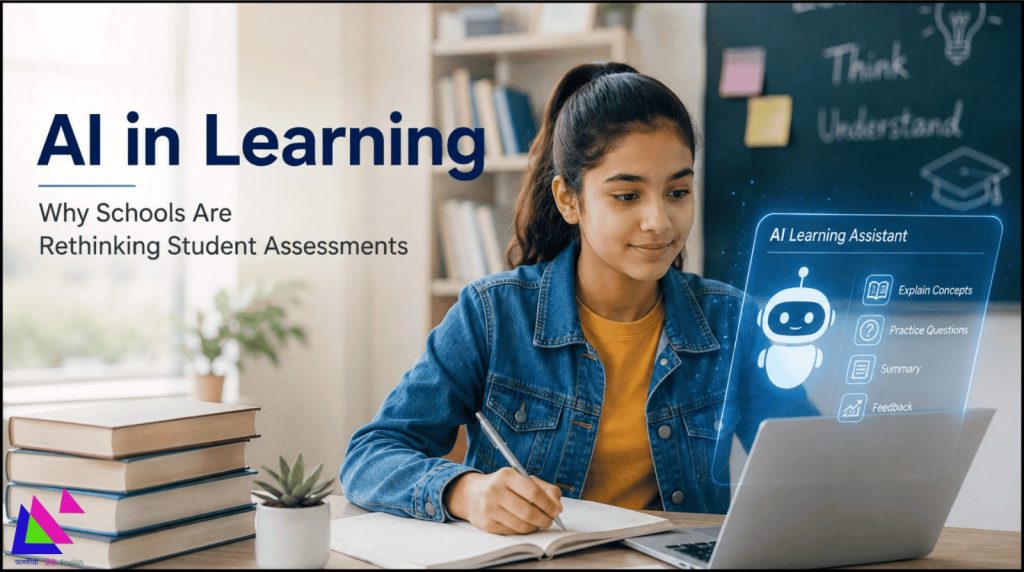
At the same time, the growing use of generative AI is creating a new challenge for schools and universities: How can educators measure genuine understanding when AI can help produce assignments, essays, presentations, and code?
How Is AI Changing the Way Students Learn?
AI can make studying more flexible and personalized. Instead of following exactly the same learning method, students can ask questions and request explanations according to their own level.
Students can use AI to:
- Explain difficult topics in simpler language.
- Create practice questions and quizzes.
- Provide step-by-step explanations.
- Summarize study materials.
- Help identify mistakes.
- Give feedback on writing.
- Generate examples for better understanding.
- Practice questions before an examination.
The important thing is how the technology is used. Asking AI to provide an answer is very different from using it to understand why the answer is correct.
How Is AI Changing the Role of Teachers?
AI in Learning does not remove the need for teachers. Instead, it can help teachers reduce repetitive work, prepare learning materials, and spend more time supporting students individually.
Teachers can use AI to:
- Prepare lesson ideas.
- Create practice exercises.
- Generate different versions of questions.
- Adapt explanations for different learning levels.
- Provide initial feedback.
- Identify topics where students may need additional practice.
The teacher’s role remains important because understanding a student’s progress involves much more than looking at an AI-generated response.
Read Also: AI in Emerging Economies: Can Artificial Intelligence Close the Development Gap?
Why Is Assessment Becoming More Difficult?
This is one of the biggest challenges created by generative AI.
A student can now use AI to help create:
- Essays.
- Reports.
- Presentations.
- Computer programs.
- Research summaries.
- Homework responses.
Because of this, a completed assignment may not always provide a clear picture of how much the student actually understands. AI in Learning has made this challenge more important, as students can now use AI tools to assist with writing, research, coding, and other academic tasks.
Educators are therefore exploring assessment methods that focus more on reasoning, practical application, independent thinking, and direct interaction rather than relying only on take-home assignments.
How Could Education Be Measured Differently?
Future assessments may include a wider combination of methods.
Possible Approaches
- Oral presentations: Students explain their work in their own words.
- Viva and discussions: Teachers ask questions to test understanding.
- Practical projects: Students demonstrate how they apply knowledge.
- Classroom activities: Teachers observe problem-solving directly.
- Project-based assessment: Students show both the final result and their process.
- AI-supported assignments: Students use AI but must evaluate and improve its output.
The goal is not necessarily to prevent students from using AI. Instead, assessments can be designed to measure skills that AI cannot simply demonstrate on a student’s behalf.
What Skills Are Becoming More Important?
As AI becomes better at generating basic answers, education may need to place greater value on skills such as:
- Critical thinking.
- Problem-solving.
- Creativity.
- Communication.
- Research.
- Fact-checking.
- Digital literacy.
- AI literacy.
- Independent reasoning.
UNESCO’s AI Competency Framework for Students highlights areas including human-centred thinking, AI ethics, AI techniques and applications, and AI system design. (unesco.org)
Benefits of AI in Learning
Used responsibly, AI can provide several advantages:
- Personalized study support.
- Faster feedback.
- Additional practice opportunities.
- Easier access to explanations.
- Support for different learning levels.
- More interactive study experiences.
- Assistance with research and revision.
Research into AI-supported formative assessment is also exploring how these tools can support feedback and higher-order thinking rather than simply generating answers. (link.springer.com)
Challenges Students and Schools Need to Consider
- Overdependence: Students may rely on AI instead of developing their own problem-solving abilities.
- Accuracy: AI can sometimes provide incorrect or misleading information.
- Academic Integrity: Schools need clear rules about when AI assistance is acceptable.
- Unequal Access: Students may not have the same access to devices, internet connections, or paid AI tools.
- Privacy: Student information must be handled carefully.
- Teacher Training: Educators need to understand both the benefits and limitations of AI.
How Should Students Use AI Responsibly?
The best approach is to treat AI as a learning assistant, not a replacement for thinking.
Students can:
- Try solving a problem independently first.
- Ask AI for hints when they are stuck.
- Request explanations instead of copying answers.
- Check important facts from reliable sources.
- Explain the concept in their own words.
- Follow their school’s or college’s AI-use policy.
This approach allows students to benefit from technology while continuing to develop their own abilities.
Conclusion
AI in Learning is changing both sides of education. Students have access to new tools for studying, practicing, and receiving feedback, while teachers and institutions are reconsidering how genuine learning should be measured.
The goal should not be to choose between AI and traditional education. A better approach is to use AI where it adds value while continuing to develop critical thinking, creativity, communication, and independent reasoning.
As AI becomes a normal part of everyday learning, students who know how to use it responsibly—without becoming dependent on it—may be better prepared for the future.
FAQs
1. How is AI changing student learning?
Ans: AI can provide personalized explanations, practice questions, feedback, summaries, and interactive study support.
2. Can AI replace teachers?
Ans: No. AI can assist with certain tasks, but teachers remain important for guidance, judgment, motivation, and understanding students’ individual needs.
3. Why is AI making assessment difficult?
Ans: Students can use AI to produce essays, presentations, code, and other assignments, making it harder to determine how much of the work reflects their own understanding.
4. How can students use AI responsibly?
Ans: Students should use AI for explanations, practice, feedback, and learning support rather than simply copying answers. They should also verify important information.
5. What skills will students need in an AI-powered world?
Ans: Critical thinking, creativity, communication, problem-solving, digital literacy, research skills, and the ability to evaluate AI-generated information will remain important.






 Buy Now