
AI Robots Are Getting Smarter: How Whole-Body Control Is Changing Robotics
AI Robots are becoming more capable of handling physical tasks in real-world environments. Earlier robotic systems were often designed for one specific job, such as lifting an object or moving products on a fixed route.
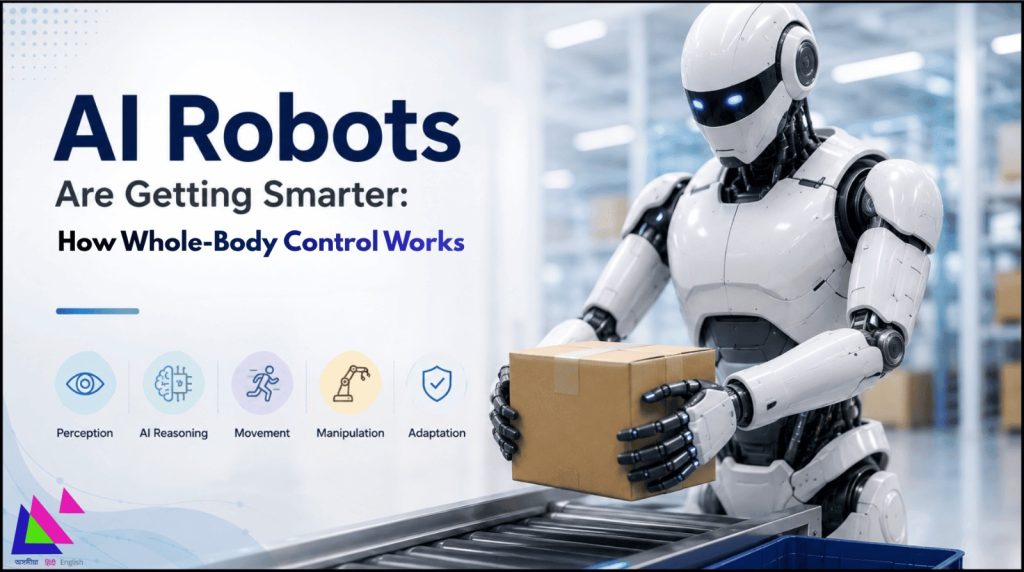
Now, newer systems are combining AI with robotics to help machines understand their surroundings, follow instructions, and coordinate multiple body movements at the same time.
What Is Whole-Body Control?
Whole-body control means coordinating different parts of a robot’s body to complete one task.
For a humanoid robot, this can include:
- Walking and maintaining balance.
- Moving arms and hands.
- Grasping and carrying objects.
- Adjusting body position.
- Avoiding obstacles.
- Coordinating several movements at once.
The goal is to make robots more flexible instead of limiting them to a single programmed movement.
How AI Is Making Robots Smarter
They can use:
- Computer vision to understand their surroundings.
- Language models to understand instructions.
- AI reasoning to plan actions.
- Motion control to perform physical movements.
- Sensors to respond to changes around them.
This combination allows robots to connect what they see and understand with what they physically do.
From Simple Tasks to Complete Workflows
Traditional robots often perform one repetitive task. Newer AI-powered systems are being developed to handle multiple steps.
For example, a robot could:
- Identify an object.
- Move toward it.
- Pick it up.
- Navigate around an obstacle.
- Carry the object.
- Place it in the correct location.
This type of coordination is an important part of the move toward whole-body robotic control.
Read Also: AI in Learning: Why Schools Are Rethinking Student Assessments
Where Could AI Robots Be Used?
Manufacturing
- Moving materials.
- Handling tools.
- Supporting assembly work.
- Performing repetitive physical tasks.
Warehouses
- Picking products.
- Moving packages.
- Navigating warehouse spaces.
- Sorting and organizing items.
Healthcare
- Supporting controlled physical tasks.
- Moving supplies.
- Assisting healthcare workers in specific workflows.
Logistics
- Handling packages.
- Moving materials.
- Working in changing environments.
Homes
In the longer term, robots could potentially help with tasks such as:
- Carrying objects.
- Organizing items.
- Simple household assistance.
- Responding to voice instructions.
Home environments are particularly challenging because they are less predictable than factories or warehouses.
Recent Developments
Google DeepMind’s Gemini Robotics 2 is an example of the industry’s move toward more capable physical AI.
According to Google DeepMind, the system is designed to control humanoid robots and connect language understanding with physical actions. Demonstrations include robots performing multi-step tasks involving movement, object handling, and navigation.
The important development is not simply that a robot can move an object. It is the ability to coordinate several actions as part of a larger task.
Why Is Whole-Body Control Difficult?
They have to deal with the physical world, which is much less predictable than software.
Major challenges include:
- Maintaining balance.
- Understanding unfamiliar environments.
- Handling objects of different shapes and weights.
- Avoiding people and obstacles.
- Coordinating many joints.
- Reacting quickly when something changes.
- Performing tasks safely.
Even a small error can cause a robot to drop an object or lose balance.
Benefits of More Capable Robots
- More flexible automation.
- Ability to perform multiple tasks.
- Better adaptation to changing environments.
- Reduced repetitive physical work.
- Potential support for workers in demanding environments.
- Greater use of robots in human-designed spaces.
Will AI Robots Replace Human Workers?
Not immediately.
Today’s systems still face limitations related to:
- Reliability.
- Cost.
- Safety.
- Speed.
- Training requirements.
- Real-world adaptability.
A more realistic near-term use is to have robots handle repetitive or physically demanding tasks while humans continue to supervise operations and make important decisions.
What Does the Future Look Like?
AI Robots are expected to become more adaptable as models, sensors, hardware, and control systems improve.
Future systems could become better at:
- Learning tasks from demonstrations.
- Following natural-language instructions.
- Working alongside humans.
- Adapting to unfamiliar environments.
- Using both hands and their full body.
- Completing multi-step tasks.
The long-term goal is to create robots that can understand a task and figure out how to physically complete it rather than simply following a fixed sequence of movements.
Conclusion
AI Robots are moving beyond simple programmed actions toward more flexible physical intelligence. Whole-body control allows machines to combine movement, balance, perception, and manipulation to complete larger tasks.
The technology is still developing, and challenges around safety, cost, reliability, and real-world performance remain. However, the direction of robotics is clear: future machines are likely to become more capable of understanding instructions and interacting with the physical world.
FAQs
1. What is whole-body control?
Ans: It allows a robot to coordinate multiple body parts, such as its arms, legs, hands, and torso, while completing a task.
2. How are AI Robots different from traditional robots?
Ans: Traditional robots are often designed for specific programmed tasks, while AI-powered robots can use vision, language, reasoning, and sensors to respond to changing situations.
3. Where can these robots be used?
Ans: Potential applications include manufacturing, warehouses, logistics, healthcare, and eventually household assistance.
4. Can robots replace human workers?
Ans: They may automate some repetitive physical tasks, but current systems still require human supervision and face important limitations in safety, reliability, and adaptability.
5. What is the future of robotics?
Ans: Future robots are expected to become better at understanding instructions, learning new tasks, navigating environments, and working alongside humans.







 Buy Now