
AI in Emerging Economies: Can Artificial Intelligence Close the Development Gap?
AI in Emerging Economies could play an important role in improving productivity, expanding access to essential services, and creating new economic opportunities. As AI tools become more affordable and accessible, developing countries can use them to support areas such as healthcare, education, agriculture, finance, and small businesses.
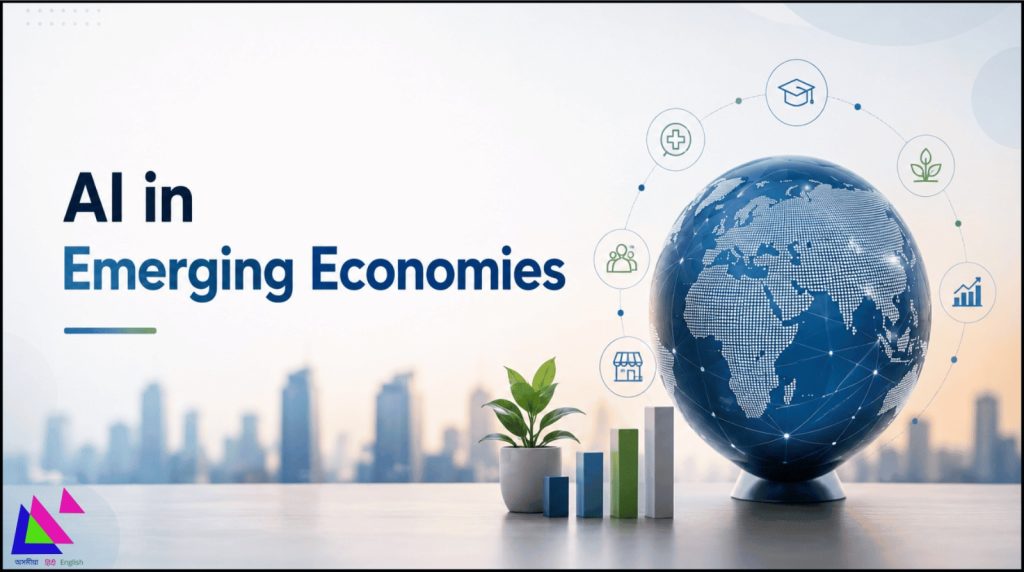
Unlike earlier technologies that often required expensive infrastructure and specialized expertise, many modern AI tools can be accessed through cloud platforms and relatively low-cost digital services. This creates an opportunity for AI in Emerging Economies to address practical challenges and improve how existing systems work.
Where Could AI Make the Biggest Difference?
1. Healthcare
- AI can support healthcare systems by helping analyze medical images, assist with diagnosis, and improve access to medical information.
- This could be particularly useful in regions where there are not enough doctors or specialists.
- AI-based medical imaging and other digital tools are already showing potential in developing countries, although they require proper clinical validation and oversight.
2. Education
- Education is another area where AI could have a major impact.
- AI tutors and learning tools can provide students with explanations, practice questions, feedback, and personalized learning support.
- This could help schools and teachers manage large classrooms and provide additional learning resources where qualified teachers are limited.
3. Agriculture
- Agriculture remains an important part of many emerging economies.
AI can help farmers and agricultural organizations analyze:
- Weather patterns.
- Crop conditions.
- Soil information.
- Pest risks.
- Market information.
- Irrigation requirements.
Better information can help farmers make more informed decisions and potentially reduce waste.
4. Small Businesses
Small businesses could benefit from relatively inexpensive AI tools without needing to build advanced technology themselves.
A small company can use AI for:
- Customer support.
- Marketing.
- Translation.
- Bookkeeping assistance.
- Market research.
- Content creation.
- Business analysis.
This is important because affordable AI tools can allow smaller businesses to access capabilities that were previously available mainly to larger companies.
The Infrastructure Problem
The biggest challenge for AI in Emerging Economies is building the right digital foundation.
A country cannot fully benefit from AI if people don’t have reliable internet, electricity, devices, and digital skills.
The World Bank identifies four important foundations for inclusive AI adoption:
- Connectivity — affordable and reliable internet.
- Compute — access to the computing resources needed to use AI.
- Context — relevant and reliable local data.
- Competency — people with the skills to use and develop AI effectively.
These foundations will determine whether AI becomes widely useful or remains concentrated among a small group of businesses and people.
AI Could Create New Economic Opportunities
AI doesn’t only improve existing businesses. It could also create new industries and services.
Emerging economies could potentially use AI to build businesses around:
- Software and digital services.
- AI-assisted customer support.
- Local-language applications.
- Financial technology.
- Healthcare technology.
- Agricultural technology.
- Digital education.
The World Bank has also noted that AI-related job postings are growing faster in middle-income economies than in high-income economies, although access to skills and infrastructure remains uneven.
Read Also: Multimodal AI: How Image, Video, and Voice AI Are Transforming Creativity
What Are the Risks?
The AI opportunity comes with real risks.
- Job Disruption: Some repetitive and highly digitized tasks may become automated.
- Inequality: People with better internet access and stronger digital skills could benefit much more than others.
- Dependence on Foreign Technology: Emerging economies could become overly dependent on a small number of foreign AI providers.
- Misinformation: AI-generated content can make misinformation easier and cheaper to produce.
- Data and Privacy: Countries need strong rules for protecting personal and sensitive information.
The World Bank has warned that without the right policies and foundations, AI could widen existing digital and economic gaps instead of reducing them.
The Future of AI in Emerging Economies
The next stage of AI development may not be determined only by the countries building the biggest models.
It could also be shaped by countries that find creative ways to adapt AI to local problems.
Smaller and more efficient AI models could make adoption easier in places where computing power and electricity are limited. Local-language AI could improve access to education and government services, while AI-powered tools could help businesses operate with fewer resources.
The World Bank’s research suggests that emerging economies have an opportunity to use AI for faster productivity growth, but success will depend heavily on infrastructure, skills, local data, and responsible policies.
Conclusion
AI could become an important development tool for emerging economies, but technology alone will not solve economic or social challenges.
The biggest opportunity lies in using AI to strengthen existing systems—helping teachers reach more students, supporting healthcare workers, improving farming decisions, making businesses more productive, and expanding access to useful information.
Countries that invest in connectivity, skills, reliable data, and responsible AI adoption will be better positioned to benefit.
The future of AI in emerging economies may therefore be less about competing to build the biggest AI system and more about using the technology effectively to solve real-world problems.
FAQs
1. How can AI help emerging economies?
Ans: AI can improve productivity and support healthcare, education, agriculture, small businesses, and public services.
2. Will AI replace jobs in developing countries?
Ans: Some tasks may be automated, but the World Bank estimates that developing economies have a lower share of jobs exposed to AI automation than high-income economies. AI can also increase worker productivity.
3. Which sectors could benefit most?
Ans: Healthcare, education, agriculture, financial services, government services, and small businesses could all benefit from practical AI applications.
4. What do countries need to benefit from AI?
Ans: Reliable connectivity, electricity, computing access, relevant data, digital skills, and responsible policies are essential foundations.
5. Can AI increase inequality?
Ans: Yes. If access to technology, skills, and infrastructure remains unequal, AI could increase existing economic and digital gaps.







 Buy Now