
AI Disease Screening: How Artificial Intelligence Is Improving Early Detection
AI Disease Screening is changing the way doctors detect diseases at an early stage. In healthcare, early diagnosis often makes a significant difference, allowing treatment to begin sooner and improving a patient’s chances of recovery. Artificial intelligence is now helping medical professionals analyze large amounts of health data more quickly, making the screening process faster and more efficient.
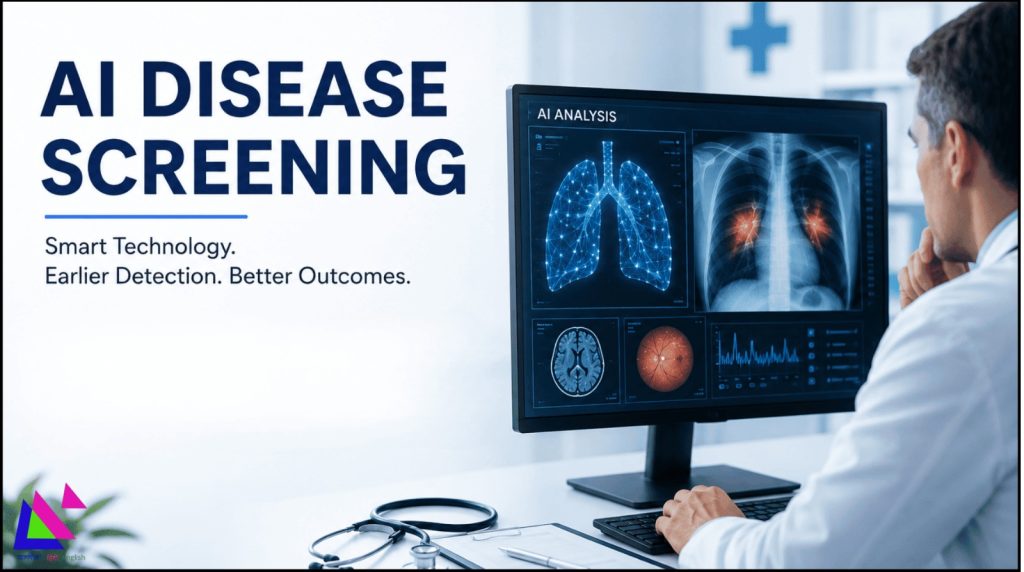
It’s important to understand that AI isn’t replacing doctors. Instead, it acts as a powerful assistant, helping healthcare professionals identify potential health concerns that may require closer examination.
What Is AI Disease Screening?
AI disease screening uses artificial intelligence to analyze medical information and identify patterns that could indicate a disease.
These systems can examine:
- X-rays
- CT scans
- MRI scans
- Mammograms
- Retinal images
- Patient health records
After analyzing the data, AI highlights areas that may need further review, allowing doctors to make more informed decisions.
Read Also: AI Coding Assistant: Best AI Tools for Developers and Beginners
How Does It Work?
Although the technology behind AI is complex, the process is quite simple.
- Medical images or patient data are uploaded into the AI system.
- The AI analyzes the information by comparing it with patterns learned from large medical datasets.
- It identifies unusual findings or potential signs of disease.
- Doctors review the AI’s suggestions along with the patient’s medical history.
- The final diagnosis and treatment decisions are always made by qualified healthcare professionals.
Where Is AI Being Used?
1. Breast Cancer Screening: AI helps radiologists analyze mammograms by highlighting suspicious areas, supporting earlier detection and reducing the chances of missed findings.
2. Lung Disease Detection: AI examines chest X-rays and CT scans to help identify conditions such as lung cancer and pneumonia more quickly.
3. Heart Disease: AI analyzes medical records and test results to detect patterns that may indicate cardiovascular disease, helping doctors assess patient risk.
4. Eye Disease Screening: AI reviews retinal images to detect diabetic retinopathy early, allowing treatment before serious vision problems develop.
5. Skin Cancer Detection: AI analyzes images of skin lesions to help dermatologists identify suspicious changes that may require further examination.
Why Is This Technology Important?
Healthcare professionals review thousands of medical images every day. AI helps by quickly analyzing large amounts of information and bringing attention to areas that deserve a closer look.
Some of its biggest benefits include:
- Supports earlier disease detection.
- Assists doctors during diagnosis.
- Speeds up the screening process.
- Helps prioritize urgent cases.
- Improves efficiency in busy healthcare settings.
Pros & Cons
Pros
- Faster analysis of medical images.
- Supports doctors with additional insights.
- Can improve screening efficiency.
- Helps detect subtle patterns that may be difficult to notice.
- May contribute to earlier diagnosis in certain cases.
Cons
- Cannot replace medical professionals.
- Results depend on the quality of medical data.
- False positives and false negatives can still occur.
- Patient privacy and data security remain important concerns.
- Requires continuous testing and clinical validation.
The Future of Healthcare
The future of AI Disease Screening looks promising as healthcare continues to adopt more advanced technologies.
In the coming years, AI is expected to:
- Improve early disease detection.
- Support personalized treatment plans.
- Expand remote healthcare services.
- Assist hospitals with faster patient screening.
- Help researchers discover new medical insights.
Rather than replacing doctors, AI will continue to work alongside healthcare professionals, helping them make faster and better-informed decisions.
Conclusion
AI Disease Screening is becoming an important part of modern healthcare by helping doctors detect diseases earlier and analyze medical information more efficiently. While AI cannot replace medical expertise, it serves as a valuable tool that supports clinical decision-making and improves screening workflows.
As the technology continues to evolve, it has the potential to make healthcare more accurate, accessible, and efficient, ultimately benefiting both patients and medical professionals.
FAQs
1. What is AI disease screening?
Ans: It uses artificial intelligence to analyze medical images and health data, helping doctors identify potential diseases at an early stage.
2. Can AI detect cancer?
Ans: AI can assist doctors by identifying suspicious patterns in medical images, but the final diagnosis is always made by qualified healthcare professionals.
3. Which diseases can AI help detect?
Ans: AI is being used to support the detection of breast cancer, lung disease, heart disease, diabetic retinopathy, skin cancer, and several other medical conditions.
4. Is AI more accurate than doctors?
Ans: AI is designed to assist, not replace, doctors. It can improve efficiency and help identify patterns, but medical professionals make the final clinical decisions.
5. What is the future of AI in healthcare?
Ans: AI is expected to play a larger role in early diagnosis, personalized medicine, remote healthcare, and clinical decision support, making healthcare more efficient while continuing to work alongside medical professionals.
Subject Ka Complete Video Solution Dekhein
Step-by-step easy concept explanation aur full questions Answer ke liye watch karein ya app download karein:






 Buy Now