
SEBA Class 10 Maths Chapter 14 Probability Solutions English Medium As Per New Syllabus. to each chapter is provided in the list so that you can easily browse through different chapters SEBA Class 10 Maths Chapter 14 Probability Notes and select need one. SEBA Class 10 Maths Chapter 14 Probability Question Answers Download PDF. SEBA Class 10 General Mathematics Solutions.
SEBA Class 10 Maths Chapter 14 Probability
Also, you can read the SEBA book online in these sections Solutions by Expert Teachers as per Board of Secondary Education, Assam (SEBA) Book guidelines. SEBA Class 10 Maths Chapter 14 Probability are part of All Subject Solutions. Here we have given SEBA Solutions For Class 10 Maths for All Chapters, You can practice these here.
Class 10 Mathematics Video Classes
Step-by-step easy concept explanation aur full questions Answer ke liye watch karein ya app download karein:

Probability
Chapter: 14
| Exercise 14.1 |
1. Complete the following statements:
(i) Probability of an event E + Probability of the event ‘not E’ = _______.
Ans: 1
(ii) The probability of an event that cannot happen is _________ Such
as an event is called _________.
Ans: 0, impossible event.
(iii) The probability of an event that is certain to happen is _________.
Such an event is called ________.
Ans: 1, sure event or certain event
(iv) The sum of the probabilities of all the elementary events of an
experiment is_________.
Ans: 1
(v) The probability of an event is greater than or equal to _______ and
less than or equal to _______.
Ans: 0, 1
2. Which of the following experiments have equally likely outcomes? Explain.
(i) A driver attempts to start a car. The car starts or does not start.
Ans: It is not an equally likely event, as it depends on various factors such as whether the car will start or not. And factors for both the conditions are not the same.
(ii) A player attempts to shoot a basketball. She/he shoots or misses the Shot.
Ans: It is not an equally likely event, as it depends on the player’s ability and there is no information given about that.
(iii) A trial is made to answer a true-false question. The answer is right or Wrong.
Ans: It is an equally likely event.
(iv) A baby is born. It is a boy or a girl.
Ans: It is an equally likely event.
3. Why is tossing a coin considered to be a fair way of deciding which team should get the ball at the beginning of a football game?
Ans: When we toss a coin, the possible outcomes are only two, head or tail, which are equally likely outcomes. Therefore, the result of an individual toss is completely unpredictable.
4. Which of the following cannot be the probability of an event?
(a) 2/3
(b) -1.5
(c) 15%
(d) 0.7
Ans: (b) -1.5
5. If P(E) = 0.05, what is the probability of ‘not E’?
Ans: P(not E) = 1 – P (E) = 1 – 0.05 = 0.95
6. A bag contains lemon flavoured candles only. Malini takes out one candy without looking into the bag. What is the probability that she takes out
(i) an orange flavoured candy?
Ans: The bag contains lemon flavoured candies only. It does not contain any orange flavoured candies. This implies that every time, she will take out only lemon flavoured candies. Therefore, event that Malini will take out an orange flavoured candy is an impossible event. Hence, P (an orange flavoured candy) = 0
(ii) a lemon flavoured candy?
Ans: As the bag has lemon flavoured candies, Malini will take out only lemon flavoured candies. Therefore, event that Malini will take out a lemon flavoured candy is a sure event.
P (a lemon flavoured candy) = 1
7. It is given that in a group of 3 students, the probability of 2 students not having the same birthday is 0.992. What is the probability that the 2 students have the same birthday?
Ans: Probability that two students are not having same birthday P (E ) = 0.992
Probability that two students are having same birthday P (E) = 1 − P
= 1 − 0.992
= 0.008
8. A bag contains 3 red balls and 5 black balls. A ball is drawn at random from the bag. What is the probability that the ball drawn is
(i) Red?
Ans: Total number getting a red ball = Number of favourable outcomes/Number of total possible outcomes.
= 3/8
(ii) Not red?
Ans: Probability of not getting red ball
= 1 − Probability of getting a red ball
= 1 – 3/8
= 5/8
9. A box contains 5 red marbles, 8 white marbles and 4 green marbles. One marble is taken out of the box at random. What is the probability that the marble taken out will be
(i) Red?
Ans: Total number of marbles = 5 + 8 + 4 = 17
Number of red marbles = 5
Probability of getting = Number of favourable outcomes
= 5/17
(ii) White?
Ans: Number of white marbles = 8
Probability of getting while marble = Number of favourable outcomes/Number of total possible outcomes = 8/17.
(iii) Not green?
Ans: Probability of getting green marble = 1 – 4/17 = 13/17
10. A piggy bank contains hundred 50 p coins, fifty ₹ 1 coins, twenty ₹ 2 coins and ten ₹ 5 coins. If it is equally likely that one of the coins will fall out when the bank is turned upside down, what is the probability that the coin.
(i) Will it be a 50 p coin?
Ans: Total number of coins in a piggy bank = 100 + 50 + 20 + 10 = 180
Probability of getting 50 P coin = Number of favourable outcomes/Number of total possible outcomes
= 100/180
= 5/9
(ii) Will not be a ₹ 5 coin?
Ans: Probability of getting Rs. 5 coin = Number of favourable outcomes/Number of total possible outcomes
= 10/180
= 1/18
Probability of not getting a Rs 5 coin = 1 – 1/18
= 17/18
11. Gopi buys fish from a shop for his aquarium. The shopkeeper takes out one fish at random from a tank containing 5 male fish and 8 female fish (see Fig. 14.2.) What is the probability that the fish taken out is a male fish?
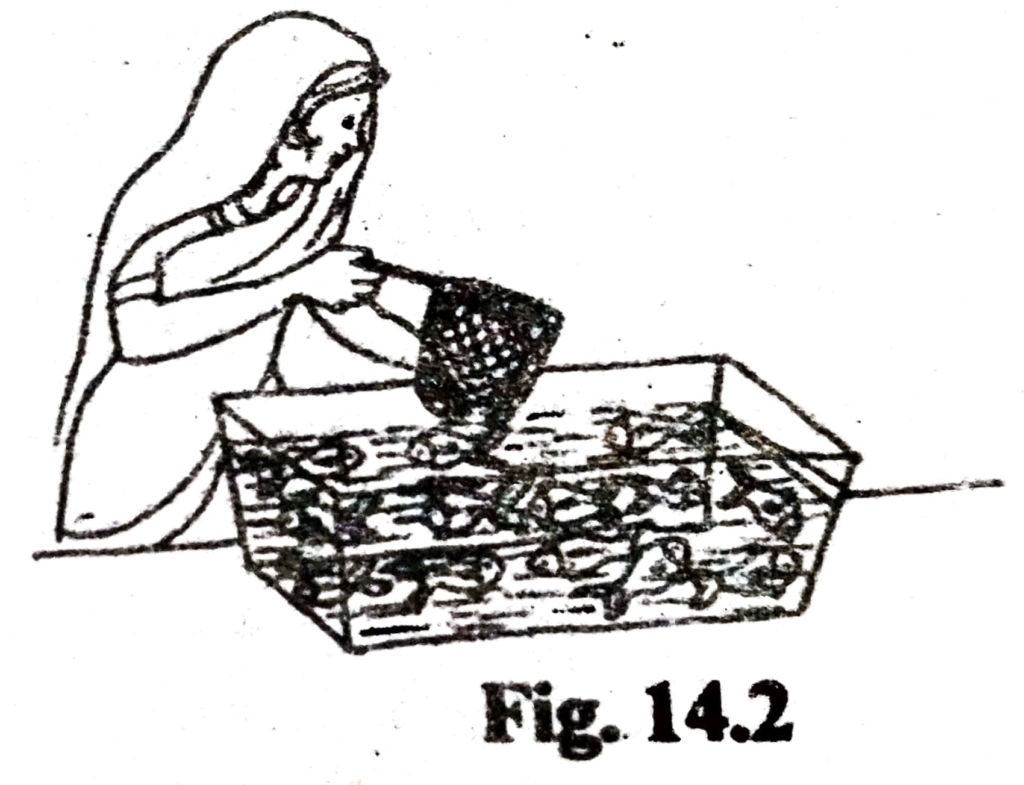
Ans: Total number of fishes in a tank = 5 + 8 = 13
= Number of male fishes + Number of female fishes = 5/13
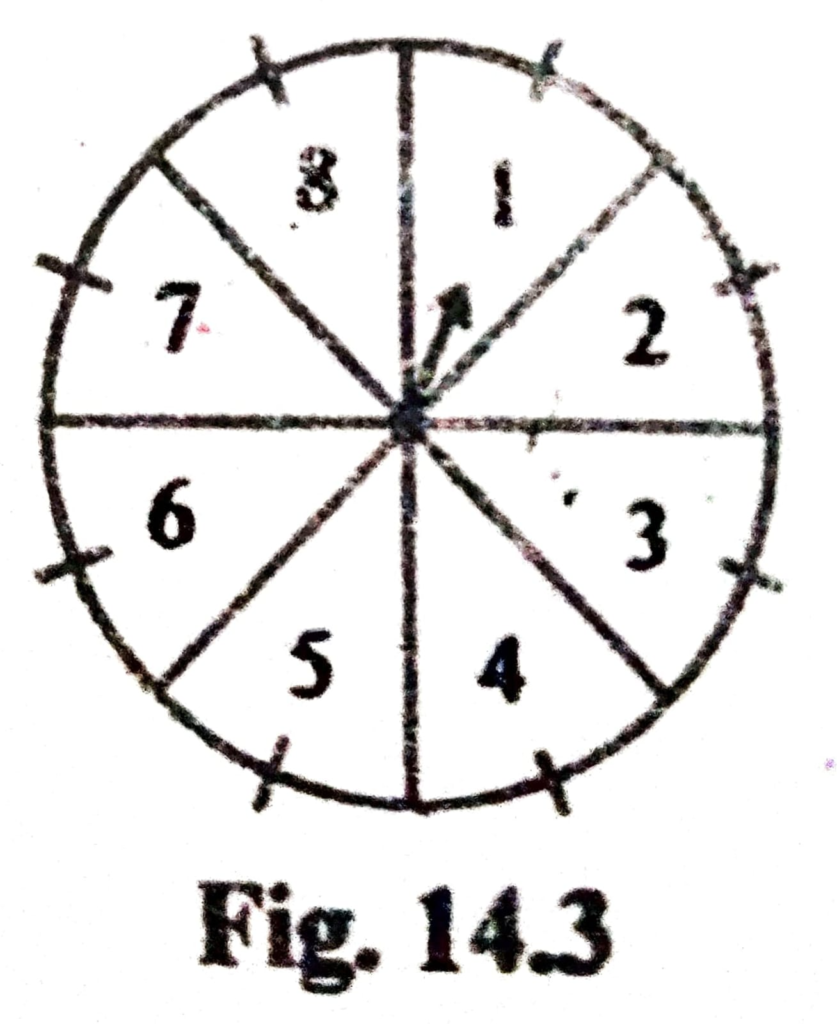
12. A game of chance consists of spinning an arrow which comes to rest
pointing at one of the numbers 1, 2, 3, 4, 5, 6, 7, 8 (see fig.14.3), and these are equally likely outcomes. What is the probability that it will point at
(i) 8?
Ans: Probability of getting 8 = Number of favourable outcomes/Number of total possible outcomes = 1/8
(ii) An odd number?
Ans: Total number of odd numbers on spinner = 4 Number of favourable outcomes/Number of total possible outcomes = 4/8 = 1/2
(iii) A number greater than 2?
Ans: The numbers greater than 2 are 3, 4, 5, 6, 7, and 8.
Therefore, total numbers greater than 2 = 6
Probability of getting a number greater than 2
= Number of favourable outcomes/Number of possible of outcomes = 6/8 = ¾
(iv) A number less than 9?
Ans: The numbers less than 9 are 1, 2, 3, 4, 6, 7, and 8.
Therefore, total numbers less than 9 = 8
Probability of getting a number less than 9 = 8/8 = 1
13. A die is thrown once. Find the probability of getting
(i) A prime number.
(ii) a number lying between 2 and 6.
(iii) an odd number.
Ans: The possible outcomes when a dice is thrown = {1, 2, 3, 4, 5, 6}
Number of possible outcomes of a dice = 6
(i) Prime numbers on a dice are 2, 3, and 5. Total prime numbers on a dice = 3/6 = 1/2
(ii) Probability of getting number = 3 , 4 , 5
Total number lying between 2 and 6 = 3
Probability of getting a number = 3/6 = 1/2
(iii) Odd numbers on a dice = 1, 3, and 5
Total odd numbers on a dice = 3
Probability of getting an odd number = 3/6 = 1/2
14. One card is drawn from a well-shuffled deck of 52 cards. Find the probability of getting. Total number of cards in a well-shuffled deck = 52
(i) A king of red colour.
Ans: Total of numbers of king of red colour = 2
P (getting a king of red colour) = number of favourable outcomes/Number of total possible outcomes = 2/52 = 1/26
(ii) A face card.
Ans: Total number of face cards = 12
P (getting a face card) = Number of favourable outcomes/Number of total possible
outcomes = 12/52 = 3/13
(iii) A red face card.
Ans: Total number of red face cards = 6
P (getting a red face cards = Number of favourable outcomes/Number of total possible outcomes = 6/52 = 3/26
(iv) The jack of hearts.
Ans: There is only one Jack of hearts in a standard deck of 52 cards.
So, P (getting the Queen of Diamonds) = 1/52
(v) A spade.
Ans: Total number of spade cards = 13/52 = 1/4
(vi) The queen of diamonds.
Ans: P (getting a spade card) = Number of favourable outcomes/Number of total possible = 1/52
15. Five cards−the ten, jack, queen, king and ace of diamonds, are well shuffled with their face downwards. One card is then picked up at random.
(i) What is the probability that the card is the queen?
Ans: Total number of cards = 5
Total number of queens = 1
P (getting a queen) = Number of favourable outcomes/Number of total possible = 1/5
(ii) If the queen is drawn and put aside, what is the probability that the second card picked up is (a) an ace? (b) a queen?
Ans: When the queen is drawn, four cards are left which are a ten, a jack, a king and an ace.
(a) P (ace) = 1/4 (b) P(a queen) = 0/4 = 0
16. 12 defective pens are accidentally mixed with 132 good ones. It is not possible to just look at a pen and tell whether or not it is defective. One pen is taken out at random from this lot. Determine the probability that the pen taken out is a good one.
Ans: Total number of pens = 12 + 132 = 144
Total number of good pens = 132
P (getting a good pen) = Number of favourable/Number of total possible outcomes = 132/144 = 11/12
17. (i) A lot of 20 bulbs contain 4 defective ones. One bulb is drawn at random from the lot. What is the probability that this bulb is defective?
Ans: Total number of bulbs = 20
Total number of defective bulbs = 4
P (getting a defective bulb) = Number of favourable/Number of total possible outcomes = 4/20 = 1/5
(ii) Suppose the bulb drawn in (i) is not defective and is not replaced. Now one bulb is drawn at random from the rest. What is the probability that this bulb not defective?
Ans: Remaining total number of bulbs = 19
Remaining total number of non-defective bulbs = 16 − 1 = 15
P (getting a not defective bulb) = 15/19
18. A box contains 90 discs which are numbered from 1 to 90. If one disc is drawn at random from the box, find the probability that it bears
(i) a two-digit number.
Ans: Total number of discs = 90
Total number of two-digit numbers between 1 and 90 = 81
P (getting a two-digit number) = 81/90 = 9/10
(ii) a perfect square number.
Ans: Perfect squares between 1 and 90 are 1, 4, 9, 16, 25, 36, 49, 64, and 81.
Therefore, the total number of perfect squares between 1 and 90 is 9.
P (getting a perfect square) = 9/90 = 1/10
(iii) a number divisible by 5
Ans: Numbers that are between 1 and 90 and divisible by 5 are 5, 10, 15,
20, 25, 30, 35, 40, 45, 50, 55, 60, 65, 70, 75, 80, 85, and 90. Therefore,
total numbers divisible by 5 = 18
Probability of getting a number divisible by 5 = 18/90 = 1/5
19. A child has a die whose six faces shows the letters as given below:

The die is thrown once. What is the probability of getting (i) A? (ii) D?
Ans: Total number of possible outcomes on the dice = 6
Total number of faces having A on it = 2
P (getting A) = 2/ 6 = 1/3
(ii) Total number of faces having D on it = 1
P (getting D) = 1/6
20. A lot consists of 144 ball pens of which 20 are defective and the others are good. Nuri will buy a pen if it is good, but will not buy it if it is defective. The The shopkeeper draws one pen at random and gives it to her. What is the probability that.
(i) She will buy it?
(ii) She will not buy it?
Ans: Total number of pens = 144
Total number of defective pens = 20
Total number of good pens = 144 − 20 = 124
(i) Probability of getting a good pen = 124/144 = 31/36
P (Nuri buys a pen) = 31/36
(ii) P (Nuri will not buy a pen) = 1 – 31/36 = 5/36
Subject Ka Complete Video Solution Dekhein
Step-by-step easy concept explanation aur full questions Answer ke liye watch karein ya app download karein:

 Buy Now