
NIOS Class 12 Introduction to Law Chapter 21 The Executive Solutions English Medium As Per New Syllabus. to each chapter is provided in the list so that you can easily browse throughout different chapters NIOS Class 12 Introduction to Law Chapter 21 The Executive Notes and select need one. NIOS Class 12 Introduction to Law Chapter 21 The Executive Question Answers Download PDF. NIOS Study Material of Class 12 Introduction to Law Paper Code: 338.
NIOS Class 12 Introduction to Law Chapter 21 The Executive
Also, you can read the NIOS book online in these sections Solutions by Expert Teachers as per National Institute of Open Schooling (NIOS) Book guidelines. These solutions are part of NIOS All Subject Solutions. Here we have given NIOS Class 12 Introduction to Law Chapter 21 The Executive Solutions, NIOS Senior Secondary Course Introduction to Law in Hindi Medium for All Chapter, You can practice these here.
The Executive
Chapter: 21
| Module – 6 The Constitution of India – II |
INTEXT QUESTIONS 21.1
1. State the composition of the Electoral College for the election of the President of India.
Ans: All the elected members of Lok Sabha, Rajya Sabha and the State Legislative Assemblies.
2. Who is called Head of the Union Executive?
Ans: The President of India =
3. Mention the qualifications required for the post of President of India.
Ans: Should be a citizen of India; not less than 35 years of age; should be eligible to contest the Lok Sabha election; should not hold any office of profit.
4. How is the value of vote for each Member of Legislative Assembly is calculated for the election of the President of India?
Ans: Value of M.L.A’s vote =

5. How is the value of vote of each Member of Parliament is calculated for the election of the President of India?
Ans: Value of vote of each elected member of parliament:
= Total value of all the elected MLAs of all the State Assemblies / Total elected members of Parliament
6. What is meant by electoral quota and how is it calculated for the election of President of India?
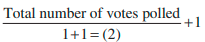
Ans: The electoral quota is the minimum number (value) of votes required by a candidate to be declared elected as the President of India.
It is calculated by the following formula:
Electoral Quota = (Total valid value of votes polled ÷ 2) + 1
A candidate who secures this quota is declared elected. If no candidate obtains the quota in the first count, the candidate with the lowest votes is eliminated and his/her votes are transferred according to the next preference until a candidate secures the required quota.
7. Name the procedure for the removal of the President of India from his/her office.
Ans: The President of India can be removed from office only by the process of impeachment for violation of the Constitution.
8. Mention the situations under which the post of the President falls vacant?
Ans: The post of the President of India falls vacant under the following situations:
(i) Resignation – when the President resigns by writing to the Vice-President.
(ii) Death – when the President passes away while in office.
(iii) Removal through Impeachment – if the President is removed for violation of the Constitution.
9. Who officiates in the absence of the President?
Ans: In the absence of the President, the Vice-President of India officiates as the Acting President until a new President is elected or the President resumes duties.
INTEXT QUESTIONS 21.2
1. Mention any three executive powers of the President of India.
Ans: (i) Appointment of Prime Minister,Governors, Chief Justice of Supreme Court.
(ii) As Supreme Commander of the Armed forces declares war and make peace.
(iii) All laws are enacted by the Union Parliament are enforced in his/her name.
2. List any three legislative powers of the President of India.
Ans: (i) President summons and prorogues the Houses of Parliament.
(ii) He/she nominates twelve member of Rajya Sabha.
(iii) The President can call a joint sitting of the two Houses of Parliament in case of disagreement.
3. What is meant by the ‘Collegium of Supreme Court’.
Ans: The power of appointment of judges has been passed on to a group of Supreme Court judges which is called ‘Collegium’ of the Supreme Court.
4. Fill in the blanks:
(i) National emergency is proclaimed under Article ______________.
Ans: (i) 352.
(ii) President’s Rule can be imposed on any State under Article _____________.
Ans: 356.
(iii) Financial Emergency can be proclaimed by _____________ of India under Article ___________.
Ans: The President, 360.
(iv) Resignation of the President of India should be addressed to ____________.
Ans: Vice President.
(v) _____________ of India automatically officiates as President in the event of the vacancy.
Ans: Vice President.
INTEXT QUESTIONS 21.3
1. How can a Vice-President be removed from his/her office?
Ans: The Vice-President can be removed by a resolution passed by a majority of all the then members of the Rajya Sabha and agreed to by the Lok Sabha. A 14-day notice must be given before moving the resolution.
2. What is the term of office of Vice-President.
Ans: The term of office of the Vice-President of India is five (5) years from the date on which he/she enters upon the office. However, the Vice-President continues to hold office until a successor assumes office.
3. Describe any two functions of the Vice-President.
Ans: (i) He/she is the ex-officio chairman of the Rajya Sabha.
(ii) He/she officiates as President in case of Vacancy.
INTEXT QUESTIONS 21.4
(A) Fill in the Blanks:
1. Prime Minister is the ______ head of the Government.
Ans: Real.
2. The Meetings of the Council of Ministers presided over by ______ .
Ans: Prime Minister.
3. Prime Minister is link between _______ and _______ .
Ans: Council of Ministers and President.
4. President appoints the minister on the _______ of _______ .
Ans: Advice of Prime Minister.
(B) Answer the following questions:
1. Who is the head of the Council of Ministers?
Ans: Prime Minister.
2. Mention any two categories of Ministers.
Ans: (i) Cabinet Rank Minister.
(ii) Ministers of the State.
INTEXT QUESTIONS 21.5
Fill in the blanks:
1. Governor of a State is appointed by the ______________.
Ans: President.
2. A Governor holds office for a period of ____________Years from the date on which he/she enter his/her office.
Ans: Five.
3. A Governor can be removed from his office by ___________ before ___________ of his tenure.
Ans: President, expiry.
4. The Chief Minister is ______________ head of the Sate Government.
Ans: Rea.
5. The Chief Minister is appointed by the ____________.
Ans: Governor.
| TERMINAL EXERCISES |
1. State the qualifications required for the office of the President of India.
Ans: The qualifications required for the office of President are:
(i) He/she is a citizen of India.
(ii) Has completed the age of 35 years.
(iii) Is qualified to be elected as a member of Lok Sabha and.
(iv) Should not hold any office of profit under the Union Government or any State Government. However, the office of the President, the Vice President, the Governor or the Ministers of Union or State is not considered as an office of profit.
2. How is the President of India elected? Explain the manner of his/her election.
Ans: The President of India is elected indirectly by an Electoral College according to the system of proportional representation by means of a single transferable vote, and the voting is done by secret ballot.
(i) Electoral College:
The Electoral College consists of —
(a) The elected members of both Houses of Parliament.
(b) The elected members of the Legislative Assemblies of the States.
(c) The elected members of the Legislative Assemblies of the Union Territories of Delhi, Puducherry, and Jammu & Kashmir.
(ii) Manner of Election:
(a) The election is conducted by the system of proportional representation.
(b) Voting is done through a secret ballot.
(c) Each elector (MP or MLA) has a fixed number of votes, which varies to maintain uniformity among the States and parity between the States and the Union.
(iii) Calculation of Vote Value:
(a) The value of the vote of an MLA = (Total population of the State ÷ Total number of elected MLAs) ÷ 1000.
(b) The value of the vote of an MP = (Total value of votes of all MLAs of all States) ÷ (Total number of elected MPs).
(iv) Process of Voting:
(a) Each voter marks his or her preferences (1, 2, 3, etc.) on the ballot paper.
(b) To win, a candidate must secure more than 50% of the total valid votes.
(c) If no candidate gets the majority in the first round, the candidate with the lowest votes is eliminated and the second preferences are transferred.
(d) The process continues until a candidate obtains the required majority.
3. Describe the executive powers of the President.
Ans: The executive powers of the President of India are laid down in Article 53 of the Constitution, which states that the executive power of the Union shall be vested in the President and exercised by him or her either directly or through officers subordinate to him or her. The President appoints the Prime Minister, and on the advice of the Prime Minister, appoints other Council of Ministers. The President also appoints the Chief Justice and other judges of the Supreme Court and High Courts after consulting the Chief Justice of India. However, as per the Supreme Court’s 1993 judgment (reinterpreted in 1999), the President is bound by the recommendations of the Collegium of senior judges for judicial appointments.
Besides, the President appoints the Attorney General of India, the Comptroller and Auditor General (CAG), the Chief Election Commissioner and other Election Commissioners, the Chairman and members of the Union Public Service Commission (UPSC), the Governors of States, Lt. Governors of Union Territories, and the Chiefs of the Army, Navy, and Air Force. The President also represents India in foreign affairs and conducts all international treaties and agreements in his or her name. Though the President is the constitutional head, the real executive powers are exercised by the Prime Minister and the Council of Ministers in the President’s name.
4. Explain the legislative and financial powers of the President of India.
Ans: Legislative powers The President is an integral part of the Parliament and enjoys many legislative powers. The President may summon the Parliament at least twice a year with a gap of not more than six months between two consecutive sessions. The President addresses both Houses of Parliament jointly at the first session after every general election and also at the commencement of the first session every year. The President can dissolve the Lok Sabha on the recommendation of the Prime Minister. The President has the power to nominate twelve members to the Rajya Sabha and two members of Anglo-Indian Community in the Lok Sabha. Every bill passed by the Parliament is sent to President for his/her assent to become a law. Without his/her assent, no bill can become a law. The President can issue an ‘Ordinance’ when the Parliament is not in session. This ‘Ordinance’ has the force of law and needs to be approved by both the Houses within six weeks after the commencement of the session, otherwise it gets lapsed automatically.
Financial Powers India-II The President is the custodian of Contingency Fund of India. This fund is kept by Union Government to meet any unforeseen expenditure. The President has full control over this fund. All money Bills are introduced in the Lok Sabha with the prior approval of the President. Annual budget and Railway budget are introduced only after the recommendation of the President. The President appoints the Financial Commission after every five years. The reports of the Controller and Auditor General of India (CAG) is placed before the President for necessary action.
5. Critically examine the position of the President of India as Head of the State and Head of the executive.
Ans: Position of the President of India as Head of the State and Head of the Executive:
(i) Constitutional Head of the State: The President of India is the constitutional head of the Union. Article 52 provides for a President of India, and Article 53 vests in him/her the executive power of the Union. However, the President acts on the aid and advice of the Council of Ministers headed by the Prime Minister (Article 74). Thus, the President’s powers are largely formal and nominal, not real.
(ii) Head of the Executive: As the executive head, the President formally appoints the Prime Minister and other ministers, Governors of States, Ambassadors, Judges of the Supreme Court and High Courts, the Attorney-General, and other key officials.
All executive actions of the Government of India are taken in the name of the President, but actual decisions are made by the Cabinet.
(iii) Symbol of the Nation’s Unity: The President represents the unity, integrity, and continuity of the nation. In international relations, he/she represents India, signs treaties, and accredits ambassadors, acting on the advice of the Council of Ministers.
(iv) Legislative and Judicial Roles:
- The President is an integral part of Parliament and summons, prorogues, and dissolves the Lok Sabha.
- He/she gives assent to bills, can promulgate ordinances, and nominates members to Parliament.
- In judicial matters, the President can grant pardons, reprieves, respites, or remissions of punishment (Article 72).
(v) Discretionary Powers:
- Though the office is mainly ceremonial, certain situations give limited discretionary power:
- When no party commands a clear majority in the Lok Sabha (appointment of the Prime Minister).
- When deciding whether to dissolve the Lok Sabha.
- When returning a bill for reconsideration (except Money Bills).
(vi) Real vs. Nominal Head: In practice, the Prime Minister and the Council of Ministers exercise real executive power. The President performs duties as advised by them. Hence, the President is a constitutional or nominal executive, while the Prime Minister is the real executive authority.
(vii) Critical Evaluation:
- The President’s position is often described as that of a “constitutional monarch” like the King or Queen of Britain.
- Yet, the President can play a vital role during political crises, hung parliaments, or emergencies.
- The effectiveness of the President’s office depends largely on the personality and constitutional propriety of the incumbent.
6. Discuss the role of Governor as the Executive Head of the State.
Ans: Role of the Governor as the Executive Head of the State:
(i) The Governor is the constitutional head of the State (Article 153). The executive power of the State is vested in the Governor and is exercised according to the Constitution.
(ii) The Governor acts as a nominal executive head, while the real powers are exercised by the Council of Ministers headed by the Chief Minister (Article 163).
(iii) The Governor is appointed by the President of India for a term of five years and holds office during the President’s pleasure, thus serving as a link between the Centre and the State.
(iv) All executive actions of the State are taken in the name of the Governor, showing that he/she is the formal head of the State administration.
(v) The Governor appoints the Chief Minister and, on his/her advice, other ministers, the Advocate-General, and key officials like the State Election Commissioner and members of the State Public Service Commission.
(vi) The Governor ensures that the administration of the State is carried on in accordance with the Constitution, protecting the rule of law and constitutional values.
(vii) As part of the Legislature, the Governor summons, prorogues, and dissolves the Legislative Assembly and addresses it at the commencement of the first session after elections.
(viii) The Governor gives assent to bills, may withhold assent, or reserve bills for the consideration of the President, and can issue ordinances when the Legislature is not in session.
(ix) The Governor enjoys certain discretionary powers, such as appointing a Chief Minister in case of a hung Assembly, recommending President’s Rule (Article 356), or reserving bills for the President.
(x) During an emergency, the Governor acts as the agent of the Central Government, ensuring constitutional machinery and stability in the State.
(xi) The Governor acts as a symbol of unity and integrity, maintaining healthy relations between the Union and State governments.
Conclusion: The Governor, as the Executive Head of the State, plays mainly a constitutional and ceremonial role. Yet, in times of political crisis, he/she assumes an active and vital role to uphold the Constitution and democratic governance.
7. Describe the relationship of the Governor with the Chief Minister of the State.
Ans: Relationship between the Governor and the Chief Minister:
(i) The Governor is the constitutional head of the State, while the Chief Minister is the real executive authority. The Governor acts on the advice of the Council of Ministers headed by the Chief Minister (Article 163).
(ii) The Chief Minister is appointed by the Governor, generally the leader of the majority party in the Legislative Assembly. Other ministers are appointed by the Governor on the advice of the Chief Minister.
(iii) The Chief Minister advises the Governor on all important matters of State administration and keeps him/her informed about government decisions (Article 167).
(iv) The Governor acts on the advice of the Chief Minister and Council of Ministers in all matters, except where he/she is required by the Constitution to act in discretion.
(v) The Chief Minister acts as a link between the Governor and the State Council of Ministers, communicating all decisions and policies of the Council to the Governor.
(vi) In case of differences, the Governor can advise or warn the Chief Minister, but must ultimately follow constitutional norms and democratic principles.
(vii) The Chief Minister is collectively responsible to the Legislative Assembly, not to the Governor. However, the Governor can require the Chief Minister to prove majority support if needed.
(viii) The Governor can dismiss the Chief Minister only when he/she loses the confidence of the Legislative Assembly.
(ix) The relationship should be based on mutual respect, cooperation, and constitutional balance — the Governor representing the Centre, and the Chief Minister representing the people of the State.
(x) In practice, harmony between both offices ensures political stability, smooth administration, and effective governance of the State.
Subject Ka Complete Video Solution Dekhein
Step-by-step easy concept explanation aur full questions Answer ke liye watch karein ya app download karein:

 Buy Now