
NCERT Class 9 Social Science Chapter 5 State and Society up to 1000 CE Solutions English Medium As Per New Syllabus. NCERT Class 9 Social Science Chapter 5 State and Society up to 1000 CE Notes to each chapter is provided in the list so that you can easily browse throughout different chapter NCERT Class 9 Social Science Chapter 5 State and Society up to 1000 CE Question Answer Download PDF and select needs one.
NCERT Class 9 Social Science Chapter 5 State and Society up to 1000 CE
Also, you can read the CBSE book online in these sections Solutions by Expert Teachers as per (CBSE) Book guidelines. NCERT Class 9 Social Science Textual Solutions. These solutions are part of NCERT All Subject Solutions. Here we have given NCERT Class 9 Social Science Notes in English Medium Solutions for All Subject, You can practice these here.
State and Society up to 1000 CE
Chapter – 5
| Part – I: History |
| Textual Question Answer |
The Big Questions
1. How did society and state organise themselves prior to 1000 CE?
Ans: Before 1000 CE, society was organised around families (kula), villages (grāma), clans (jana), and later into territorial units called janapadas and mahājanapadas. The state was headed by a king (rājā), who governed with the help of assemblies such as the sabha, samiti, and vidhata, and later with a council of ministers and a well-developed administrative system.
2. How did states and societies emerge and spread to different parts of the Indian subcontinent?
Ans: States evolved from kin-based communities into territorial kingdoms called janapadas and later larger mahājanapadas. Improvements in agriculture, the use of iron tools, expansion of trade, and population growth helped powerful kingdoms such as Magadha emerge. Over time, empires like the Mauryas, Guptas, Satavahanas, Pallavas, Chalukyas, Rashtrakutas, and Cholas spread political organisation and cultural traditions across different regions of the Indian subcontinent.
3. How did the ideas of dharma and chakravarti samrāṭ help create unity in social values and governance, and promote the idea of the Indian subcontinent as one political entity?
Ans: The idea of dharma promoted righteousness, justice, moral conduct, and the welfare of all people. The concept of the chakravarti samrāṭ (universal ruler) represented the ideal of a king ruling the entire Indian subcontinent with justice and good governance. Together, these ideas encouraged common social values, ethical administration, and the vision of India as one political and cultural entity.
4. How did different social, administrative, and occupational groups take shape over time and come together culturally?
Ans: Over time, society developed different varṇas, jātis, occupational groups, guilds, and administrative divisions. Although people had different occupations and social roles, they remained connected through trade, agriculture, governance, religious practices, literature, festivals, and shared ethical principles like dharma. These interactions helped create cultural unity across different regions of India.
1. How did political organisation change from the Vedic period to the age of large empires such as the Mauryas and the Guptas? Explain the administrative system of the early Indian states.
Ans: During the Vedic period, society was organised into janas (clans) led by a rājā (king). The king was assisted by popular assemblies such as the sabha, samiti, and vidhata. As agriculture, trade, and settlements expanded, these clans developed into janapadas and later mahājanapadas. Powerful kingdoms such as Magadha eventually gave rise to large empires like the Mauryas and Guptas.
The administrative system became more organised with the growth of these empires. The kingdom was divided into provinces, districts, and villages, each managed by appointed officials. The king was assisted by a council of ministers (mantri-pariṣhad) and officers such as governors, tax collectors, military commanders, and village headmen. Village assemblies also played an important role in local administration.
2. Describe the role of the king, important officers, and the methods used to govern large territories.
Ans: The king was the supreme ruler and was responsible for protecting the people, maintaining law and order, administering justice, collecting revenue, and defending the kingdom. He was expected to rule according to dharma and ensure the welfare of his subjects.
The king was assisted by important officers, including the council of ministers, the treasurer, the chief tax collector, the commander-in-chief, the chief legal adviser, provincial governors, district officers, and village headmen. Large territories were governed by dividing the kingdom into provinces, districts, and villages. Local officials and village assemblies managed administration, tax collection, irrigation, public works, and the maintenance of law and order.
3. After studying this chapter, what do you think were the most important features of the state and society in India before 1000 CE?
Ans: (i) Society was organised around families (kula), villages (grāma), clans (jana), varṇas, and jātis.
(ii) Political organisation developed from kin-based clans to janapadas, mahājanapadas, and large empires such as the Mauryas and Guptas.
(iii) Kings ruled with the help of ministers, officials, councils, and local assemblies.
(iv) Administration was decentralised through provinces, districts, and villages.
(v) The principles of dharma, justice, and ethical governance guided both rulers and society.
(vi) Agriculture, trade, crafts, and guilds formed the foundation of the economy.
(vii) The Vedas, epics, Sangam literature, and religious traditions promoted cultural unity across the Indian subcontinent.
4. What do early texts such as the Ṛig Veda, Arthaśhāstra, and the Mahābhārata reveal about political and social life?
Ans: The Ṛig Veda describes early Vedic society, kin-based communities, the role of the king, and assemblies like the sabha and samiti. The Arthaśhāstra explains statecraft, administration, taxation, diplomacy, and the duties of the king and ministers. The Mahābhārata emphasises dharma, justice, ethical governance, and the responsibilities of rulers towards their subjects. Together, these texts provide valuable information about the political, social, economic, and moral life of early India.
5. What can we learn from early Indian society about varṇa and the role of women?
Ans: (i) Early Indian society was organised into four varṇas—Brāhmaṇas, Kṣhatriyas, Vaiśhyas, and Śhūdras.
(ii) In the early Vedic period, occupations were flexible and were not strictly determined by birth.
(iii) Over time, the jāti system developed, leading to a larger number of social groups.
(iv) Women enjoyed a respected position in society and participated in education, religious rituals, and social activities.
(v) Women sages such as Apālā, Ghoṣhā, Viśhvavārā, and Lopāmudrā composed hymns of the Ṛig Veda.
(vi) Although the status of women changed over time, many continued to contribute to administration, agriculture, literature, crafts, and religious life.
6. Explain how assemblies like sabhā and samiti limited the power of the rājā. Which modern institutions perform similar functions today?
Ans: The sabhā and samiti were important assemblies during the Vedic period. They advised the king, discussed important political matters, and participated in decision-making. These assemblies prevented the king from exercising absolute power by involving representatives of society in governance.
Today, similar functions are performed by Parliament (Lok Sabha and Rajya Sabha), State Legislative Assemblies, the Judiciary, and other constitutional institutions that ensure checks and balances on the powers of the government.
7. What do the terms varṇa and jāti refer to in early Indian society? How were they different, and what factors may have contributed to the formation of various jātis?
Ans: (i) Varṇa refers to the four broad social categories—Brāhmaṇas, Kṣhatriyas, Vaiśhyas, and Śhūdras.
(ii) Jāti refers to the numerous social groups that developed over time based on occupation, locality, customs, and community.
(iii) The number of varṇas remained fixed at four, whereas the number of jātis continued to increase.
(iv) Various jātis emerged due to intermarriage among varṇas, migration of communities, territorial differences, occupational specialisation, and the practice of endogamy (marrying within one’s own group).
8. Why do you think education in early India emphasised both knowledge and moral values? How might this have benefited society?
Ans: (i) Education aimed to develop both knowledge and good character.
(ii) Students were taught values such as truthfulness, discipline, honesty, self-control, and respect.
(iii) Moral values helped people perform their duties according to dharma.
(iv) This created responsible citizens, ethical rulers, and a peaceful, harmonious society.
9. Look at the major trade routes of early India (Fig. 5.12). How do you think these routes helped people in the exchange of goods, skills, beliefs, and cultural practices?
Ans: (i) Trade routes enabled the exchange of goods such as spices, textiles, metals, and precious stones.
(ii) They helped spread skills and technologies among different regions.
(iii) Traders, travellers, and monks exchanged religious beliefs, languages, art, and cultural traditions.
(iv) These routes promoted economic growth and strengthened cultural unity across the Indian subcontinent.
10. What might have been the advantages and challenges of ruling a large empire in the absence of modern communication systems?
Ans: Advantages:
(i) Local officials and village assemblies managed day-to-day administration.
(ii) Decentralised administration allowed local problems to be solved quickly.
Challenges:
(iii) Communication between the king and distant provinces was slow.
(iv) It was difficult to control rebellions and respond quickly to emergencies.
(v) Collecting taxes, enforcing laws, and coordinating the army across large territories was challenging.
11. Many ideas about governance come from texts composed by scholars and advisors of the king. What might be some limitations of relying only on such sources?
Ans: (i) These texts mainly present the views and ideals of scholars and royal advisors.
(ii) They may not fully describe the lives of ordinary people.
(iii) Some texts focus on ideal governance rather than actual practices.
(iv) Therefore, historians also use inscriptions, archaeological evidence, coins, and literary works to obtain a more complete understanding of the past.
12. Read the source and answer the questions.
The Nāśhik cave inscription (2nd century CE) of Uṣhavadāta records:
“Uṣhavadāta, son of Dinika, son-in-law of king Nahapāna … has bestowed this cave on the Saṁgha generally; he has also given a perpetual endowment, three thousand—3000 kāhāpaṇas, which, for the members of the Saṁgha of any sect, and any origin dwelling in this cave, will serve as cloth money and money for outside life (kuśhaṇa); and those kāhāpaṇas have been invested in guild dwelling at Govadhana—2000 in a weavers’ guild, interest one pratika (monthly) for the hundred, (and) 1000 in another weaver’s guild, interest three quarters of a paḍika (monthly) for the hundred.”
(a) What does this source tell us about the economic role of guilds?
Ans: (i) Guilds accepted and safely managed money deposits.
(ii) They invested the deposited money and paid regular interest.
(iii) Guilds supported religious institutions by helping provide funds for the needs of the Saṁgha.
(iv) This shows that guilds played an important role in trade, finance, and the economy.
(b) Why were guilds trusted with money deposits?
Ans: (i) Guilds were well-organised and financially stable institutions.
(ii) They managed funds responsibly and paid regular interest.
(iii) They had a reputation for honesty and reliability.
(iv) Therefore, people trusted them to keep and invest money safely.
(c) Identify the donor and the donees from the given source.
Ans: Donor: Uṣhavadāta, son of Dinika and son-in-law of King Nahapāna.
Donees: The Saṁgha (Buddhist monastic community) of all sects and origins living in the cave.
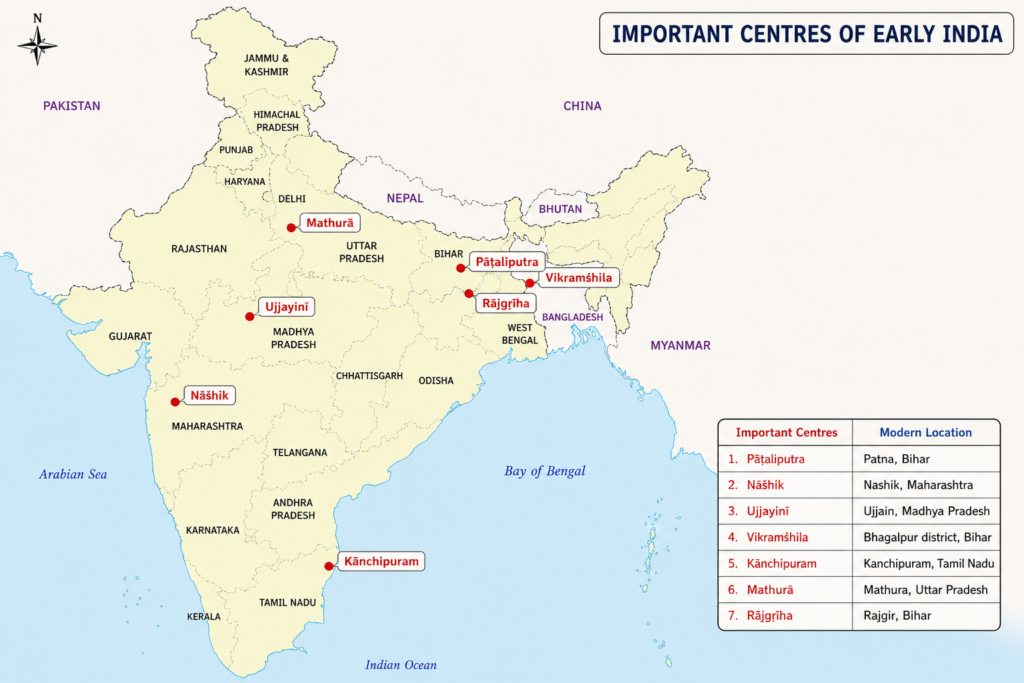
13. Mark and locate on the map of India the following important centres: Pāṭaliputra, Nāśhik, Ujjayinī, Vikramśhila, Kānchipuram, Mathurā, Rājgṛiha.
Ans:

 Buy Now