
NCERT Class 9 Social Science Chapter 4 Early Humans and Beginning of Civilisation Solutions English Medium As Per New Syllabus. NCERT Class 9 Social Science Chapter 4 Early Humans and Beginning of Civilisation Notes to each chapter is provided in the list so that you can easily browse throughout different chapter NCERT Class 9 Social Science Chapter 4 Early Humans and Beginning of Civilisation Question Answer Download PDF and select needs one.
NCERT Class 9 Social Science Chapter 4 Early Humans and Beginning of Civilisation
Also, you can read the CBSE book online in these sections Solutions by Expert Teachers as per (CBSE) Book guidelines. NCERT Class 9 Social Science Textual Solutions. These solutions are part of NCERT All Subject Solutions. Here we have given NCERT Class 9 Social Science Notes in English Medium Solutions for All Subject, You can practice these here.
Early Humans and Beginning of Civilisation
Chapter – 4
| Part – I: History |
| Textual Question Answer |
The Big Questions
1. How did humans live on Earth before the beginning of civilisation?
Ans: Before civilisation, humans lived as hunter-gatherers. They hunted animals, gathered fruits, roots, and nuts, used simple stone tools, and lived in caves or temporary shelters. Later, they began farming, domesticating animals, and settling in permanent villages.
2. How did humans communicate before writing was invented?
Ans: Before writing was invented, humans communicated through spoken language, gestures, signs, symbols, cave paintings, engravings, and body decoration. These helped them share ideas, experiences, and information.
3. How is archaeology helpful in understanding our past?
Ans: Archaeology helps us understand the past by studying tools, fossils, pottery, bones, buildings, cave paintings, and other artefacts left behind by early humans. These discoveries help archaeologists reconstruct how people lived, worked, and developed over time.
4. How did early civilisations interact with each other?
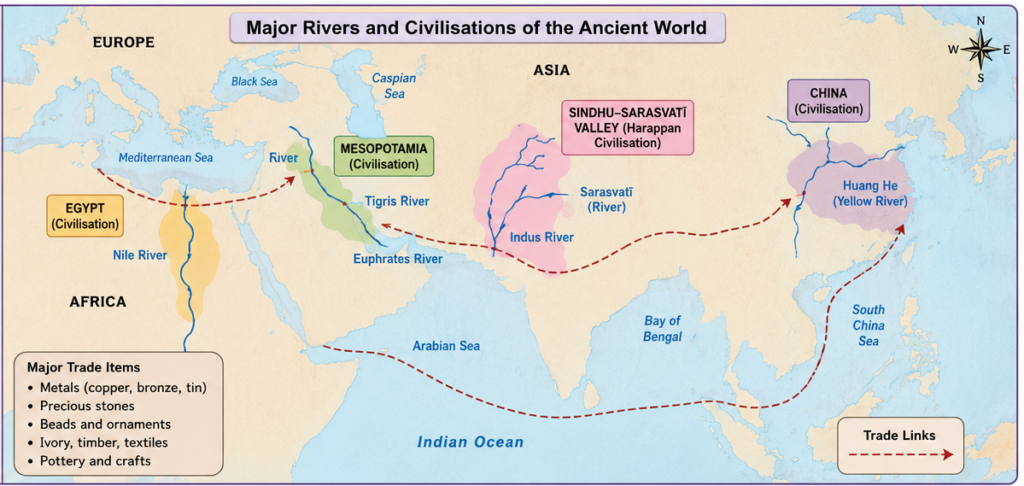
Ans: Early civilisations interacted mainly through trade and cultural exchange. They exchanged goods such as semi-precious stones, ivory, timber, metals, and other products. For example, the Harappan (Sindhu–Sarasvatī) civilisation traded with Mesopotamia, which helped spread ideas, technology, and economic growth.
Questions and activities
1. Do you think life became easier or more challenging after humans started farming? Give two reasons for your answer.
Ans: Life became easier in many ways, although it also brought new challenges.
Reasons:
Farming provided a regular and reliable food supply, reducing dependence on hunting and gathering.
People settled in permanent villages, allowing them to build houses, domesticate animals, make pottery, and develop trade and civilisation.
2. The environment offers human societies both opportunities as well as challenges. Explain with reference to early farming communities and river-valley civilisations.
Ans: The environment provided fertile land, water, and natural resources, which helped early farming communities grow crops and raise animals. Rivers such as the Indus, Nile, Tigris-Euphrates, and Huang He supported agriculture, trade, transport, and the growth of great civilisations.
However, the environment also created challenges. Floods, droughts, changing climates, and river changes could destroy crops and settlements. Early people had to build dams, canals, reservoirs, and irrigation systems to manage water and protect their communities.
3. Why do historians divide early human history into different ages such as Stone Age, Bronze Age, and Iron Age? What does this classification tell us about human progress?
Ans:Historians divide early human history into the Stone Age, Bronze Age, and Iron Age based on the materials people used to make tools and weapons. This classification helps us understand the changes in technology, lifestyle, agriculture, trade, and society over time. It shows that human beings gradually became more skilled, developed new technologies, built settlements, and established advanced civilisations.
4. Imagine you are a Neolithic farmer. Describe one day of your life. What challenges would you face that a hunter-gatherer would not?
Ans: I wake up early and work in my fields, sowing seeds, watering crops, and caring for my cattle and goats. I repair my house, store grain, and make tools and pottery for daily use. In the evening, I help my family prepare food and plan for the next day’s work.
Unlike a hunter-gatherer, I face challenges such as protecting crops from pests and animals, depending on rainfall for a good harvest, storing food safely, and dealing with crop failures caused by droughts or floods.
5. Imagine that the Harappan script gets deciphered tomorrow. What new types of information do you think historians might learn?
Ans: If the Harappan script were deciphered, historians might learn about:
(i) The language spoken by the Harappans.
(ii) Their government and administration.
(iii) Their religious beliefs and customs.
(iv) Their trade, economy, and daily life.
(v) The names of their rulers, cities, and important people.
(vi) Their laws, literature, and historical events.
6. Prepare a table with three columns—Palaeolithic, Mesolithic, and Neolithic—and fill in their distinctive features.
Ans:
| Features | Palaeolithic (Old Stone Age) | Mesolithic (Middle Stone Age) | Neolithic (New Stone Age) |
| Tools | Handaxes, cleavers, scrapers, choppers | Microliths (small stone tools), bone tools | Polished stone tools, axes, sickles |
| Settlements | Caves and temporary camps | Caves, rock shelters, temporary settlements near rivers and lakes | Permanent villages with houses |
| Art | Cave paintings, engravings, beads, body decoration | Rock paintings and cave art | Pottery, weaving, decorated objects |
| Subsistence | Hunting and gathering | Hunting, fishing, gathering wild grains | Farming, animal domestication, food production |
7. “Bronze Age civilisations developed independently but shared common features.” Examine this statement with reference to the civilisations given in the chapter.
Ans: The Bronze Age civilisations of the Sindhu–Sarasvatī (Harappan), Mesopotamian, Egyptian, and Chinese regions developed independently in different river valleys. However, they shared many common features:
(i) They developed near fertile river valleys.
(ii) They practised agriculture and produced surplus food.
(iii) They built well-planned settlements and cities.
(iv) They developed writing systems for administration and trade.
(v) They practised trade, crafts, and metallurgy.
(vi) They had organised governments, social hierarchies, and religious beliefs.
8. Although rivers provided many benefits, they also created challenges for early societies. Discuss both the advantages and disadvantages of settling near rivers.
Ans: Advantages:
(i) Rivers provided water for drinking and irrigation.
(ii) Fertile soil helped in growing crops.
(iii) Rivers supported transport and trade.
(iv) They provided fish and other natural resources.
Disadvantages:
(i) Floods could destroy crops and settlements.
(ii) Droughts reduced water supply for farming.
(iii) River courses sometimes changed, affecting settlements.
(iv) People had to build dams, canals, and reservoirs to control water.
9. With the help of your teacher, find out more about the Code of Hammurabi. Why was it important? Do you think it was fair to all sections of society? Give reasons for your answer.
Ans: (i) The Code of Hammurabi was one of the earliest written law codes, introduced by King Hammurabi of Babylon.
(ii) It established clear rules for justice, trade, property, family matters, and punishment.
(iii) It helped maintain law, order, and uniform justice throughout the empire.
(iv) However, it was not completely fair because punishments often differed according to a person’s social status, wealth, and gender. Wealthy and powerful people sometimes received different treatment than common people or slaves.
10. If you had to choose one major innovation from early civilisations that changed the world permanently, what would it be and why?
Ans: (i) I would choose the invention of writing as the most important innovation.
(ii) Writing helped people record laws, trade, history, and knowledge.
(iii) It improved communication and administration.
(iv) It allowed knowledge to be passed on to future generations.
(v) It laid the foundation for education, literature, science, and modern civilisation.
11. Compare the social hierarchy and daily life of people in the Egyptian civilisation with those in Mesopotamia. What similarities and differences do you notice?
Ans: Similarities:
(i) Both had a well-organised social hierarchy with rulers at the top.
(ii) Both societies depended mainly on agriculture.
(iii) People practised trade, crafts, and pottery.
(iv) Religion played an important role in daily life.
Differences:
(i) In Egypt, the Pharaoh was the supreme ruler, while in Mesopotamia, each city-state had its own king.
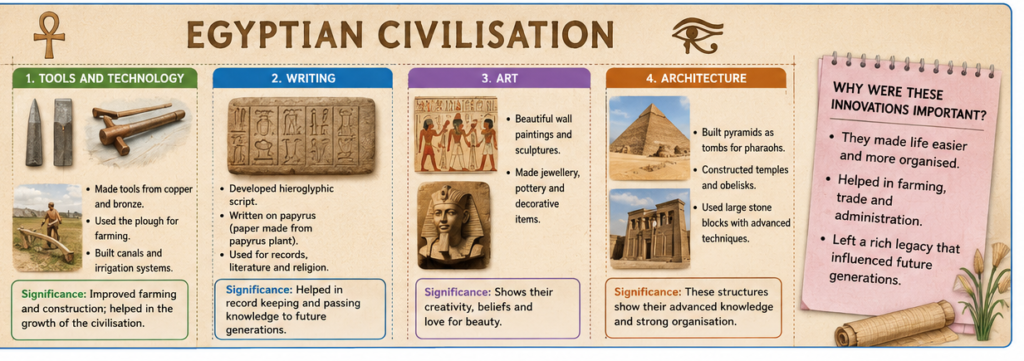
(ii) Egyptians are famous for building pyramids and preserving bodies through mummification, whereas Mesopotamians built ziggurats as temples.
(iii) Egyptians wrote on papyrus using hieroglyphics, while Mesopotamians used cuneiform script on clay tablets.
12. Activity: Using maps, locate the major rivers and civilisations of Mesopotamia, Egypt, China, and the Sindhu–Sarasvatī Valley. Mark the trade links between them.
Ans:
13. Activity: Choose one early civilisation (Mesopotamia, Egypt, or China) and prepare a mini-scrapbook or a presentation showing their innovations in tools, writing, art, and architecture. Include pictures, brief descriptions, and explain their significance.
Ans:

 Buy Now