
NCERT Class 9 Social Science Chapter 3 Atmosphere and Climate Solutions English Medium As Per New Syllabus. NCERT Class 9 Social Science Chapter 3 Atmosphere and Climate Notes to each chapter is provided in the list so that you can easily browse throughout different chapter NCERT Class 9 Social Science Chapter 3 Atmosphere and Climate Question Answer Download PDF and select needs one.
NCERT Class 9 Social Science Chapter 3 Atmosphere and Climate
Also, you can read the CBSE book online in these sections Solutions by Expert Teachers as per (CBSE) Book guidelines. NCERT Class 9 Social Science Textual Solutions. These solutions are part of NCERT All Subject Solutions. Here we have given NCERT Class 9 Social Science Notes in English Medium Solutions for All Subject, You can practice these here.
Atmosphere and Climate
Chapter – 3
| Part – I: Geography |
| Textual Question Answer |
The Big Questions
1. What is the composition of the atmosphere?
Ans: (i) The atmosphere is a mixture of gases surrounding the Earth.
(ii) It contains about 78% Nitrogen.
(iii) It contains about 21% Oxygen.
(iv) About 0.93% is Argon.
(v) About 0.04% is Carbon dioxide.
(vi) It also contains small amounts of other gases, water vapour, and dust particles.
2. How do the different layers of the atmosphere affect the planet Earth?
Ans: (i) Troposphere is the layer where weather changes, clouds, and rainfall occur.
(ii) Stratosphere contains the ozone layer, which protects Earth from harmful UV rays.
(iii) Mesosphere burns up meteors before they reach the Earth’s surface.
(iv) Thermosphere absorbs harmful solar radiation and is where auroras occur.
(v) Exosphere is the outermost layer and merges with outer space.
3. What is the mechanism of monsoon?
Ans: (i) In summer, land heats up faster than the sea.
(ii) A low-pressure area develops over the land.
(iii) Moist winds blow from the sea towards the land.
(iv) These winds rise, cool, and condense to form clouds.
(v) Heavy rainfall occurs over many parts of India.
(vi) In winter, the land cools faster than the sea, and dry winds blow from land to sea.
4. How can we reduce our carbon footprint?
Ans: (i) Use public transport, cycle, or walk whenever possible.
(ii) Save electricity by switching off unused lights and appliances.
(iii) Plant more trees and protect forests.
(iv) Reduce, reuse, and recycle waste materials.
(v) Use renewable energy such as solar and wind power.
(vi) Avoid excessive use of fossil fuels and plastic products.
Questions and activities
1. What is atmosphere? Explain its composition with the help of a pie diagram.
Ans: The atmosphere is a blanket of air surrounding the Earth. It is held around the Earth by gravity and is a mixture of different gases. It protects living beings from harmful solar radiation, regulates the Earth’s temperature, and supports weather and climate.
Composition of the Atmosphere
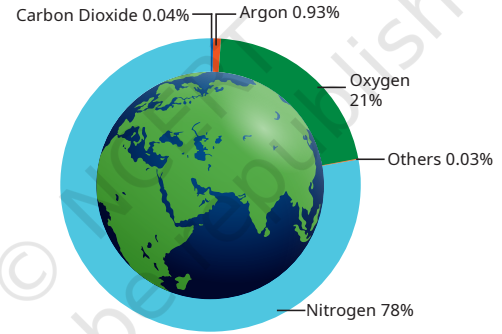
(i) Nitrogen – 78%
(ii) Oxygen – 21%
(iii) Argon – 0.93%
(iv) Carbon dioxide – 0.04%
(v) Other gases – 0.03%
(vi) The atmosphere also contains water vapour and dust particles, which help in cloud formation and rainfall.
2. Draw a labelled diagram of the structure of atmosphere.
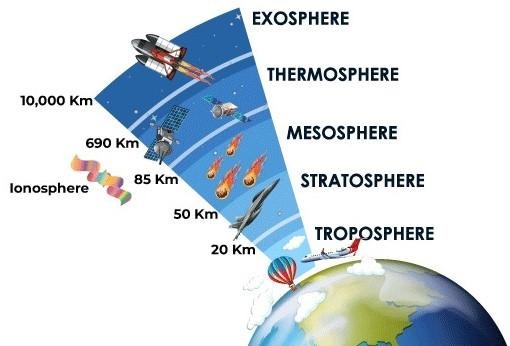
Labels:
(i) Troposphere
(ii) Stratosphere
(iii) Mesosphere
(iv) Thermosphere
(v) Exosphere
3. Which are the four main seasons of India?
Ans: According to the Indian Meteorological Department (IMD), India has four main seasons:
(i) Winter Season: December to early April.
(ii) Summer (Pre-monsoon) Season: April to June.
(iii) Monsoon (Rainy) Season: June to September.
(iv) Post-monsoon (Retreating Monsoon) Season:October to December.
4. Why do you not feel the pressure of the atmosphere?
Ans: We do not feel the pressure of the atmosphere because our body exerts an equal outward pressure that balances the air pressure acting on us. Air presses equally from all directions, so no single part of the body is crushed. Our body is naturally adapted to this balanced pressure and only notices changes in atmospheric pressure, not the constant pressure itself.
5. In which layer of the atmosphere do aeroplanes fly and why?
Ans: Aeroplanes fly in the stratosphere because this layer is free from clouds and most weather disturbances. The air in the stratosphere is stable, which provides smooth and safe flying conditions. As there is very little turbulence, flights are more comfortable and fuel-efficient. Therefore, the stratosphere is considered the ideal layer for aeroplanes to fly.
6. Distinguish between the following:
(a) The Troposphere and Stratosphere
| Troposphere | Stratosphere |
| (i) It is the lowest layer of the atmosphere. | (i) It lies above the troposphere. |
| (ii) Weather phenomena occur here. | (ii) It is free from weather disturbances. |
| (iii) Temperature decreases with altitude. | (iii) Temperature increases with altitude. |
| (iv) It extends up to about 12 km. | (iv) It extends from about 12 km to 50 km. |
| (v) It contains most of the air, clouds, and water vapour. | (v) It contains the ozone layer, which absorbs harmful UV rays. |
(b) The South-west Monsoon and North-east Monsoon
| South-west Monsoon | North-east Monsoon |
| (i) Blows from sea to land. | (i) Blows from land to sea. |
| (ii) Occurs from June to September. | (ii) Occurs from October to February. |
| (iii) Brings heavy rainfall to most parts of India. | (iii) Mostly dry, but brings rainfall to the south-eastern coast of India. |
| (iv) Caused by low pressure over the heated land. | (iv) Caused by high pressure over the cooled land. |
7. Do it yourself: Table 3.3 shows the average monthly temperatures and rainfall amounts for 10 representative stations. Study these figures on your own and convert them into ‘temperature and rainfall’ graphs. The visual representations will help you grasp their similarities and differences at a glance. One such graph (Fig. 3.14) is already prepared for you. See if you can arrive at some broad generalisations about our diverse climatic conditions.
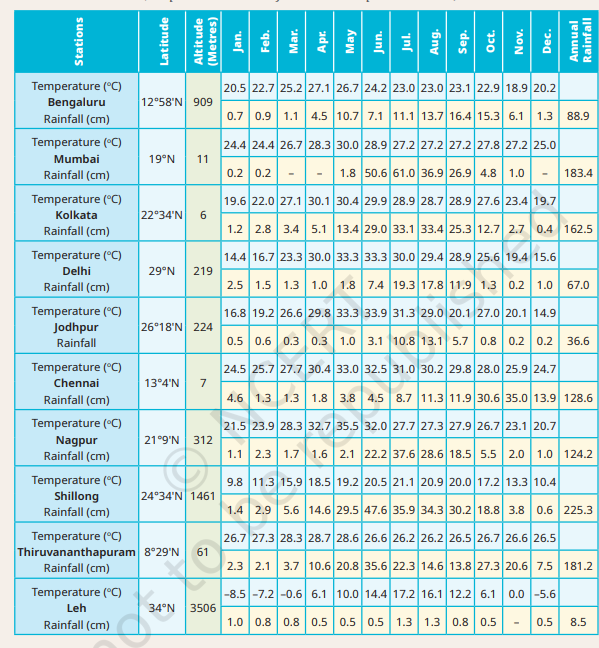
7.1. Now look at Table 3.3 again. Re-arrange the 10 stations according to their distance from the equator.
Ans:
| Order | Station | Latitude |
| 1. | Thiruvananthapuram | 8°29’N |
| 2. | Bengaluru | 12°58’N |
| 3. | Chennai | 13°4’N |
| 4. | Mumbai | 19°N |
| 5. | Nagpur | 21°9’N |
| 6. | Kolkata | 22°34’N |
| 7. | Shillong | 24°34’N |
| 8. | Jodhpur | 26°18’N |
| 9. | Delhi | 29°N |
| 10. | Leh | 34°N |
7.2. Find out:
(a) Two stations with the most extreme climate.
Ans: (i) Delhi
(ii) Jodhpur
(b) Two stations influenced by retreating monsoons.
Ans: (i) Chennai
(ii) Thiruvananthapuram
(c) The two hottest stations in the months of:
(i) February
Chennai (25.7°C)
Mumbai (24.4°C)
(ii) June
Jodhpur (33.9°C)
Delhi (33.3°C)
7.3. Now find out:
(a) Why does Shillong experience more rainfall than Kolkata?
Ans: Shillong receives more rainfall because the moisture-laden south-west monsoon winds are forced to rise over the Khasi Hills. As the air rises, it cools and causes heavy orographic rainfall, which is much greater than in Kolkata.
(b) Why does Delhi receive more rainfall than Jodhpur?
Ans: Delhi receives more rainfall because it is directly influenced by the south-west monsoon winds from the Bay of Bengal. Jodhpur lies in the arid region of Rajasthan, where the Aravalli Hills run parallel to the monsoon winds, preventing them from causing significant rainfall.
7.4. Now think why
(a) Why does Thiruvananthapuram have an equable climate?
Ans: Thiruvananthapuram has an equable climate because it is located near the Arabian Sea. The sea moderates the temperature throughout the year, preventing extreme heat or cold.
(b) Why does Chennai have more rainfall only after the fury of the monsoon is over in most parts of the country?
Ans: Chennai receives most of its rainfall from the north-east (retreating) monsoon during October to December. These winds pick up moisture from the Bay of Bengal and bring heavy rainfall to Chennai after the south-west monsoon has retreated.
(c) Why does Leh have moderate precipitation almost throughout the year?
Ans: Leh receives very little precipitation because it lies in the rain shadow region of the Himalayas. The mountains block the moisture-laden monsoon winds, so Leh remains dry and gets only light rainfall or snowfall throughout the year.
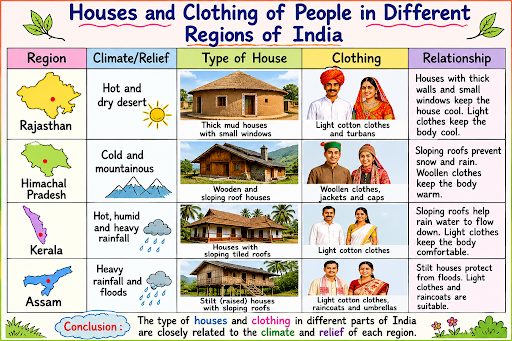
8. Collect pictures of houses and clothing of people from different regions of India. Examine whether they reflect any relationship with the climatic conditions or the relief of those regions.
Ans: Yes, the houses and clothing of people in different regions of India reflect the climate and relief of those regions.

 Buy Now