
AI in Manufacturing: How Artificial Intelligence Is Making Factories Smarter
AI in Manufacturing is changing the way modern factories operate. Earlier, automation mainly followed fixed instructions. Today, artificial intelligence can analyse data from machines, sensors and production systems to identify patterns, predict possible problems and support faster decisions.
This does not mean that every factory is becoming fully autonomous. Instead, manufacturers are gradually using AI for specific tasks where data analysis and prediction can improve efficiency. NIST’s 2026 roadmap highlights applications including industrial data analytics, advanced sensing, robotics, digital twins, supply-chain optimization and sustainable manufacturing.
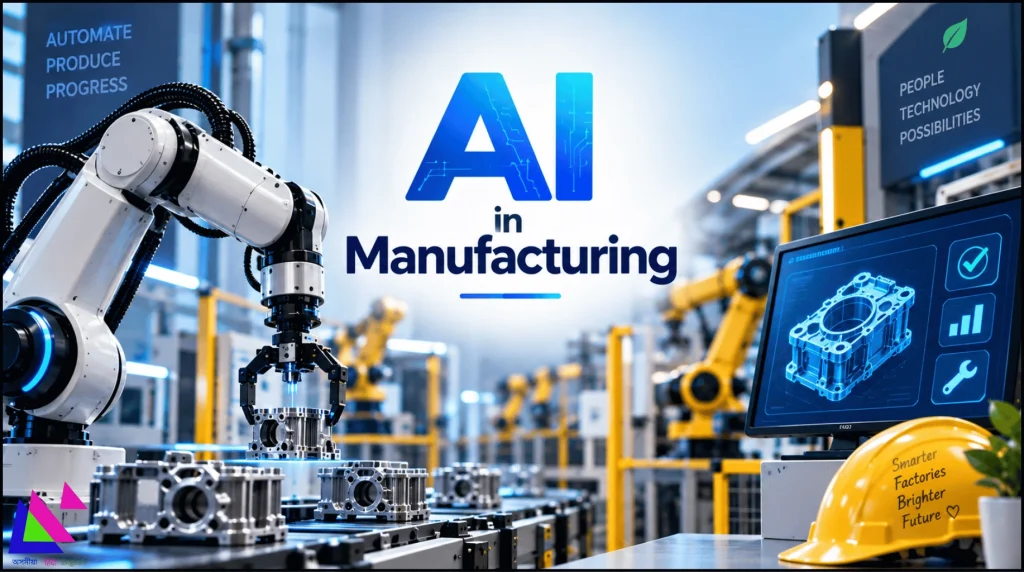
The goal is simple: make factories more efficient, reliable and adaptable while keeping humans involved in important decisions.
How Does AI Work in a Factory?
Modern factories generate large amounts of data. Machines can produce information about temperature, vibration, speed, energy use and production output.
AI in Manufacturing can analyse this information and look for unusual patterns. For example, if a machine begins showing signs that are associated with a possible failure, an AI system may help maintenance teams investigate before the equipment stops working completely.
AI can also support production planning, quality inspection and resource management. According to NIST, manufacturers are increasingly using AI across operations to improve decision-making, efficiency and visibility into complex processes.
Predictive Maintenance: Fixing Problems Before Machines Fail
One of the most useful applications is predictive maintenance. Traditional maintenance often follows a fixed schedule or begins after equipment breaks down. AI-based systems can analyse sensor data to identify patterns that may indicate a developing problem.
For example, changes in vibration or temperature could suggest that a machine needs inspection.
Predictive maintenance can help factories:
- Detect possible equipment problems earlier.
- Reduce unexpected downtime.
- Plan maintenance more efficiently.
- Improve machine availability.
- Avoid unnecessary maintenance in some situations.
However, AI predictions are not perfect. Engineers still need to inspect equipment and decide what action is necessary.
AI for Quality Control
Quality inspection is another important area for AI in Manufacturing.Factories can use cameras and computer vision systems to inspect products for defects. AI can help analyse images and identify unusual patterns or visible problems.
This can be especially useful when factories produce large numbers of similar products.
AI-powered quality inspection can support:
- Detection of visible defects.
- Identification of unusual patterns.
- Faster inspection of large production volumes.
- More consistent monitoring.
- Early detection of quality issues.
Still, the accuracy of the system depends on proper training data, testing and regular monitoring.
What Are Digital Twins?
A digital twin is a virtual representation of a physical machine, product or manufacturing system.
Manufacturers can use digital twins to monitor equipment, simulate possible changes and study how a system might behave before making changes in the real factory.
NIST explains that digital twins can help observe, diagnose, predict and optimize manufacturing systems in near real time. They can also support applications such as machine-health analysis, maintenance planning and virtual commissioning.In simple terms, a digital twin can allow engineers to test certain ideas digitally before applying them to physical equipment.
Also Read: AI Voice Agents: Why Businesses Are Changing Traditional Customer Service
Benefits of AI in Manufacturing
- Reduced Downtime: AI can support early detection of potential machine problems.
- Improved Quality: Computer vision and data analysis can help identify defects.
- Better Production Planning: AI can analyse data to support scheduling and resource allocation.
- Higher Efficiency: Manufacturers can use AI to optimize selected processes.
- Smarter Decision-Making: Engineers and managers can use data-driven insights when making decisions.
- Digital Simulation: Digital twins can support testing and optimization without relying only on physical trial and error.
NIST’s manufacturing research identifies process improvement, predictive maintenance, productivity, cost reduction and quality improvement among important areas where AI is being applied.
Challenges and Limitations
Despite its potential, AI in Manufacturing also creates challenges.
- High Initial Costs: New sensors, software and computing systems can require significant investment.
- Data Quality: Incorrect or incomplete data can produce unreliable AI results.
- Legacy Systems: Older factory equipment may be difficult to integrate with modern AI tools.
- Cybersecurity Risks: Connected industrial systems need strong security.
- Skills Gap: Workers and engineers may need new technical skills.
- Trust and Reliability: AI systems must be tested and validated before they are used for important industrial decisions.
NIST’s recent work on smart manufacturing also emphasizes the importance of trustworthy, explainable and reliable AI, along with challenges involving complex industrial data and system integration.
Will AI Replace Factory Workers?
AI may automate some repetitive tasks, but it is unlikely to remove the need for people from manufacturing.Factories still need engineers, technicians, operators and managers to maintain equipment, solve unexpected problems and make important decisions.
Instead, AI in Manufacturing is likely to change many roles. Workers may increasingly use AI tools, sensors and digital systems as part of their daily work.The most practical model may be a combination of human expertise and AI-based analysis.
Conclusion
AI in Manufacturing is helping factories become smarter by improving maintenance, quality control, production planning and system monitoring.
Technologies such as predictive maintenance, computer vision and digital twins show that AI can provide practical support beyond simple automation. At the same time, successful adoption depends on reliable data, proper testing, cybersecurity and skilled human oversight.
In the future, the smartest factories may not be the ones that simply use the most AI. They may be the ones that use AI in Manufacturing in the right places while combining technology with human experience and judgment.
FAQs
1. What is AI in Manufacturing?
Ans: AI in Manufacturing refers to using artificial intelligence and machine learning to analyse data, optimize operations and support factory decision-making.
2. What is predictive maintenance?
Ans: It uses data and AI-based analysis to identify signs of possible equipment problems before a machine fails.
3. How does AI improve quality control?
Ans: AI can analyse images and production data to help identify defects or unusual patterns.
4. What is a digital twin in manufacturing?
Ans: A digital twin is a virtual representation of a physical machine or manufacturing system that can support monitoring, prediction and optimization.
5. Will AI replace factory workers?
Ans: AI can automate some tasks, but human workers remain important for maintenance, supervision, problem-solving and decision-making.
Subject Ka Complete Video Solution Dekhein
Step-by-step easy concept explanation aur full questions Answer ke liye watch karein ya app download karein:






 Buy Now