
SEBA Class 10 Maths Chapter 11 Areas Related to Circles Solutions English Medium As Per New Syllabus. to each chapter is provided in the list so that you can easily browse through different chapters SEBA Class 10 Maths Chapter 11 Areas Related to Circles Notes and select need one. SEBA Class 10 Maths Chapter 11 Areas Related to Circles Question Answers Download PDF. SEBA Class 10 General Mathematics Solutions.
SEBA Class 10 Maths Chapter 11 Areas Related to Circles
Also, you can read the SEBA book online in these sections Solutions by Expert Teachers as per Board of Secondary Education, Assam (SEBA) Book guidelines. SEBA Class 10 Maths Chapter 11 Areas Related to Circles are part of All Subject Solutions. Here we have given SEBA Solutions For Class 10 Maths for All Chapters, You can practice these here.
Class 10 Mathematics Video Classes
Step-by-step easy concept explanation aur full questions Answer ke liye watch karein ya app download karein:

Areas Related to Circles
Chapter: 11
| Exercise 11.1 |
Unless stated otherwise use π = 22/7
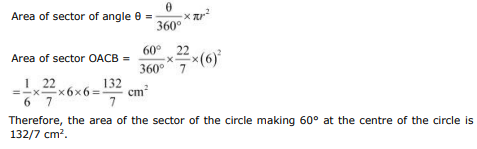
1. Find the area of a sector of a circle with radius 6 cm if angle of the sector is 60°.
Ans:
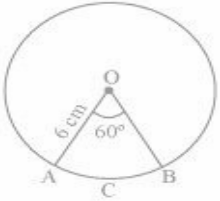
Let OACB be a sector of the circle making 60° angle at centre O of the circle
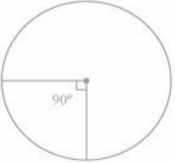
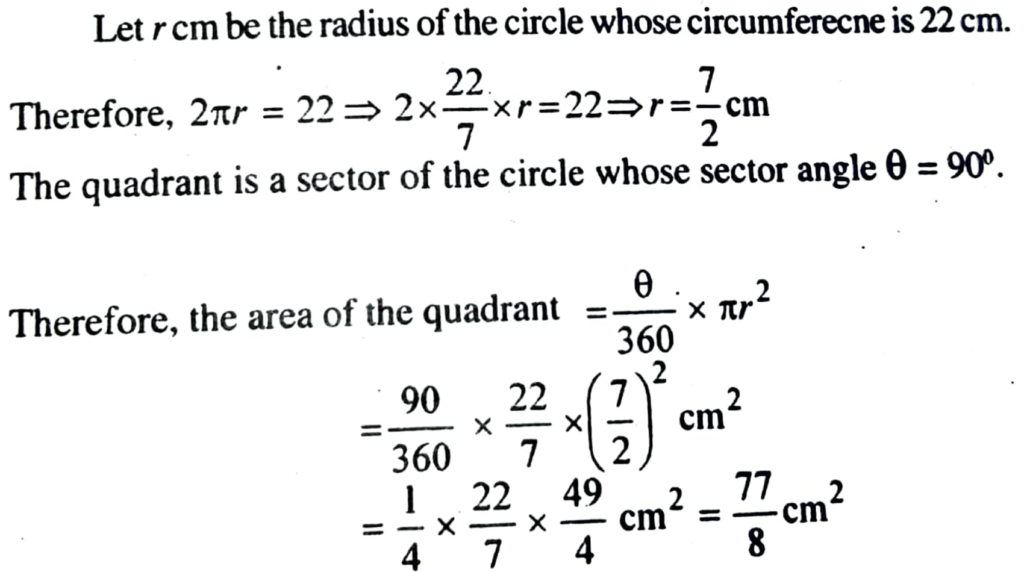
2. Find the area of a quadrant of a circle whose circumference is 22 cm.
Ans:
3. The length of the minute hand of a clock is 14 cm. Find the area swept by the minute hand in 5 minutes.
Ans:
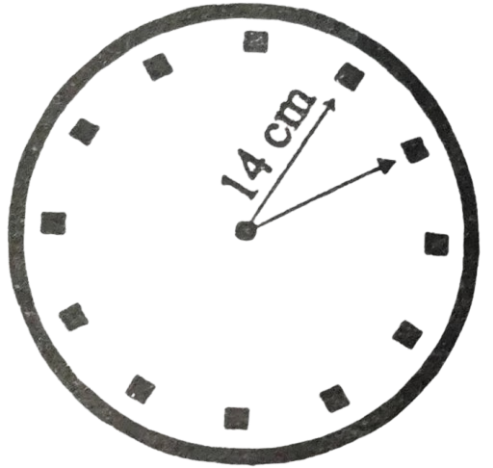
We know that in 1 hour (i.e., 60 minutes), the minute hand rotates 360°.
In 5 minutes, minute hand will rotate = 360o/60 × 5 = 30
Therefore, the area swept by the minute hand in minute in will be the area of a sector of sectors of 30o in a circle of 14 cm radius
Area of sector of 30o = θ/360o × πr2
Area of sector of 30o = 30o/360o × 22/7 × 14 × 14
= 22/12 × 2 × 14
= 11 × 14/3
= 154/3 cm2
Therefore, the areas swept by the hand in 5 minutes is 154/3 cm2
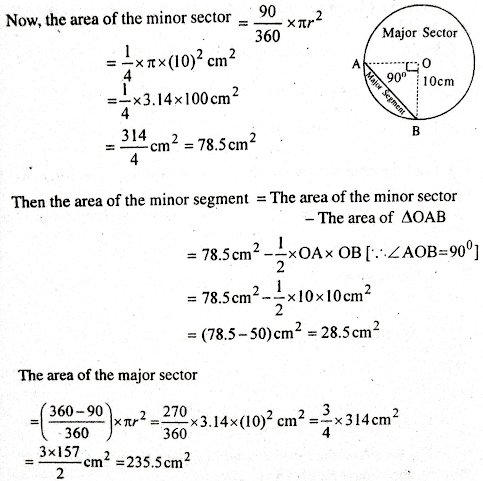
4. A chord of a circle of radius 10 cm subtends a right angle at the centre. Find the area of the corresponding: (i) minor segment (ii) major sector. (use π = 3.14)
Ans: Here, the radius of the circle r = 10 cm.
Sector angle of the minor sector made corresponding to the chord AB is 90o.
5. In a circle of radius 21 cm, an arc subtends an angle of 60° at the centre. Find.
(i) The length of the arc.
Ans: Length of the arc 60/360 × 2 × 22/7 × 21 cm = 1/6 × 2 × 22 × 3cm2 = 22cm
(ii) Area of the sector formed by the arc.
Ans: The area of the sectors formed by the arc corresponding to sector angle 60o.
= 60/360 × πr2 = 1/6 × 22/7 × (21)2 cm2 = 1/6 × 22/7 × 21 × 21cm2 = 231cm2
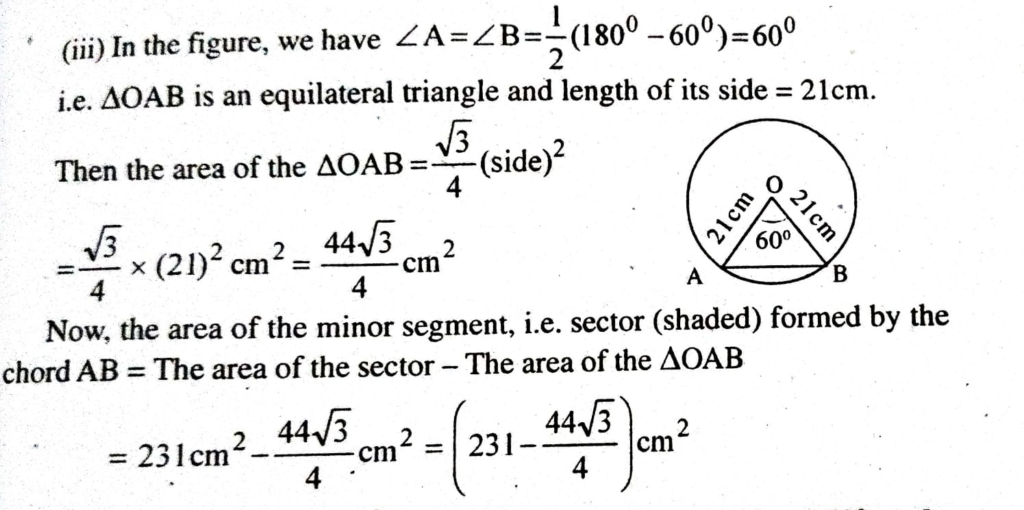
(iii) Area of the segment forced by the corresponding chord.
Ans:
6. A chord of a circle of radius 15 cm subtends an angle of 60° at the centre. Find the areas of the corresponding minor and major segments of the circle. [𝑈𝑠𝑒 𝜋 = 3.14 𝑎𝑛𝑑 √3 = 1.73]
Ans:
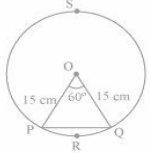
Radius (r) of circle = 15 cm
Area of sector OPRQ = 60/360o × πr2

= 117.75cm2
In ∆OPQ,
∠OPQ = ∠OQP (As OP = OQ)
∠OPQ + ∠OQP + ∠POQ = 180°
2 ∠OPQ = 120°
∠OPQ = 60°
∆OPQ is an equilateral triangle.
Area of major segment PSQ = Area of circle − Area of segment PRQ
= 117.75 – 97,3125
= 20,4375cm2
= 3.14 × 225 – 20,4375
= 706.5 – 20,4375
= 686.0625 cm2
7. A chord of a circle of radius 12 cm subtends an angle of 120° at the centre. Find the area of the corresponding segment of the circle. [𝑈𝑠𝑒 𝜋 = 3.14 𝑎𝑛𝑑 √3 = 1.73]
Ans:
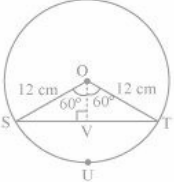
Let us draw a perpendicular OV on chord ST. It will bisect the chord ST.
SV = VT
In ∆OVS,
OV/OS = cos60°
OV/12 = 1/2
OV = 6cm
SV/SO = sin 60° = √3/2
SV/12 = √3/2
SV = 6√3cm
ST = 2SV = 2 × 6√3 cm
Area of ∆OST = ½ × ST × OV
= ½ × 12√3 × 6
= 36 √3 = 36 × 1.73 = 62.28 cm2
Area of segment = area of sector SOUTH – area of ∆OST
= 150.72 – 32,28
= 88.44cm2
8. A horse is tied to a peg at one corner of a square shaped grass field of side 15 m by means of a 5 m long rope. (see the given figure). Find [Use π = 3.14]
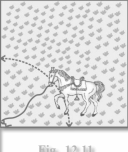
(i) The area of that part of the field in which the horse can graze.
(ii) The increase in the grazing area of the rope were 10 m long instead of 5 m.
Ans: From the figure, it can be observed that the horse can graze a sector of 90° in a circle of 5 m radius.
(i) Area that can be grazed by horse = Area of sector OACB
= 90o/360oπr2
= 1/4 × 3.14 × (5)2
= 19.625m2
Area that can be grazed by the horse = Area of sector OABC
= 90o/360o πr2
1/4 × 3.14 × (5) 2
= 19.625m2
Area that can be grazed by the horse when length of rope is 10 m long
= 90o / 360o × π × (10)2
= 1/4 × 3.14 × 100
= 78.875m2
(ii) Increase in grazing area = (78.5 − 19.625) m2
= 58.875 m2
9. A brooch is made with silver wire in the form of a circle with a diameter 35 mm. The wire is also used in making 5 diameters which divide the circle into 10 equal sectors as shown in figure. Find.
(i) The total length of the silver wire required.
(ii) The area of each sector of the brooch.
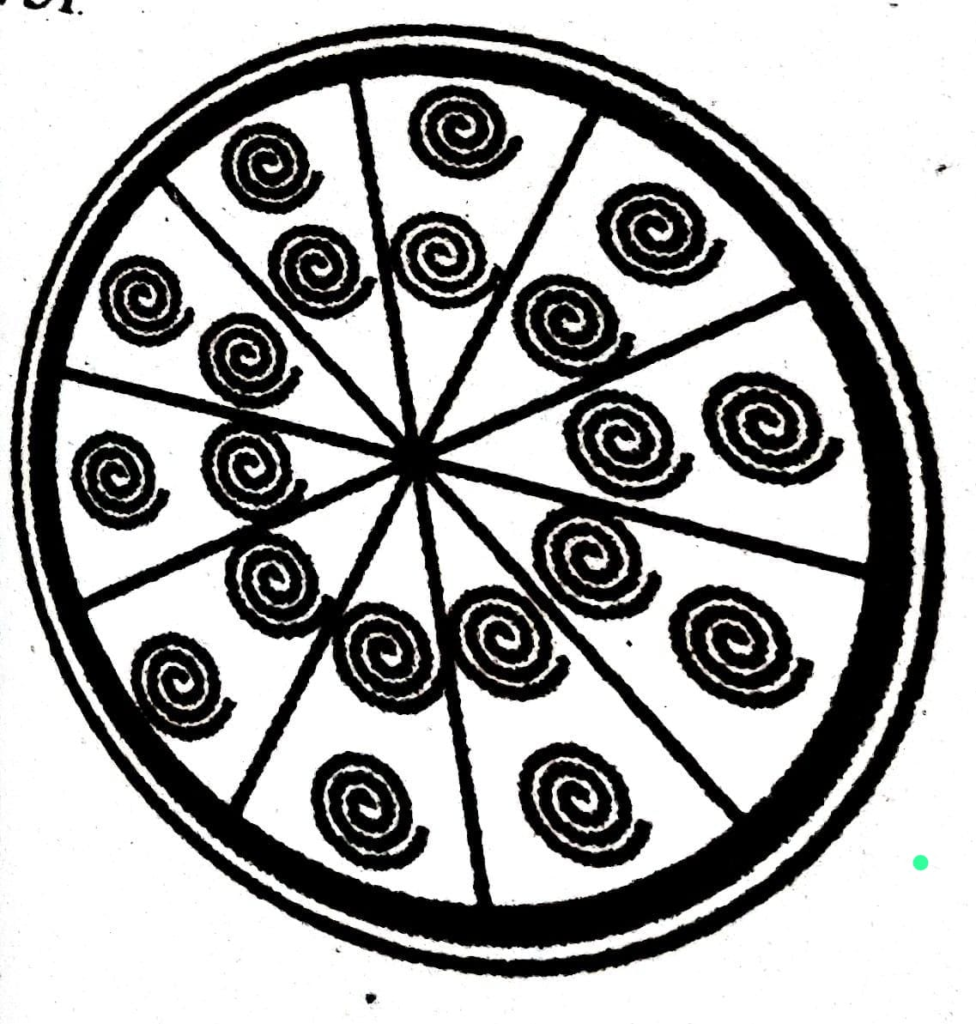
Ans: Diameter of the circle = 35mm
35/2 Then radius r = mm
The total length of wire required = The length of wire required for making 5 diameters + the length of wire required for making the perimeter of the circle.
5 × 35mm + 2π × 35/2mm2
= (175 + 22 /7 × 35)]mm = 285mm
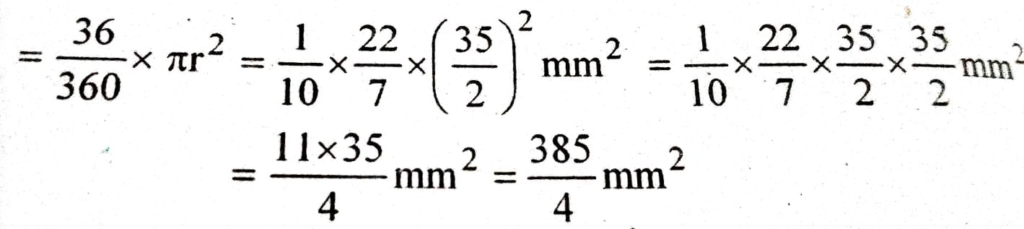
(ii) Here r = 35/2mm
The sector angle of each brooch = 360/10 degrees. i.e θ = 36o Therefore, the area of each brooch
Subject Ka Complete Video Solution Dekhein
Step-by-step easy concept explanation aur full questions Answer ke liye watch karein ya app download karein:

 Buy Now