
NIOS Class 12 Physics Chapter 20 Reflection and Refraction of Light Solutions English Medium As Per New Syllabus to each chapter is provided in the list so that you can easily browse throughout different chapters NIOS Class 12 Physics Chapter 20 Reflection and Refraction of Light Notes in English and select need one. NIOS Class 12 Physics Solutions English Medium Download PDF. NIOS Study Material of Class 12 Physics Notes Paper Code: 312.
NIOS Class 12 Physics Chapter 20 Reflection and Refraction of Light
Also, you can read the NIOS book online in these sections Solutions by Expert Teachers as per National Institute of Open Schooling (NIOS) Book guidelines. These solutions are part of NIOS All Subject Solutions. Here we have given NIOS Class 12 Physics Notes, NIOS Senior Secondary Course Physics Solutions in English for All Chapter, You can practice these here.
Reflection and Refraction of Light
Chapter: 20
| Module – VI: Optics And Optical Instruments |
INTEXT QUESTIONS 20.1
1. Answer the following questions:
(a) Which mirror has the largest radius of curvature: plane, concave or convex?
Ans: Plane mirror has the largest radius of curvature because it can be thought of as a spherical mirror with infinite radius. The more curved a mirror is, the smaller its radius; so, a plane being flat, can be seen as a sphere of infinite size.
(b) Will the focal length of a spherical mirror change when immersed in water?
Ans: No, the focal length of a spherical mirror does not change when immersed in water. This is because for mirrors, the focal length depends only on the radius of curvature of the reflecting surface and not on the refractive index of the surrounding medium.
(c) What is the nature of the image formed by a plane or a convex mirror?
Ans: Both a plane mirror and a convex mirror form virtual and erect images. For a plane mirror, the image is always the same size as the object and laterally inverted. For a convex mirror, the image is always smaller than the object and situated behind the mirror.
(d) Why does a spherical mirror have only one focal point?
Ans: A spherical mirror has only one focal point because parallel rays incident close to the principal axis all converge from a single point, which is the focus. This is due to the symmetry and geometry of the spherical surface.
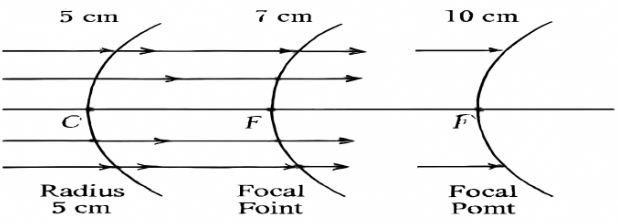
2. Draw diagrams for concave mirrors of radii 5 cm, 7 cm, and 10 cm with common centre of curvature. Calculate the focal length for each mirror. Draw a ray parallel to the common principal axis and draw reflected rays for each mirror.
Ans: Given: R1 = 5 cm
R2 = 7 cm
R3 = 10 cm.
F = R/2
Calculations:
For R = 5 cm
f1 = 5/2
= 2.5 cm
For R = 7 cm
f2 = 7/2
= 3.5cm
For R = 10 cm
f3 = 10/2
= 5.0 cm
Diagram:
Draw three arcs sharing the same center (common centre of curvature C), each with different radii as above. Draw a principal axis. For each mirror, mark its focal point F midway between the surface and C. Draw an incident ray parallel to the axis; after reflection from each mirror, show the ray passing through its own focus.
3. The radius of curvature of a spherical mirror is 30 cm. What will be its focal length if (i) the inside surface is silvered? (ii) the outside surface is silvered?
Ans: Given:
Radius of curvature, R = 30 cm
(i) Inside surface silvered (concave):
f = R/2 = 30/2 = 15 cm
So, focal length = 15 m
(ii) Outside surface silvered (convex):
The formula is the same:
F = R/2 = 30/2 = 15 cm
But, by convention, for convex mirrors, focal length is positive: +15 cm
4. Why are dish antennas curved?
Ans: Dish antennas are curved so that they can collect and focus signals effectively. The curved shape of the dish is usually a part of a paraboloid. When signals such as radio or television waves come from a satellite, they arrive in parallel rays. The parabolic shape of the dish reflects these parallel rays to a single point called the focus. At this focus point, a receiver or feed horn is placed, which collects the concentrated signals and sends them to the receiver box for processing. This design increases the strength of the received signal and improves clarity. The curved shape also helps in minimizing signal loss and interference.

Hi, I’m Dev Kirtonia, Founder & CEO of Dev Library. A website that provides all SCERT, NCERT 3 to 12, and BA, B.com, B.Sc, and Computer Science with Post Graduate Notes & Suggestions, Novel, eBooks, Biography, Quotes, Study Materials, and more.
Subject Ka Complete Video Solution Dekhein
Step-by-step easy concept explanation aur full questions Answer ke liye watch karein ya app download karein:

 Buy Now