
NIOS Class 12 Physics Chapter 21 Dispersion and Scattering of Light Solutions English Medium As Per New Syllabus to each chapter is provided in the list so that you can easily browse throughout different chapters NIOS Class 12 Physics Chapter 21 Dispersion and Scattering of Light Notes in English and select need one. NIOS Class 12 Physics Solutions English Medium Download PDF. NIOS Study Material of Class 12 Physics Notes Paper Code: 312.
NIOS Class 12 Physics Chapter 21 Dispersion and Scattering of Light
Also, you can read the NIOS book online in these sections Solutions by Expert Teachers as per National Institute of Open Schooling (NIOS) Book guidelines. These solutions are part of NIOS All Subject Solutions. Here we have given NIOS Class 12 Physics Notes, NIOS Senior Secondary Course Physics Solutions in English for All Chapter, You can practice these here.
Dispersion and Scattering of Light
Chapter: 21
| Module – VI: Optics And Optical Instruments |
INTEXT QUESTIONS 21.1
1. Most ordinary gases do not show dispersion with visible light. Why?
Ans: Most ordinary gases, like those found in our atmosphere, do not show dispersion with visible light because they have almost the same refractive index for all wavelengths in the visible spectrum. Dispersion occurs when the refractive index of a medium changes significantly with wavelength, causing different colors to refract or bend by different amounts. However, in the case of ordinary gases, the difference in speed between different wavelength components of visible light is extremely small, so all colors pass through with almost equal speed. Thus, they don’t get separated into different colors as they do in dispersive media like glass or water. This is why we do not observe dispersion of visible light in ordinary gases.
These gases are considered non-dispersive for visible light because their molecular structure doesn’t cause significant variation in refractive index.
Visible light in such media behaves as if all its wavelengths have the same speed, so separation of colors does not occur.
2. With your knowledge about the relative values of μ for the component colours of white light, state which colour is deviated more from its original direction?
Ans: The refractive index (μ) of a transparent medium, such as glass or water, is generally higher for shorter wavelengths than for longer wavelengths. In the visible spectrum, violet light has the shortest wavelength, and red light has the longest. According to the laws of refraction, when white light passes through a prism:
Violet light is deviated the most because it has the highest refractive index (μ is greatest for violet).
Red light is deviated the least because it has the lowest refractive index (μ is smallest for red).
Thus, among the seven colors of white light (VIBGYOR), violet is always deviated more from its original path compared to red, and the order of deviation is:
Violet > Indigo > Blue > Green > Yellow > Orange > Red.
3. Does dispersion depend on the size and angle of the prism?
Ans: Yes, dispersion depends on both the size and angle of the prism:
The angle of the prism (the refracting angle) determines how much the different colors will separate after passing through. A larger angle will typically result in more noticeable dispersion, that is, a larger spread between the different colors.
The size of the prism affects the path length that light travels inside the medium. A larger prism gives the different colors more space to separate, making the spectrum wider and more distinct on a screen.
However, the key factor is the material (refractive index) and the refracting angle, as they determine the degree of bending and spreading of colors. The physical size is of secondary importance, but for practical visibility of the dispersion, a reasonably large prism is needed.
In summary, while dispersion mainly depends on the material and angle of the prism, the size helps in making the spectrum more visible and separated.
4. Calculate the refractive index of an equilateral prism if the angle of minimum deviation is equal to the angle of the prism.
Ans: Given:
Angle of the prism, A = 60° (equilateral prism)
Angle of minimum deviation, Sm = A = 60°
To find:
Refractive index,
Step 1: Use the formula for refractive index with minimum deviation:
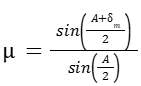
Step 2: Insert the given values:
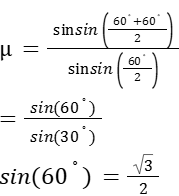
sin (30°) = 1/2
sin(30)=12
Step 3: Calculate:
The refractive index of the prism is 1.732
INTEXT QUESTIONS 21.2
1. Why dense clouds appear black?
Ans: Dense clouds appear black because they are so thick and consist of such large water droplets that most of the sunlight entering them is either absorbed or scattered multiple times, instead of being transmitted through or reflected efficiently.
When sunlight enters a dense cloud, much of its energy is absorbed by the water droplets.
Because of this absorption and extensive scattering in all directions, very little light reaches our eyes from the interiors of such clouds.
Thus, dense or thick clouds prevent sunlight from passing through and reflecting, resulting in a dark or black appearance.Thin clouds, on the other hand, scatter all wavelengths almost equally and hence appear white.
The darkness is an indication of the cloud’s density and thickness, blocking sunlight from reaching observers underneath.
2. Why does the sky appear deep blue after rains on a clear day?
Ans: After rains on a clear day, the sky appears deep blue mainly due to reduced dust and particulate matter in the atmosphere:
Rain effectively “washes” away dust, smoke, and other particles, leaving behind cleaner air made up of smaller molecules like nitrogen and oxygen.
In clean air, Rayleigh scattering (which strongly affects shorter wavelengths like blue) is more pronounced because the remaining particles are smaller and the longer wavelengths (like red and orange) are scattered less.
As a result, blue light is scattered much more effectively in all directions, making the blue color dominant when we look at the sky.
Since there are fewer pollutants, the blue light is not mixed with other scattered colors, enhancing the deep blue effect.

Hi, I’m Dev Kirtonia, Founder & CEO of Dev Library. A website that provides all SCERT, NCERT 3 to 12, and BA, B.com, B.Sc, and Computer Science with Post Graduate Notes & Suggestions, Novel, eBooks, Biography, Quotes, Study Materials, and more.
Subject Ka Complete Video Solution Dekhein
Step-by-step easy concept explanation aur full questions Answer ke liye watch karein ya app download karein:

 Buy Now